
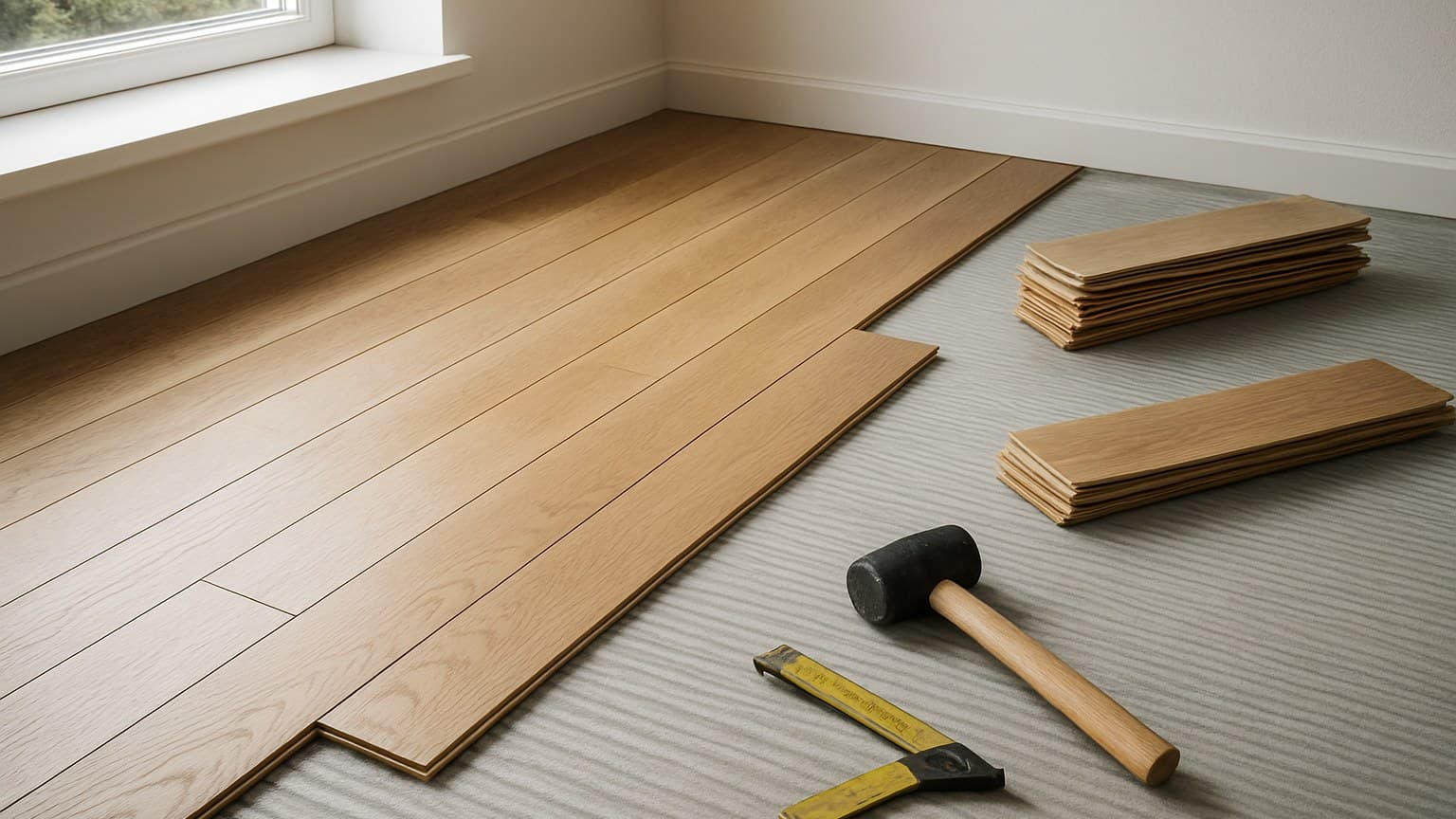
When Sarah in Denver asked me to source a kid-safe laminate for her son's nursery, I learned fast that GreenGuard Gold certified flooring means one exact product tested in a sealed chamber and proven to stay under strict limits on the gases it releases into your air. It's not a brand-wide badge, a maker can have one certified line sitting right next to an uncertified one from the same catalog. She'd already picked out a warm oak-look SPC plank from a big-box store's in-stock display, but when I pulled that exact color name up in UL's SPOT database, it wasn't listed at all, only two other collections from the same brand were, and neither was the one on the shelf. Search "greenguard gold certified flooring" today and you'll still find brand lists that copy each other and quote certificates that lapsed months ago, because a floor's status can change while the post sits frozen.
Key takeaways
- GreenGuard Gold (UL 2818) means the product was chamber-tested by UL and stayed under tight limits for total VOCs and formaldehyde, the stricter tier above base GreenGuard.
- Certification is per-product and time-limited, not a permanent brand badge, and big names like Pergo and Mohawk have moved in and out of it.
- Verify any specific floor on the day you buy it at UL's SPOT database (spot.ul.com), matching the exact product line, not just the brand name.
- FloorScore and SCS Indoor Advantage are also EPA-recognized indoor-air standards, so a floor without Gold is not automatically worse.
- There is essentially no GreenGuard Gold carpet; carpet uses its own program, CRI Green Label Plus, instead.
What GreenGuard Gold Certified Flooring Actually Means
GreenGuard Gold is UL's stricter indoor-air certification, built on the UL 2818 standard. In plain terms, that exact product went into a sealed test chamber and had to stay under tight limits for the gases it releases into your air.
Gold is the tougher tier above plain GreenGuard. It was set up for sensitive spaces like kids' rooms, schools, and homes where someone deals with asthma or allergies, so the bar is lower than the general version.
Here's the catch that drives this whole article: it's certified per product, and it expires. It's never a permanent stamp slapped on a whole brand. One maker can have a certified collection sitting right next to an uncertified one.
And it only covers what the plank or board itself gives off. Your install is separate. The glue, the underlayment, and the trim can each add their own fumes, and none of that rides on the floor's certificate. When I tore out a "low-VOC" LVP floor for a customer in Aurora, Colorado, the sharp, solvent-like smell hit before I'd pulled up more than two planks, not from the vinyl itself, which still had an active FloorScore listing when I checked the collection name in SPOT that same afternoon, but from the yellow contact adhesive underneath, which had never been tested at all and was still off-gassing enough to sting my eyes an hour later.
GreenGuard Gold vs. FloorScore vs. SCS Indoor Advantage
Gold isn't the only label that counts. There are three other independent standards you'll see on flooring, and any of them from a real lab beats an uncertified floor with a vague "low-VOC" line on the box. If you want the fuller landscape before you shop, non-toxic flooring options lines up all four standards side by side.
FloorScore, run for the RFCI (the Resilient Floor Covering Institute), is the flooring-specific standard you'll spot most on luxury vinyl. SCS Indoor Advantage Gold is another option that the EPA recognizes. According to the EPA's Indoor airPLUS program, which maintains a list of qualifying low-emission certifications for building products, GreenGuard Gold, FloorScore, and SCS Indoor Advantage Gold are all accepted standards, so a floor carrying FloorScore instead of GreenGuard Gold isn't a red flag.
| Standard | Issuer | Total VOC limit | Formaldehyde limit | What it covers |
|---|---|---|---|---|
| GreenGuard | UL Solutions | 0.5 mg/m3 | 0.05 ppm | General low-emission products |
| GreenGuard Gold | UL Solutions | 0.22 mg/m3 | 0.0073 ppm | Stricter tier for sensitive users (kids, schools) |
| FloorScore | SCS Global, for RFCI | Meets CDPH V1.2 chamber test | Per CDPH V1.2 | Flooring and adhesives only, common on LVP |
| SCS Indoor Advantage Gold | SCS Global | Meets CDPH V1.2 chamber test | Per CDPH V1.2 | Furniture and building products, incl. flooring |
Source: UL's GREENGUARD Gold spec (UL 2818) read next to the FloorScore and SCS Indoor Advantage program documents
How the four main indoor-air standards compare on issuer, VOC and formaldehyde limits, and scope. CDPH V1.2 is the California Department of Public Health's chamber-test method that FloorScore and SCS both use.
The takeaway: don't treat Gold as the only trustworthy sticker. Treat "tested by an independent lab" as the line that matters, and any of these three clears it.
The VOC and Formaldehyde Limits, in Plain Numbers
VOCs are gases that new materials give off into your air. Formaldehyde is one of those gases, and it's the main worry in laminate and engineered floors because their cores are held together with glue.
A quick word on the units. Parts per million (ppm) just means how much gas sits in a set amount of air. You'll also see parts per billion (ppb) and micrograms per cubic meter (ug/m3), which are simply finer ways to measure the same thing.
The gap between the tiers is bigger than most people expect. Base GreenGuard allows formaldehyde up to about 0.05 ppm, while Gold cuts that to roughly 0.0073 ppm, per UL's spec. That makes Gold's limit close to one-tenth of the base version's.
Why sweat it? According to the EPA, indoor VOC levels commonly run 2 to 5 times higher than the air outside. Once a material is sealed inside a closed-up house, what it off-gasses matters far more than people think. If you're weighing this alongside every other factor, the healthiest flooring for a home walks through how each material stacks up on indoor air.
Where does the formaldehyde come from? Mostly the glues in MDF and HDF cores, which is why laminate and engineered wood tend to carry the most. Solid hardwood, tile, natural stone, and cork all give off very little on their own, though cork brings its own set of installation quirks I break down in 6 cork flooring failures and what lasts.
How to Verify Any Floor's Live Status in UL SPOT
This is the skill no brand list teaches: check the product yourself, on the day you buy it, in UL's free SPOT database at spot.ul.com. It takes about two minutes and it's the only way to know the certificate is still alive.
The steps are simple. Search the product or brand name, filter the results to GREENGUARD Gold and the flooring category, open the listing, then read its current status and expiry date.
Match the exact product line and color, not just the brand. One collection can be certified while another from the same maker is not, so "Brand X is certified" tells you almost nothing on its own.
That's the whole reason a two-year-old blog list can be flat wrong. Well-known national brands have moved in and out of certification over the years, and specific lines change without notice. The database shows you today's truth; a copied list shows you someone's snapshot from whenever they wrote it.
Before you hand over money, it's worth doing two more things a certification page alone won't cover. First, read actual owner reviews on the retailer's own product page or a flooring forum, a certificate tells you about emissions, not about how a plank wears, clicks together, or holds up under a dog's claws, and those are separate questions worth separate answers. Second, buy from a retailer or installer who can produce that SPOT listing or a current spec sheet on request rather than one who just repeats "eco-friendly" on the display sign; if they can't point you to the documentation, treat that as a sign to verify the product yourself before you commit. And if cost is what's holding you back, our guide on affordable non-toxic flooring options makes the case that you don't have to pick one over the other.
Does the Certification Actually Matter?
Yes, but it matters most on certain floors. As covered above, a closed-up home traps whatever a floor off-gasses, so an independent chamber test is real proof of low emissions, not just a marketing word.
But construction type matters just as much as the sticker. The naturally low-emitting materials mentioned earlier don't need a badge to be safe. The certification earns its keep on engineered wood, laminate, and LVP, where the core is built with glue.
So here's my honest read from that Aurora tear-out and the laminate jobs I've bid since: chase the certification hardest on glued-core products, and lean on it less for materials that are naturally low-emitting. A certified solid oak floor and an uncertified one are barely different on air; a certified versus uncertified laminate can be a real gap.
For the wider picture, it's worth reading our guides on what flooring is the least toxic and what flooring materials to avoid.

Certified Flooring by Type (a Point-in-Time Snapshot)
Treat this as a snapshot, not evergreen fact. It reflects what each flooring type commonly carries, but you should still verify each product in SPOT before you pay.
Two bits of jargon first, since they show up all over LVP boxes. SPC means stone plastic composite and WPC means wood plastic composite. Those are the two rigid core types under most modern luxury vinyl.
| Flooring type | Cert it usually carries | Notes |
|---|---|---|
| Laminate | GreenGuard Gold or FloorScore | HDF core uses glue, so certification matters most here |
| LVP / hybrid (SPC/WPC) | FloorScore, sometimes GreenGuard Gold | Rigid glued core; FloorScore is the most common label |
| Engineered wood | GreenGuard Gold or FloorScore | Plywood or HDF core with glue; check the exact line |
| Bamboo | FloorScore or GreenGuard Gold | Strand bamboo is bonded with resin |
| Cork | GreenGuard Gold or FloorScore | Held together with binders; check the finish and backing too |
| Solid hardwood | Often none needed | Naturally low-emitting; any cert usually covers the finish |
| Carpet | CRI Green Label Plus | Its own program; there is essentially no GreenGuard Gold carpet |
Source: a UL SPOT database check I ran while writing this in September 2026
What certification each flooring type most commonly carries, as a point-in-time snapshot to verify per product.
Carpet is the odd one out. It runs on a separate program, CRI Green Label Plus (CRI is the Carpet and Rug Institute), so don't go hunting for a Gold carpet that basically doesn't exist.
If budget is your first filter, cross-check these against our roundup of the cheapest non-toxic flooring before you commit.