
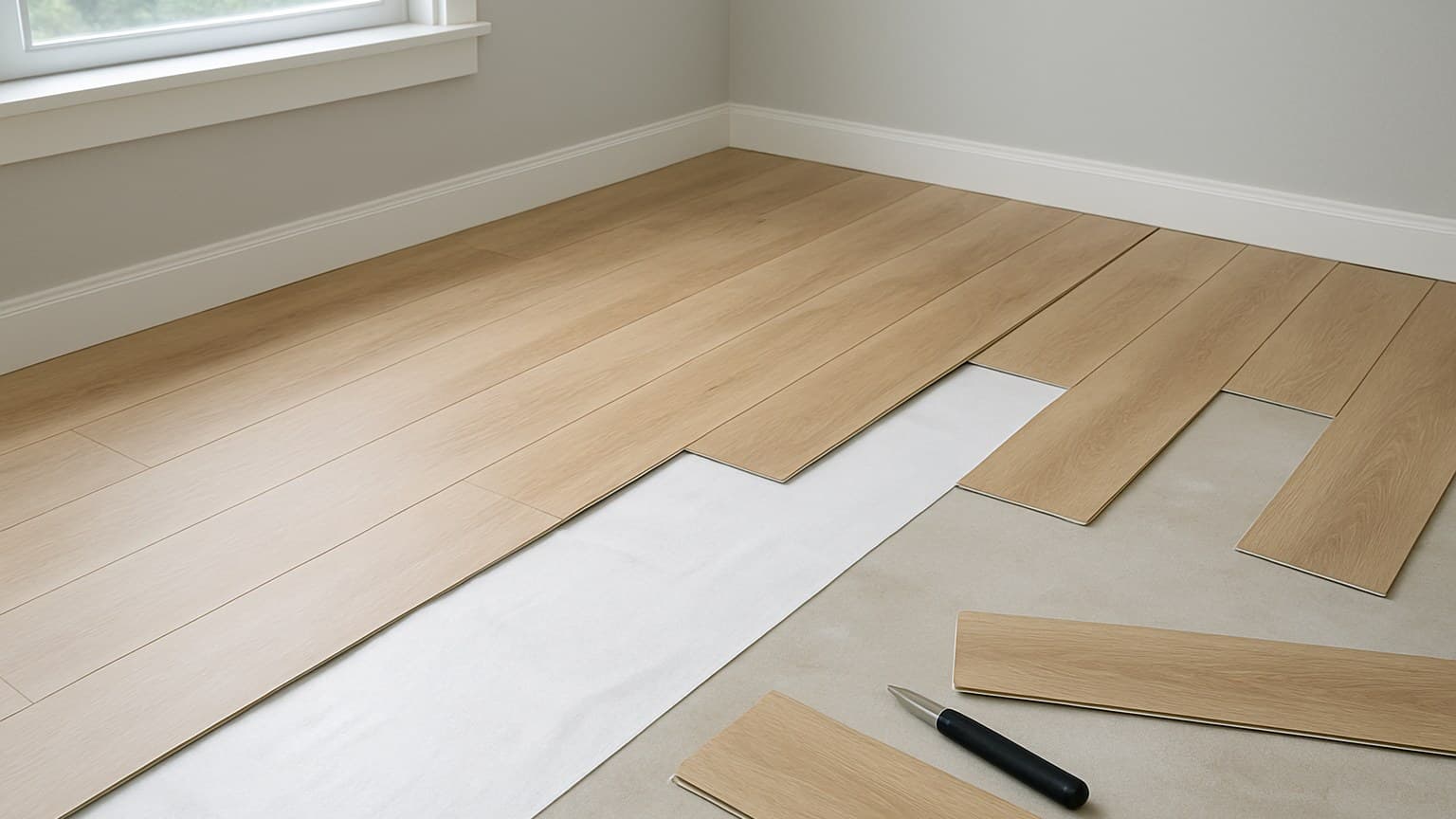
The low-VOC lines you can actually trust at Home Depot are the ones that carry a third-party certification you can look up yourself: FloorScore, CARB Phase 2, or GreenGuard Gold. That covers most LifeProof rigid-core and vinyl planks, Cali's bamboo and SPC (stone plastic composite), and a handful of Mohawk carpet styles. The trouble is the shelf tag in the aisle rarely spells any of this out, and a floor that smells fine on day one can still off-gas for weeks, so you have to go looking for the proof instead of trusting your nose.
Key takeaways
- Any Home Depot floor's low-VOC claim is checkable: look for FloorScore, CARB Phase 2, or GreenGuard Gold on the box, then confirm it's still active in UL's SPOT database.
- Most LVP (luxury vinyl plank) and LifeProof rigid-core planks Home Depot stocks carry FloorScore; Cali lists its strand bamboo formaldehyde below 0.005 ppm.
- The adhesive, underlayment, and finish off-gas too. A FloorScore plank set in a non-rated glue is not the low-VOC floor you think you bought.
- Materials run roughly $1.50-12 per sq ft and labor $1-8 per sq ft depending on the line, with basements and stairs costing more than open rooms.
- For a bathroom, basement, or kitchen, a waterproof-core SPC (stone plastic composite) or LVP with a certified low-VOC rating is the safest Home Depot pick.
What "Low-VOC" Really Means at Home Depot (and the Certs to Trust)
Home Depot's shelf labels won't tell you which private-label line is low-emission, so judge by third-party certification, not a sniff test in the aisle. A plank can smell neutral and still release fumes for weeks. The certification is the only thing you can check before you pay.
VOCs are volatile organic compounds, fumes a new floor can release into the room air. Formaldehyde is one of them, and it hides in the glue that binds composite wood cores. Both are worst when the box is fresh and taper off over time. If you're weighing materials beyond what's in this guide, the non-toxic flooring options overview covers a wider range of low-VOC choices.
Here are the four marks worth hunting for on a carton, and where you confirm each one is real.
| Certification | What it limits | Where to verify |
|---|---|---|
| FloorScore (SCS Global Services) | Total VOC emissions from hard flooring and the adhesives used with it | Search the brand and SKU on the SCS Global Services certified-product list |
| CARB Phase 2 / TSCA (the Toxic Substances Control Act) Title VI | Formaldehyde released by composite wood cores, HDF (high-density fiberboard), plywood, and strand bamboo | Look for "CARB2 compliant" or "TSCA Title VI" printed on the carton |
| GreenGuard Gold (UL) | Stricter VOC and formaldehyde limits aimed at nurseries, schools, and sensitive spaces | Confirm the product is still active in UL's SPOT database |
| EPA Indoor airPLUS | Low-emission criteria the Environmental Protection Agency sets for building products in its program homes | Cross-check against the EPA's published compliant-product criteria |
The four third-party marks a Home Depot box may carry, what each one caps, and how to confirm it before you buy.
FloorScore comes from SCS Global Services. CARB Phase 2 is the California Air Resources Board's limit on formaldehyde in wood cores, now matched by the federal TSCA Title VI rule. GreenGuard Gold is UL's tighter standard for sensitive rooms. EPA Indoor airPlus is the U.S. Environmental Protection Agency's own list of low-emission criteria for building products used in its certified program homes, and the Environmental Protection Agency's (EPA) Environmentally Preferable Purchasing Program for flooring recommends checking for these same VOC specifications before you buy. If you want the lowest-emission materials of any kind, not just the Home Depot catalog, start with the least-toxic flooring guide and work back to what's on the shelf.
Engineered and Solid Hardwood Lines (Malibu Wide Plank, Home Decorators, Home Legend)
Solid hardwood has no added formaldehyde because it's one species, cut and milled with nothing glued into the core. Engineered wood is where formaldehyde can hide, in the plywood or fiberboard layers under the wear surface, so check for CARB Phase 2 on the carton. Solid hardwood's lack of added formaldehyde is a big reason it ranks near the top of any guide to flooring with the least off-gassing.
Home Depot stocks Malibu Wide Plank, Home Decorators Collection, and Home Legend engineered planks. The ones worth buying list CARB2 and often FloorScore right on the box or spec sheet. If it doesn't say, treat that as a no until you can confirm it.
The finish matters as much as the core. A factory UV-cured finish is cured hard before it ever reaches the store, so it off-gasses very little. A floor you sand and coat on site with an oil-based finish is a different story, and that's the smell that lingers in a house for days.
On install: nail-down and glue-down hardwood is a pro job. Two winters ago I tore out a DIY hardwood floor in a Beavercreek split-level that had cupped along every seam because the owner nailed it straight down without ever checking the subfloor for moisture. This is not a weekend project unless you've done it before.
Hybrid and SPC Flooring (LifeProof Rigid Core, Cali)
SPC stands for stone-plastic composite, a dense rigid core that makes the plank stiff and holds its shape when the room's temperature swings. LifeProof rigid-core and similar SPC lines at Home Depot commonly carry FloorScore, so the plank surface meets a VOC-emission cap you can actually verify in the SCS database.
Cali lists its strand bamboo and hybrid lines with formaldehyde emissions below 0.005 ppm, per Cali's own product information. That's a published figure tied to a specific product line, which is exactly what you want to see instead of a vague "eco-friendly" sticker.
A waterproof core does not mean a leak-proof floor, and that's the mix-up that trips up a lot of buyers. The core resists water through the body of the plank, but the seams and edges are where most water trouble starts. On a walkout basement job in West Chester last spring, the floor itself held up fine while water crept up through the perimeter gap. No brand's core rating changes that fact.
Luxury Vinyl Plank and Tile (LifeProof, TrafficMaster)
Yes, vinyl can off-gas, but most LifeProof and TrafficMaster LVP (luxury vinyl plank) sold at Home Depot carries FloorScore, meaning it was tested against a VOC-emission limit. That's the answer for anyone searching "low-VOC vinyl flooring Home Depot": the certification exists, you just have to confirm the exact SKU carries it.
Some newer vinyl uses DOTP, a phthalate-free plasticizer that replaces older plasticizers that drew health concerns. If that matters to you, the spec sheet is where it's listed, not the display.
Check the wear layer and waterproof rating on the specific SKU's spec sheet, not a sign hanging over a whole aisle. Wear layers and ratings vary from line to line within the same brand, so a number you saw on one plank does not carry across the display. For the full list of what to confirm before you call a vinyl floor safe, the non-toxic LVP checklist walks through it product by product.
Click-lock LVP is realistic for most DIYers. Glue-down LVP, stairs, and big open-plan rooms with moisture transitions are where I'd tell you to hire it out.
Bamboo Flooring at Home Depot
Strand bamboo is a composite, shredded bamboo glued back together under heat and pressure, so its formaldehyde depends entirely on the resin used to bind it. Look for CARB Phase 2 and a stated emissions figure, not just the word "natural."
Cali and Home Decorators Collection strand bamboo are the usual Home Depot picks. Cali publishes emissions below 0.005 ppm for its lines, which is the kind of specific number that lets you make a real decision.
Bamboo is hard and renewable, but it's still a glued product, and that's the tradeoff a lot of shoppers overlook. That means it is not automatically lower-emission than a certified LVP. Judge it on the same cert you'd use on anything else. If you want truly resin-free options with no added formaldehyde at all, the formaldehyde-free flooring guide sorts out which materials qualify.
Low-VOC Carpet at Home Depot
Carpet's emissions come from four places: the fiber, the backing, the adhesive, and any stain treatment. The mark to look for is GreenGuard Gold, plus a PFAS-free claim if stain chemistry worries you.
Triexta is a carpet fiber often marketed as low-VOC and stain-resistant without added treatment chemistry. PFAS are the "forever chemicals" used in some older stain-proofing. If a carpet leans on a heavy stain treatment, that's an emission source the fiber rating won't cover.
The pad and seam adhesive off-gas too. A low-VOC carpet stretched over a cheap foam pad is not the clean-air floor you paid for. Mohawk lines stocked at Home Depot are a common place to find GreenGuard Gold carpet, but verify the exact style in UL's SPOT database before you assume the whole brand qualifies.
The Subfloor and Prep Products Almost Nobody Checks
The finished floor is only as clean as the whole assembly. The glue, underlayment, patch, and concrete sealer matter as much as the plank you picked, and they're the parts nobody reads the label on.
On a kitchen remodel I did in Oakwood last year, the homeowner, Linda, had paid extra for a FloorScore plank, but the crew laid it in whatever adhesive was open on the shelf. That cheap glue off-gassed right alongside the floor and undid the cert she'd paid for.
Home Depot sells the clean versions right next to the flooring. Pick a FloorScore-rated or low-VOC construction adhesive, confirm the underlayment is low-emission, and look for "low-VOC" on any concrete floor paint or sealer, the EPA's ChemExpo database documents low-VOC concrete floor paint formulations, so the option is real and not just marketing. Read the safety data sheet on grout and finish while you're at it.
Before any of that goes down, run the two checks every floating floor quietly depends on. Moisture-test the slab, and check the subfloor is flat. The manufacturer's warranty hinges on both, and a floor that cups or telegraphs every bump underneath will come back on you no matter how good the cert was. For how glue, underlayment, finish, and grout add up across the whole floor, the guide to flooring that doesn't off-gas breaks down each layer.
What These Floors Actually Cost (Materials vs. Labor)
How much more a certified low-VOC line costs over a standard one varies by product and brand, some certified SKUs price close to their uncertified counterparts, others carry a real markup. What moves the price more than the certification is the material type and the room you're flooring.
| Line type | Materials (per sq ft) | Labor (per sq ft) |
|---|---|---|
| TrafficMaster / LifeProof LVP | $1.50 - 4 | $1 - 3 |
| SPC / rigid core | $2.50 - 5 | $1.50 - 4 |
| Strand bamboo | $3 - 6 | $2 - 5 |
| Engineered hardwood | $4 - 9 | $3 - 6 |
| Solid hardwood | $5 - 12 | $4 - 8 |
Rough installed ranges by line type at Home Depot; labor varies by region and job.
Materials run roughly $1.50-12 per square foot and labor $1-8 depending on the line. Basements and stairs cost more than an open room, because of the extra cutting, transitions, and moisture prep. A plain rectangular living room is cheap to floor; stairs take the most labor per square foot in the house. If you're after the cheapest certified low-VOC floor on this list, FloorScore-rated TrafficMaster or LifeProof LVP is it, the table above puts it at $1.50-4 per square foot in materials, well under any certified bamboo or hardwood line.