
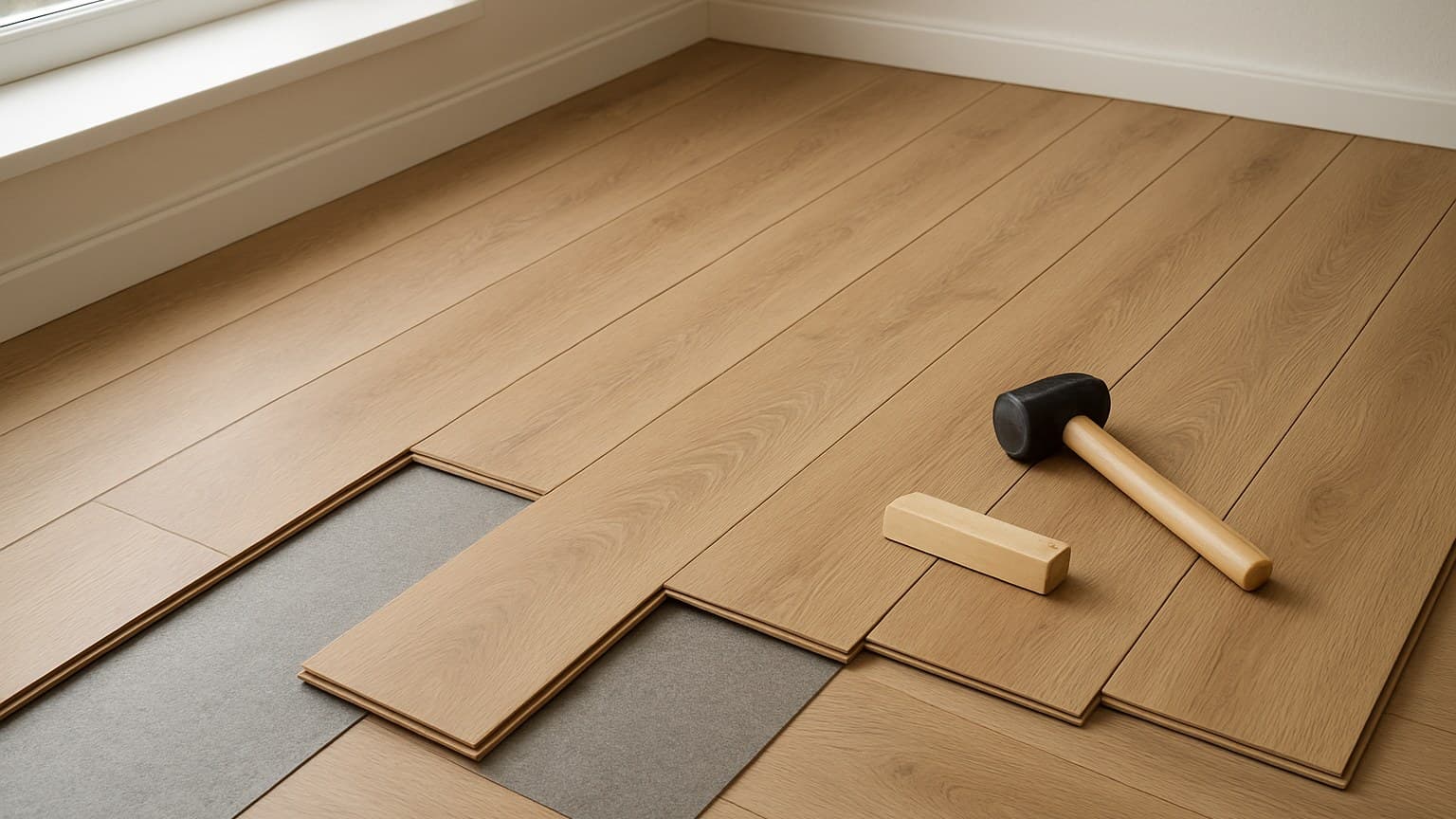
Which flooring has formaldehyde comes down to the core, not the category: pressed-wood cores glued with urea-formaldehyde resin are the source, which puts laminate, some engineered wood, and particleboard underlayment on the list. The surface you walk on isn't the problem. "Vinyl" gets called both safe and risky online, and only the core settles the argument.
Key takeaways
- Formaldehyde in flooring comes from urea-formaldehyde glue in pressed-wood cores. Laminate (HDF core), some engineered wood (plywood core), and particleboard underlayment are the real sources, not the surface you walk on.
- SPC and WPC vinyl cores have no wood and no urea-formaldehyde glue, so a standard LVP core is formaldehyde-free. The backing and adhesive can still off-gas other things, so judge the whole assembly.
- EPA's TSCA Title VI caps hardwood plywood at 0.05 ppm, particleboard at 0.09 ppm, MDF at 0.11 ppm, and thin MDF at 0.13 ppm. Look for CARB2/TSCA Title VI compliant, NAUF, ULEF, or FloorScore labels on the box.
- New flooring off-gases the most in the first 24-48 hours. Ventilate hard during install and the days after to cut the peak.
- Tile, stone, and solid hardwood carry essentially no added formaldehyde. The low-emission versions of composite floors usually cost more than the bargain equivalents, not less.
The Short Answer: Check the Core, Not the Category
Formaldehyde lives in the glue that binds pressed-wood cores, so the risk follows the core material, not the word on the ad. A plank can say laminate, engineered, or vinyl and tell you almost nothing until you know what's underneath the top layer.
That core confusion is why you'll read that vinyl is dangerous on one site and perfectly clean on another. One writer means a wood-flour backing or a cheap composite; another means a stone-plastic core with no wood in it at all. Both get called "vinyl." They are not the same floor.
Here's the rule worth keeping: formaldehyde comes from glue, and glue lives in pressed-wood cores. No wood core means no urea-formaldehyde glue, which is why solid hardwood, tile, stone, and a standard stone-plastic vinyl core sit in the clear. A brand name on the box doesn't answer the question until you've checked the core. If you'd rather start from a shortlist of what to skip outright, the guide on which flooring materials to avoid covers the categories that fail this test most often.
The rest of this is a five-step check you can run this afternoon: identify your core, match it to the real risk, read the box and labels, check the government limits, then cut exposure on a floor that's already down.
What Formaldehyde Is and Why It's in Flooring
Formaldehyde is a cheap, fast, strong adhesive chemical. Urea-formaldehyde resin, UF for short, binds loose wood fibers and thin wood plies into the stiff boards that become flooring cores. It presses quick and costs little, which is why it ends up in high-density fiberboard (HDF), medium-density fiberboard (MDF), particleboard, and a lot of plywood.
As that glue cures and ages, small amounts of gas leak out into the room air. This is off-gassing. It's heaviest when the floor is brand new and tapers off over time.
On the health side: formaldehyde is a known irritant to eyes, nose, and throat, and the Environmental Protection Agency (EPA) and the Centers for Disease Control and Prevention (CDC) classify it as a cancer risk at higher, long-term exposures. If someone in the house has a real sensitivity or you're worried, the move is to test the air and talk to a doctor, not to guess from a label. If formaldehyde exposure is your main worry when picking a floor, the guide to the healthiest flooring for a home weighs that risk against other materials.
One thing most guides skip: the floor may not be the only source in the room. According to the EPA, the same UF-bonded boards regulated under TSCA Title VI also show up as subflooring, closet shelving, and cabinet boxes. If you're hunting down a smell, don't stop at the floor.
Step 1: Identify Your Floor's Core Material
Find a cut end, a leftover plank, or the edge of a board in a closet, and look at what the core is actually made of. That one look tells you more than any ad copy.
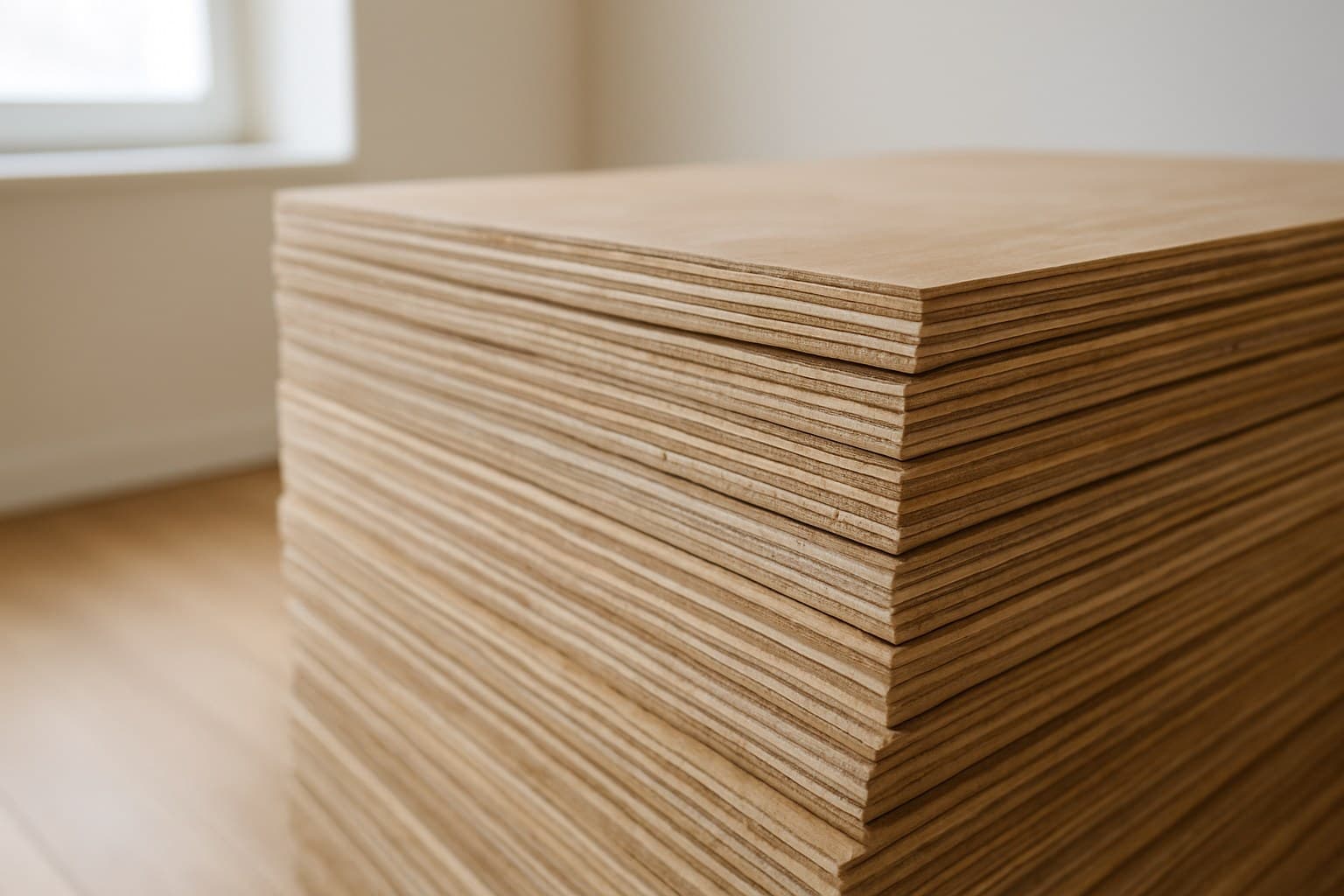
A dense brown fiber core, almost like a stiff cardboard that soaks up water fast, is HDF or fiberboard. That's laminate. Thin wood layers stacked and glued like a sandwich is plywood, which means engineered wood.
For vinyl, two tells matter. A rigid, gray-white core that feels like stone and taps hard is stone-plastic composite (SPC). A slightly softer, warmer plastic core is wood-plastic composite (WPC). Neither one uses UF wood glue.
The easy ones round it out. One solid piece of real wood, top to bottom, is solid hardwood. A crumbly tan board sitting under the finish floor is particleboard underlayment, and that's a hidden source people often don't think to check.
Once you know the core, Step 2's table tells you whether formaldehyde glue is even possible.
Step 2: Match Your Core to the Formaldehyde Risk
Here the vinyl-versus-engineered argument resolves, because we're matching by core, not by category name. The EPA caps formaldehyde emissions in parts per million (ppm), lower numbers mean a tighter limit, under a federal rule called TSCA Title VI, short for the Toxic Substances Control Act, Title VI. The table lines up each core against the flooring that uses it, whether UF glue is in play, and the EPA limit that applies.
| Flooring | Core | UF glue? | EPA limit |
|---|---|---|---|
| Laminate | HDF / fiberboard | Usually yes | MDF 0.11 ppm / thin-MDF 0.13 ppm |
| Engineered wood | Hardwood plywood | Sometimes (NAUF versions use no UF) | Hardwood plywood 0.05 ppm |
| Vinyl plank (SPC) | Limestone + PVC, no wood | No | Not pressed wood, not covered by TSCA VI |
| Vinyl plank (WPC) | Plastic + wood-flour composite | No UF resin | Not pressed wood, not covered by TSCA VI |
| Particleboard underlayment | Particleboard | Usually yes | 0.09 ppm |
| Solid hardwood | Solid wood, no core | No | No added formaldehyde |
Source: the EPA's TSCA Title VI emission limits for pressed wood
Formaldehyde risk by core material, with the EPA's federal emission caps for pressed-wood products.
Engineered wood runs the whole range. A plywood core may use UF glue, or it may use a no-added-urea-formaldehyde binder instead. The same "engineered oak" category stretches from a cheap off-gasser to a clean floor, so the box matters here more than anywhere else.
The vinyl verdict is simpler. Standard SPC and WPC cores contain no wood and no UF resin, so the core itself is formaldehyde-free. You still judge the backing and the adhesive separately, since those can off-gas other chemicals even when the core is clean. If you're leaning vinyl and want the cleanest options, the non-toxic LVP flooring guide breaks down which lines test lowest across the whole plank.
Which laminate floors have formaldehyde?
Nearly all laminate has an HDF core bound with UF glue, so the real question is how much it emits, not whether any is present. According to the EPA, laminate sold for the US market has to meet the federal cap, and lower-emitting lines carry a NAUF (no added urea-formaldehyde) or ULEF (ultra-low-emitting formaldehyde) label (more on those next). A bargain laminate with no cert visible and no spec sheet is one to be careful with.
Step 3: Read the Box, Spec Sheet, and Cert Labels
Now turn the box over and hunt for the words that actually mean something. Each label promises a different thing, and two of them get mixed up constantly.
| Label | What it promises |
|---|---|
| TSCA Title VI compliant | Meets the US federal cap for formaldehyde from pressed-wood cores |
| CARB2 | California's standard; limits match the federal TSCA caps |
| NAUF | No added urea-formaldehyde glue used in the core |
| ULEF | Ultra-low-emitting formaldehyde; a tiny amount allowed, well under the limit |
| FloorScore | Independent test of total low chemical emissions for indoor air, not formaldehyde alone |
| E1 / E0 | European emission grades; E0 is the stricter, lower-emission tier |
What each formaldehyde and emissions label on a flooring box actually certifies.
The two that trip people up are NAUF and ULEF. NAUF means no added urea-formaldehyde glue went into the core at all. ULEF means ultra-low-emitting formaldehyde, which still allows a tiny amount but holds it well under the legal cap. TSCA Title VI is a section of the federal Toxic Substances Control Act, and CARB stands for the California Air Resources Board.
A box with no cert isn't automatically dangerous, but it's a flag. Any pressed-wood floor legally sold in the US should be TSCA Title VI compliant, so if the box is bare, ask the retailer for the spec sheet before you buy. A seller who can't produce one is telling you something.
If you want to confirm a certification claim is real and still active rather than printed and expired, the GREENGUARD Gold certified flooring guide walks through how to verify a label's live status. And a note on money: the low-emission version of a floor, plus the matching low-emission adhesive, usually costs more than the bargain equivalent, not less. The affordable non-toxic flooring guide is worth a read before you set a budget.
Step 4: Check the EPA ppm Limits for Your Core
If your core is pressed wood, the EPA sets a hard cap on how much formaldehyde it can emit, measured in parts per million (ppm). Lower is tighter. The table below breaks down where each board type lands.
| Core type | EPA cap (ppm) |
|---|---|
| Hardwood plywood | 0.05 |
| Particleboard | 0.09 |
| MDF | 0.11 |
| Thin MDF | 0.13 |
EPA TSCA Title VI formaldehyde emission caps for pressed-wood cores, in parts per million.
Read it this way: these are ceilings, not targets, so a compliant floor emits at or below the number for its core. Hardwood plywood gets the tightest cap at 0.05 ppm. A NAUF or ULEF floor lands well under its cap, which is the whole point of paying for one.
SPC and WPC vinyl, solid hardwood, tile, and stone aren't on this chart because they aren't pressed wood. There's no UF glue to regulate, so there's no ppm number to hit. If your core is one of those, Step 4 is already a pass. Those same core materials anchor most of the picks in the non-toxic flooring options guide, since skipping a pressed-wood core sidesteps UF glue entirely.
Step 5: Cut Exposure on a Floor That's Already Down
If the floor is already installed and it's a pressed-wood core, you can't swap the glue, but you can knock down the peak. New flooring typically off-gases the most in the first day or two after it goes in, then drops off over the following days and weeks.
Ventilate hard during that window. Open windows, run fans, and if you can, raise the heat a little, since warmth speeds the glue's release and gets it over with faster. Keep the air moving through install day and the days right after, not just one afternoon.
Two more honest notes. First, if you're the one laying it: click-lock laminate and click-lock LVP (luxury vinyl plank) are realistic DIY jobs, but glue-down planks, stairs, and big open-plan rooms with moisture transitions are where hiring a pro makes sense, because a bad install off-gasses adhesive on top of everything else. Second, before any floor goes down, the subfloor has to be flat and dry, checked for both high spots and moisture, or the floor fails for reasons that have nothing to do with formaldehyde.
If the smell lingers past a few weeks, remember the floor may not be the only culprit. Cabinets, shelving, and subfloor made from the same boards off-gas too. For the bigger picture on which materials emit least over time, the guide on what flooring has the least off-gassing ranks materials by how long and how much they release, not just whether they pass a cap. And if you're still choosing and health is the deciding factor, which type of flooring is best for health sorts the options by what actually ends up in your air.
Sources
- EPA: Questions and Answers Regarding Laminate Flooring
- EPA: What Should I Know About Formaldehyde and Indoor Air Quality
- EPA: Frequent Questions for Consumers About Formaldehyde Standards for Composite Wood Products
- EPA: Formaldehyde Standards for Composite Wood Products, Final Rule FAQ for Consumers (PDF)