
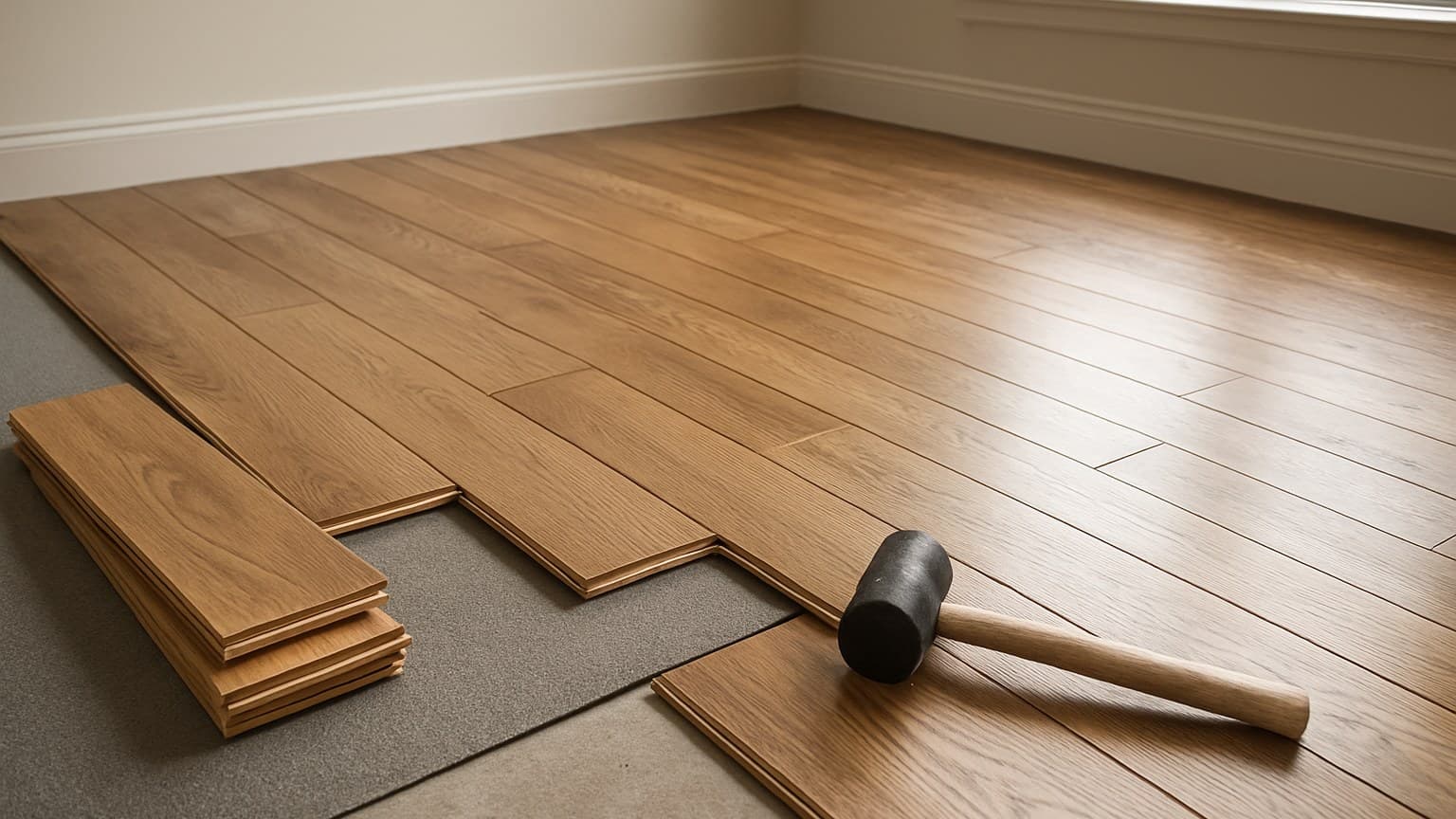
Real linoleum like Marmoleum, FloorScore-certified LVP, and solid hardwood finished with a water-based coat can all test as genuinely non-toxic, but the same materials installed with the wrong glue can off-gas worse than a certified click-lock floor. That's because two floors made of the same material can perform very differently depending on what's glued underneath and coated on top. The word "natural" on a label means almost nothing by itself, so here's how to tell the real thing from the marketing.
Key takeaways
- The plank is rarely the problem. Adhesives, finishes, and grout release most of the VOCs and formaldehyde in a brand-new floor.
- Solid hardwood, porcelain tile or stone, and real linoleum like Marmoleum score lowest for indoor-air toxins; PVC vinyl and formaldehyde-bonded laminate score highest.
- Porcelain tile is fired above 2000F, which burns off organic compounds and leaves an inert surface, so the real toxin risk shifts to the grout and sealer, not the tile.
- Trust FloorScore, GREENGUARD Gold, or CARB Phase 2 / NAF labels, and verify them on the product's own spec sheet, not the showroom sign.
- Installed cost runs roughly $2-9 per sq ft for carpet and laminate up to $8-25 for hardwood and tile, and basement or stair jobs cost more than open rooms.
What Non-Toxic Flooring Means, and Who's Most at Risk
"Non-toxic" flooring realistically means low-emitting and third-party tested, not zero chemicals. Almost every building material breathes off a little something when it's brand new, so the honest bar is low emissions you can verify, not a magic floor that releases nothing.
A few plain terms first. VOCs are volatile organic compounds, chemicals that evaporate off a material into the air you breathe. Off-gassing is that release, strongest in the first days to months after install; for a full ranking of which materials off-gas the least, see what flooring has the least off-gassing. Formaldehyde is one common VOC used as a cheap glue in the cores of some boards, and it's the one most people worry about.
Who feels it first? Babies and toddlers crawling and breathing right at floor level, where the air is heaviest with off-gassing. Anyone with asthma, allergies, or chemical sensitivity. And anyone in a small, sealed room with little fresh air, or a family moving in the same week the floor goes down, before the worst of the off-gassing has settled.
If you want a single ranked pick rather than a survey, the deeper dives on which type of flooring is best for health and the healthiest floor covering go further than this overview can. This page is the map; those are the close-ups.
The Real Source of Floor Toxins: Adhesives, Finishes, and Grout
The plank you agonize over in the showroom is usually the cleanest part of the whole floor. The glue under it, the finish on top of it, and the grout around tile are where most of the emissions come from.
The usual culprits are solvent-based construction adhesives, some oil finishes, formaldehyde binders hidden in fiberboard cores, and cheap sealers. Not the wood, the stone, or the cork itself.
This flips how you shop. A "natural" cork or wood floor set in a cheap solvent glue can off-gas worse than a certified click-lock floor that needs no glue at all. I pulled up a five-year-old glue-down cork floor for the Reyes family outside Salem, and the cork was fine. It was the amber solvent adhesive underneath that still had a smell to it.
So the practical moves are simple. Favor click-lock (floating) installs that skip adhesive entirely. Pick water-based or hardwax-oil finishes over solvent ones. Ask for low-VOC grout and a water-based penetrating sealer on any tile job.
The Non-Toxic Flooring Scorecard
Below is a matrix rating nine common materials on VOC risk, formaldehyde risk, cost tier, and best rooms. Read one row and you can decide, instead of piecing it together from ten paragraphs.
Two ratings need a caveat. Cork and bamboo only earn a good score when the binder and adhesive are clean. Engineered wood and laminate ride almost entirely on what's in their core. So a "Medium" here can swing to Low or High depending on that one spec.
| Material | VOC risk | Formaldehyde risk | Cost tier | Best rooms |
|---|---|---|---|---|
| Solid hardwood | Low (finish-dependent) | Very low | $$$ | Bedrooms, living areas |
| Porcelain tile / stone | Very low | None (inert) | $$-$$$ | Bath, kitchen, entry |
| Real linoleum (Marmoleum) | Low | None | $$ | Kitchen, playroom |
| Cork | Low-Med (adhesive/finish) | Low if NAF-bonded (NAF means no-added-formaldehyde) | $$ | Nursery, office |
| Bamboo | Med (binder-dependent) | Med unless NAF | $$ | Living areas |
| Engineered wood | Med (core glue) | Low if CARB2 (California's formaldehyde-emission standard) or NAF | $$-$$$ | Most rooms, basements |
| Laminate | Med-High | Medium (fiberboard core) | $ | Low-traffic dry rooms |
| Vinyl / LVP | High (PVC, the plastic vinyl is made from, plus phthalates) | Low | $-$$ | Bath, laundry (if certified) |
| Carpet | High (backing/adhesive) | Low-Med | $-$$ | Bedrooms (natural fiber only) |
Source: the FloorScore and CARB Phase 2 emission limits these materials are tested against
Toxin-risk ratings reflect the FloorScore and CARB Phase 2 emission limits these materials are tested against; cost tiers are installed cost, materials plus labor.
For a single ranked pick, see the guides on what flooring is the least toxic and the healthiest flooring for a home. If your worry runs the other way, what flooring materials to avoid covers the offenders in detail.
The Inert Top Tier: Solid Hardwood, Tile, and Stone
These three lead because they're near-inert once installed. Solid wood, porcelain, ceramic, and natural stone barely emit anything on their own, so the only real toxin question is what you put on them or between them.
Porcelain and ceramic tile get an edge no competitor mentions: according to the Tile Council of North America (TCNA), tile is fired at temperatures above 2,000°F, a process that burns off the organic compounds in the clay, leaving a surface that emits essentially nothing. So with tile the toxin risk isn't the tile at all, it's the grout and the sealer. Ask for low-VOC grout and a water-based penetrating sealer and you've handled the only weak spot.
Solid hardwood has one weak spot too, and it's the finish. Choose site-finished with a water-based or hardwax-oil coat, or a factory (prefinished) floor that carries a low-emission certification like FloorScore. The raw wood was never the problem.
Stone is the priciest of the group and heavy to install, but on emissions it's as clean as tile. Same rule: the sealer decides its indoor-air score.
Natural but Adhesive-Dependent: Real Linoleum, Cork, and Bamboo
These materials are genuinely natural, but their toxin score is decided by the binder and adhesive more than the name on the box. Get the glue wrong and a "green" floor stops being green.
Start with linoleum, because the word gets abused. Real linoleum, like Marmoleum, is made from linseed oil, cork dust, pine rosin, and a jute backing, and it's genuinely low-emitting. A lot of what stores call "linoleum" is actually vinyl, which is PVC (polyvinyl chloride), a completely different, higher-VOC product. Read the material, not the nickname.
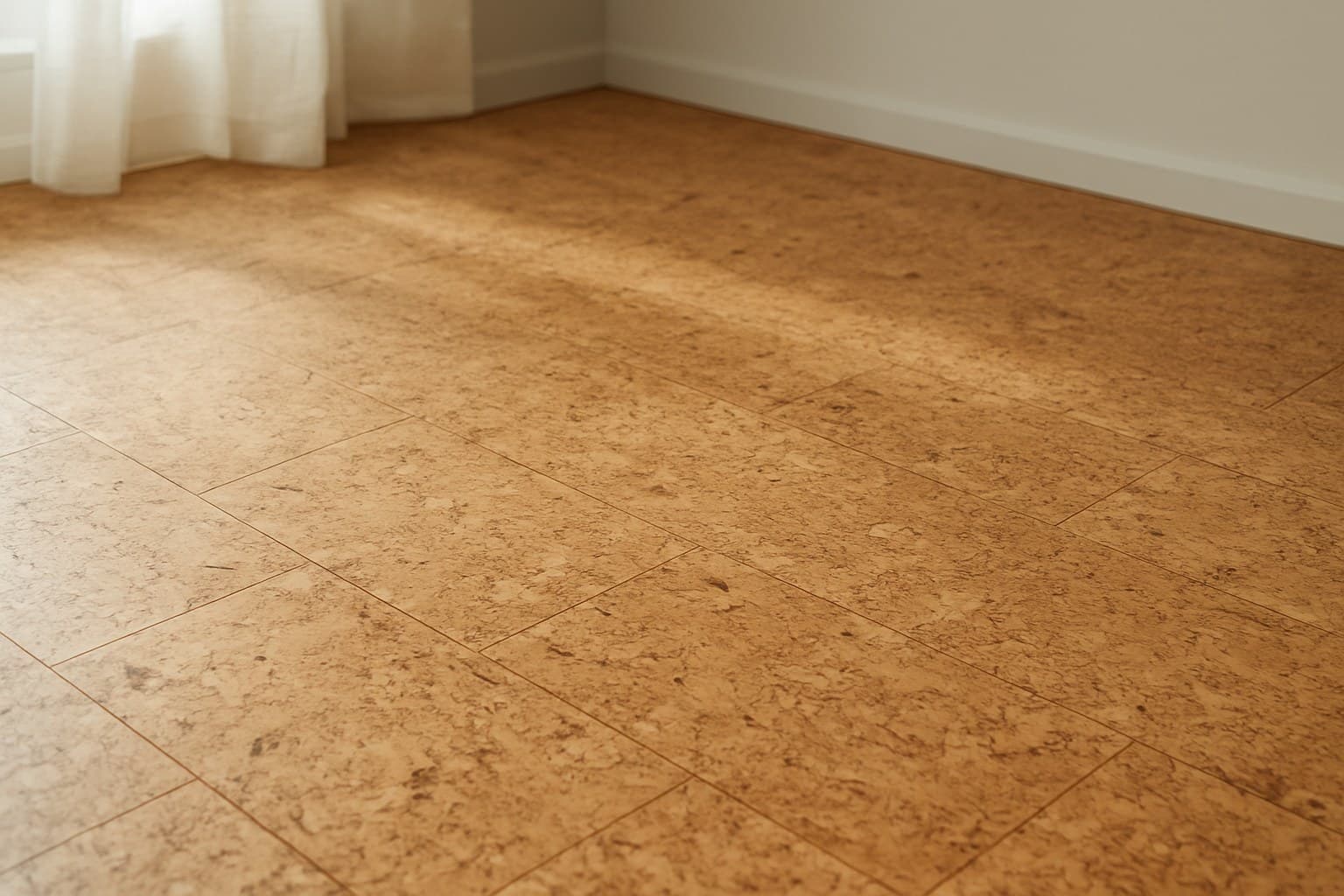
Cork is warm, quiet, and easy on the joints, and it's low-toxin only when it uses a no-added-formaldehyde (NAF) binder and a clean finish. The floating click-lock version stays cleaner than glue-down, which rides on whatever adhesive you use. There's more on this in the FAQ below, and it's worth a look for a nursery.
Bamboo has a catch worth knowing. It's a fast-growing grass, which sounds eco-friendly, but strand-woven bamboo is bound with resins that can carry formaldehyde unless the box says NAF or ULEF (ultra-low-emitting formaldehyde). Buy it uncertified and you're gambling on the binder.
Where Formaldehyde and PVC Hide: Laminate, Engineered Wood, Vinyl, and Carpet
This is the group where the core or the backing does the off-gassing, so certification isn't optional here.
Laminate's risk is its fiberboard core, which can be bonded with urea-formaldehyde glue. Only laminate labeled CARB Phase 2 (the California Air Resources Board's formaldehyde limit) or NAF belongs in a low-toxin home. If you're weighing it against vinyl, laminate tends to give a more realistic wood look for less money, while vinyl tolerates water better. Which one's right depends on the room.
Engineered wood deserves a fair shake. The core glue is the concern, but a CARB2 or NAF engineered floor is a legitimate low-emission pick, and it handles basements and wide open rooms better than solid wood because it moves less with moisture.
Vinyl and LVP sit at the high-VOC end of this list, because they're PVC and can carry phthalates (plasticizers that keep the plank flexible). If you want vinyl anyway, and in a bathroom or laundry it's a reasonable call, insist on a FloorScore-certified product and check the waterproof non-toxic flooring guide before you buy.
Carpet's toxins live in the backing and the glue, plus the pad. Choose natural fiber (wool) or a low-VOC synthetic, a cushion (pad) without added formaldehyde, and let it air out before you move furniture back.
What These Floors Actually Cost, Materials vs. Labor
Installed cost runs roughly $2-9 per square foot for carpet and laminate at the low end, up to $8-25 for hardwood, tile, and stone. There's no single national number worth quoting, so here's the split that actually helps: materials versus labor.
| Material | Materials ($/sq ft) | Labor ($/sq ft) | Installed total |
|---|---|---|---|
| Laminate | $1-3 | $1-3 | $2-6 |
| Carpet (natural fiber costs more) | $1-4 | $1-3 | $2-7 |
| Real linoleum (Marmoleum) | $3-5 | $2-4 | $5-9 |
| Cork | $3-6 | $2-4 | $5-10 |
| Engineered wood | $3-8 | $3-5 | $6-13 |
| Solid hardwood | $4-10 | $4-8 | $8-18 |
| Porcelain tile | $2-7 | $6-14 | $8-21 |
| Natural stone | $5-15 | $8-15 | $13-25 |
Approximate US installed ranges by material, split into materials and labor; wide bands reflect grade, region, and room.
Two things move these numbers. Tile and stone carry high labor because setting and grouting is slow, skilled work. And a basement or a staircase costs more than an open room, sometimes a lot more, because of cuts, moisture prep, and awkward angles.
On DIY versus hiring: click-lock laminate, cork, and engineered floors are realistic for most handy homeowners. Glue-down anything, tile, stairs, and big open-plan moisture transitions are where paying a pro is worth it. Whatever you lay, check the subfloor for flatness and moisture first with a meter (a handheld tool that reads how wet the slab or wood is), skip that check and no certification on the box will save the install. For budget-first shoppers, affordable non-toxic flooring and the cheapest non-toxic flooring go deeper on stretching dollars.
How to Verify a Floor Is Actually Low-Toxin
Trust three labels, and verify them, don't take the showroom sign's word for it. FloorScore and GREENGUARD Gold are third-party emission certifications, and CARB Phase 2 or NAF speaks to formaldehyde specifically. If you'd rather start from specific manufacturers than labels alone, non-toxic flooring brands checked against safety registries cross-references twenty of them against the public databases so you know which names actually back up their claims.
The trick is to confirm the exact product carries the cert, not just the brand. A brand can sell one certified line and three that aren't. Pull the product's own spec sheet or check the certifier's database, and match the SKU. The full walkthrough lives in the GREENGUARD Gold certified flooring guide, and if you want the least-emitting options ranked head to head, see the least-toxic flooring breakdown.
Sources
- Tile Council of North America, "Tile: The Natural Choice" (PDF)