
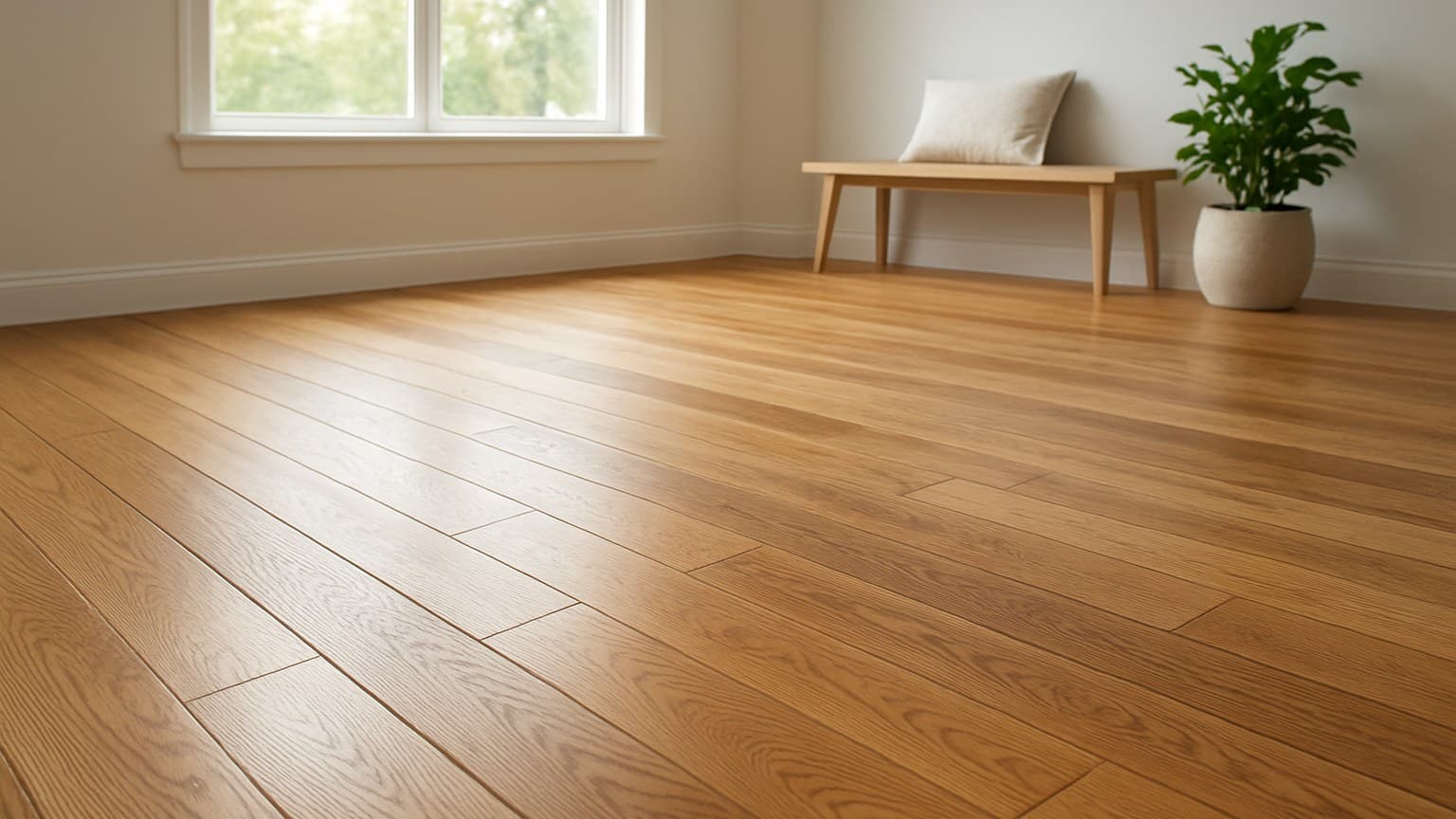
When Priya Nair in Austin asked me which floor would off-gas the least before her baby's nursery went in, I gave her the short answer first: raw solid hardwood and porcelain or ceramic tile release the least, because neither has a resin-bound core to breathe fumes into the room. The catch is that the plank or tile face is rarely what makes a new floor smell, it's the glue and finish layered on top of it. Here's how to tell a clean install from a fume-heavy one before you pay for either.
Key takeaways
- Raw solid hardwood and porcelain or ceramic tile emit almost nothing from the material itself; nearly all off-gassing comes from the glue, finish, and core, not the plank.
- Under California's CARB Phase 2 rule, composite-wood formaldehyde is capped at 0.05 ppm for hardwood plywood, and the EPA finds most laminate off-gasses under 0.03 ppm, so the flat 'laminate is toxic' warning is overstated.
- New carpet VOCs typically fade within 48-72 hours of airing out, per Carpet & Rug Institute data (industry-funded, cited with that caveat) - carpet is not the worst emitter.
- The label caps emissions, not the material name: look for FloorScore, GREENGUARD Gold, and CARB 2 / NAUF or ULEF on the box.
- Glue-down and site-finished floors off-gas more and longer than click-lock prefinished planks, so ask for the product's own spec sheet before you buy.
What Off-Gassing Is and How Long It Lasts
Off-gassing is when a brand-new floor releases VOCs into your air. VOC stands for volatile organic compound, which is just a name for a gas that evaporates out of glues, finishes, and the resins that hold a plank's core together. Formaldehyde is the one most people ask about, because it has a sharp smell and can bother your lungs.
The people who feel it first are babies, folks with asthma, and anyone with chemical sensitivity. That's usually who's typing this search at 11 p.m. with a new floor going in next week. The signs are headaches, itchy eyes, and that chemical "new floor" smell that won't quit.
Here's the honest timeline. Emissions spike hard in the first few days, then taper off over weeks. A raw tile floor is basically done off-gassing the day it's set. A site-finished hardwood or a full glue-down floor can keep smelling for weeks if you shut the windows.
The plank or tile face you picked is rarely the problem. It's what goes under and on top of it. If you're specifically chasing vinyl, I break that down in how long LVP off-gasses, because the curing story there is its own animal.
Flooring Ranked by Off-Gassing: The VOC and Cure-Time Table
Here's the short version before the table: raw solid hardwood and porcelain or ceramic tile off-gas the least, and carpet isn't the monster it's made out to be. The table below ranks each common floor from safest to worst, with how long it off-gasses and real cost split into materials and labor, and if you want the fuller rundown of non-toxic flooring options, this table is the shorthand version of that guide.
Two reference lines to keep in your head. Under California's CARB Phase 2 rule (CARB is the California Air Resources Board), formaldehyde in hardwood plywood is capped at 0.05 ppm, where ppm means parts per million, a way to measure how much gas is in the air. The EPA reports most laminate off-gasses under 0.03 ppm formaldehyde, which is why the flat "laminate is toxic" line is overblown.
| Flooring | Typical emissions | How long it off-gasses | Materials $/sq ft | Labor $/sq ft |
|---|---|---|---|---|
| Solid hardwood (raw/unfinished) | Near-zero from the wood; risk is the site finish | Hours to days once finish cures | $4-9 | $3-6 |
| Porcelain / ceramic tile | Near-zero; watch the thinset (tile mortar) and grout | Effectively none from the tile | $2-8 | $5-10 |
| Real linoleum (Marmoleum) | Low; slight natural linseed smell early on | Days with ventilation | $3-6 | $3-6 |
| Cork | Low if it has a NAUF core (no added urea-formaldehyde); adhesive is the variable | Days | $3-7 | $3-6 |
| Engineered hardwood | Low to moderate; depends on core resin (look for CARB 2 or NAUF, meaning no added urea-formaldehyde) | Days to weeks | $4-10 | $3-6 |
| Laminate | Usually under 0.03 ppm formaldehyde per EPA; not automatically hazardous | Days to a few weeks | $1-4 | $2-5 |
| Vinyl / LVP | Moderate; PVC and plasticizers, worse if not FloorScore-certified | Days to weeks; longer if glue-down | $2-7 | $2-5 |
| Carpet | Low, and drops fast; see the myth section | 48-72 hours with ventilation (per CRI, the Carpet and Rug Institute) | $2-6 | $1-3 |
Source: CARB Phase 2 limits and the EPA formaldehyde Q
Off-gassing, cure time, and installed cost by flooring type, with costs split into materials and labor per square foot.
Read your own case off it. Putting a floor in a nursery on a tight timeline? Go straight to the cure-time column and pick something that's near-done at install. Working a tight budget? The two cost columns are yours, and the guide to affordable non-toxic flooring walks through the cheapest picks that still keep emissions low.
Two cautions. Basement and stair jobs cost more per square foot than an open room, because they're slow and cut-heavy. I learned that the hard way quoting flat rate until a job full of closets and a bay window ate an extra day. And the same material can land in a different spot on this list depending on its glue and finish, which is the whole point of the next two sections.
NAUF, by the way, means "no added urea-formaldehyde." It's a label you want on any composite-wood product.
The Safest Base Materials, Ranked
Raw solid hardwood and porcelain or ceramic tile win because they're inert. Solid wood is milled from one piece, no glued-together core. Tile is fired clay, no resin binding anything. Neither one has a urea-formaldehyde core quietly breathing into your room.
But each has an honest catch, and the safe base material can still be undone by what goes with it.
- Raw solid hardwood. The wood is clean. The risk is the finish someone brushes on at your house, which cures over days.
- Porcelain / ceramic tile. The tile is clean. The risk is the thinset (the mortar that bonds tile to the floor) and the grout.
- Real linoleum (Marmoleum). Low-emitting and made from linseed oil and cork dust. The catch is the seam adhesive.
- Cork. Warm, quiet, low-emitting, but only if you pick a NAUF core with no added formaldehyde.
Linoleum, cork, and bamboo lean on their adhesive and core, not only the raw plant they came from. If you want the fuller health picture across materials, I go deeper in the guide to the healthiest flooring to install.
Why the Glue and Finish Matter More Than the Material
On a tear-out I did for a customer in Fort Worth, the plank face was almost always the lowest emitter in the room. The smell comes from three other places: the solvent adhesive under a glue-down job, the resin hiding in a composite core, and the fresh polyurethane finish curing on a site-finished floor.
Break it down and it's obvious. Urea-formaldehyde resin can live in the core of cheap engineered wood and laminate. Solvent-based glue on a full-spread job off-gasses harder than any plank I've ever pulled up. Site-applied finish keeps releasing VOCs for days as it hardens.
So here's the practical lever. Click-lock prefinished planks skip both the wet glue and the wet finish. They snap together dry, and the coating was cured at the factory. That's why a click-lock floor off-gasses less, and for less time, than a site-finished or full-spread glue-down floor. If formaldehyde is your specific worry, the rundown of which flooring has formaldehyde names where it hides.
The Carpet Myth: What the Data Actually Shows
Common wisdom says carpet is the worst off-gasser in the house. The data says otherwise. According to the Carpet and Rug Institute's Carpet and Indoor Air Quality report, new carpet VOC emissions are low and typically drop off within about 48 to 72 hours once you air the room out.
Here's the caveat worth flagging: CRI is an industry-funded group, so treat that number accordingly rather than as neutral. Even with that grain of salt, carpet's emissions fade fast compared with a glue-down vinyl or a site-finished wood floor that smells for weeks.
That doesn't make carpet the cleanest choice. It traps dust and dander, which is a different health issue from off-gassing. But on the narrow question of VOCs over time, carpet is far from the villain it's painted as.
How to Buy for the Least Off-Gassing
The label caps emissions, not the material name. Whatever you pick, the move is the same: find the certification on the box and ask for the product's own spec sheet. Three labels do the real work.
- FloorScore tests hard flooring and adhesives for indoor air quality.
- GREENGUARD Gold sets tight VOC limits, strict enough that it's used for schools and daycares.
- CARB 2 / NAUF or ULEF on composite wood tells you the core meets California's formaldehyde cap or has none added. (ULEF means "ultra-low-emitting formaldehyde.")
Then stack the odds with how you install and air it out:
- Choose click-lock prefinished planks over glue-down or site-finished where you can.
- If you must glue, ask for a low-VOC, FloorScore-listed adhesive by name.
- Run fans and open windows for the first 3 days, the window when emissions peak.
- Get the spec sheet, not the salesperson's word. A real product sheet lists its emissions test.
For brands that already clear these bars, see the roundup of non-toxic flooring brands, and if you're shopping one store, low-VOC flooring at Home Depot narrows it down. For the widest-net material picks, the best low-VOC flooring guide is the next read, because it ranks options by certification rather than just by feel.
Sources
- EPA: Formaldehyde Questions and Answers (2016 revision)
- EPA: Formaldehyde Questions and Answers (2015)
- Carpet and Rug Institute: Carpet and Indoor Air Quality
- Carpet and Rug Institute: Benefits of Carpet
- EPA HERO Database: Formaldehyde Reference Document