
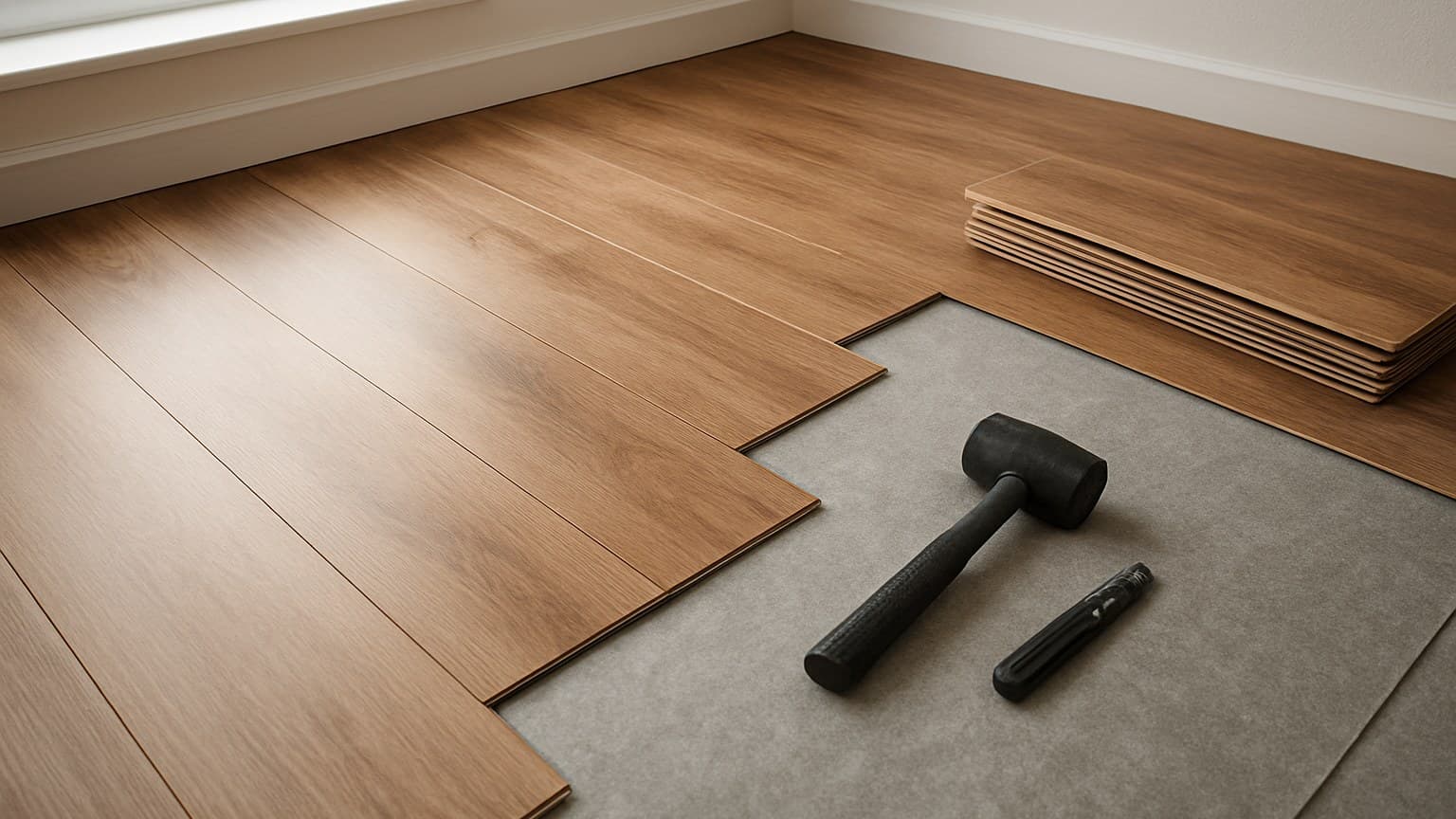
Non-toxic LVP (luxury vinyl plank) flooring is real, but only if you verify it: a FloorScore or GREENGUARD Gold certificate tied to that exact product is what separates a low-toxin plank from a bargain-bin gamble. The box rarely makes that clear, and "low-VOC" marketing copy means next to nothing on its own. Here are nine things to confirm before you call a vinyl plank floor safe. If you're weighing vinyl against other categories entirely, I rank the safest non-toxic flooring options across materials in a separate guide.
Key takeaways
- LVP can be a low-toxin floor, but only if you verify it: a FloorScore or GREENGUARD Gold certificate tied to that exact product is the single most important thing to confirm.
- Off-gassing peaks in the first days after install and fades; some products can keep emitting for several months up to about 2 years, so ventilate hard early.
- SPC cores run about 60-80% limestone and use less soft plasticizer than WPC; look for a phthalate-free plasticizer (DOTP) and a CARB2 or NAUF core either way.
- The glue and underlayment can off-gas as much as the plank, so a 'non-toxic' plank set in cheap adhesive is not the clean floor you paid for.
- Budget LVP materials start around $3.49/sq ft (Shaw In the Grain) and climb to roughly $5-8 for certified lines, plus labor; basements and stairs cost more than open rooms.
Is LVP Actually Toxic, or Not? Why the Guides Disagree
A modern, certified vinyl plank is a reasonably low-toxin floor for most rooms. A cheap, uncertified plank is a real gamble. What separates the two is the label, not the word "vinyl." If you're weighing vinyl against other materials, it helps to see the full range of non-toxic flooring options side by side.
That's why you'll find guides that flatly contradict each other. Some name specific low-toxin LVP lines and call them fine. Others lump all vinyl together and call it among the worst choices you can buy. Both sides are telling the truth, just about different products. For a broader rundown of which materials show up on worst-case lists and why, see my guide to flooring materials you should avoid.
"LVP" covers a huge spread. It runs from older planks loaded with legacy phthalate softeners to newer, phthalate-free lines that carry real emissions certificates. The word on the box tells you almost nothing about what's off-gassing in your living room. If avoiding off-gassing altogether is the goal, I break down which flooring doesn't off-gas in a separate guide.
| Position | Verdict | What it gets right |
|---|---|---|
| Safe-with-caveats guides | LVP is a reasonably low-toxin choice; some even name specific low-toxin brands | True for FloorScore / GREENGUARD Gold, phthalate-free lines |
| Pro-natural-material guides | Vinyl is among the worst choices available | True for cheap, uncertified, legacy-phthalate vinyl |
| Our take | Both are right; certification is the dividing line, not the word "vinyl" | A certified plank and a bargain-bin plank are not the same product |
Where the main flooring guides land on whether LVP is toxic.
If you want the full picture of how LVP is built, graded, and how long it holds up, start with my vinyl flooring buyer's guide. This article picks up where that one stops: proving a plank is actually safe before it goes down.
1. A FloorScore or GREENGUARD Gold Certificate You Can Actually Look Up
The first thing to confirm is a real emissions certificate on that exact product. VOC stands for volatile organic compounds, the gases a floor can release into your air. FloorScore and GREENGUARD Gold are the two labels you want, not a vague "low-VOC" line in the marketing copy. If you're specifically trying to settle whether a GREENGUARD Gold-labeled LVP is actually safe, I answer that question on its own.
Both programs test the finished product for how much it emits indoors. The key move is to verify it yourself. Look the product up in the certifier's own registry and match the SKU, instead of trusting a logo printed on a display board. FloorScore keeps its certified-product list at floorscore.com, GREENGUARD certifications show up in UL's SPOT database, and CARB2 formaldehyde rules are published directly on the California Air Resources Board's composite wood program page.
On the spec sheet or the product's own listing, you're looking for the words "FloorScore certified" or "GREENGUARD Gold" next to a model you can actually find in that registry. If the plank isn't in the database, treat the claim as marketing.
GREENGUARD Gold uses stricter emission limits aimed at schools and daycares, which is why parents search it by name. If you've got young kids or someone with asthma in the house, that's the one I'd hold out for. For a deeper look at the label itself, see my guide to GREENGUARD Gold certified flooring.
| Certification | What it tests | What to look for on LVP | Limit |
|---|---|---|---|
| FloorScore | Indoor air emissions from hard-surface flooring | "FloorScore certified" on the spec sheet, SKU in the registry | Covers emissions, not every ingredient |
| GREENGUARD Gold | Low chemical emissions, stricter limits for schools and kids | "GREENGUARD Gold" label plus a registry listing | Emissions-based, not an ingredient ban |
| CARB2 | Formaldehyde in any composite-wood parts | "CARB2 compliant" or "NAUF" on the core or backing | Formaldehyde only |
| Prop 65 | A warning if a California-listed chemical may be present | Read the warning, then cross-check a cert | A disclosure, not a toxicity score |
What each LVP label actually proves, and where each one stops.
2. A CARB2 or NAUF Core Label (the Formaldehyde Check)
Confirm the core or backing is CARB2 compliant, and ideally NAUF. CARB2 is the California Air Resources Board Phase 2 rule that caps formaldehyde in composite wood. NAUF means "no added urea-formaldehyde," and products made this way typically emit substantially less formaldehyde than ones built with standard urea-formaldehyde resin.
Most buyers assume formaldehyde risk lives in the vinyl surface, but that's rarely where it hides. The adhesives and any wood-plastic backing or composite layer are the usual source. A plank with a gorgeous printed wood look can still carry formaldehyde underneath where you'd never think to check.
On the spec sheet, look for "CARB2 compliant" or "NAUF" called out on the core. If the plank is pure stone-plastic core with no wood content, formaldehyde is less of a concern there, but you still want the adhesive and backing accounted for.
Formaldehyde isn't unique to vinyl, either. If you want to see which floors carry the most of it and which carry almost none, I broke that down in my guide to what flooring has the least off-gassing.
3. How to Read the Prop 65 Warning Without Panicking
A California Proposition 65 warning means the product may contain a chemical on California's list. It is a disclosure, not a toxicity ranking. A missing warning does not prove a floor is clean.
Proposition 65 is a California law that requires a heads-up label when a product might expose you to one of hundreds of listed chemicals. The bar for slapping on the warning is low, so a huge share of flooring, furniture, and building products carry it. The label alone tells you very little.
The practical move is simple. A Prop 65 warning tells you to look closer, not to run. The actual emissions certificate is what settles whether a floor is low-toxin. Use the warning as a prompt to go check the FloorScore or GREENGUARD Gold registry, never as the verdict on its own.
4. Know Your Core: SPC vs WPC
SPC stands for stone-plastic core, made mostly of limestone (the exact ratio varies by manufacturer), which makes it harder and generally lets the maker use less soft plasticizer. WPC stands for wood-plastic core, which is softer and warmer underfoot. Neither one is automatically non-toxic; the certificates still decide that.
Pick the core for the job. SPC is my default for basements, busy entryways, pets, and anywhere a floor takes a beating, because it's rigid and dent-resistant. WPC earns its keep in bedrooms and spaces where comfort underfoot matters more than brute durability.
Most of the rigid, COREtec-style floating lines are built around exactly this core decision. If you're trying to match a specific line to a specific room, my COREtec line-by-line breakdown walks through which one holds up where.
| Factor | SPC | WPC |
|---|---|---|
| Core makeup | Mostly limestone plus PVC, rigid (exact ratio varies by brand) | Wood-plastic composite plus PVC, softer |
| Feel underfoot | Harder, colder | Warmer, more cushioned |
| Plasticizer load | Generally lower | Generally higher (softer plank) |
| Dent resistance | Higher | Lower |
| Cost | Often lower-to-mid | Mid-to-higher |
| Best for | Basements, high traffic, pets | Comfort underfoot, bedrooms |
How stone-plastic and wood-plastic cores trade off against each other.
5. A Phthalate-Free Plasticizer (Look for DOTP)
Confirm the plank uses a phthalate-free plasticizer such as DOTP instead of the older ortho-phthalates. A plasticizer is the ingredient that keeps vinyl soft and flexible instead of brittle. DOTP (dioctyl terephthalate) is a common replacement for the ortho-phthalates that drew health concerns.
This matters because phthalate exposure is widespread. CDC biomonitoring data from the National Health and Nutrition Examination Survey has found that kids often carry a higher body burden than adults, partly because of how much time they spend close to the floor. You can't control every source of exposure, but the floor your kids crawl on is one you get to pick.
On the spec sheet, the phrase you want is simply "phthalate-free." Treat it as a bonus that should sit next to a real emissions certificate, not as a substitute for one. A plank can be phthalate-free and still emit other VOCs, so the FloorScore or GREENGUARD Gold listing from check one is still the thing that decides it.
6. No Antimicrobial Additive You Didn't Ask For
Plenty of LVP lines bake an antimicrobial into the wear layer, using silver, zinc, copper, zeolite, PHMG, or nisin. You get to decide whether you actually want that extra chemistry in your floor. It isn't a safety feature you're forced to accept.
These additives claim to fight mold and bacteria on the surface. In a dry, well-kept home, that's mostly marketing. A sealed, cleanable vinyl surface already doesn't give microbes much to live on, and some of these additives raise their own questions, so adding more chemistry to a floor you chose for being low-toxin can feel backward.
If the health angle is why you're buying LVP in the first place, read the spec sheet and skip the lines that pile on antimicrobials you never asked for. If a brand won't tell you what the additive is, that's an answer too.
7. The Glue and Underlayment Underneath
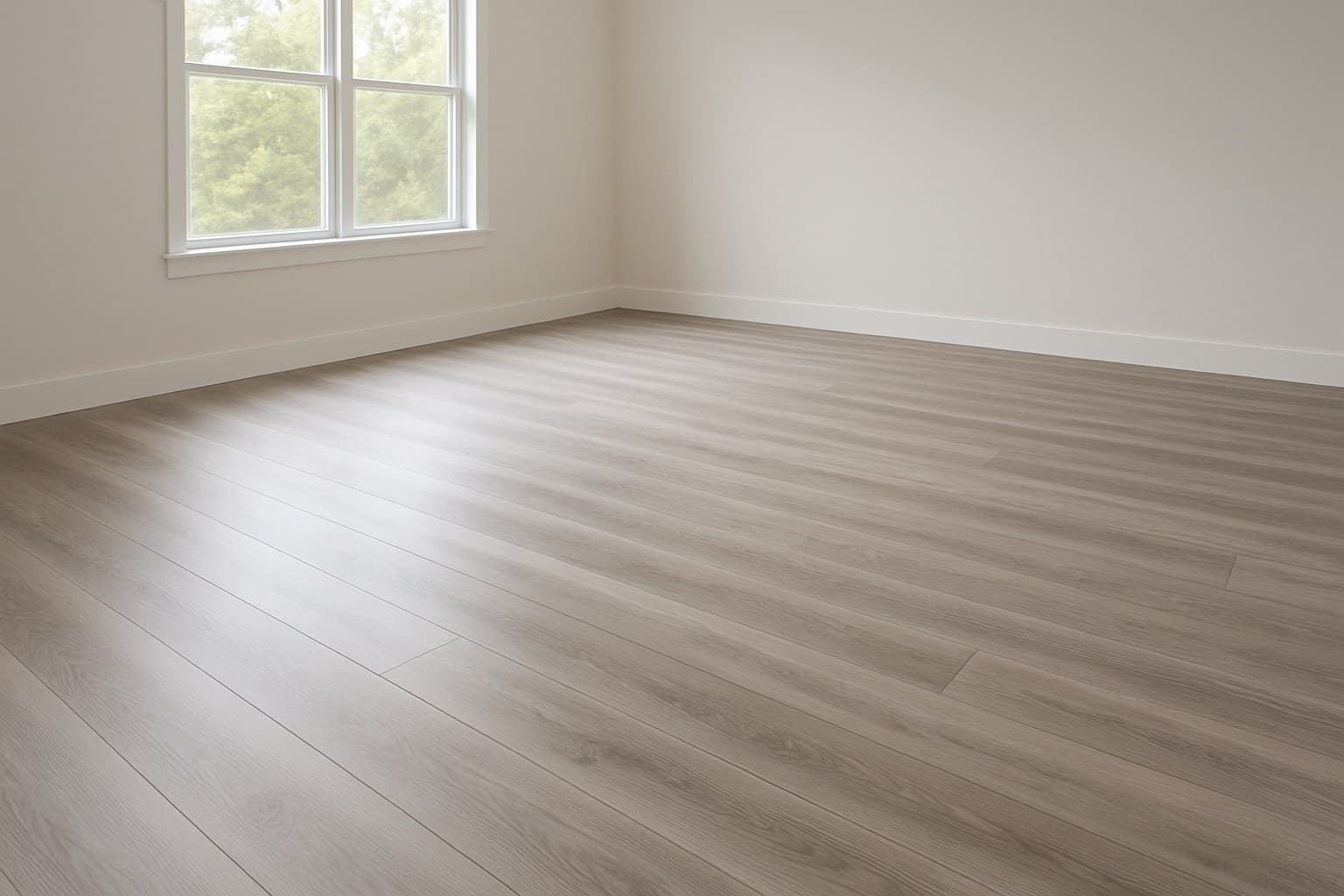
A "non-toxic" plank set in cheap glue is not the clean floor you paid for. The adhesive and the underlayment can off-gas as much as the vinyl itself. If you only vet the plank, you've vetted maybe two-thirds of what's going into the room.
I learned this the hard way on a job near Dayton. A family with a new baby had me tear out a floor they'd installed themselves, because weeks later the room still smelled. The plank was fine. It was the bargain adhesive under it doing the off-gassing. They'd have happily kept that floor if anyone had told them the glue counted too.
So whichever check you run on the plank, run it on the glue and the underlayment. Look for a low-VOC or FloorScore-certified adhesive, and an underlayment that carries its own emissions label. The whole assembly is the floor, not just the top layer. For more on how to think about the full stack, my guide to the healthiest flooring for a home digs into why the setting materials matter as much as the surface.
Underlayment isn't one product. The three you'll run into under LVP are cork, EVA foam, and IXPE foam. Cork is a natural material that resists mold and dampens sound well, but it usually costs more than foam options. EVA (ethylene vinyl acetate) foam is the cheapest and most common choice, light and easy to install, though a cheap, uncertified EVA pad is more likely to carry its own VOC smell. IXPE (cross-linked polyethylene) foam is denser than EVA, handles moisture better, and holds its shape longer under a floating floor. Whichever type you pick, the same rule applies: check that it carries its own FloorScore or similarly certified low-VOC rating, because the pad underneath the plank is a separate product and graded separately.
One more thing before anything goes down: check the subfloor. Run a moisture test on concrete and make sure the surface is flat, with no dips or humps over the maker's allowed tolerance. Floating-floor failures and warranty denials often trace back to moisture or an out-of-flat subfloor, not the plank. Click-lock LVP over a flat, dry subfloor is a realistic weekend job for a handy homeowner. Glue-down, stairs, and big open-plan rooms with a moisture transition are where I'd hire a pro.
8. A Ventilation Plan for the First Weeks
Off-gassing isn't forever, but it's real at the start, so plan to air the room out hard right after install. The Environmental Protection Agency's (EPA) general guidance on indoor air quality says VOC emissions from new materials peak shortly after they go in and then fade over time. Depending on the product, some LVP can keep emitting at a lower level for several months, and in a few cases longer, though the exact duration isn't pinned down by a single study and varies by product.
That early window is the one that matters most. Open windows, run fans, and keep the HVAC moving air for the first week or two. If you can stage the install so a bedroom or nursery sits empty and ventilated for a few days before anyone sleeps in it, do that.
A certified plank shortens this problem because it was tested to stay under strict emission limits in the first place. But even a good floor smells like a new floor for a bit. Ventilation is cheap insurance, especially if someone in the house has asthma or allergies.
9. The Real Price, Materials vs Labor
Budget certified LVP materials can start around $3-4 per square foot (pricing varies by retailer and line, such as Shaw's In the Grain), and certified lines with better wear layers and cores climb to roughly $5-8 per square foot. That's just the material. Labor is a separate number, and the room swings it a lot.
Click-lock LVP labor commonly runs about $2-4 per square foot in my area, though it varies by region and installer. Glue-down costs more because of the adhesive work and prep. Basements and stairs cost more than an open rectangle of living room, because stairs are slow, fiddly cuts and basements usually need moisture testing and sometimes leveling first.
| Line | Materials per sq ft | Notes |
|---|---|---|
| Budget certified (e.g., Shaw In the Grain) | ~$3-4 | Entry-level FloorScore-certified vinyl plank; price varies by retailer |
| Mid certified lines | $5-8 | Better wear layer, SPC or WPC core |
| Install labor | $2-4 (click-lock) | Higher for glue-down, stairs, and basements |
What a non-toxic vinyl plank floor runs, split by material and labor, before room premiums.
Run the numbers on a 200-square-foot bedroom with a mid-tier certified plank: 200 sq ft at $6 materials is $1,200, plus click-lock labor at $3 is $600, for about $1,800 total. Swap that same floor into a basement with a moisture barrier and leveling, or run it up a staircase, and the labor line climbs well past that example.
If keeping the cost down is the priority without giving up the certificates, I pulled together the lines worth buying in my roundup of affordable non-toxic flooring.