
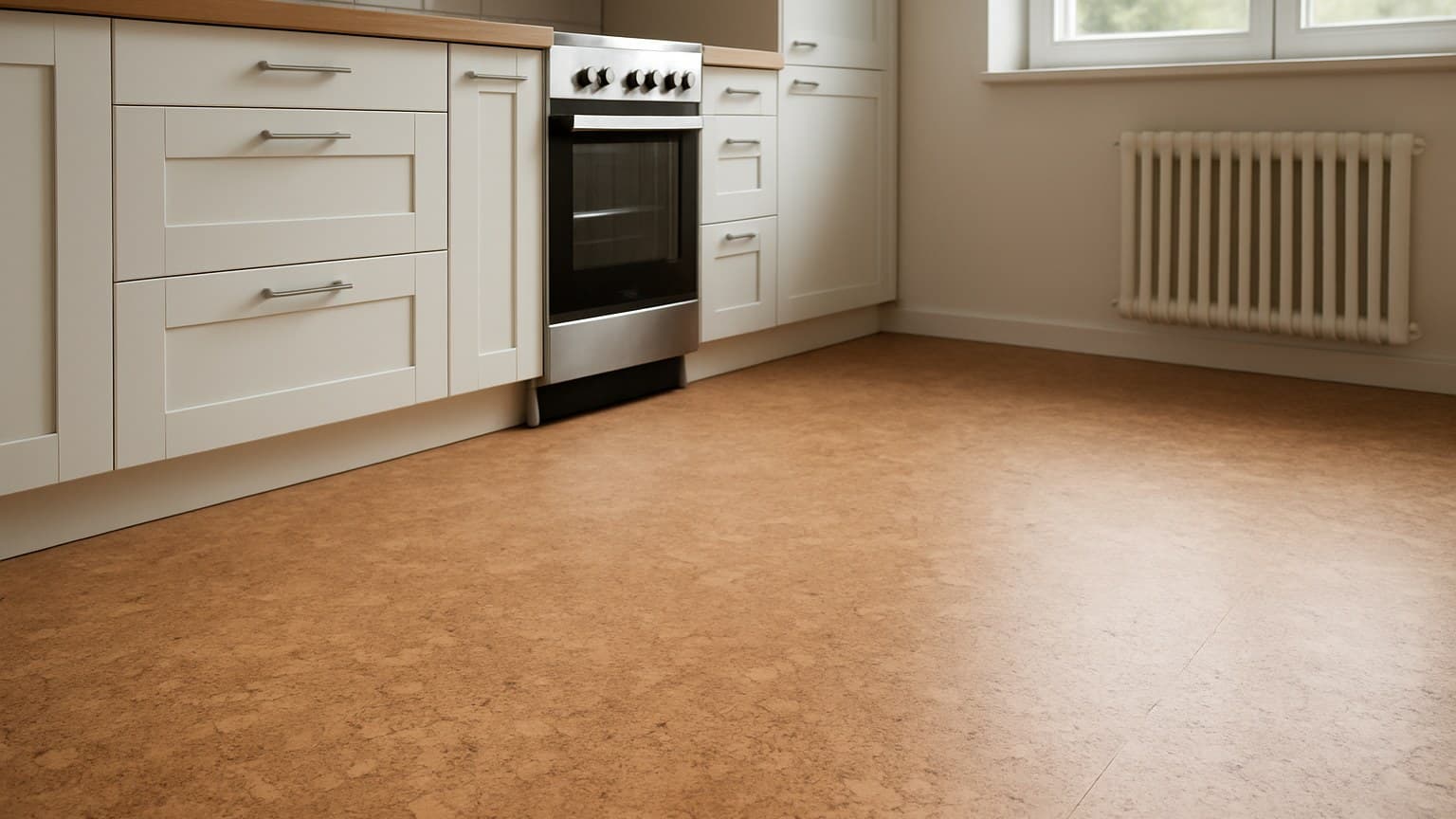
A kitchen sink and a running dishwasher are hard on any floor, and cork feels riskier than most until you see why installs actually fail. In my kitchens, the tiles that lifted were the wrong format for a wet room, or the seams by the sink were never sealed in the first place. Kitchen cork flooring can absolutely last, but only if you settle a few things first. These same lifting-and-swelling patterns show up well beyond the kitchen, and I've rounded up the worst offenders in my cork flooring failures roundup.
Below are the eight checks I run through before I'd let cork go down in a working kitchen. Get these right and you'll know, before you spend a dime, whether cork survives your sink, your dishwasher, and your dropped plates.
Key takeaways
- Cork can work in a kitchen, but only a sealed, kitchen-rated product, ideally one meeting the ASTM F3008 cork tile standard, not raw cork.
- You're buying one of three formats: glue-down cork tiles, floating click-lock planks with an HDF (pressed-wood) core, or vinyl-topped 'waterproof' cork; glue-down handles the sink zone best.
- Budget roughly $5-8 per sq ft for materials (EPA) plus about $2-5 per sq ft for labor; glue-down and cut-heavy kitchens with islands and cabinets cost more than an open room.
- Seams and edges fail before the plank surface does, so seal the seams near water even on factory-finished cork.
- Cork's core swells for good if water reaches it through an open seam, so wipe spills fast and never let water pool at the sink or dishwasher.
1. Is Cork Even Rated for a Kitchen? (Check for ASTM F3008)
Yes, cork can go in a kitchen, but only a sealed, kitchen-rated product, not a bag of raw cork tiles off a craft-store shelf. Those unsealed craft-store tiles aren't wasted, though — they're actually the right pick for a project like a cork board wall.
Here's a check most buying guides skip: ask the seller if the product meets ASTM F3008. According to ASTM International, which publishes the standard, F3008 is the resilient floor covering specification that sets requirements for cork floor tile, including minimum thickness, density, and wear resistance. A product that meets it has been built and tested to behave like a floor, not a corkboard.
I've seen both ends of this in the Dayton area. One kitchen I laid a sealed, rated cork floor in was still tight and flat when I went back years later for an unrelated job. Another homeowner had bought unsealed hobby tiles online and glued them down themselves. Within a season the tiles near the sink had curled at the corners and lifted, because unsealed, non-kitchen-rated cork simply can't handle standing water sitting at a seam.
So the material can pass the test. But the format you buy, the way the seams are sealed, and the install are what actually decide whether it lasts.
2. Which of the Three Cork Formats You're Actually Buying
There isn't one "cork floor." When someone says cork, they're really choosing between three different products, and the difference matters more in a kitchen than anywhere else in the house.
The three are glue-down cork tiles, floating click-lock planks with an HDF core, and vinyl or resin-topped "waterproof" cork. HDF means high-density fiberboard. It's a pressed wood board in the middle of most floating planks, and it's the weak link near water: once moisture reaches it, it swells for good and there's no un-swelling it. Solid glue-down cork has no HDF board inside it at all.
For a kitchen, that one fact reshuffles the ranking. Glue-down and vinyl-topped cork tolerate the sink zone better than a floating HDF plank, because there's no pressed-wood core waiting to soak up a leak. A floating click-lock plank is the easiest to install yourself, but it's also the one most likely to come back on you at the seams.
| Format | Core | Kitchen moisture | Install | Seams |
|---|---|---|---|---|
| Glue-down cork tile | Solid cork, no HDF | Best of the three near sink/dishwasher | Hire out; glued to a flat, dry subfloor | Sealed after install |
| Floating click-lock plank | HDF (pressed wood) center | Weakest; HDF swells if seams open | DIY-friendly; needs expansion gap | Click joint, not glued |
| Vinyl/resin-topped "waterproof" cork | Cork under a vinyl or resin layer | Good surface; still check the seams | Usually click-lock | Water-resistant edge, not truly sealed |
How each of the three cork formats holds up in a kitchen, by core, moisture tolerance, install method, and seams.
If you want the deeper buy on each, I've broken down cork floor tiles and the vinyl-topped "waterproof" cork claims in their own guides.
3. Factory Finish vs Site-Sealed Seams
Two claims get blurred here, and blurring them is how kitchens end up with lifted planks. A "waterproof core" is not the same as watertight seams. In a kitchen, the failures start at the seams and edges, not the middle of the plank.
You've got two finish choices. A factory finish is a top coat baked on at the plant, cured hard before the plank ever ships. A site-applied finish is a clear water-based polyurethane, a sealer you roll on after the floor is down. Both protect the surface. Neither one automatically seals the joints between planks.
The real rule for a kitchen is simple: seal the seams even on factory-finished planks near water. That thin bead of sealer in the joint is what keeps a spill on top instead of down inside. Then follow the reseal schedule for your specific product, because that timer is set by the finish you have.
Before you lean on any "waterproof" label, read how far those claims really go in the waterproof cork flooring guide, because most of them cover the surface, not the edge.
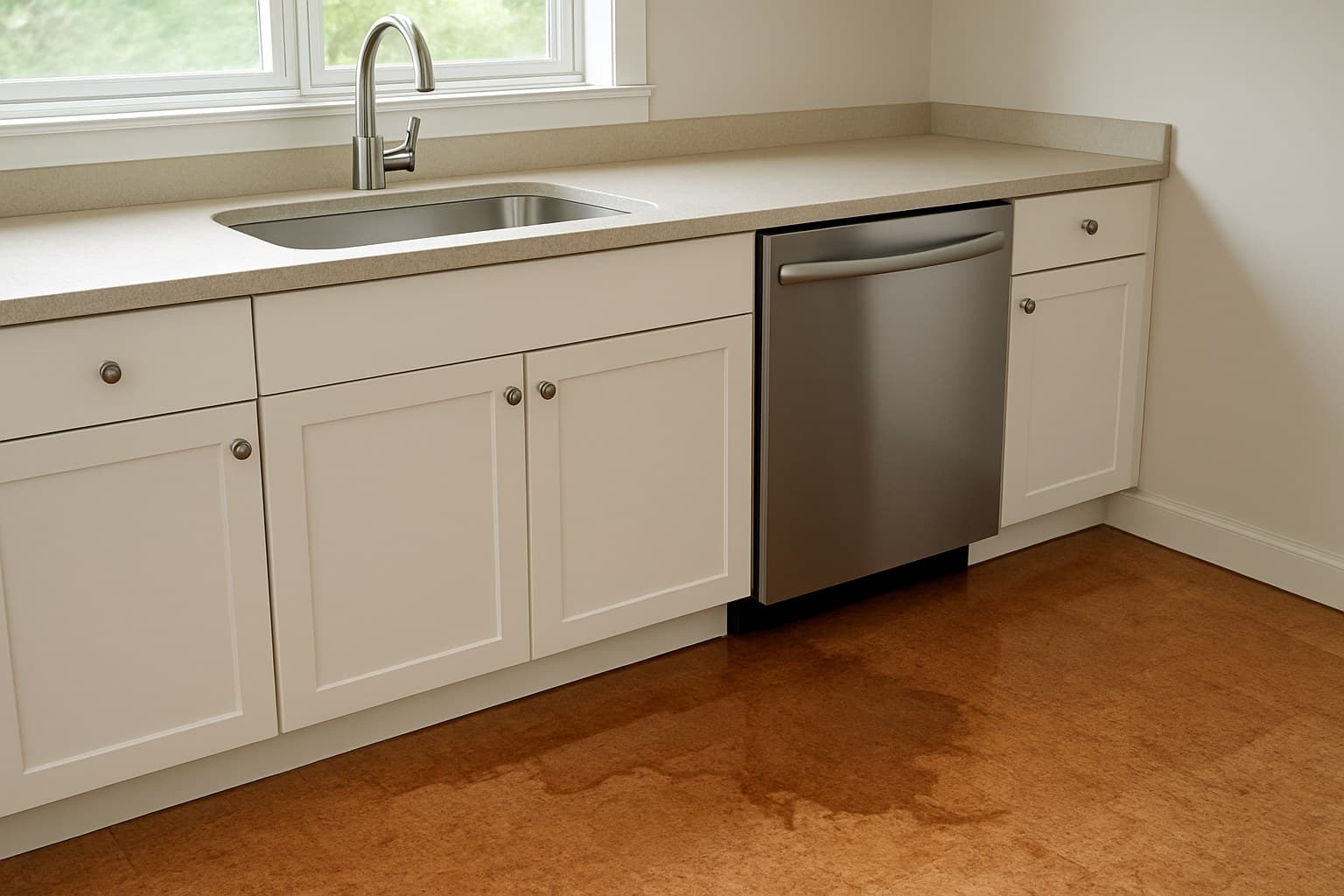
4. The Sink and Dishwasher Zone (Where Cork Kitchens Die)
If cork fails in a kitchen, this is where. Not the odd splash you wipe up, but standing water at the base of the sink cabinet and slow dishwasher leaks that run for weeks before anyone notices.
As the EPA has noted, cork is porous, meaning it has tiny open spaces that can soak up water once it gets past a seam. From my own cork jobs, that's exactly how it goes: water finds an open joint, the cork drinks it in, swells at the seams, and stays swollen. There's no pressing it back flat.
So protect this zone on purpose. Seal every seam within a few feet of the sink and dishwasher. Run a bead of silicone along the base of the sink cabinet so water can't wick under it. Damp-mop only, never a soaking wet mop, and wipe spills the moment they land instead of letting water pool. Twice a year, pull the kick panel and check under the dishwasher for a slow leak. My rule for cleaning cork is a damp mop and a gentle cleaner, full stop, which I walk through in the how to clean cork flooring guide. If you're wondering whether a vinegar solution counts as that gentle cleaner, I answer that question directly in a guide on cleaning cork with vinegar.
In this zone specifically, glue-down solid cork beats a floating HDF plank, because there's no pressed-wood board under the sink to soak.
5. Will It Work Over Radiant Heat?
Sometimes, but there's a catch worth knowing before you commit. Cork is a natural insulator, which is great underfoot in a cold kitchen but works against you over radiant heat. It slows the warmth coming up through the floor, so you lose some of the heat you paid to install compared to tile.
Check the specific product's spec sheet for two things: whether it's approved for radiant heat at all, and its maximum floor temperature. Not every cork is rated for it, and the box governs here, not a rule of thumb. Run it too hot and you can cook the finish or open the seams.
Format matters too. Floating and glue-down cork behave differently over a heated slab, and if your product asks for acclimation, meaning letting the planks sit in the room before install, that matters more when the floor cycles warm and cool. If radiant warmth is the whole reason you're redoing the kitchen, be honest about whether cork's insulation is quietly fighting your goal.
6. Floating Click-Lock vs Glue-Down for a Kitchen
This is the DIY-versus-hire fork, and in a kitchen it's not a toss-up.
Floating click-lock is realistic for a confident DIYer. The planks snap together and float over the subfloor. Just remember it needs an expansion gap around the whole room, a small space at the walls so the floor can move without buckling, and remember its HDF core is the part that fails at kitchen seams.
Glue-down solid cork is the better call for a moisture-heavy kitchen, but it's a hire-out job. The adhesive has an open time, the roller pressure has to be even, and the timing leaves no room to fumble. I've fixed enough DIY glue-downs that lifted at the edges to say this plainly: pay a pro for this one.
Either way, do the prep first. Per NWFA installation guidelines, check that the subfloor is flat and run a moisture test to the manufacturer's own numbers before a single plank goes down. Skip that and the seams will open no matter how good the plank is. When you're ready, my step-by-step glue-down guide walks the whole process, including how to keep the edges from lifting.
7. What Cork Actually Costs: Materials vs Labor
Don't trust a single flat number on cork. Split it into materials and labor, because they move for different reasons. According to the EPA's Sustainable Flooring report, cork flooring materials run roughly $5-8 per square foot for kitchen-rated cork tile or plank; on the kitchen jobs I've quoted, labor typically adds about $2-5 per square foot on top.
Kitchens land at the higher end of labor. All those cuts around cabinets, islands, and toe-kicks (the recessed strip at the bottom of your cabinets) eat time, so a kitchen costs more per foot than an open room of the same size. Glue-down also runs higher labor than a floating floor because it's slower, fussier work. Basements and stairs push labor even higher than a kitchen, since a damp slab needs extra prep and stair nosing takes more time per foot than any flat room.
Here's a quick real-world run: a 150 square foot kitchen at $6 materials plus $3.50 labor is $9.50 per foot, which lands near $1,425 before anyone tears out the old floor. Add removal and disposal on top of that.
| Cost line | Low ($/sq ft) | High ($/sq ft) |
|---|---|---|
| Labor, floating click-lock | 2.00 | 4.00 |
| Labor, glue-down | 3.00 | 5.00 |
| Materials, cork | 5.00 | 8.00 |
Per-square-foot cost ranges for a kitchen cork install, split into labor by install method and cork materials. Not to scale for bar spacing.
For the full "is cork expensive" breakdown against other floors, see the cork flooring pros and cons guide.
8. Cork vs Vinyl and Tile: When to Pick Something Else
Before you commit, be honest about whether cork is really the right call for your kitchen, or whether vinyl or tile does the job with less babysitting.
Cork's edge is comfort. It's soft and warm underfoot, easy on your back at the sink, and quiet. Its weakness is water at the seams and the babysitting that comes with it. Luxury vinyl plank shrugs off standing water far better and asks almost nothing of you, but you lose that soft, warm feel and the natural material. Tile is the toughest of the three around water and heat, and it plays best over radiant floors, but it's hard, cold, and unforgiving when you drop a glass.
| Floor | Water tolerance | Comfort underfoot | Upkeep |
|---|---|---|---|
| Sealed cork | Fair; seal seams and wipe fast | High, soft and warm | Higher; reseal on schedule |
| Luxury vinyl plank | Strong | Low to medium | Low |
| Tile | Strongest | Low, hard and cold | Low |
How sealed cork stacks up against luxury vinyl plank and tile for a kitchen, by water tolerance, comfort, and upkeep.
If cork feels like more maintenance than you want, walk through the full room-by-room rundown in how to choose the right kitchen flooring before you decide, since it weighs every material against your traffic and budget in one place.