
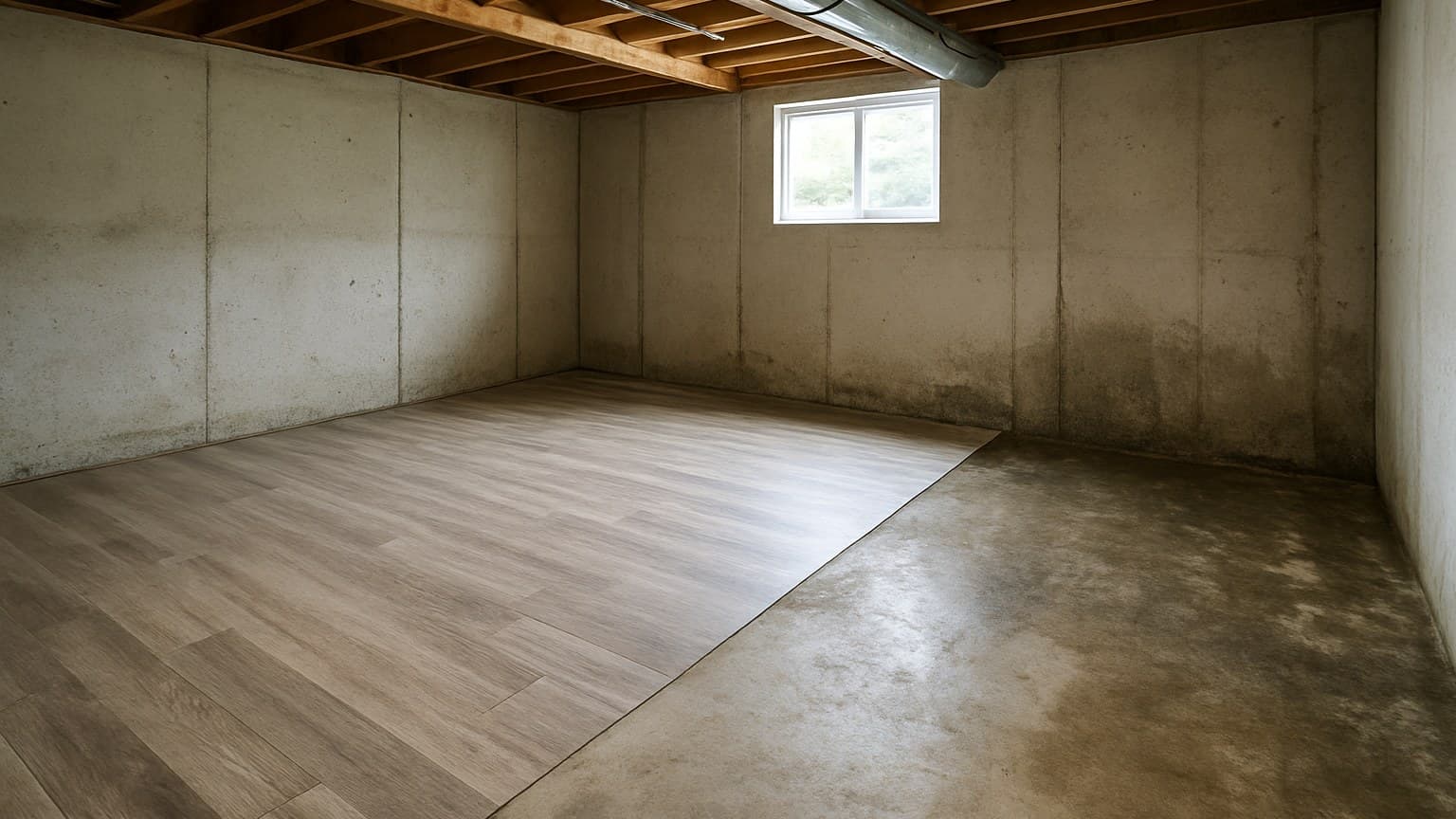
The best flooring for a basement isn't a single product, it's whichever one survives how wet your slab actually gets. I ripped out a client's brand-new laminate in a Dayton, Ohio basement after just eighteen months, because nobody tested the concrete before it went down. Read the moisture right and the choice gets simple.
Key takeaways
- Run a 24-hour plastic-sheet test on your bare slab before you buy anything. Fog or dark patches under the plastic means moisture is still coming up through the concrete.
- Flood-prone slabs need porcelain tile, sheet vinyl, or an epoxy/polyaspartic coating. These shrug off standing water better than anything with seams or a wood layer.
- SPC rigid-core vinyl plank is the best all-around basement pick for damp-to-dry slabs, running roughly $3-7 material plus $2-4 labor per square foot.
- Never put solid hardwood or standard (non-waterproof) laminate on a below-grade slab. Both swell and buckle the first time the concrete gives up moisture.
- Basement and stair jobs cost more than open rooms because closets, transitions, and cut-heavy corners eat labor hours the flat middle never does.
Start Here: What Moisture Bracket Is Your Basement In?
Before you look at a single plank, figure out which of three brackets your basement falls into: bone-dry finished, occasionally damp, or flood-prone. This whole article is organized around those three, because the floor you can get away with in one bracket will fail in the next one down.
Here's the part the pretty buying guides skip: a basement floor lasts as long as the prep and moisture control under it, not the plank on top. I've laid budget vinyl over a properly sealed, flat slab that's still going strong, and I've pulled premium product off a slab nobody tested. The concrete decides.
The biggest mistake is buying before testing. People fall for a color at the store, then discover the moisture problem after it's glued down. The next section shows you the DIY test that takes five minutes to set up.
One more thing on money: basement jobs cost more per square foot than an open room upstairs, the kind of straightforward space covered in a living room flooring guide. Closets, the area around the stairs, and all those transitions and corners eat labor hours that the flat middle of a room never does.
Which basement moisture bracket are you in?
- Bone-dry finished: no musty smell, no efflorescence (the white chalky crust concrete leaves behind), and the plastic-sheet test stays clear.
- Occasionally damp: musty smell after heavy rain, some crusting at the base of the walls, light fog under the plastic test.
- Flood-prone: standing water has happened before, the sump pump runs often, or you're below the outside soil line with poor drainage.
Source: my own basement install jobs
Test Your Slab's Moisture Before You Buy Anything
Run the plastic-sheet test on the bare slab first, every time. Tape a 2x2 foot square of clear plastic flat to the concrete, seal all four edges tight with tape, and leave it 24 to 72 hours.
Then read it. If you see fog, water beads, or a darkened patch of concrete under the plastic, vapor is still pushing up through the slab and you have to treat it before any floor goes down. Clear plastic and same-color concrete means you're likely dry enough to proceed.
If the result is borderline, get a real number. RH (relative humidity, the amount of moisture trapped in the slab) can be measured with a calcium chloride kit or an in-slab probe, both of which give you a figure instead of a guess. That number is what waterproof-floor warranties quietly hinge on.
The EPA's guidance on remodeling and indoor air quality makes the same point from a health angle: controlling moisture during a remodel is essential, because trapped moisture behind or under new material is what leads to mold and indoor air quality problems down the road, exactly what this test is meant to catch before you floor over it.
While that plastic sits, check for the other red flags at the same time: cracks in the slab, efflorescence at the base of walls, and a sump pump that kicks on a lot. Any one of those pushes you toward a more water-tolerant floor.
The three plastic-sheet test results and what each one tells you to do next.
The 9 Basement Floors, Ranked at a Glance
Here are all nine floors with cost split into material versus labor, water rating, comfort, and the moisture bracket each one belongs in. The ranking pages love to quote one flat "national average," which is useless when your basement has closets and a stair landing. Splitting material from labor is the only honest way to do it.
To use the table as a skimmer: find your moisture bracket, then read across to the two or three floors that survive it. Everything else is off the table for you.
Note the huge spread on tile. That's scope, not confusion. A plain porcelain field tile is cheap; a marble or an intricate laid pattern is not, the same range you'll see if you browse pictures of kitchen floors for pattern ideas.
| Floor | Material /sq ft | Labor /sq ft | Water | Comfort | Best bracket |
|---|---|---|---|---|---|
| Porcelain tile | $3-15 | $4-8 | Excellent, e.g., Daltile's impervious-rated porcelain absorbs very little water; grout is the weak point | Cold and hard | Flood-prone |
| Sheet vinyl | $1-4 | $1-3 | Excellent, e.g., Armstrong's Vivero Best has almost no seams for water to get under | Firm | Flood-prone / damp |
| Epoxy or polyaspartic coating | $2-7 | $1-5 | Excellent, e.g., Rust-Oleum's RockSolid bonds straight to the slab, no seam at all | Hard | Flood-prone |
| SPC (stone plastic composite) rigid-core vinyl plank | $3-7 | $2-4 | Very good core, e.g., COREtec Pro Plus resists water; click seams are the risk | Firm, warmer with pad | Damp to dry |
| Carpet tiles | $2-5 | $1-3 | Fair, replace the single soaked tile instead of the whole floor | Soft and warm | Dry to lightly damp |
| Waterproof laminate | $3-6 | $2-4 | Good core, e.g., Pergo's Extreme Waterproof resists water; edges swell if flooded | Firm | Dry to damp |
| Engineered hardwood | $4-11 | $3-6 | Fair, real wood top layer swells below grade regardless of finish | Warm, natural | Dry only |
| Rubber tile / roll | $2-6 | $1-4 | Good, e.g., Roppe rubber tile resists water at the surface; seams are weak | Soft, cushioned | Damp to dry |
| Broadloom carpet | $1-4 | $1-3 | Poor, traps moisture in the backing and pad | Softest | Dry only |
Source: my own basement install jobs
Cost, water tolerance, and comfort for nine basement floors, split into material and labor.
Here's that same set of floors as one total installed number, low to high, so you can see the real spread without doing the math yourself:
| Floor | Installed range /sq ft |
|---|---|
| Sheet vinyl | $2-7 |
| Carpet tiles | $3-8 |
| Rubber tile | $3-10 |
| Waterproof laminate | $5-10 |
| Epoxy coating | $3-12 |
| SPC vinyl plank | $5-11 |
| Engineered hardwood | $7-17 |
| Porcelain tile | $7-23 |
Notice how much of that upper range is labor, not material, a stair landing or a maze of closets can turn a $7 material floor into a $17 or $23 installed job before you've bought a single extra plank. That's the number to plan your budget around, not the sticker price at the store, and it's the same trap covered in a kitchen flooring cost breakdown, where cabinets and islands eat labor the same way our closets do.
Porcelain Tile: Best for Flood-Prone Slabs
Nothing survives standing water like porcelain, because the fired tile body itself absorbs almost nothing. If your basement has flooded before or the sump pump earns its keep, this is the safest bet on the list.
But separate the strength from the weak point. A tile like Daltile's impervious-rated porcelain body absorbs almost no water on its own; the grout lines between tiles and the thinset (the mortar that bonds tile to the slab) are where flood water and rising vapor cause trouble. Water doesn't come through that tile, it works the seams. Grout shrugging off water depends on you sealing it, and I put a waterproof membrane over the slab before the thinset goes down.
The honest tradeoffs: it's cold and hard underfoot, labor runs higher than most floors on this list, and it needs a flat slab or the tiles crack over the hollow spots. Tiles rated impervious absorb the least water of any porcelain, which is what you want down here, though I won't pin one absorption number to the whole category.
Warm it up with an area rug where you sit or stand. For a deeper dive on which floors fail first when water shows up, the guide to waterproof basement floors ranked by what actually fails first is worth a read.
Sheet Vinyl: Cheap, Nearly Seamless, Flood-Tolerant
For a damp or flood-prone slab on a tight budget, a wide sheet like Armstrong's Vivero Best sheet vinyl has almost no seams and is hard to beat at keeping water off the concrete. Material runs $1-4 and labor $1-3 per square foot, so it's one of the cheapest water-friendly floors you can put down, and the same product shows up as a top pick in this rundown of kitchen flooring options.
The weak link is the same as tile, just relocated: the perimeter edges and any seam are where water sneaks underneath. Heat-welded or glued seams matter here, and in a wide basement you want as few of them as possible.
On comfort and looks, be realistic. Sheet vinyl is firmer and less convincing than a good plank, so it reads as "practical" rather than "premium." But it's water-friendly, which is the whole point in a wet basement.
That same seam logic carries straight over to waterproof flooring for a bathroom if you're solving that problem next.
Epoxy and Polyaspartic Coatings: Turn the Slab Into the Floor
A coating like Rust-Oleum's RockSolid epoxy doesn't sit on the slab, it bonds to it, so there's no seam for water to get under in the first place. That makes epoxy or a faster-curing polyaspartic coating a strong flood-prone pick, with material around $2-7 and labor $1-5 per square foot, pricing that tracks closely with a garage floor coating cost guide.
The catch is vapor. A coating bonds tight until moisture pushing up from below breaks the bond and peels it off in sheets. This is why the plastic-sheet test isn't optional here: if the slab is still giving up moisture, the coating won't stay stuck no matter how well it's applied.
It's hard underfoot and it shows every dip in the concrete, so prep matters a lot. Done over a dry, sound, properly ground slab, though, it's low-maintenance, and if you're pricing the same kind of coating for a garage instead, a polyurea garage floor coating cost guide breaks down that faster-curing alternative.
SPC Rigid-Core Vinyl Plank: The Best All-Around Basement Pick
For most damp-to-dry basements, SPC rigid-core vinyl plank is the floor I steer people toward. SPC stands for stone plastic composite, and in a product like COREtec Pro Plus that means a dense, rigid core that doesn't swell when it gets wet, clicking together as a floating floor with no glue. It's the same rigid core that shows up in most guides to choosing the right kitchen flooring, since both rooms deal with spills and standing moisture. Figure roughly $3-7 material plus $2-4 labor per square foot.
Here's the line most sellers blur: COREtec Pro Plus advertises a waterproof core, but the click seams are still the risk. A spill wipes up fine and the planks won't puff up like laminate, but sitting flood water can still work its way down through those joints to the slab. That's a "waterproof plank on a water-tolerant floor," not a sealed surface. It's also one of the materials that regularly tops rankings in guides to the best flooring for a kitchen, where standing spills are common but flooding isn't.
It's firm underfoot and warms up noticeably with an attached or separate pad. Because it floats, it also forgives small slab imperfections better than tile or coating, which is part of why it's an easier result for a first-timer. It's also a scratch-tough choice if you've got animals, which I get into more in the rundown on the best flooring for dogs.
Carpet Tiles: Warm Underfoot, Swappable When Wet
Carpet tiles give you soft, warm footing in a basement while keeping a plan B for water. When one tile gets soaked, you lift and replace that single tile instead of tearing out the whole floor. Material runs $2-5 and labor $1-3 per square foot, and plenty of DIYers lay them without help.
They belong in the dry-to-lightly-damp bracket, not flood-prone. The backing can trap moisture against the slab if water keeps coming, so they're a comfort upgrade for a basement you've already got under control, not a fix for a wet one. Look for tiles with a moisture-resistant backing made for below-grade use.
Waterproof Laminate: Good Core, Watch the Edges
Waterproof laminate like Pergo's Extreme Waterproof line solves laminate's oldest weakness at the surface, but the edges are still the story. Its core resists water far better than old-school laminate, yet the plank edges can still swell if flood water sits on them long enough. Call it dry-to-damp, not flood-proof.
Material lands around $3-6 and labor $2-4 per square foot. Where it beats vinyl is the look: laminate's printed and textured surface often reads as more realistic wood, at a similar or lower price. Where vinyl wins is water tolerance. That's the real LVP-versus-laminate tradeoff, and neither one is flat-out "better" for a basement, it depends on how wet your slab gets.
Engineered Hardwood: Only for Truly Dry Slabs
Engineered hardwood can go in a basement, but only over a slab that tests bone-dry and stays that way. The NWFA's Homeowners Handbook to Real Wood Floors is direct about it: solid wood flooring isn't recommended below grade at all. That's exactly why engineered's plywood-style base, built to handle small humidity swings better than solid wood, is the only real-wood construction worth considering here, and even then the top layer is still real wood, and real wood and moisture don't mix below grade.
Material runs $4-11 and labor $3-6 per square foot, so it's a real investment to risk on a damp slab. Skip solid hardwood down here entirely, it swells and cups the first time the concrete gives up moisture. If your slab passed the plastic test clean and you want genuine wood warmth, engineered is the only wood I'd lay in a basement, and I'd still keep a dehumidifier running.
Rubber Tile and Roll: Cushioned and Forgiving
Rubber is the floor for a basement that doubles as a workout or play space. It's soft, cushioned, and forgiving on joints and dropped weights, at $2-6 material and $1-4 labor per square foot. Interlocking tiles are one of the easiest DIY floors going.
Water rating on something like Roppe's rubber tile is good but not great, because the seams between tiles are the weak spot, same story as everywhere else in a basement. Keep it in the damp-to-dry bracket. If a home gym is the actual goal, the breakdown of home gym flooring options covers thickness and rubber types in more detail than a basement roundup can.
Broadloom Carpet: Softest, but Dry Basements Only
Wall-to-wall broadloom carpet is the softest, warmest floor you can put in a basement, and the riskiest. It traps moisture against the slab, so one damp spell can mean mold in the backing and pad. Reserve it for a basement that tests bone-dry and has stayed dry through a wet season.
At $1-4 material and $1-3 labor per square foot it's cheap to buy, but I've hauled out a lot of musty basement carpet over the years. If you love the softness, carpet tiles or a good area rug over vinyl give you most of the comfort with an exit plan when water shows up.
What It Really Costs, and Where the Money Goes
Basement floors cost more per square foot than the same product in an open upstairs room, and it's not the material, it's the labor. I used to quote a flat rate by the square foot until a job full of closets, doorways, and a bay window ate an entire extra day. The open middle of a room is never where the time goes; the cut-heavy corners, transitions, and the area around the stairs are.
So when you compare quotes, expect the labor half to climb with how chopped-up your basement is. A wide-open finished rectangle prices close to the low end of each range above; a warren of little rooms and a stair landing pushes toward the high end. Stairs are their own labor line, since every tread is a cut-and-fit.
DIY or Hire It Out?
Click-lock SPC vinyl plank and interlocking carpet or rubber tiles are realistic DIY projects for most people, as long as you've done the moisture test and the slab is flat. Those floating floors forgive small mistakes and come up easily if you get one wrong.
Hire out the jobs where a mistake is expensive or permanent: tile that needs a waterproof membrane and a dead-flat setting bed, epoxy or polyaspartic coatings that fail if the slab prep or moisture is off, and any glue-down over a questionable slab. Stairs are the other one I'd hand to a pro, because the cutting and fit is unforgiving and it's the first place a bad install shows. If you want the full walkthrough on getting the install itself right, the guide to installing basement flooring that won't fail covers each of these steps in more depth.
The NWFA's installation guidelines and jobsite checklist back this up from the pro side: they call for verifying subfloor flatness, cleanliness, and moisture condition as a documented step before any finish flooring goes down, not something you eyeball after the fact.