
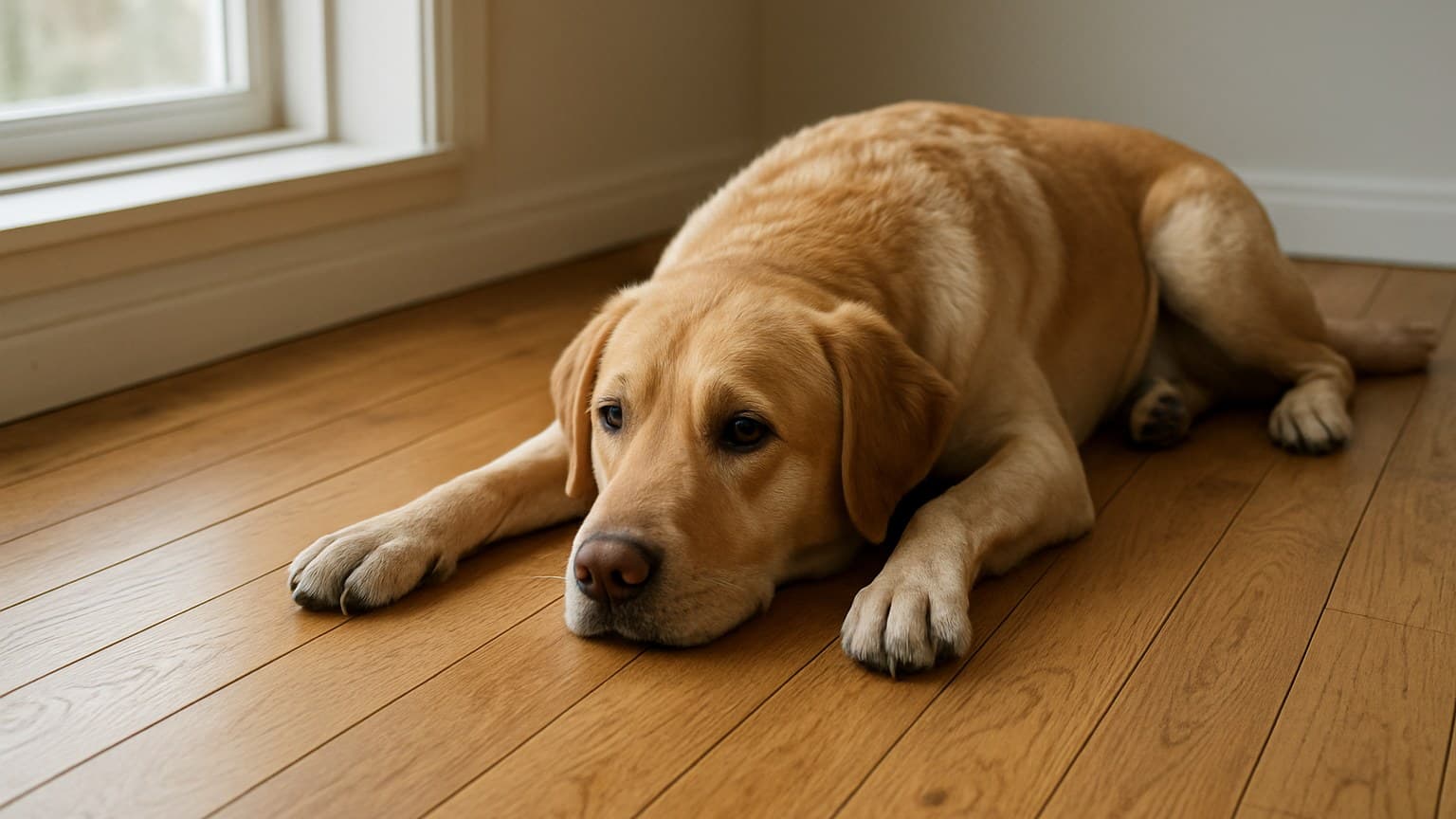
Search "best flooring for dogs" and most lists just hand you a generic ranking without saying why floors actually fail in a dog's house. My answer: rigid-core luxury vinyl plank (LVP) and porcelain tile hold up best, because they resist the two failures I get called back for most, a scratched, dulled finish and swollen seams from accidents. Here is the full ranking, plus what to check before you buy.
Key takeaways
- Rigid-core LVP is my top pick for most dogs: a waterproof core, a tough wear layer, and enough grip, for roughly $4-9 per square foot installed.
- The two things that bring me back are claws scratching a thin wear layer gray and accident water swelling the seams, and a waterproof core does not save you if urine sits in the seams.
- Porcelain tile is the closest thing to bulletproof for big breeds and repeat accidents, but it is hard and cold on senior joints, so plan on rugs.
- Carpet is not disqualified: with solution-dyed fiber, low cut pile, and a moisture-barrier backing (the Carpet and Rug Institute's pet checklist), it suits senior and slip-prone dogs.
- Cheapest to buy is rarely cheapest over a dog's life; a floor that comes back torn up gets paid for twice.
Best Flooring for Dogs, Ranked From Toughest to Riskiest
Ranked by what I actually get called back to fix: porcelain tile and rigid-core luxury vinyl plank (LVP) survive best, engineered hardwood sits in the middle, laminate is risky at the seams, and pet-spec carpet comes last but is not disqualified. If you're trying to decide between those two middle-of-the-pack materials specifically, my laminate vs hardwood flooring comparison breaks down why one handles claws better than the other.
Almost every dog-floor callback I take comes down to two failures. Claws scratch the surface until the finish goes gray and dull. Or accident water swells the seams and edges until the plank lifts. Keep those two in mind and the ranking below makes sense.
| Flooring | Scratch resistance | Waterproofing | Traction | Senior comfort | Early failure risk |
|---|---|---|---|---|---|
| Rigid-core LVP | Good (depends on wear-layer thickness) | Waterproof core only on products that spec it; seams are the real risk | Fair to good with embossing | Fair, hard but warmer than tile | Rarely |
| Porcelain tile | Excellent | Excellent with sealed grout | Great if textured, slick if polished | Poor, hard and cold | Almost never (grout needs upkeep) |
| Engineered hardwood | Fair, depends on species and finish | Water-resistant, not waterproof | Fair | Fair | Sometimes |
| Laminate | Good surface, but core swells | Water-resistant seams are the weak point | Fair | Fair | Often, at the seams |
| Carpet (pet spec) | Nothing to scratch | Only with a moisture-barrier backing | Excellent | Excellent | Sometimes (odor and stains) |
Source: the dog-home floors I've been called back to pull up and relace
How the five floors compare on the factors that decide a dog's house.
LVP is my top all-rounder for most dogs, but only when the product's spec sheet backs it up: look for a waterproof core and a thick wear layer, the clear top coat that takes scratches and daily foot traffic. Porcelain tile is what I reach for on the hardest cases, big breeds and repeat accidents.
Scratches and Swollen Seams: The Two Failures That Actually Happen
Scratch resistance belongs to the specific product, not the whole category. A thick wear layer on an LVP plank, or a baked-on aluminum-oxide factory finish on hardwood, shrugs off claws far better than a thin budget layer. With wood, harder species dent less, which is what the Janka hardness scale measures: a simple test of how hard a wood is, where a higher number means fewer dents from paws and dropped bowls. Light oak tends to sit on the softer end of that scale, so if that's the look you want, my guide to light oak flooring options covers how to offset the extra dent risk.
Now the part the box label hides. A waterproof core and water-resistant seams are not the same promise. Most accident failures I pull up are not on the plank face at all. They are at the seams and edges, where urine wicks down into the core and swells it from underneath. I go deeper on which waterproof laminate flooring claims actually hold up at the seams versus which are just marketing in a dedicated breakdown.
So cleanup speed beats whatever rating is printed on the carton. Wipe an accident fast, every time, no matter what the floor claims.
Traction matters here too. A floor your dog slides across stresses hips and joints every time it takes off or stops. An embossed or textured surface gives the paw something to grab.
Is Laminate Flooring Good for Dogs?
Laminate is a middling choice for dogs, and the reason is its build. The printed top layer can look great and resist surface scratches well, but underneath sits a wood-fiber core. Once water reaches the seams, that core swells and the edges peak up, and no amount of mopping brings it back. That's why laminate makes more sense in some rooms than others, a question I break down in my guide to which rooms suit laminate flooring.
For a puppy that still has accidents, I steer people away from laminate until the dog is house-trained. If you are weighing it against vinyl anyway, my full breakdown of how LVP and laminate differ on water tolerance and looks lays out the real trade-off.
Slip, Traction, and Your Dog's Joints
There is no honest cross-brand slip number for home flooring, so most of the time you cannot compare two brands on a real figure. Most makers only describe their texture or embossing in words.
A few pet-floor sellers do publish lab numbers. The clearest I found come from floorsforpaws.com, which lists a Pendulum Test Value (PTV) of 48 wet on its domestic range and 63 PTV wet on its commercial range. PTV is a lab score for how much grip a wet floor gives, measured with a swinging test rubber slider (TRL); a higher number means less slipping. Those are one company's own numbers, not an industry standard, so treat them as a guide, not a ruler.
The practical fix does not need a lab. Ask for an embossed surface, and lay runners or rugs along the paths your dog actually runs, the hallway, the turn into the kitchen, the spot by the back door.
What You'll Really Pay: Materials vs. Labor
Here is the installed cost split into materials and labor, per square foot. Tile carries the highest labor by a wide margin, while laminate and carpet are the cheapest floors to put down.
| Flooring | Materials ($/sq ft) | Labor ($/sq ft) |
|---|---|---|
| Carpet (pet spec) | $1-$4 | $1-$3 |
| Laminate | $1-$4 | $2-$4 |
| Rigid-core LVP | $2-$5 | $2-$4 |
| Engineered hardwood | $4-$9 | $3-$6 |
| Porcelain tile | $2-$10 | $5-$12 |
Installed cost per square foot, split into materials and labor, as typical ranges for residential rooms.
Basements and stairs cost more than open rooms. A basement needs moisture prep over concrete, and stairs are slow, piece-by-piece work on every tread. No matter which floor you pick, check that the subfloor is flat and run a moisture test before anything goes down. Skip that and even a waterproof core can telegraph every hump and dip underneath.
On DIY versus hiring out, be honest with yourself. Click-lock LVP and laminate are realistic for most handy homeowners. Glue-down vinyl, tile, and stairs are where I earn my keep, and they are usually worth hiring out.
The cheapest floor to buy is rarely the cheapest over a dog's life. A floor that fails early means buying and installing it all over again. Floorsforpaws.com models a 30-year domestic lifecycle for exactly this reason, and the math usually favors spending a little more up front. The National Wood Flooring Association's own life-cycle cost analysis makes a similar case for wood floors: spreading a higher purchase price over a longer service life can make the better-built floor the cheaper one in the end.
Is Carpet Actually Safe for Dogs?
Carpet is not automatically wrong for dogs. It just has to be the right spec, and most big-box carpet is not it.
According to the Carpet and Rug Institute's pet flooring checklist, the industry's trade group recommends looking for three things: solution-dyed fiber, which means the color runs all the way through the strand so it resists stains and even bleach cleanup; a low cut pile, so there is less for claws and dirt to grab; and a moisture-barrier or waterproof backing, so accidents do not soak straight through to the pad.
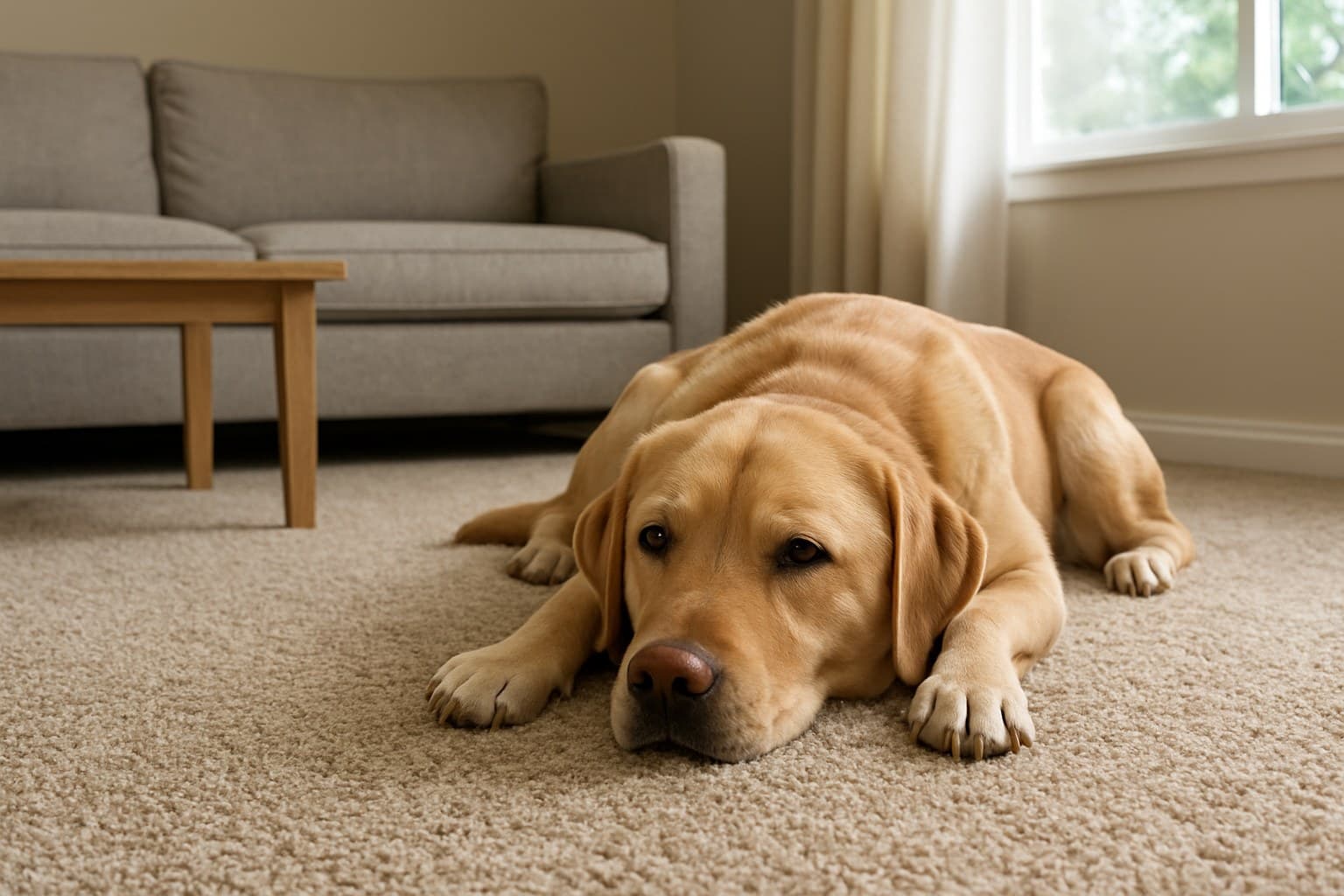
Carpet suits senior and slip-prone dogs better than any hard floor. It gives traction and a soft landing for sore joints.
It does not suit a dog that still has accidents or marks. Odor soaks into the pad underneath, and once it is there, you are replacing pad, not shampooing fiber.
Pick by Your Dog: Puppy, Big Breed, Senior
Match the floor to the dog in front of you, not to a generic "best" badge. Here is how I break it down.
Puppy, with accidents and unclipped claws: rigid-core LVP with a waterproof core and a mid-grade wear layer. Skip laminate until the dog is house-trained.
Big breed, where weight, traction, and deep scratches are the worry: porcelain tile in the entry and high-traffic runs, or a thick-wear-layer LVP, with runners down the hallways for grip.
Senior dog, with stiff joints and a need for warmth and footing: pet-spec carpet, or LVP softened with padded rugs. Keep an old dog off bare, cold tile where it likes to lie down.
Still torn between the two materials most dog owners end up choosing from? My guide on whether laminate or vinyl is the better fit walks through it room by room.