
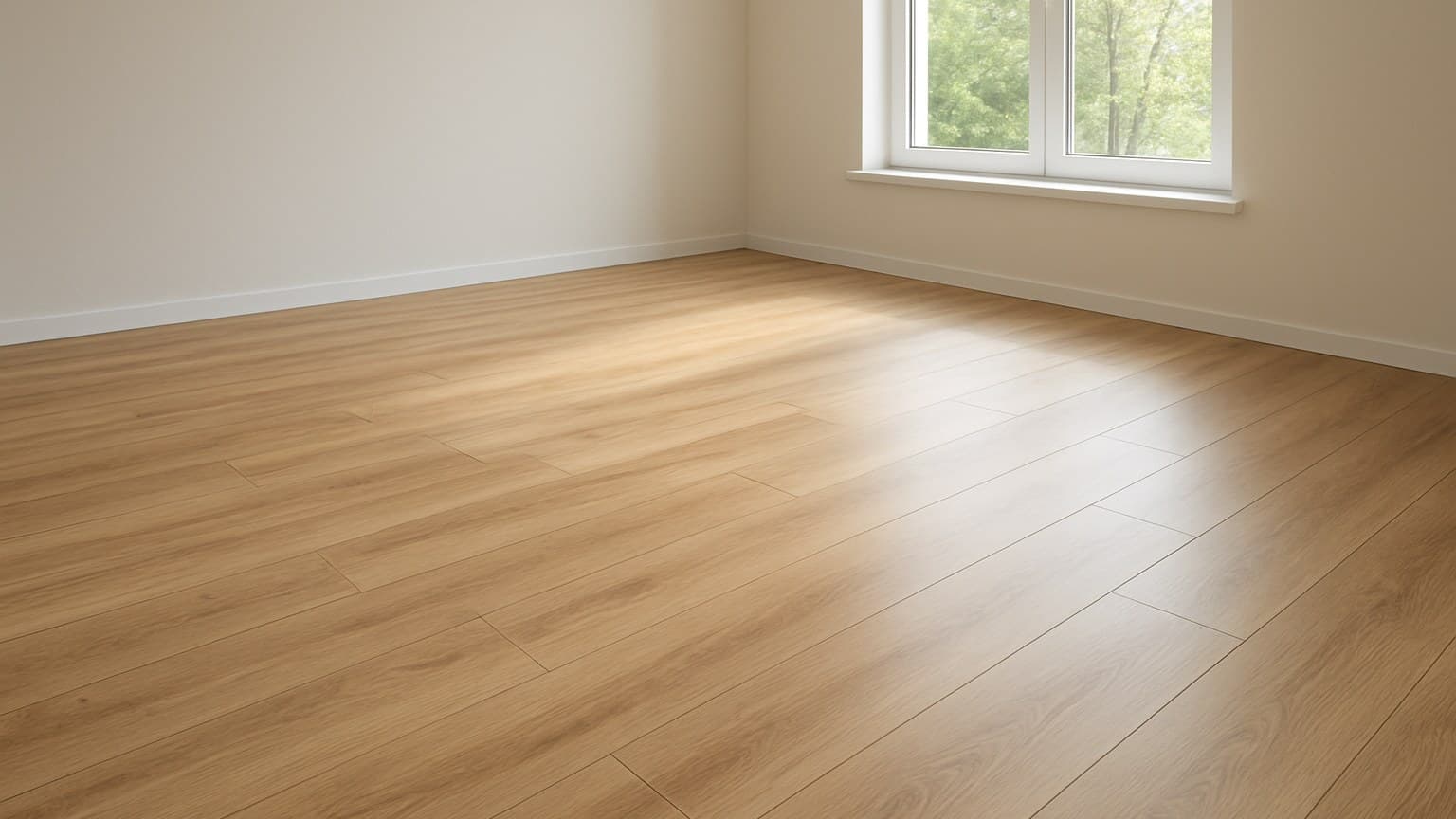
The best laminate isn't a brand name, it's a match: the right AC wear grade and water tolerance for the exact room you're covering. Most "best laminate" lists rank logos, which is how people end up with a floor that scuffs through by the front door inside two years. Here are 8 picks by room, with the caveats that actually matter.
Key takeaways
- The real 'best' spec is the AC (abrasion class) rating, not the brand: AC3 is the floor for normal home rooms, AC4-AC5 for busy entryways and homes with big dogs.
- Laminate's core is wood fiber, so even 'water-resistant' lines fail at the seams. NALFA (North American Laminate Flooring Association) says keep it out of full baths and high-moisture areas; a powder room is the farthest I'd push it.
- Basements only work over a concrete slab that passes a moisture test and a flatness check. If the slab is damp, go vinyl instead.
- Flatten an uneven subfloor before a single plank goes down. Click-lock on a flat floor is realistic DIY; stairs and glue-down are worth hiring out.
- Installed laminate runs about $4-7 per square foot split between materials and labor; basements and stairs cost more per square foot than open rooms.
First, the One Spec That Decides "Best": the AC Rating
The single best predictor of laminate that lasts is its AC rating, not the brand on the box. AC stands for abrasion class, the scratch-and-wear grade set by NALFA, the North American Laminate Flooring Association, which certifies these ratings for the industry.
The scale runs AC1 to AC5. AC3 is the floor for a normal home room. Anything busier than a quiet bedroom wants more.
| AC rating | Rated for | Best home use |
|---|---|---|
| AC1 | Light residential | Closets, guest bedrooms |
| AC2 | General residential | Bedrooms, dining rooms |
| AC3 | Heavy residential / light commercial | Any home room, living rooms included |
| AC4 | General commercial | Busy homes, entryways, homes with pets |
| AC5 | Heavy commercial | Overkill for most homes; only the hardest-worked entryways |
Source: the NALFA laminate standard's abrasion-class (AC) scale
AC abrasion-class grades and the home use each one suits.
Under that printed wear layer sits the core. On almost every laminate that core is HDF, high-density fiberboard, which is basically compressed wood fiber. HDF is what swells if water gets into it. A "waterproof core" claim is not the same thing as waterproof seams, and I'll come back to that in the kitchen. Those marketing claims are worth weighing against what you can actually verify about waterproof laminate flooring before you buy.
Best laminate brands: it's the spec, not the logo
A brand name buys you a feature set, a warranty, and dealer backing, not built-in quality. Two floors with the same AC rating and the same core thickness will wear about the same no matter whose logo is on them.
So shop the spec first, then pick the brand that carries it at your price. If you want that side of it, Best Laminate Flooring: 7 Brands Ranked by What They're Actually Best For sorts the names by what each one actually does well.
High-end vs. budget laminate: what the extra money buys
On the higher-end lines, the extra money mostly buys three things: a thicker core, a tighter locking system, and a more convincing surface texture. None of that is wasted, but it isn't magic either. Those are exactly the features usually marketed as luxury laminate flooring, greige tones included.
A budget AC3 plank in a spare bedroom will outlast a pricey AC5 plank laid over a bad subfloor. Spend where the room is hard on the floor, save where it isn't.
Busy Entryway or Hallway: Go AC4 or Higher
For entryways, hallways, and mudrooms, buy AC4 or AC5 with a textured, matte finish. A builder-grade AC3 doesn't have the wear layer for a door everyone tracks grit through.
Grit is the real enemy at an entry. Sand and salt under shoes act like sandpaper on the print. A walk-off mat plus a tough wear layer beats any marketing adjective on the box. A glossy finish only makes every scuff and footprint show. A stone-effect laminate flooring option with a matte, textured surface hides that wear better than a glossy finish ever will.
I pulled a builder-grade floor from a Dayton-area entryway where the owner, Terry, had scuffed clean through the print near the front door in a couple of years. Nothing was wrong with the install. The grade just didn't match the traffic. AC4 in that same spot would still be going.
Kids-and-Dogs Living Room: Texture Beats Shine
For a living room with kids and a dog, go AC4 or higher, pick an embossed or textured surface, and choose a mid-tone color. A mid-tone with visible grain hides hair, dust, and fine claw marks better than very dark or very light.
Understand the tradeoff with pets. Dog claws plus a high-gloss finish equals scratches you'll see from across the room, and slick laminate gives dogs poor traction so they skate on it. Laminate is scratch-resistant, not pet-proof. Keeping claws trimmed helps more than people expect.
The real failure point isn't the surface anyway, it's accidents that sit in the seams. Wipe them up fast, and in the busiest corner consider a water-resistant line. Matte or textured, never high-gloss, and a color that forgives a mess is the whole playbook here.
Kitchen: Water-Resistant Core, and Mind the Seams
Only a water-resistant laminate with a tight locking seam belongs in a kitchen, and only if you commit to wiping spills right away. A standard laminate will not forgive a kitchen for long.
Here's the split that trips people up. A water-resistant core protects the plank face, but the plank still has edges. Failures happen at the seams, where water sits and wicks into the wood-fiber core, not on the surface you can see. The locking edge and any edge seal vary by product, so read that specific spec.
A quick warning on tile-look laminate before you fall for the photo. That grout-look groove still collects grit and gunk, so cleaning it takes more work than the showroom picture suggests. I tell people that up front so they're choosing it with eyes open.
And no laminate survives a real leak. A dishwasher line or a sink supply that lets go will swell the core regardless of the grade. For which lines genuinely hold up and which are just marketing, see Water-Resistant Laminate Flooring: What Holds Up and What's Just Marketing.
Bathroom and Powder Room: Where I'd Stop You
A powder room, meaning a half bath with no tub or shower, is the farthest I'd push laminate, and only with a water-resistant line and the discipline to wipe spills. A full bath is a no from me.
Some sales pages will happily sell you laminate for a bathroom. But NALFA's own guidance says laminate isn't suitable for areas with excessive moisture. Standing water around a toilet base or a tub is exactly that, and I've pulled up enough swollen, black-edged planks from damp baths to take that at face value.
For a room with a tub or shower, the safer call is tile or sheet vinyl. The honest downside is that tile is cold underfoot and costs more to install, and sheet vinyl won't give you a true wood look. But either one shrugs off water the way laminate never will.
Basement: Only If the Slab Passes the Test
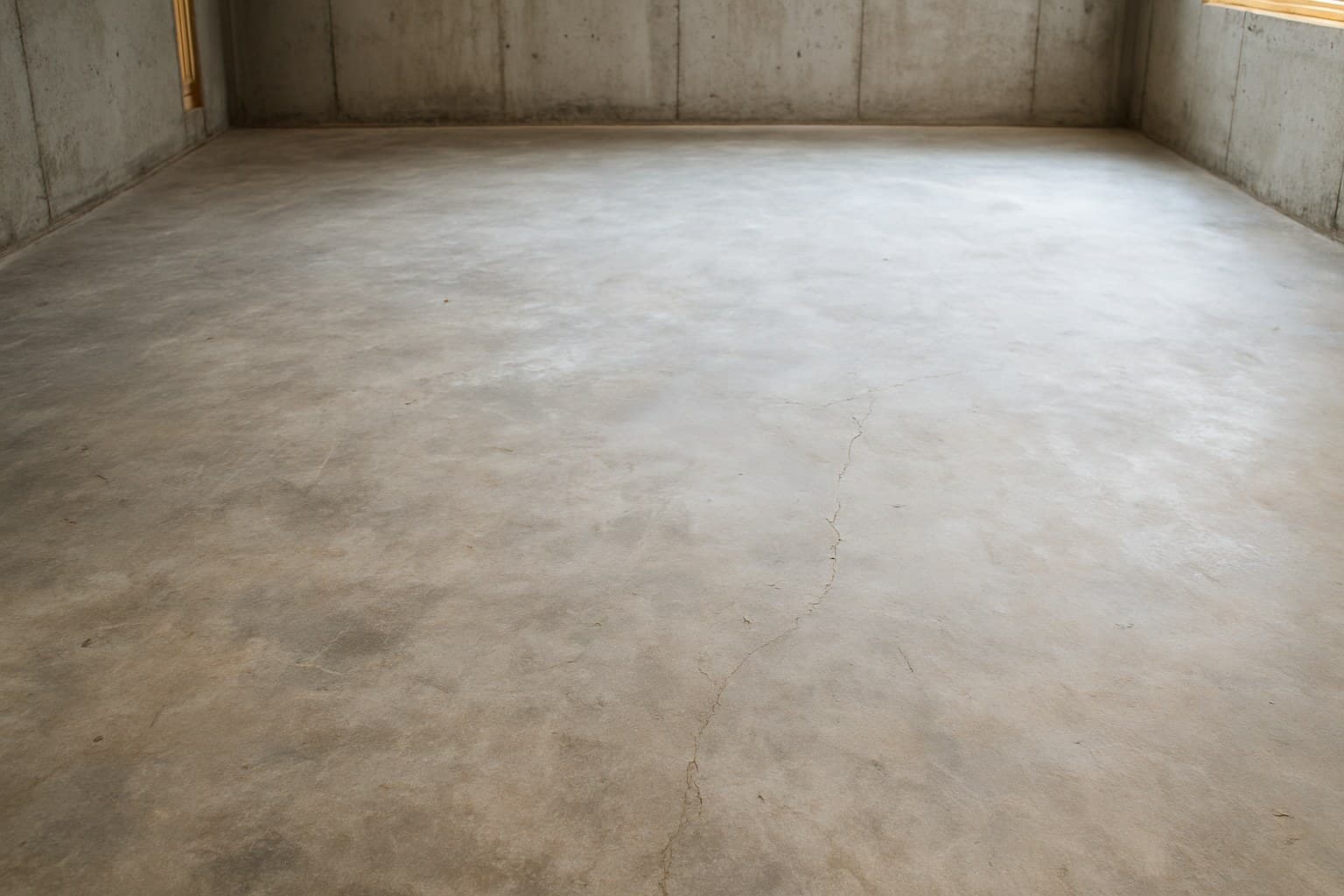
Laminate can go in a basement only over a concrete slab that passes both a moisture test and a flatness check. Below-grade slabs push moisture up from below, and that moisture has to be ruled out first.
The install itself is a floating floor over the slab, with whatever underlayment or vapor barrier the product's own sheet calls for. Doubling up barriers or skipping the one it requires can void the warranty, so the box instruction governs. If the slab is damp, the planks buckle no matter how high the AC grade.
I had a Columbus basement where the slab read too high on my moisture meter. Rather than watch a brand-new laminate floor cup and lift inside a year, we switched the homeowner to vinyl, which tolerates that moisture far better.
That's the usual fork down there. If your slab fails the test, a laminate-or-vinyl decision almost always lands on vinyl for a basement, and it's worth reading before you buy a single box.
Uneven or Old Subfloor: Fix the Floor, Not the Plank
No laminate fixes a bad subfloor. Flatten it first to the tolerance the manufacturer's instructions name, then lay AC3 or better over it.
The check is simple. Lay a long straightedge across the floor and watch for daylight under it. Sand or grind down the high spots, fill the low spots with leveling compound, and recheck. Skip the dips and you get bounce underfoot, clicking as you walk, and joints that slowly pull apart.
One myth worth killing: a thicker 12mm plank with an attached pad hides minor unevenness, but underlayment is not a leveler. It will not bridge a real dip, and the warranty won't cover a floor laid over one.
For the full prep sequence the box glosses over, Laminate Flooring Installation: The Rules the Box Instructions Leave Out walks it step by step.
Stairs: The One Room Worth Hiring Out
Stairs are the one place I steer DIYers toward hiring a pro, whatever the AC grade. Click-lock laminate on a flat open floor is realistic weekend work for most people. Stairs are not.
Each tread needs a custom-cut nosing, the planks have to be glued or fastened down rather than floated, and every step has to be measured on its own because old stairs are rarely identical. A gap at a stair nosing is a tripping edge, not just a cosmetic miss.
If you want laminate on stairs, buy an AC4 and have it installed. The labor runs well above the per-square-foot rate of a room because it's slow, fussy work priced by the step.
Bedrooms and Low-Traffic Rooms: Where You Can Save
Bedrooms, guest rooms, and home offices are where you can drop down to AC2 or AC3 and pocket the difference. These rooms see soft traffic and no water, so paying for an AC4 entry-grade plank in a bedroom is money spent on durability you'll never use.
This is also where a budget line earns its keep. A simple rectangular bedroom is mostly straight runs with few cuts, which keeps labor low and makes it an easy DIY room.
Save your heavy-duty budget for the entry, the hall, and the kitchen, and let the quiet rooms take the cheaper plank.
What Installed Laminate Really Costs by Room
Installed laminate runs roughly $3-7 per square foot, split between materials and labor. Materials land around $1-3 per square foot depending on grade, and labor around $2-4, which is why the room and its prep swing the number as much as the plank does.
| Room | Why it's priced this way | Installed per sq ft |
|---|---|---|
| Bedroom or quiet office | Simple layout, few cuts, budget-grade plank | $4-5 |
| Open living room | Straight runs, AC3-AC4 material | $4-6 |
| Entryway or hallway | More cuts, usually AC4 material | $5-7 |
| Basement | Moisture prep, leveling, vapor barrier on top | $5-7 plus prep |
Cost by room, materials and labor combined.
Basements and stairs cost more per square foot than an open room, because of the prep below-grade and the slow custom work on steps. Stairs are usually priced per step rather than per square foot.
A quick worked example: a 200-square-foot bedroom at $3-7 installed runs about $600 to $1,400 all in. Buy about 10 percent extra for cuts and mistakes. For a full line-item breakdown of what drives the number up or down, 9 Things That Set Your Laminate Flooring Cost lays out the bid the way I write it.
If you've got your AC grade sorted and now want to match it to a name, Best Laminate Flooring: 7 Brands Ranked by What They're Actually Best For is the useful next read, because it tells you which brand carries that spec best at your price.