
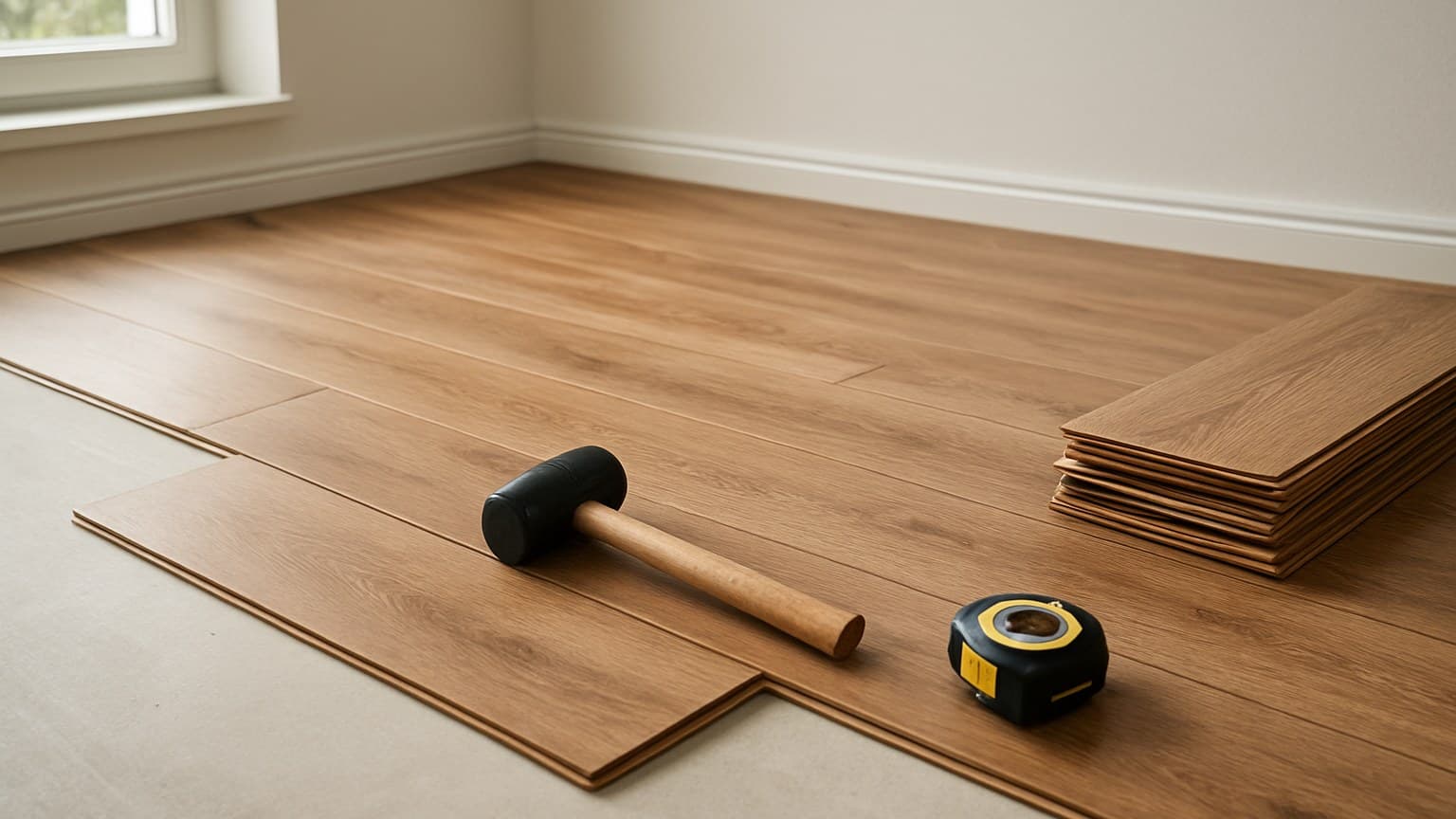
Laminate flooring runs $4-$7 per square foot installed, but most cost guides stop at that one tidy number and the installer's bid lands hundreds higher. That gap is almost always what a per-square-foot headline skips: tear-out, a soft subfloor, stairs. Below is every line a real bid carries, so nothing surprises you.
Key takeaways
- Budget $4-$7 per sq ft all-in nationally: roughly $1.50-$5 for materials (by grade) and $2-$3 for labor.
- A 2,000 sq ft home runs about $8,000-$14,000 for the base install, before any add-ons.
- The add-ons are what blow up quotes: subfloor leveling $500-$2,500, stairs $70-$150 per step, glued tile tear-out up to about $4,000 whole-house.
- Whole-house jobs run 10-20% cheaper per sq ft than room-by-room, and you should order 8-10% overage (12-15% for diagonal or complex layouts).
- The same floor can cost 20-40% more in a coastal metro than a Midwest quote, so treat any one number as regional, not national.
1. The All-In Number: $4-$7 Per Square Foot, Split Materials vs. Labor
Most laminate jobs land at $4-$7 per square foot all-in. That breaks down to roughly $1.50-$5 for materials and $2-$3 for labor. When someone asks me the cost of flooring per square foot for laminate, that's the spread I give them.
"All-in" here means the plank, the underlayment, and a standard floating install across a flat, bare subfloor. It doesn't include tearing out the old floor, fixing or leveling the subfloor, stairs, or the metal transition strips between rooms. Those are separate lines, and they're where quotes grow (section 3 walks through each one). Picking the right underlayment matters just as much as the plank itself, which is why we put together a guide to choosing laminate underlayment that covers what works best over concrete.
The material number is wide because the plank itself is wide. A thin builder-grade board sits near $1.50, while a thick water-resistant plank runs past $5. Same install labor, very different box price.
| Line item | Range |
|---|---|
| Materials (plank + underlayment) | $1.50-$5.00/sq ft |
| Labor (install only) | $2.00-$3.00/sq ft |
| All-in, typical job | $4.00-$7.00/sq ft |
This table shows a typical laminate job split into its material and labor parts, per square foot, before you adjust for your local market.
The bars show labor as the steady part of a laminate quote and the plank grade as the part that swings the price.
Why a Columbus Quote Isn't a Coastal Quote
Treat any single number as regional, not national. The same plank and the same install can cost 20-40% more in a coastal metro than in a Midwest market. A floor I'd bid at $5 a foot around Columbus can run $6.50-$7 in a high-cost coastal city, mostly on labor. So when a national guide says "$5 per square foot," read it as a starting point and get a local bid before you set your budget.
2. Laminate Flooring Cost by Home Size
At $4-$7 per square foot, the base install scales straight with your area. Below are the common tiers, from a single room to a whole house.
| Area | Base install total |
|---|---|
| 500 sq ft (one room) | $2,000-$3,500 |
| 1,000 sq ft | $4,000-$7,000 |
| 1,500 sq ft | $6,000-$10,500 |
| 2,000 sq ft (whole house) | $8,000-$14,000 |
This table shows base laminate install cost by home size before any tear-out, subfloor, or stair work.
The bars show the base cost climbing with square footage, with bigger jobs landing nearer the low end per foot.
Bigger jobs usually come in at the low end of the per-foot range. The crew sets up once, cuts fewer odd pieces per hundred feet, and keeps a rhythm going across open space. A 2,000 square foot whole-house job often beats a 300 square foot single room on a per-foot basis for exactly that reason. These are base numbers. Tear-out, subfloor work, and stairs get added on top.
3. The Hidden Line Items That Blow Up a Laminate Bid
A clean $5 a foot quote leaves five things out: tearing out and hauling the old floor, leveling the subfloor, fixing moisture problems, stairs, and transitions. These are the lines that turn a $7,000 job into a $10,000 one.
| Add-on | Cost |
|---|---|
| Carpet tear-out and haul | $0.50-$1.00/sq ft |
| Glued vinyl or tile tear-out | $1.50-$3.00/sq ft (up to about $4,000 whole-house) |
| Subfloor leveling or repair | $500-$2,500 |
| Stairs | $70-$150 per step |
| Transitions / thresholds | $20-$40 each |
This table lists the common add-on lines that get added on top of the base laminate install.
Tear-Out and Haul-Away by Old Floor Type
What's coming up decides this line. Pulling carpet and pad is quick, so it runs $0.50-$1 per square foot including haul-away. Glued-down vinyl or ceramic tile is a different animal. That's $1.50-$3 per square foot, and a full house of glued tile and thinset can climb to about $4,000 on its own. If your bid looks low and you have old tile, ask the installer if tear-out is even in there.
Subfloor Leveling and Moisture Fixes
Budget $500-$2,500 here, and don't skip it. On a floating laminate floor, the subfloor matters more than the plank. Flatness and moisture control are what the manufacturer's warranty actually depends on, so if the floor fails because the slab was too wavy or too wet, that's on the prep, not the box.
Before anyone lays a plank, the subfloor needs two checks: is it flat, and is it dry. Flatness gets checked with a long straightedge against the floor, and high or low spots get ground down or filled with leveling compound. Moisture gets tested, especially on concrete and in basements, because a slab that reads wet will wreck a laminate floor from underneath. These checks come first on every job I do.
Stairs and Transitions
Stairs are the priciest laminate work in the house at $70-$150 per step. Each tread is a custom cut, and the front edge needs a stair nosing piece. I don't trust laminate's click system to hold on a stair nose, so I glue the treads and use real nosing. A floating tread is the one that eventually creaks and shifts underfoot. Transitions between rooms or between laminate and another floor run $20-$40 each, and a typical house has more of them than people expect.
4. Material Grades: Builder, AC4, and Water-Resistant
The plank you pick drives the whole material line, and it falls into three grades. AC4 is a wear rating, the scale that measures how well a laminate's top layer stands up to scuffing and foot traffic, and it's the rating you'll see most on mid-range boxes. Builder grade sits near $1.50 a square foot and is usually a lighter AC3. Mid-range AC4 runs $2.50-$4. Premium water-resistant planks start around $5 and go up. If you're leaning toward that top tier, premium laminate flooring guide breaks down which manufacturers actually justify the higher price.
| Grade | Material cost | Best for |
|---|---|---|
| Builder grade | ~$1.50/sq ft | Low-traffic rooms, rentals |
| Mid-range AC4 | $2.50-$4.00/sq ft | Most living areas and halls |
| Premium water-resistant | $5.00+/sq ft | Kitchens, entries, busy homes |
This table shows the three common laminate grades by material-only cost and the rooms each suits.
Builder, AC4, and Water-Resistant Tiers
AC4 is a wear rating, and it's worth knowing before you shop. The AC scale measures how well the surface stands up to traffic and scuffing. AC4 is built for heavy home traffic and light commercial use, which covers most living rooms, halls, and family spaces. Builder grade is often AC3, fine for a guest room or a rental, lighter on the wear surface. For how the grades line up by brand, our ranking of the best laminate for each use breaks it down maker by maker. Paw traffic wears a floor the same way foot traffic does, so if dogs are part of the household, our best flooring options for dogs weighs AC ratings against scratch resistance.
Water-resistant is where you have to read carefully. A "waterproof core" claim is about the board's center, but laminate fails at the seams and edges, not the plank face. Water that sits in a joint can still reach the wood-fiber core and swell it. The core claim and the seam claim are two different promises, so check what the specific product says about both. We dig into which claims hold up in our look at what water-resistant laminate actually survives, and at the stronger waterproof laminate claims worth verifying.
Big-Box Pricing: Lowe's and Home Depot
On the shelf at big-box stores, most stocked laminate tends to run roughly $1-$4 per square foot, with premium water-resistant lines priced above that; exact shelf prices vary by store, region, and promotion. The cheap end is thin builder stock, often with the pad already attached. The pricier end is thicker board with a better wear layer and a tighter locking system. Bring your room's square footage and read the AC rating and thickness on the label, not just the per-foot price. Since Home Depot is where most people end up doing that comparison shopping, guide to Home Depot's waterproof laminate lineup walks through which of its stocked lines are actually worth the upcharge.
5. Labor Cost: What the Install Portion Really Pays For
Labor runs about $2-$3 per square foot. A good crew lays 800-1,200 square feet of click-lock laminate a day on open, flat floor, which is why the install line stays steady while the plank price swings. When people ask about the average cost of flooring installation, laminate sits on the lower end because the floating install is fast.
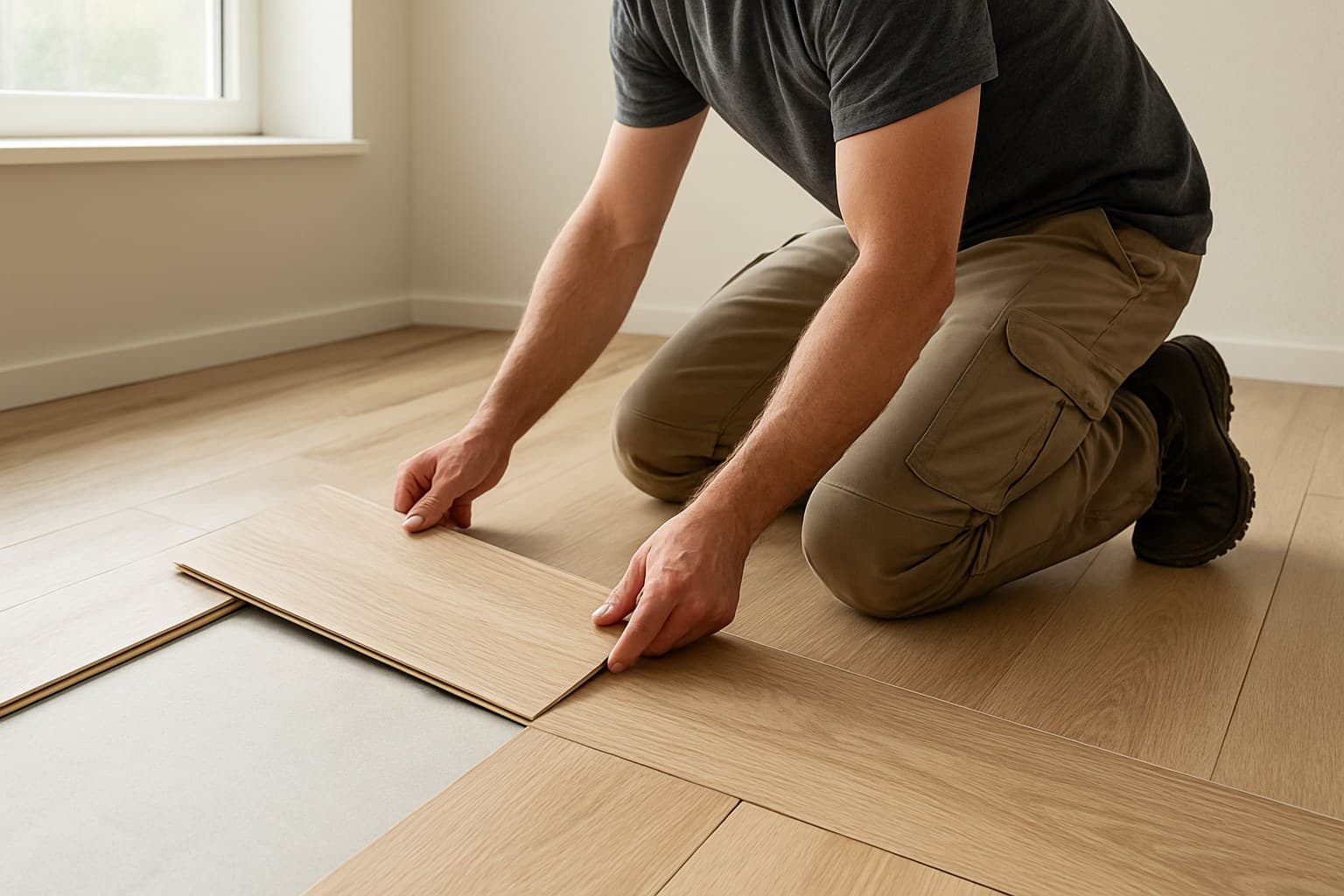
Here's the straight DIY-versus-hire call. Click-lock laminate across one open, flat room is realistic for most handy homeowners, and it's the job I tell people to try themselves. Hire out stairs, any glue-down install, and large open-plan floors that cross a moisture transition, because those are where a small mistake turns into a buckled floor. Either way, the subfloor gets flattened and moisture-tested first.
One more thing that drives labor cost: the room has to be empty. I once had a homeowner swear the furniture would be gone before we arrived, and it wasn't, so half my crew spent the morning moving a piano and a loaded china cabinet. Now the estimate says "empty room or we reschedule" in plain words.
If you're also weighing vinyl plank, here's the quick answer before you click through: on my bids, LVP material usually falls in the same $2-$6 per square foot range as laminate, and install labor runs about the same $2-$3 a foot for click-lock product, so at the builder and mid grades the two land close enough that the grade you pick matters more than which material you pick. Where they split is at the top end, premium water-resistant laminate often prices a touch under premium LVP per square foot, but LVP's solid vinyl core doesn't carry the same seam-and-edge moisture risk, so that gap is really you paying a little more for fewer wet-room callbacks, not for the floor itself. The fuller install differences, underlayment, subfloor prep, how each handles stairs, are in whether laminate or vinyl is the better call. That moisture tolerance is just one factor in whether vinyl ends up lasting five years or twenty, a question we unpack in what makes vinyl flooring last 20 years.
6. Laminate's True Cost Per Year of Life
Cost per square foot is only half the story. The number that actually matters over time is dollars per year of life, and that's where laminate's cheap entry price looks different. Laminate's low upfront cost buys a shorter life, roughly 15-25 years, and you can't sand and refinish it. When it wears out, you replace it.
| Floor | Upfront | Life | Note |
|---|---|---|---|
| Laminate | $4-$7/sq ft all-in | ~15-25 yrs | Lowest entry cost; replace, don't refinish |
| Engineered wood | $7.92/sq ft material | 25-year study | $78.76 total over 25 years |
| Solid wood | $8.92/sq ft material | 75-year study | $75.78 total over 75 years, refinishable |
Source: NWFA's 25- and 75-year Life Cycle Cost Analysis
This table sets laminate's upfront cost against wood's material price and expected lifespan, so you can compare dollars spent per year of use.
The National Wood Flooring Association (NWFA) ran a Life Cycle Cost Analysis, and the $78.76 engineered-wood-over-25-years and $75.78 solid-wood-over-75-years totals trace back to the cost-comparison table in NWFA's own full Life Cycle Cost Analysis report (PDF), not just the summary overview page, because solid wood can be refinished several times instead of replaced. If you want the shorter version of that same table, NWFA's 2024 sales sheet (PDF) carries the identical figures. The bottom line splits by how long you're staying. Laminate wins on entry cost, no contest. Wood wins per year if you plan to live in the house for the long haul and will refinish instead of rip and replace. We compare the two head to head in laminate against hardwood.
7. Where Laminate Shouldn't Go (and the Budget Trap It Creates)
The North American Laminate Flooring Association (NALFA) flags laminate as the wrong product for outdoor areas and any spot with excessive moisture, per its flooring FAQs. Budget it into one of those rooms and you can waste the entire install, because a floor that buckles in year two is a full re-spend, not a line item you can patch.
The classic traps are the rooms whole-house planners price in without a second thought: bathrooms, laundry rooms, and below-grade basements. Standing water, splashes, and slab moisture all attack laminate at the seams. A waterproof-marketed core doesn't change the fact that water pooling at the edges finds the joints. That makes a room-by-room gut check worth doing before you lock in a whole-house bid, and our breakdown of which rooms actually suit laminate flooring walks through exactly where it holds up and where it doesn't.
So before you add those rooms to a whole-house quote, check whether laminate even belongs there. For wet rooms, read our take on putting laminate in a bathroom first, and keep the moisture-test step from section 3 non-negotiable in basements.
8. Whole-House vs. Room-by-Room (and How Much to Over-Order)
Doing the whole house at once runs 10-20% cheaper per square foot than hiring the same work room by room. One setup, one haul-away, one trip charge, and the crew keeps moving. If you're planning to redo several rooms within a year or two, bundling them into one job is the easiest money you'll save on this whole project.
Then there's overage, the extra flooring you order to cover cuts and mistakes. Order 8-10% over your measured square footage for a standard straight layout. Bump that to 12-15% for a diagonal pattern or a chopped-up floor plan with lots of closets, angles, and doorways, because every turn means more waste. Running short mid-job and finding the dye lot is gone is a worse problem than a leftover box.
9. How to Build Your Own Laminate Estimate
You don't need a calculator tool for this. The arithmetic is short, and it's the same math I run on every bid. Here's the formula:
Total = (square footage × material price per sq ft × overage) + (square footage × labor price per sq ft) + add-ons
- Square footage: measure length times width of each room, then add them up.
- Material price: pick your grade from section 4 ($1.50 builder, $2.50-$4 mid AC4, $5+ water-resistant).
- Labor price: $2-$3 per square foot.
- Overage: multiply material by 1.08 to 1.15 depending on layout.
- Add-ons: tear-out, subfloor, stairs, transitions from section 3.
Worked example, one 300 square foot living room, mid-grade AC4 plank at $3, labor at $2.50, carpet coming out, one doorway transition:
- Material: 300 × $3 × 1.08 overage = $972
- Labor: 300 × $2.50 = $750
- Carpet tear-out: 300 × $0.75 = $225
- One transition: $30
- Total: about $1,977, which pencils out to roughly $6.59 per square foot installed
Swap in your own room sizes and grade and the number moves, but the structure stays the same. If you want to sanity-check your grade choice against brands before you plug in a price, how LVP stacks up against laminate on cost and wear is the next read, since the two trade places depending on the room.