
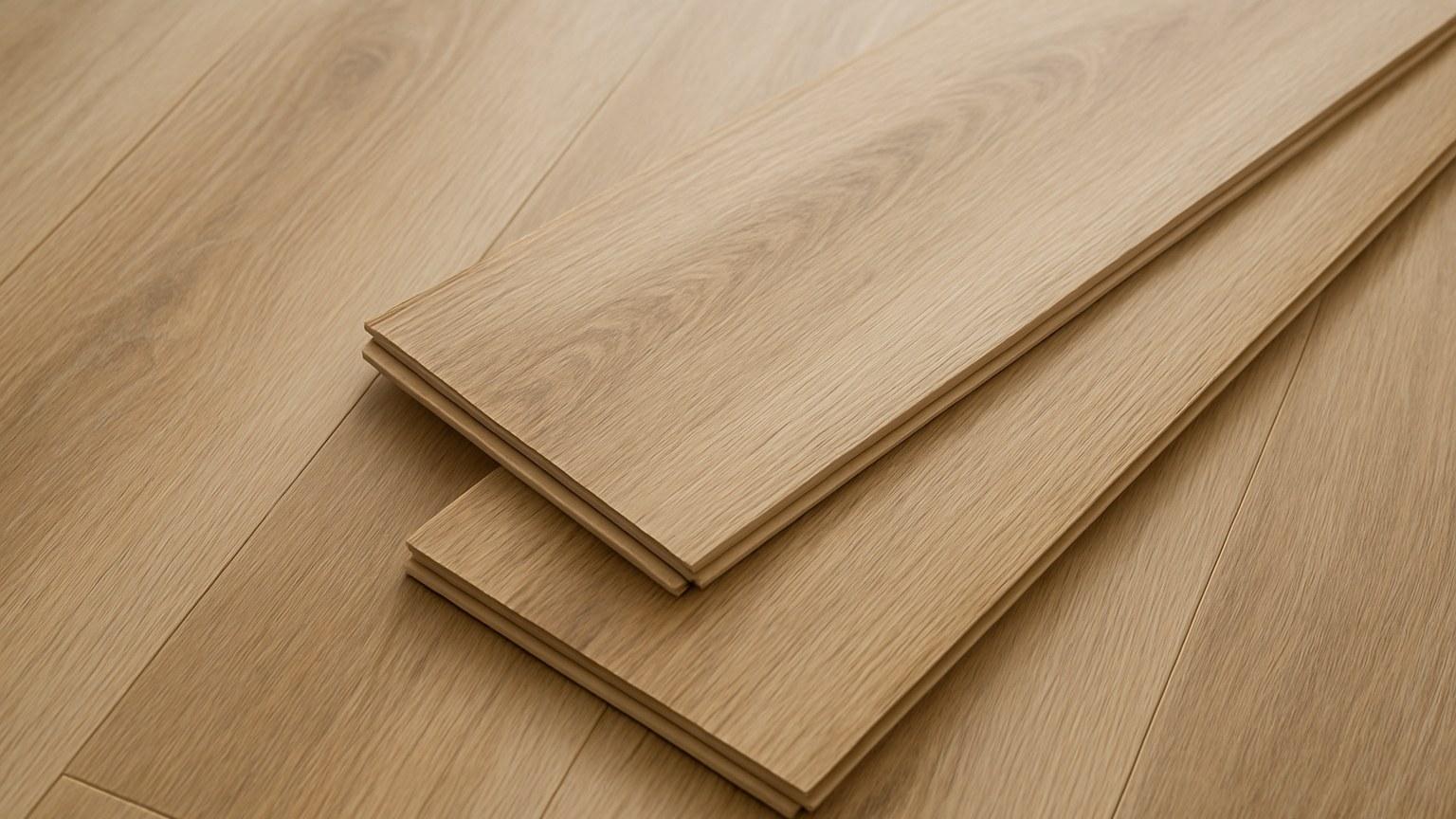
Premium laminate flooring earns the name only when four measurable specs back it up: the AC wear rating, embossed-in-register texture with beveled edges, the core type, and a warranty you have actually read. A cheap plank and a pricier one can both wear the word "premium" on the display, so the label alone tells you nothing. Spend the extra money only when the specs on the quote prove the plank earns it.
Key takeaways
- Four specs decide whether "premium" is real: AC rating, texture and bevel realism, core type, and warranty length. A high price alone proves none of them.
- For a busy home, look for AC4; AC5 and AC6 are built for stores and public buildings, not living rooms.
- North American Laminate Flooring Association's (NALFA) spotlight on CALI's laminate lists an AC-4 rating, a built-in XPS pad, and a 50-year residential warranty, a solid benchmark to measure a salesperson's claims against.
- Premium laminate materials run about $1.70-$6 per square foot (thisoldhouse.com), versus $5-$10 for solid hardwood (mrhandyman.com).
- A "waterproof core" is not a waterproof floor: most laminate fails at the seams and edges, not the plank face.
What "Premium" Laminate Flooring Actually Means: 4 Specs, Not a Price Tag
"Premium" is a sales word until four things on paper back it up: the AC wear rating, the texture and bevel, the core type, and the length and coverage of the warranty. Price isn't one of them.
I've rung up two planks just a few dollars apart on the same rack, both stamped "premium" on the display tag. What separates them is those four specs, and every one can be checked on a written quote before you pay.
Check each spec the same way: ask for the cert sheet with the AC rating, run your hand over a sample to feel the texture, find the core type listed on the product's spec sheet, and read the warranty's exact wording before you pay a premium price for any of it.
If you're chasing down the related "luxury" label on a different quote, the same spec-by-spec approach works there too. Our luxury laminate flooring guide checks that claim the same way.
Decoding AC Ratings: What AC4 vs AC5 Really Means
The AC rating measures how well the plank's surface resists scuffs, scratches, and wear on a 1-to-6 scale. For a busy home, AC4 is the practical top end. AC5 and AC6 are built for stores and public buildings, not living rooms.
Behind every AC number is a thin, clear top layer made of melamine resin mixed with aluminum oxide, a hard mineral grit that does the actual work of resisting scuffs and scratches. The AC test just grades how well that layer holds up under machine wear, impact, and stains. When two planks both say AC4, ask the retailer or the spec sheet whether that top layer names aluminum oxide specifically. If it's not listed, you're trusting a rating without seeing what's actually behind it.
The rating comes from the North American Laminate Flooring Association, shortened to NALFA. They run the certification that tests and stamps a rating on the plank, so an AC number on a cert sheet carries more weight than one printed on a box.
Here's what each grade handles.
| AC rating | What it handles | Good for |
|---|---|---|
| AC1 | Light residential | Closets, guest bedrooms |
| AC2 | General residential | Bedrooms, living rooms, normal traffic |
| AC3 | Heavy residential / light commercial | Whole home, hallways, a home office |
| AC4 | Heavy residential / general commercial | Busy households, small shops, offices |
| AC5 | Heavy commercial | Stores, public buildings |
| AC6 | Extra-heavy commercial | Rare; very high-traffic public spaces |
AC ratings matched to the room and traffic they're built for.
Read that chart against your own rooms. A whole house with kids and a dog is fine on AC4. Paying up for AC5 in a quiet bedroom is money you'll never see again on the floor. That same room-by-room thinking is what decides where laminate flooring actually works in the first place.
Texture and Bevel: The Difference Between a Real-Wood Look and Plastic Shine
A premium plank uses embossed-in-register texture, usually written EIR, meaning the bumps you feel under your hand line up with the wood grain you see. It also has beveled edges, small grooves that give each plank its own outline so the floor doesn't read as one flat sheet.
Cheap laminate skips both. It's a smooth, shiny film printed over a photo of wood. You can see grain, but you can't feel it, and square edges blur the plank lines together.
The other tell is repetition. On a budget floor, the same exact board shows up every five or six rows. Premium lines mix plank lengths, widths, and grain so no two boards near each other match.
Two quick checks in the store: run your hand flat across the surface and feel whether the grain has real texture, then crouch and look down several rows for a board that repeats. A matte finish usually reads as wood; high gloss is a tell that the realism is thin.
Even the best texture can't hide a bad subfloor. When I floated laminate atop an old tile floor without first skimming it flat, the grout lines telegraphed through within a season as shallow dips you could feel with your socks on. Now I level or skim tile before floating anything over it. If you want the full prep routine, our laminate flooring installation guide covers the subfloor flatness and moisture checks that come before the first plank.
The right side is what premium beats, feature for feature.
Core Type: Is Premium Laminate Flooring Waterproof?
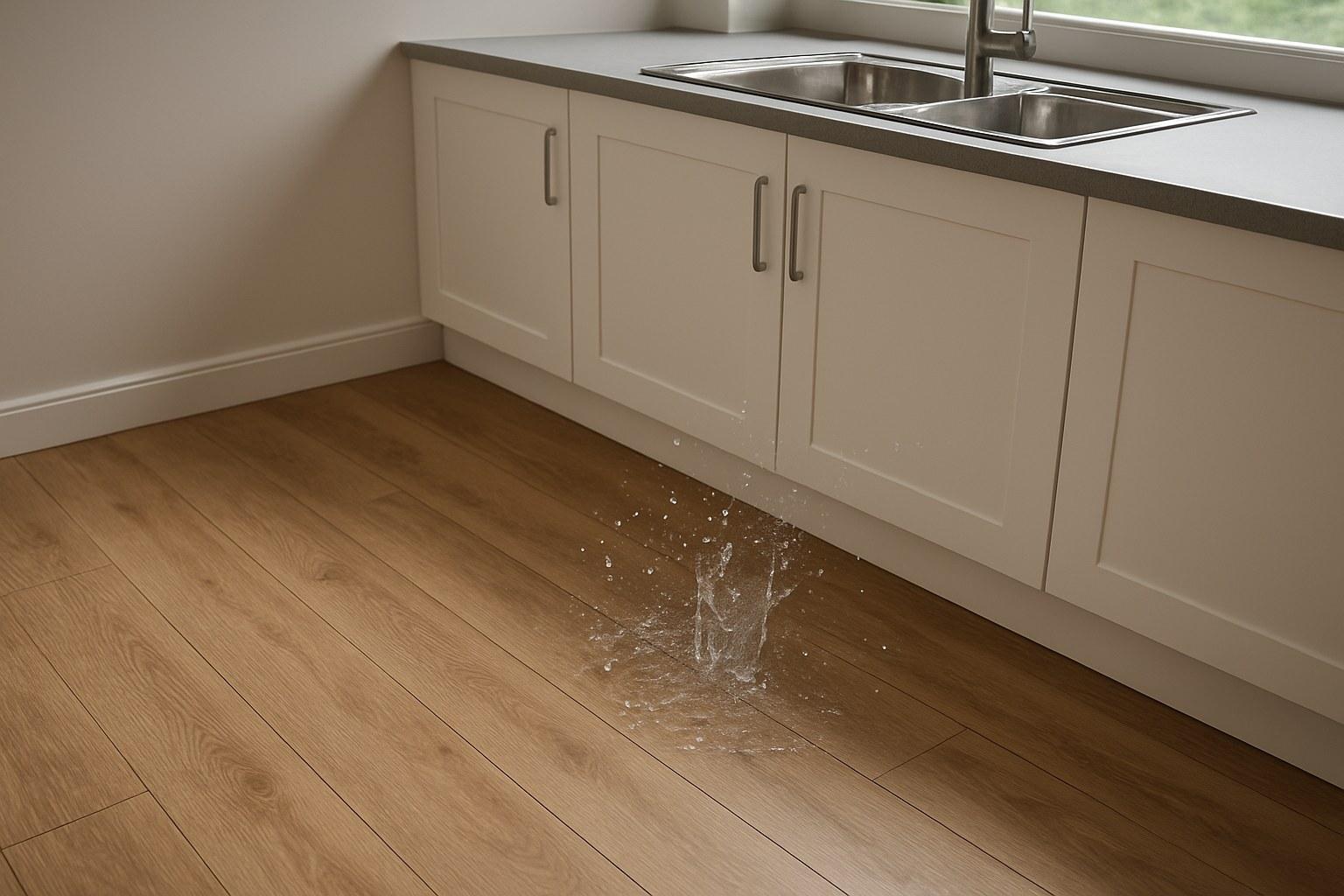
Most premium laminate rides on an HDF core, short for high-density fiberboard, which is pressed wood fiber. Because it's wood, it swells if water sits on it long enough. Some lines add a so-called waterproof core, but a waterproof core is not the same as a waterproof floor. Our waterproof laminate flooring guide breaks down which of those marketing claims actually hold up once you check the fine print.
Keep those two claims separate. A waterproof core protects the body of the plank. It does nothing for the seams and edges, and that's exactly where water gets in and where failures I get called to fix tend to start.
Treat any blanket "waterproof laminate" sign with suspicion. The only claim worth trusting is a specific product's own rating, plus the conditions written into that product's warranty, like how long a spill can sit and still be covered.
For which products genuinely hold up near water and which just print the word on the box, see our breakdown of water-resistant laminate flooring.
A Real Benchmark: CALI's 50-Year Laminate and the NALFA Seal
If you want hard numbers to hold a salesperson's "premium" claim against, use a real one. NALFA's spotlight on CALI's laminate lists an AC-4 rating, a built-in XPS pad, and a 50-year residential warranty. Those are concrete specs you can ask any competing plank to match.
NALFA, again the North American Laminate Flooring Association, certifies by testing wear, impact, and staining. That's why a cert sheet beats a glossy brochure. A brochure says "ultra-durable." A cert says the plank passed a defined test.
Run the same warranty check on any quote. Read the length and read exactly what it covers: wear, fade, stain, and structure are separate things. A short or vague warranty stapled to a "premium" price is a tell that the price is doing the selling.
The XPS pad is a foam cushion bonded to the plank back. It adds a little softness underfoot and cuts noise, and it saves you buying separate underlayment. Where a plank has no pad, underlayment runs about $0.25-$1 per square foot, according to thebestlaminateflooring.com.
Which Manufacturers Make Premium Laminate
Shoppers see names like CALI, Pergo, Mohawk's RevWood line, Quick-Step, and Shaw come up often for upper-tier laminate. Any of them can sell you a strong plank or a thin one.
The name isn't the proof. Two lines from the same maker can be worlds apart on AC rating, texture, and warranty. Make the brand show you the four specs, then decide.
Premium Laminate vs. Hardwood, Tile, and LVP: Is It Worth It?
Premium laminate costs a fraction of hardwood or stone and resists scratches better than either. The catch is that you can't refinish it, and even top-finish planks top out around $6 per square foot in materials. When a laminate floor wears through, you replace it; you don't sand it back to new. Weighing that tradeoff against solid wood's own strengths and weak points is exactly what our laminate vs. hardwood comparison walks through room by room.
According to thisoldhouse.com, premium laminate materials run about $1.70-$6 per square foot. For comparison, mrhandyman.com puts engineered hardwood at $3-$8 and solid hardwood at $5-$10, and mmgmarble.com lists porcelain tile anywhere from $4 to $43.
| Material | Materials cost per sq ft | Notes |
|---|---|---|
| Premium laminate | $1.70-$6 | Can't be refinished; strong scratch resistance |
| Engineered hardwood | $3-$8 | Thin real-wood top; limited refinishing |
| Solid hardwood | $5-$10 | Refinishable many times |
| Porcelain tile | $4-$43 | Huge range; hard, cold, grout lines |
Materials cost per square foot by flooring type; ranges are national material prices and do not include labor.
Now the labor, which is a separate line on your bill. Laminate install runs about $2-$5 per square foot, according to manasotaonline.com, though 2026 estimates from homewyse.com run higher at $6.91-$11.81 per square foot. Click-lock laminate is one of the cheaper floors to have put down, and it's realistic for most DIYers to install in a flat, dry, open room. Basements, stairs, and tricky moisture transitions are jobs worth hiring out, and they always cost more per foot than an open room.
Against LVP (luxury vinyl plank), the tradeoff is simple: premium laminate usually gives you a more realistic, more textured wood look for the money, while LVP tolerates standing water far better because its core is plastic, not wood fiber. If you want real stone instead of the wood look, see what laminate can and can't fake in our stone laminate flooring guide.
For a scratch- and claw-heavy household, a strong AC4 laminate holds its own, which is why it shows up in our ranking of the best flooring for dogs.