
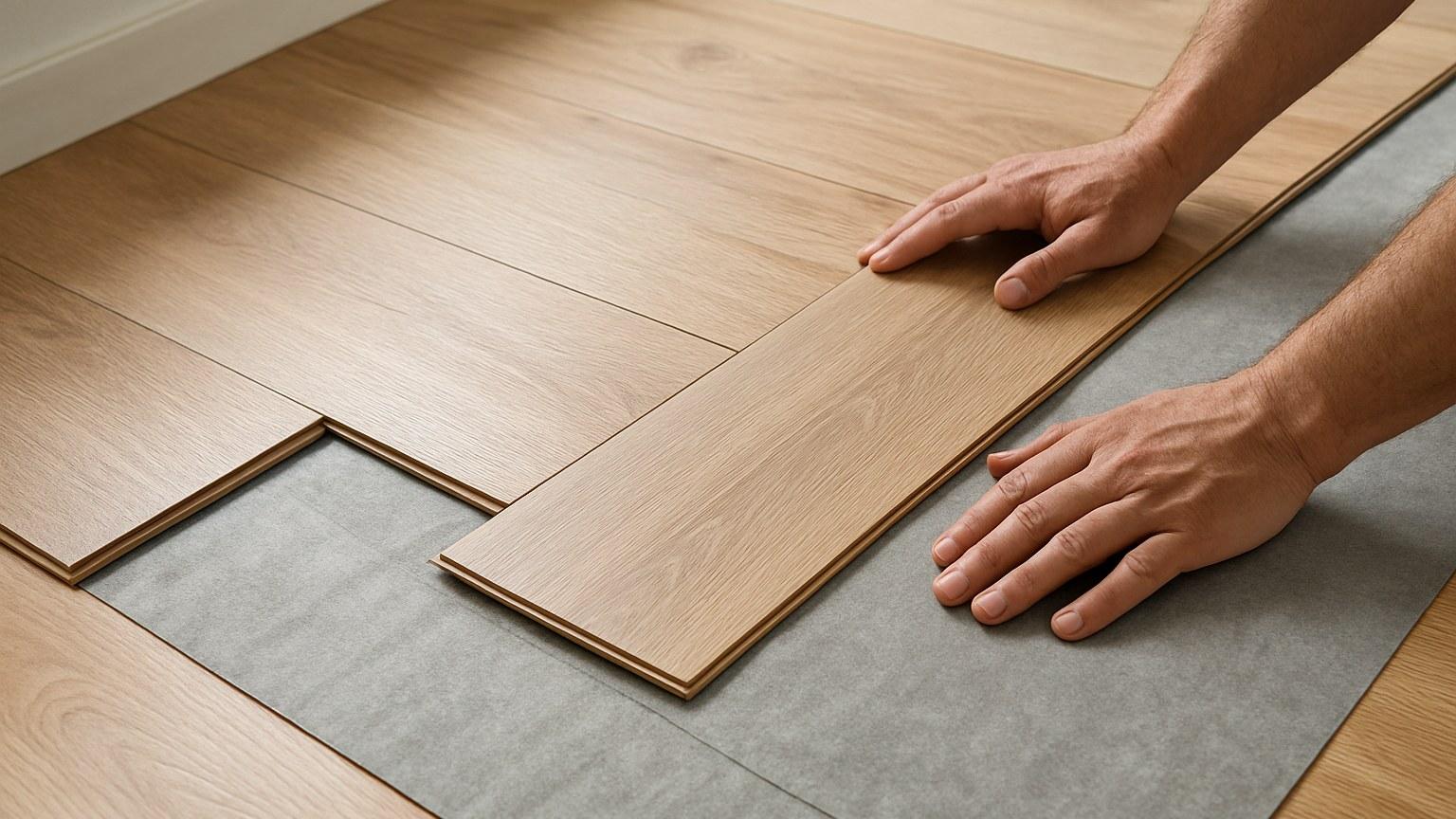
Cheap laminate flooring runs about $0.99 to $1.49 a square foot for the planks, according to thebestlaminateflooring.com, and it can hold up fine, as long as you put the right cheap plank in the right room. The catch is that the low price always hides a corner that got cut somewhere, and the wrong corner shows up as swollen seams a year later. Learn where makers skimp, and the sticker price starts telling you a lot.
Key takeaways
- Cheap laminate is usually $0.99-$1.49 per square foot for the planks alone; underlayment, trim, labor and about 10% waste make the real installed cost much higher, according to thebestlaminateflooring.com.
- Makers hit those prices by thinning the core, dropping to a low AC3 wear rating, and using weaker locking edges, so cheap floors tend to fail at the seams first.
- Before you buy, check four things: the AC rating, the wear layer, whether underlayment is attached, and what the warranty actually excludes.
- A waterproof core is not the same as waterproof seams; cheap laminate in a full bath or wet basement usually swells at the edges.
- Real bargains live in discontinued and clearance lines from solid brands, but order extra because closeout stock can't be matched later.
Is Cheap Laminate Flooring Any Good?
Yes, cheap laminate can hold up fine, but only if you match it to a room that doesn't punish it. The price tag isn't the problem. Putting a bargain-bin plank in the wrong room is. Figuring out which rooms laminate flooring actually works in is the first step to getting that match right.
Here's the tier we're talking about. Cheap laminate means planks around $0.99 to $1.49 a square foot. Right above it sits a mid-grade tier near $2 a square foot that budget buyers usually weigh it against.
The real split isn't cheap versus expensive. It's smart cheap versus false economy.
Smart cheap is a discontinued line from a solid brand, sold off at a bargain because the color got retired, not because the plank is weak. Those are often the same build quality that sold at full price last year. If that's the route you want, it's worth reading up on how waterproof laminate flooring clearance stock gets priced so you know a real deal from a dumped one.
False economy is a thin plank with the lowest wear rating going into a busy kitchen or a wet basement. That's the floor that comes apart at the joints.
Where Makers Cut Corners to Hit $0.99 a Square Foot
Makers don't hit $0.99 by magic. They shave the three parts of the plank you can't see on the store display: the core, its wear layer, and the locking edge.
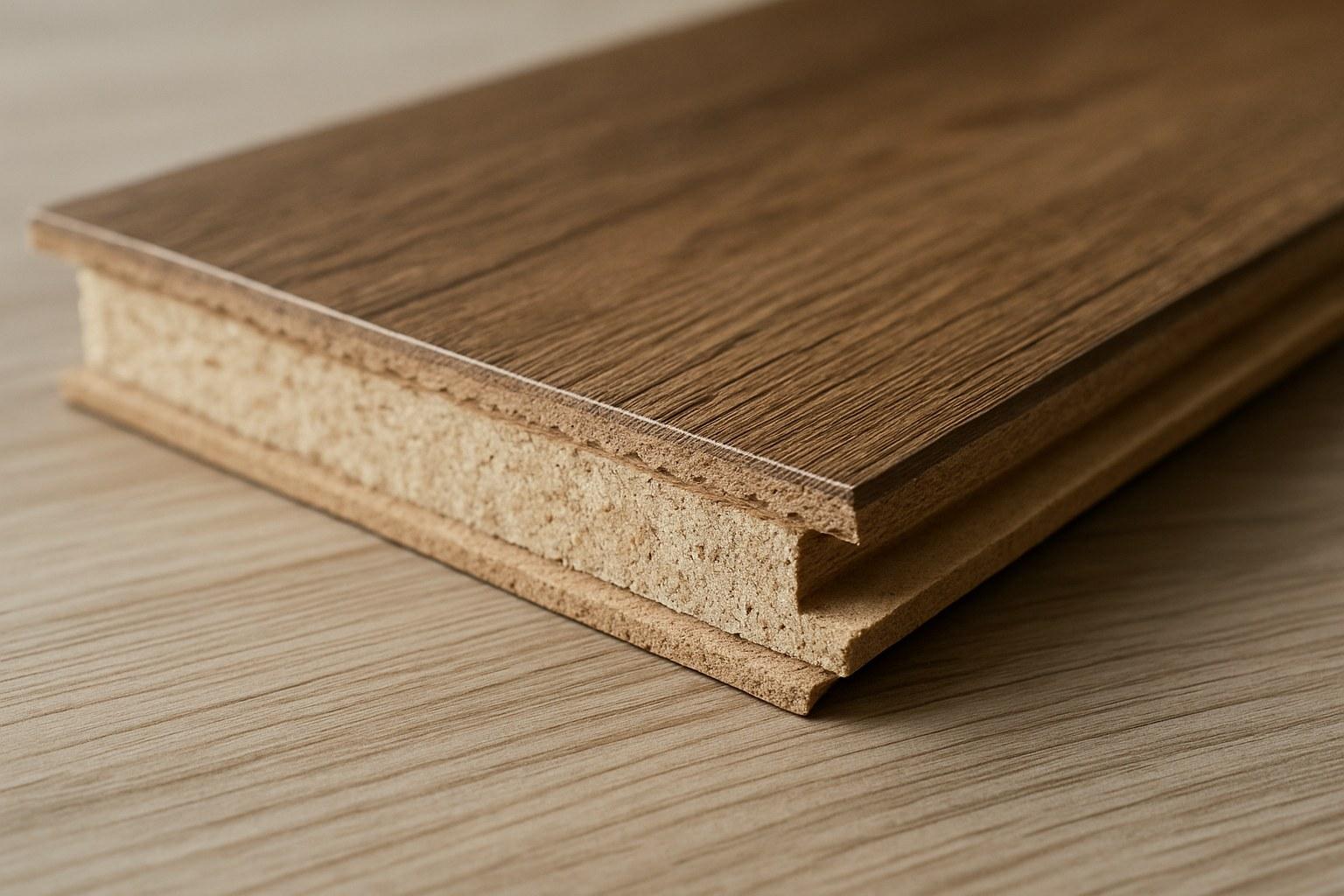
A laminate plank is built in layers. On top is the wear layer, a clear coat, usually an aluminum oxide finish, that takes the scuffs and scratches. Under that sits the decor paper, the printed photo of wood or stone you actually look at. Below that is the HDF (high-density fiberboard) core, the dense wood-fiber body that holds the click joint together. At the bottom is a backing layer that keeps the plank flat and fights moisture coming up from the subfloor.
Thin the HDF core and the plank feels hollow underfoot. It telegraphs every dip in the subfloor, and the locking edge gets shorter and weaker. That same locking edge is one of the clearest splits between laminate and LVP (luxury vinyl plank), which trades the wood-fiber core for a plastic one that doesn't weaken the same way, as this LVP vs laminate comparison lays out.
Drop the wear rating and you save money too. That rating is the AC scale, short for Abrasion Class, a number for how much traffic the surface takes. AC3 is fine for a guest bedroom but under-spec for a hallway that sees everyone's shoes.
The locking edge is the quiet one. The click joint is where cheap planks drift apart and let water reach the core. On the bargain floors, that joint is the spot I'm back out fixing more than any other.
Then there's the warranty. A big number on the box often comes with narrow coverage in the fine print, with exclusions for seams and wet rooms right where you'd want the protection.
Does Cheap Laminate Come With Underlayment?
Sometimes. Some planks ship with a thin foam pad already attached to the bottom. Many cheap lines don't, so you buy underlayment separately.
This matters for two reasons. First, it's a hidden cost that the sticker hides. Second, nearly all floating laminate requires a specific underlayment, and doubling up pads over a pre-attached one can void the warranty. Read the box before you add a layer the maker didn't ask for. Matching that pad to the subfloor underneath it is its own decision, one this guide to the best underlayment for laminate flooring sorts out by subfloor type.
How to Judge a Cheap Plank Before You Buy
The best cheap plank is a discontinued AC4 line from an established brand, not the thinnest AC3 on the rack. Spend your bargain money on build quality, not just a low number.
Run through this before you load the cart:
- AC rating: AC4 for kitchens, halls and living rooms; AC3 only for bedrooms
- Core: thicker HDF feels solid, hides subfloor flaws and locks tighter
- Wear layer: an aluminum oxide finish with a thickness named on the spec sheet
- Water claim: check the exact product wording, not "waterproof" on the display
- Underlayment: is it pre-attached, or a separate line you still have to buy?
- Warranty: read what's excluded, especially seams and wet rooms
- NALFA (North American Laminate Flooring Association) seal: a tested-to-standard mark, not just a logo
That last one is worth a word. NALFA stands for the North American Laminate Flooring Association. When a plank carries its seal, it means the product was tested to a shared standard, not just dressed up with marketing. It doesn't make a cheap plank bulletproof, but it tells you someone measured the claims.
Why $0.99 a Square Foot Isn't Really $0.99
The sticker is one line of the bill. Underlayment, trim, labor and waste all stack on top, and they usually double or triple the real number. Our breakdown of what actually sets laminate flooring cost walks through each of those add-on lines individually.
Underlayment adds $0.25 to $1 a square foot, according to thebestlaminateflooring.com, unless it's pre-attached. Budget install quotes run $2 to $5 a square foot for labor only, per manasotaonline.com. Homewyse puts its 2026 national average for basic installation labor at $6.91 to $11.81 a square foot. Those figures disagree because different sources price the same labor differently, so weigh both against the quotes you get. Once you're pricing actual rooms rather than a flat per-square-foot average, our flooring installation cost guide breaks material, labor, and prep down by room size so those competing numbers get easier to square away.
| Line item | Cost | Note |
|---|---|---|
| Cheap laminate planks (materials) | $0.99-$1.49 / sq ft | the sticker price everyone quotes |
| Underlayment, if not pre-attached | $0.25-$1 / sq ft | basic foam low, cork or vapor-barrier higher |
| Installation labor (budget quote) | $2-$5 / sq ft | open rooms, click-lock |
| Installation labor, basic (2026) | $6.91-$11.81 / sq ft | Homewyse national average, labor only |
| Transitions & trim | $2-$4 / linear ft | priced by the foot, not sq ft |
| Waste / overage | order ~10% extra | cuts, mistakes, future repairs |
Trim and transitions are priced by the linear foot, usually $2 to $4 per linear foot according to thebestlaminateflooring.com, not by the square foot. A choppy floor plan with lots of doorways and closets costs more than one open room.
Order about 10% extra for cuts, mistakes and a few spare planks tucked away for future repairs. That matters more with cheap lines, because the color may not exist to buy next year.
Can you DIY it? Click-lock cheap laminate in an open room is realistic for most handy homeowners. Stairs and big open-plan floors that cross from a dry room into a damp one are where hiring out usually earns its money.
Whatever you do, check the subfloor before a single plank goes down. Run a straightedge across it to find dips and humps, and run a moisture check on concrete. The maker's warranty quietly rests on that prep, not on the plank you picked. If you want the full labor picture, our laminate floor installation cost breakdown walks through what the install portion really pays for.
How Much Does 1,000 Square Feet Cost?
Planks alone for 1,000 square feet run $990 to $1,490 at the cheap tier. That's just the start.
Do it yourself and add underlayment ($250 to $1,000), trim, and about 10% waste. Material-only lands roughly $1,500 to $3,000.
Hire a budget installer for an open room and add $2,000 to $5,000 in labor, so figure $3,500 to $8,000 all in. Homewyse's 2026 national average for basic installation labor alone runs $6,910 to $11,810 for 1,000 square feet, add materials on top of that for the full job. To pin a number to your own floor plan, plug your rooms into our flooring estimate walkthrough.
Cheap Waterproof Laminate for Bathrooms and Basements
A waterproof core and waterproof seams are two different promises, and cheap laminate usually only keeps the first one. A waterproof HDF core can shrug off a wiped-up spill. The seams and edges are where bargain planks let water in and swell.
In a half-bath with no tub or shower, cheap waterproof laminate can work. A full bath with standing water finds the seams every time. One more thing on tile-look laminate: the grout-look groove holds grit, so I warn folks about the extra sweeping before they fall for the showroom photo.
How a spill reaches the HDF core through a cheap laminate click joint.
Basements are their own job. A concrete slab needs a vapor-barrier underlayment, a real moisture check, and a flatness check before you lay anything.
Where water is the main worry, laminate is fighting with a hand tied behind its back, because the core is still wood fiber. Luxury vinyl plank handles standing water at the seams better. Our guide on whether laminate or vinyl flooring suits a given room lays out that tradeoff room by room.