
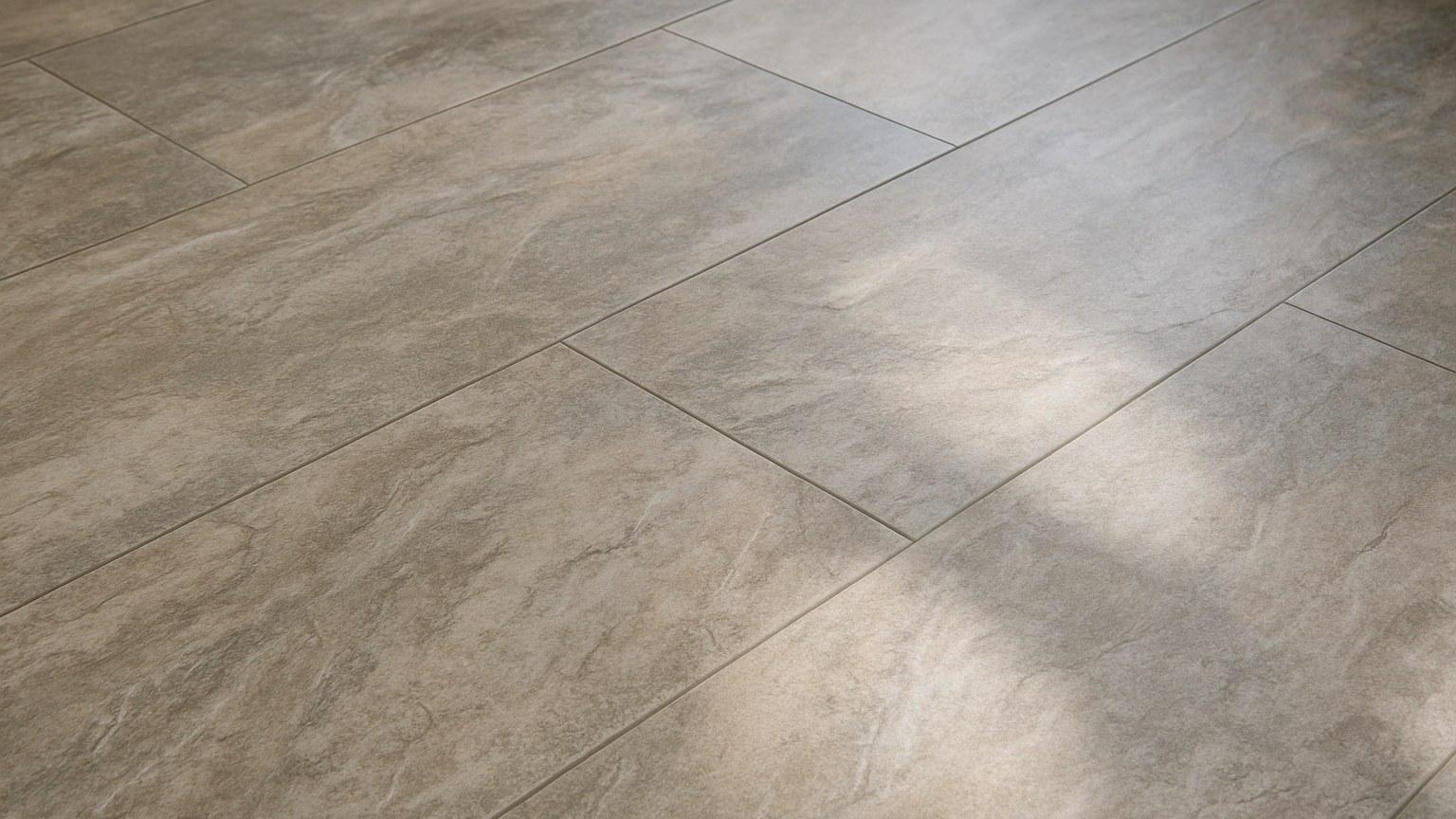
Stone laminate flooring fakes marble and slate well in dry rooms, but it fails in a full bathroom, where water collects in the seams and swells the wood-fiber core. The look is just a printed photo, so getting that part right is easy. The core handling standing water is the part that isn't, and that's the floor I end up ripping back out months later.
Key takeaways
- Stone laminate is a printed photo of marble, slate or travertine over a wood-fiber (HDF) core, sold as click-lock planks or square tiles, warm underfoot and with no sealing to keep up.
- Materials run about $3.50-$4 per square foot (This Old House); installed, Right Step Flooring puts it at $3-$13 per square foot and Homewyse estimates a $6.91-$11.81 national average for 2026.
- NALFA (North American Laminate Flooring Association), the laminate industry group, says laminate is not for bathrooms or high-moisture rooms; the core swells at the seams, so keep it out of full baths and wet entries.
- A waterproof-marketed core still does not mean waterproof seams; most failures I pull up start at the edges near a sink or dishwasher line.
- For the most convincing stone look, choose an AC3 or AC4 rating with deep embossed texture and beveled or grouted edges, not flat planks butted together.
What Stone Laminate Flooring Is (and What 'Stone Effect' Means)
Stone laminate flooring is a high-resolution photo of real stone, printed on paper, pressed over a wood-fiber core, and sealed under a clear top coat. There is no actual rock in it. It comes as click-lock planks or square tiles, in marble, slate, travertine, and limestone looks.
Picture the plank in layers, top to bottom. On top sits a clear aluminum oxide wear layer that fights scratches and fading. Under that is the decor paper, which is the printed stone image you actually see. Below that is the HDF core, short for high-density fiberboard, a dense pressed-wood board usually around 6 to 12 mm thick that gives the plank its body and holds the locking edges. A backing layer on the bottom keeps the plank flat and blocks some moisture from below.
The names trip people up. "Stone effect laminate flooring," "stone look laminate flooring," and "laminate stone flooring" all point to this same product. The core is wood fiber, not stone and not plastic. Whatever you call it, all three names funnel into the same broader category covered in the laminate tile flooring overview.
Here's the honest draw. It feels warm and has a slight give underfoot, unlike cold, hard stone. It needs no sealing. And it costs a fraction of real marble or slate. Those are exactly the reasons it keeps getting chosen for rooms it can't survive.
Which Laminate Looks Most Like Stone
The most convincing stone fakes are tile-format planks with deep embossing you can feel and beveled or grouted edges, in matte slate, tumbled travertine, honed marble, and limestone prints. Flat, glossy planks butted together with no grout line are what give a cheap stone floor away every time. If convincing tile-look planks interest you beyond just stone prints, what I check before installing tile-look laminate runs through the same embossing and edge details in more depth.
What reads as real is variety and texture. On a good line, the print changes from tile to tile instead of repeating the same photo, and you can feel the surface follow the image, with low spots where grout would sit and a slightly rough face on a slate look. Run your hand over it. If it's dead smooth under a stone picture, your eye catches the lie.
To shop by look, think in families. Polished marble prints brighten an entry. Matte slate hides crumbs and footprints in a busy kitchen. Soft cream limestone or travertine warms up a living room. Big-box lines often file these under names like "villa" or "Tuscan" stone.
For the best stone look laminate flooring, judge the physical sample in your hand, not the website photo. Check the texture and the edge treatment before anything else, because those two things decide whether it passes as stone.
What Other Tiles Look Like Limestone Tile?
Travertine, tumbled marble, and some sandstone prints read closest to limestone. They share the same soft cream and beige tones and a matte, lightly textured face. If you like limestone but want a touch more pattern, a travertine look gives you the faint pitting and veining while keeping that warm, quiet color.
Stone Laminate vs. LVT, Porcelain Tile, and Real Stone
Stone laminate wins on warmth and price. Stone-look LVT, which is luxury vinyl tile, wins on water. Porcelain tile wins on any-room durability. Real stone wins on looks but loses on cold feet, cost, and upkeep. If you're still weighing the broader laminate-versus-vinyl question before settling on a stone look, the laminate or vinyl flooring comparison breaks down that fundamental choice first.
Moisture is where the real choice gets made. Laminate only tolerates spills you wipe up fast. Many stone-look LVT lines use a waterproof core, but how well the seams resist water still depends on the specific product, so check the spec sheet. Porcelain tile's body is naturally non-porous, which is why it stands up to water in any room. Real stone resists water too, but it's porous, so it has to stay sealed or it stains.
Feel and install difficulty split the same way. Laminate and LVT click together and suit a confident DIYer. Porcelain and real stone are cold, hard, and heavy. They're usually worth hiring a tile setter for, because a bad mortar bed cracks grout within a year.
| Material | Moisture tolerance | Wear rating | Feel underfoot | Maintenance | DIY-friendly |
|---|---|---|---|---|---|
| Stone laminate | Wiped-up spills only; no wet rooms | AC rating varies by product (commonly AC3-AC4) | Warm, slight give | Sweep and damp mop; no sealing | Yes, click-lock |
| Stone-look LVT | Water-resistant seams; waterproof core varies by product | Mil wear layer, thickness varies by product | Warm, softer | Sweep and mop; no sealing | Click-lock yes; glue-down hire out |
| Porcelain tile | Non-porous body resists water in any room | PEI hardness rating, varies by product | Cold, hard | Seal and clean grout lines | Hard; usually hire out |
| Real stone (marble/slate) | Water-resistant but porous; must stay sealed | Varies by stone | Cold, hard | Periodic sealing and polishing | No; hire a stone setter |
Source: NALFA guidance on laminate in wet areas
How the four stone-look options compare on moisture, feel, upkeep, and install. A few spec terms show up in that wear-rating column: AC rating (short for abrasion class) scores a laminate's scratch and wear resistance from AC1 up to AC5; PEI rating scores how hard a porcelain tile's surface is, with a higher number standing up to heavier foot traffic; and mil wear layer is the thickness, in thousandths of an inch, of the clear protective top layer on an LVT plank.
Stone-look LVT is the real competitor in wet rooms, so if that's your fight, read the full LVP (luxury vinyl plank) vs. laminate breakdown before you buy.
Where Stone Laminate Belongs, and the One Room It Wrecks
Put stone laminate in living rooms, bedrooms, halls, and dining rooms. Keep it out of full bathrooms and wet entries. NALFA, the North American Laminate Flooring Association, which is the laminate trade group, says laminate is not made for high-moisture rooms. For a broader room-by-room breakdown that covers laminate generally, including how 12mm vinyl plank stacks up, see which rooms laminate flooring actually works in.
The failure is simple. The HDF core is wood fiber. When water sits in a seam, it soaks in and swells the edges, and no printed stone surface stops that from happening underneath it.
The pattern repeats almost every time I get pulled into one of these jobs. A marble- or slate-look plank was pretty enough to talk someone into a bathroom or a snowy mudroom. When I come to pull it up, the swelling has started at a seam near the tub or the door, out at the edges, not in the open field of the floor. Once a seam lifts, it only spreads.
If you want a stone look in a true wet room, go read the laminate bathroom flooring guide to see why I send baths toward porcelain tile or waterproof LVT instead.
Is Stone Laminate Flooring Waterproof?
No. Some lines are marketed with a water-resistant or even "waterproof" core, but that is not the same as waterproof seams. The surface can shrug off a sitting puddle for a while, while water still creeps into the edge where two planks meet. The swelling I pull up tends to start right there, at the seams near a sink or dishwasher line. If a floor is sold as waterproof, read what the specific product's warranty actually covers, because the marketing word and the fine print often don't match. I dig into that gap in the guide to waterproof laminate claims you can actually verify.
The Best Stone-Look Laminate for a Kitchen
A matte slate or tumbled travertine print with an AC4 rating and tight, beveled edges is a strong kitchen pick. Matte hides the footprints and crumbs a kitchen collects, and the higher wear rating takes chair scrapes and dropped pans. Wipe spills fast and keep the seams near the sink and dishwasher sealed, since that run is where kitchen floors swell first.
Where stone laminate fits by room, from a good fit in dry living space to avoid in a full bathroom.
Durability and Upkeep: AC Ratings, Wear Layers, and Easy Cleaning
The AC rating, short for abrasion class, is the number that tells you how well the surface stands up to scratching and wear. According to NALFA, it runs from AC1 up to AC5, with AC3 suited to normal household traffic and AC4 suited to heavier traffic like a busy kitchen or a family with pets.
For a stone look, I'd buy AC4 if the price gap is small. Stone prints live in entries and kitchens where grit gets tracked in, and a tougher wear layer holds the printed surface together longer before it dulls.
Upkeep is where stone laminate actually beats real stone. Sweep it, then damp mop it, and you're done. Keep the mop damp, not wet, so you never leave standing water on a seam. There's no sealing to keep up, which is the chore real marble and slate demand periodically to keep from staining.
What stone laminate can't do is take a deep gouge or a chip repair. If a plank gets wrecked, you swap the plank. You can't spot-polish it the way you can with real stone, so for a convincing, low-effort stone look in a dry room, that trade is usually worth it. If you want the feature-floor version of this, the luxury laminate flooring guide walks through the thicker cores and deeper textures.
What Stone Laminate Costs, Materials vs. Labor
Expect roughly $6.91 to $11.81 a square foot installed, based on Homewyse's 2026 national average, with the materials alone a smaller slice of that. This Old House puts the materials at about $3.50 to $4.00 a square foot. Right Step Flooring puts the full installed price anywhere from $3 to $13 a square foot, a wide band because the floor, the subfloor, and the room all move the number. Chasing the bottom of that range usually means a thinner core and a shallower wear layer, trade-offs the cheap laminate flooring guide lays out plank by plank.
| Line item | Range per square foot | Source |
|---|---|---|
| Materials only | $3.50-$4.00 | This Old House |
| Installed, full range | $3-$13 | Right Step Flooring |
| Installed, 2026 average | $6.91-$11.81 | Homewyse |
Materials vs. labor cost per square foot for stone laminate flooring.
Read that as two numbers. The material is the smaller part. The rest is labor and prep, and prep is what blows a bid up: leveling a wavy subfloor, adding underlayment, cutting around cabinets. An open rectangular room runs at the low end. Stairs and basements run high, because stairs are slow hand-work and basements need a slab moisture test and sometimes a vapor barrier before anything goes down.
Click-lock stone laminate in a square room is realistic DIY, and doing it yourself cuts out that labor slice. I'd call in contractors for stairs, any glue-down job, and a large open floor that transitions into a damp area, since those are the installs that come back wrong. For a full line-item breakdown of what drives a laminate bid, the laminate flooring cost guide runs the whole estimate.