
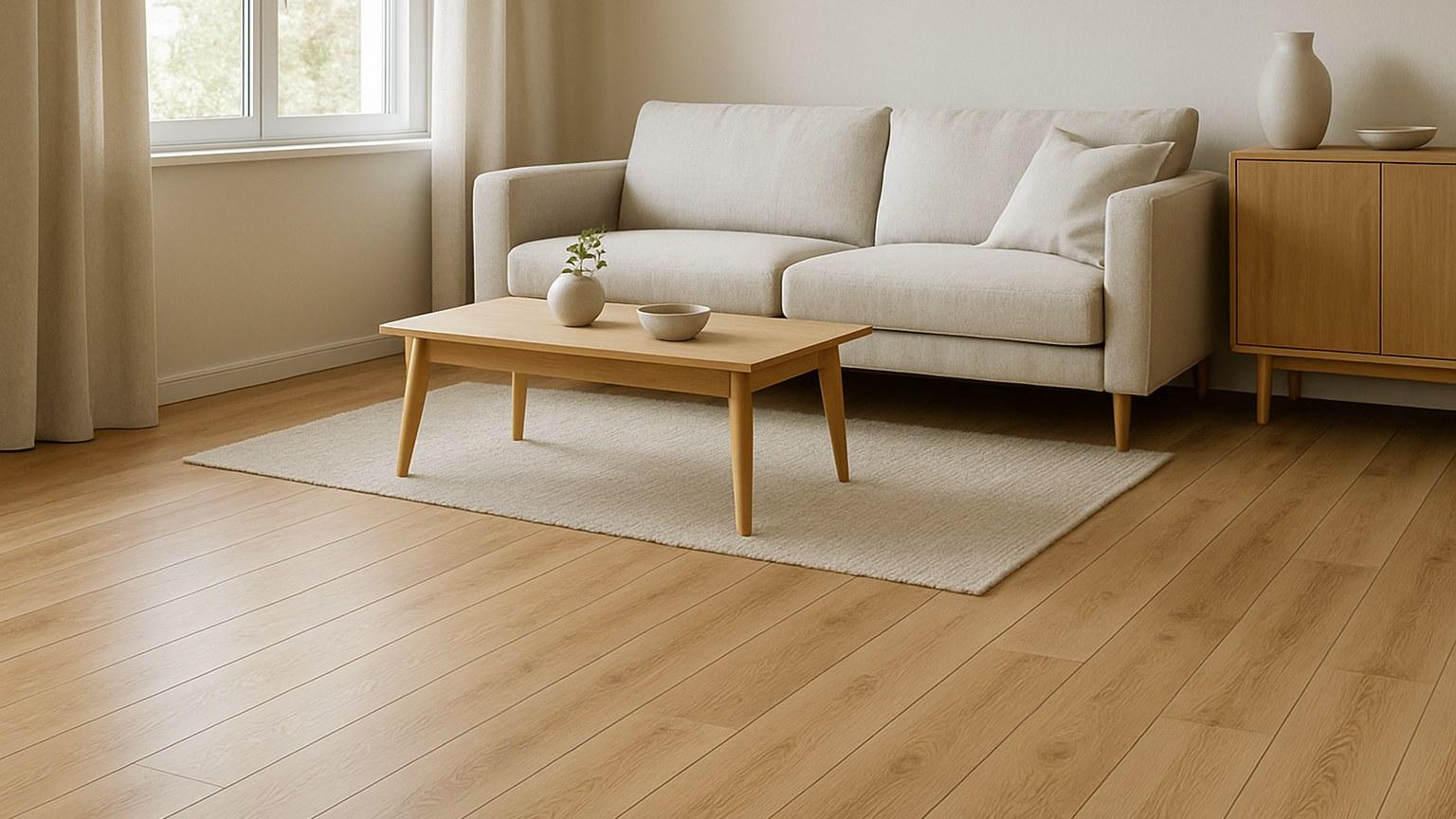
Ask what is laminate and you're really asking about two things: floating floor planks you walk on, and a thin printed sheet glued onto counters and cabinets. Most folks mean the floor. The same word landing on both a cheap countertop skin and a whole-room floor is why the searches get so tangled.
Key takeaways
- "Laminate" covers two products: floating floor planks (a wood-fiber HDF core under a printed photo layer and a melamine wear layer) and thin sheet laminate glued onto furniture, counters, and cabinets.
- Laminate flooring is mostly wood by weight, not plastic; only the thin top layers are printed paper and resin, so it is neither solid wood nor pure plastic.
- Look for a TSCA Title VI or CARB2 compliant label on the box; US law caps formaldehyde emissions from the composite-wood core.
- A "waterproof core" claim is about the plank body, not the seams; most laminate fails at the edges when water sits, so mop damp, not wet.
- For wet rooms choose vinyl, for resale value choose solid hardwood, and choose laminate for a realistic wood look at a lower price in dry, busy rooms.
What Is Laminate? Two Products, One Word
Laminate is a manufactured, layered material, and the word covers two different products that get mixed up online. One is laminate flooring, the floating planks you walk on. The other is laminate sheet, a thin decorative skin bonded to furniture, cabinets, and countertops.
When someone types "what is laminate," they're almost always shopping for flooring. Sheet laminate is the surface you've touched on a kitchen counter or an office desk, but it rarely sends people searching the way a floor project does.
Both products share the same idea. Thin layers are printed to look like wood or stone, then bonded together under heat and pressure. Neither one is a slab of real wood or a cut of real stone. It's a picture of wood, sealed hard. Stone-look designs have gotten convincing enough that stone-look laminate flooring deserves a closer look on its own.
A laminate floor has to survive years of foot traffic, furniture legs, and the occasional spill, while a laminate counter or cabinet face only has to survive wiping and a hot pan set down too fast. That durability gap is why this guide spends most of its space on laminate flooring, with sheet laminate getting its own shorter section near the end for anyone also redoing cabinets or counters.
What Laminate Flooring Is Made Of (and Is It Plastic or Wood?)
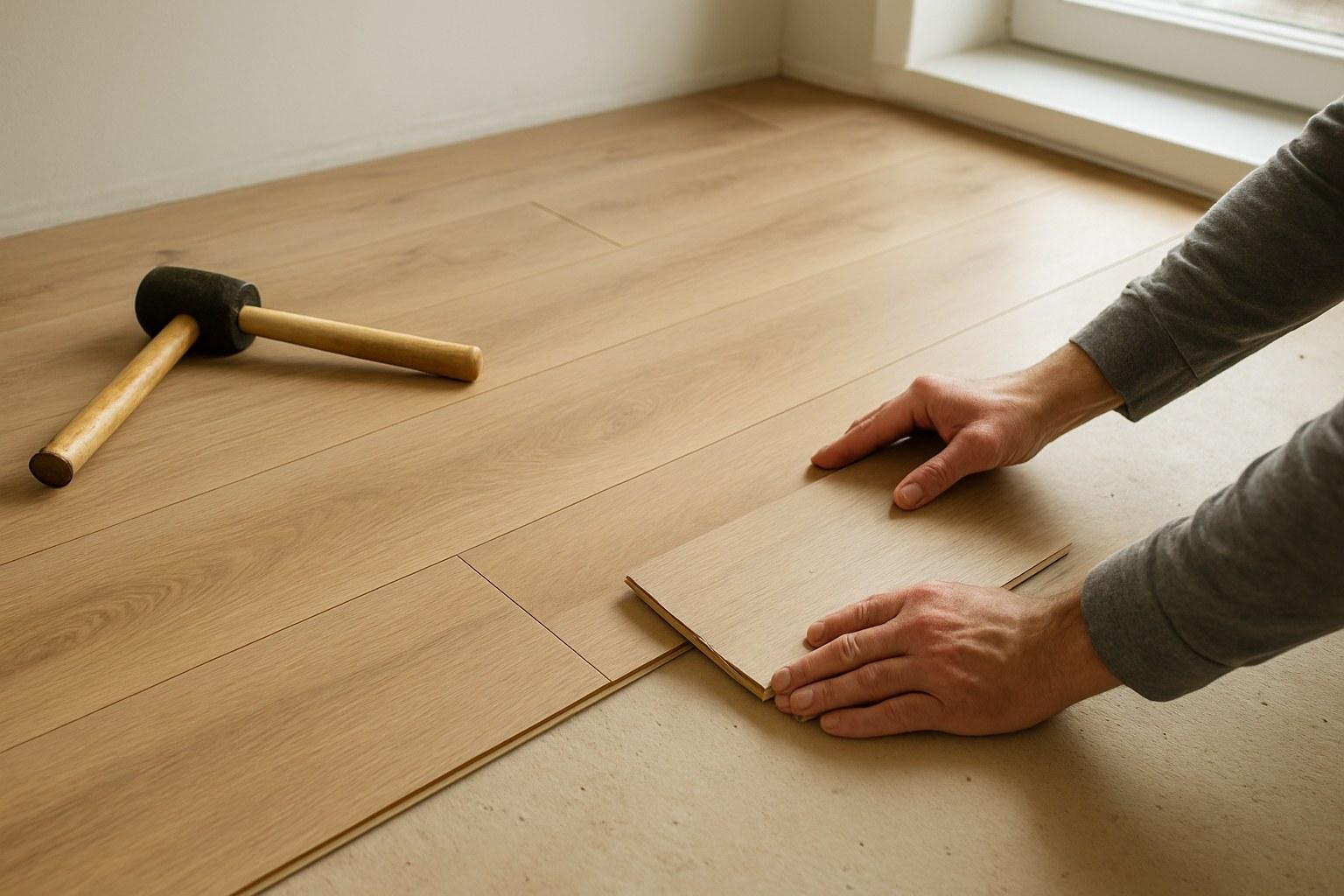
A laminate flooring plank is four layers stacked top to bottom. On top sits a clear wear layer, usually melamine resin with aluminum oxide mixed in for scratch resistance. Under that is the design layer, a printed photo of wood or stone, which is the look you actually see. Below that is the core, a thick slab of high-density fiberboard, or HDF. On the bottom is a backing layer that steadies the plank and slows moisture coming up from the floor. That same design layer is where the most convincing stone laminate flooring gets its texture and veining.
So is it plastic or wood? By weight, it's mostly wood. That HDF core is compressed wood fiber, and it makes up the bulk of the plank. Only the thin top is printed paper sealed in resin. That makes laminate neither solid wood nor pure plastic. It sits in between.
People call it "laminate wood" or "wood laminate" because it mimics wood so well. It is not boards of real timber, though. It's wood fiber pressed into a core, with a photo of a nicer wood printed on top.
A few of those trade words, in plain terms: HDF is tightly packed wood fiber, denser and heavier than regular particleboard. Melamine is a hard, clear resin that forms the see-through shield on top. Aluminum oxide is a gritty mineral baked into that top layer to fight scratches and scuffs.
Types of Laminate Flooring
Not all laminate is the same floor. The main things that separate one plank from another are the wear rating, the thickness, and whether the edges are treated to resist water.
Wear ratings run on the AC scale, short for Abrasion Class, a test that rates how well the top layer stands up to scratching and wear. AC3 handles normal homes, while AC4 and up hold up to heavier foot traffic and busier rooms. Thicker planks, often 10mm to 12mm, feel more solid underfoot and lock together more firmly than thin 7mm or 8mm boards.
Then there are the water-resistant lines, which add tighter seams and treated edges. The claims vary by product, which is worth sorting out below.
Is Laminate Flooring Safe? Formaldehyde and the EPA Rules
Laminate sold in the US is held to a federal emissions limit, so it's safe for homes when it carries the right compliance label. The question is fair, because the HDF core is held together with resin that can release small amounts of formaldehyde.
In plain terms, the Environmental Protection Agency, the EPA, enforces formaldehyde emission limits on composite wood through a regulation called TSCA Title VI, part of the Toxic Substances Control Act. That federal rule mirrors California's CARB2 standard, short for the California Air Resources Board's Composite Wood Products regulation, Phase 2, which set formaldehyde limits for composite wood before the federal rule existed.
What you check at the store is simple. Look for a "TSCA Title VI" or "CARB2 compliant" line on the box or the spec sheet. A stated low-VOC or low-emission claim is a good sign too, and any honest dealer can hand you the emission certification if you ask. Those three checks tell you the core was tested against the federal limit.
This isn't an unproven material. According to the North American Laminate Flooring Association (NALFA), laminate has been a product category for over 30 years, and it has become a widely used flooring option in homes across North America.
One sensible note: if someone in the home is sensitive to smells or has breathing trouble, air out new flooring well after it's installed, and get that emission certification from your dealer before you buy.
Laminate vs. Vinyl vs. Hardwood: Which One for Which Room
The short answer: pick laminate for a realistic wood look on a budget in dry, busy rooms. Pick vinyl, usually luxury vinyl plank (LVP), for wet rooms and basements. Pick solid hardwood when resale value and the ability to sand and refinish matter most. Weighing laminate against vinyl flooring in more depth is worth doing before you commit to either. Vinyl's own durability swings just as widely depending on the grade and the room, which is the whole subject of whether vinyl flooring lasts 5 or 20 years.
| Material | Makeup | Water | Look | DIY | Cost tier |
|---|---|---|---|---|---|
| Laminate | Wood-fiber HDF core, printed photo layer, melamine wear layer | Water-resistant at best; seams swell if water sits | Realistic wood look, usually the most convincing for the price | Click-lock is DIY-friendly in a square room | Low to mid |
| Vinyl (LVP) | Plastic (PVC) core and layers, printed film, urethane wear layer | Core shrugs off water; seams still the weak point | Good, though cheaper lines can look flatter than laminate | Click-lock DIY-friendly; glue-down is better hired out | Low to mid |
| Hardwood | Solid or engineered real wood | Low; standing water and wet rooms damage it | The real thing; adds resale value and can be refinished | Nail-down and finishing are usually worth hiring out | High |
How the three materials stack up on makeup, water tolerance, realistic look, DIY-friendliness, and cost.
The real laminate-versus-vinyl tradeoff: laminate often looks more like real wood and costs less, while vinyl tolerates water far better at the seams. Neither wins everywhere, so the right pick depends on the room. If you've narrowed it to those two, the 9 differences between LVP and laminate ranked by what wrecks each floor goes point by point.
On cost, don't trust a single national number. Materials range from bargain big-box laminate to pricier water-resistant lines, and labor rates shift by region and by whether a pro or a DIYer does the work, so the exact materials-vs-labor split looks different on every job, though materials usually run cheaper than labor. What stays true everywhere: basements and stairs cost more than open rooms, because of the extra cuts, transitions, and moisture prep. That bargain big-box laminate carries its own trade-offs worth knowing before checkout, which is exactly what the real cost of cheap laminate flooring lays out.
Which One for Whom: The Verdict by Room and Budget
Dry living rooms, bedrooms, hallways, and offices: laminate, if budget is tight and you want convincing wood. Kitchens, bathrooms, laundry rooms, and basements: vinyl, because the plastic core doesn't care about a spill. Formal spaces where you want resale value and the option to refinish down the road: solid hardwood, and plan to hire the install. For a closer look at this room-by-room split, see the guide on which rooms laminate flooring actually works in.
If your choice is really laminate against the real thing, the laminate vs. hardwood head-to-head breaks down cost, lifespan, and resale in detail.
Waterproof vs. Water-Resistant Laminate: Not the Same Thing
A "waterproof core" claim is about the plank body, not the joints. Laminate that fails tends to fail at the seams and edges, right where water sits and soaks in. The core can be the toughest part of the plank and the floor can still swell.
"Water-resistant" usually means the floor tolerates spills you wipe up quickly. Each maker writes its own definition and ties its own warranty conditions to that claim, so read the specific product's sheet rather than trusting the word on the category. One brand's water-resistant is not another's.
Even laminate marketed as waterproof still has a wood-fiber core. Once water reaches an exposed edge, that core can swell and lift, waterproof label or not.
I've seen it firsthand. A customer in a Dayton suburb mopped their new laminate soaking wet every week like it was tile. By late winter the board edges near the mudroom had swelled and chipped. Damp-mop only, never wet, and wipe spills before they sit. For a full breakdown of which water claims actually hold up, see the guide on what water-resistant laminate really does and what's just marketing.
One more thing that protects any laminate floor, water claim or not: the prep underneath. A floating floor only lasts as long as the subfloor it sits on. Before laying a single plank, check that the subfloor is flat within the maker's spec and that it's dry, since most warranties quietly hinge on both. Skip that and the seams open no matter how good the plank is.
What Sheet Laminate Is (the Countertop and Cabinet Kind)
Sheet laminate is the thin, printed skin glued onto countertops, cabinet faces, and furniture. It's the same basic idea as the floor, printed layers pressed hard, but it's a fraction of the thickness and it bonds to a substrate like particleboard instead of locking together as planks.
You've met it on a kitchen counter, an office desk, or the inside of a cabinet. It's cheap, it comes in endless wood and stone looks, and it wipes clean. What it won't do is carry foot traffic or handle a dropped pan the way a floor or a stone counter does. For the full rundown on that product, see the guide to laminate sheet flooring and surfacing.