
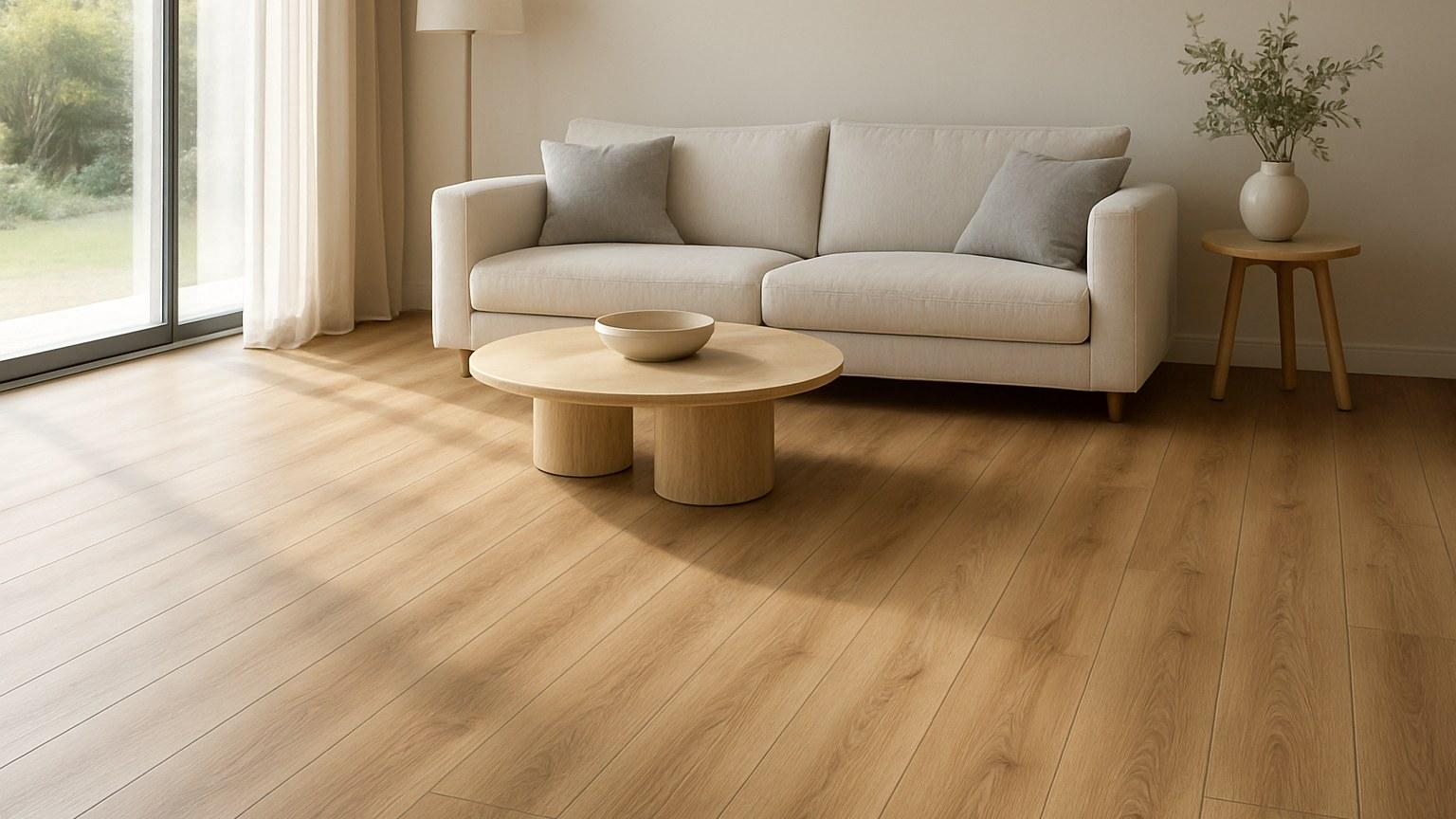
Luxury laminate flooring isn't a spec or a grade. It's a sales label with no industry definition, so the only way to know what you're really buying is to check five things: AC wear rating, core density, texture, edge treatment, and water resistance. That gap between the fancy word on the box and the actual specs is where homeowners end up paying more and getting no more.
Key takeaways
- "Luxury laminate" is a marketing word with no industry definition; what actually sets a plank apart is its AC wear rating, HDF (high-density fiberboard) core density, embossed-in-register texture, edge treatment, and whether the core is water-resistant.
- AC4 is the sweet spot for busy homes with kids and pets; AC5 is heavy-commercial grade and usually overkill in a house.
- A "waterproof core" protects the plank body, not the seams. Most failures start at the edges, so standing water in a full bathroom is still a risk.
- Luxury laminate runs about $3-$13 per square foot installed per rightstepflooringnc.com, or $6.91-$11.81 per square foot in 2026 per homewyse.com, split between materials and labor.
- Before paying luxury money, confirm four things in writing: AC rating, core type, NALFA (North American Laminate Flooring Association) or FloorScore certification, and warranty length.
What "Luxury Laminate" Actually Means
There is no legal or industry definition of "luxury laminate." Nobody sets a bar a plank has to clear to earn the word. Judge the board by its specs, not the label stuck on the display.
Here are the tells that actually separate a better laminate from a basic one:
- Embossed-in-register (EIR) texture. This means the grain you feel lines up with the grain you see in the printed photo. Run your hand across it; on a cheap plank the surface is flat under a wood picture, and your eye catches that.
- A denser HDF core. HDF is high-density fiberboard, which is just compressed wood fiber. A denser core gives the plank stiffness and a stronger locking edge.
- An AC4 or AC5 wear rating. More on that below.
- Micro-bevel or painted edges. A small groove at the plank edge that makes each board read as a separate piece, like real wood.
- A water-resistant core. Not every laminate has one, and it matters where you put the floor.
A couple of those terms trip people up. The clear top coat on nearly all laminate is aluminum oxide, a hard coating that resists scratches and fading. The core underneath is that compressed wood fiber. Stack the printed photo and a balancing backing sheet around it and you have a plank.
Worth saying: the North American Laminate Flooring Association (NALFA) points to more than 30 years of laminate manufacturing. The category itself is proven and well understood. It's the "luxury" tag floating on top that means nothing on its own.
AC Ratings and the Wear Layer, Explained
The AC rating measures how well the surface stands up to abrasion and wear, and it has nothing to do with the "luxury" branding. A budget plank can carry an AC4 rating while a pricey one is only AC3. The number is the fact; the label is the marketing.
The three AC grades split out like this, each matched to a different level of traffic.
| AC rating | Built for | Good rooms |
|---|---|---|
| AC3 | General residential | Bedrooms, dining rooms, moderate-traffic spaces |
| AC4 | Heavy residential, light commercial | Hallways, kitchens, homes with kids and pets, small offices |
| AC5 | Heavy commercial | Retail stores, busy public spaces; overkill in a house |
AC wear ratings and the rooms each grade is built to handle.
For a normal house with kids and a dog, AC4 is the sweet spot. It shrugs off the traffic a family puts down and doesn't cost a fortune. AC5 is built for store floors, so at home you're paying for durability you'll never wear through.
The wear layer is aluminum oxide on almost every laminate, but the thickness changes from product to product. Don't assume a number across the whole category. Pull up the specific board's spec sheet and read it.
Waterproof vs. Water-Resistant Core: Where It's Safe
These two claims are not the same thing, and the difference decides which rooms are safe. A "waterproof core" means the body of the plank won't swell if it gets wet. "Water-resistant" usually means the floor tolerates spills as long as you wipe them up promptly. Not every product that claims water resistance delivers the same protection, which is why it pays to check what holds up in water resistant laminate flooring before you buy.
Either way, the weak point is the seams and edges, not the printed surface on top. Water that sits in the joints reaches the HDF core and swells it, and a "waterproof" sticker on the box does nothing to stop that. Failures I get called out to tend to start at the edges, not in the middle of a board.
That split points to clear room choices. A water-resistant core is fine in kitchens, mudrooms, and entryways where spills get cleaned up fast. Full bathrooms and laundry rooms, where water can sit on the floor, are where laminate fails no matter what the core claim says. For those rooms, read our take on whether laminate belongs in a bathroom at all before you buy.
Read the product's specific language and understand the exact warranty details it provides. Since each brand interprets its standards differently, "waterproof" on one maker is not the same promise as on another. That inconsistency is exactly why marketing claims around waterproof laminate flooring deserve a closer look before you trust the label.
Luxury Laminate vs. Luxury Vinyl Plank
There's no universal winner here, just a real tradeoff. Luxury laminate usually gives a more realistic wood look and a firmer, more wood-like feel underfoot, often at a lower price. Luxury vinyl plank (LVP) tolerates water far better. That's the whole decision in one line. Weighing laminate against vinyl plank by plank comes down to which room you're flooring and what tradeoff matters most there.
The cores drive it. LVP's SPC (stone plastic composite) or WPC (wood plastic composite) core is plastic and stays stable when it gets wet. Laminate's HDF core is wood fiber, so it can swell at the seams if water gets in. Core type is only one of several factors behind what makes vinyl flooring last decades.
On cost, budget LVP runs about $2-$3 and mid-range LVP about $3-$5 per square foot per carpetexchange.com, while luxury laminate materials run about $1-$5 per square foot per rightstepflooringnc.com.
Bottom line by room: laminate for living areas and bedrooms where you want the best wood look, and LVP for bathrooms, laundry rooms, and basements where water is the real threat. If you're stuck on this exact call, the nine differences between LVP and laminate ranked by what wrecks each floor walks through it room by room.
Looks and Trends: Wide Planks, Greige, and Herringbone
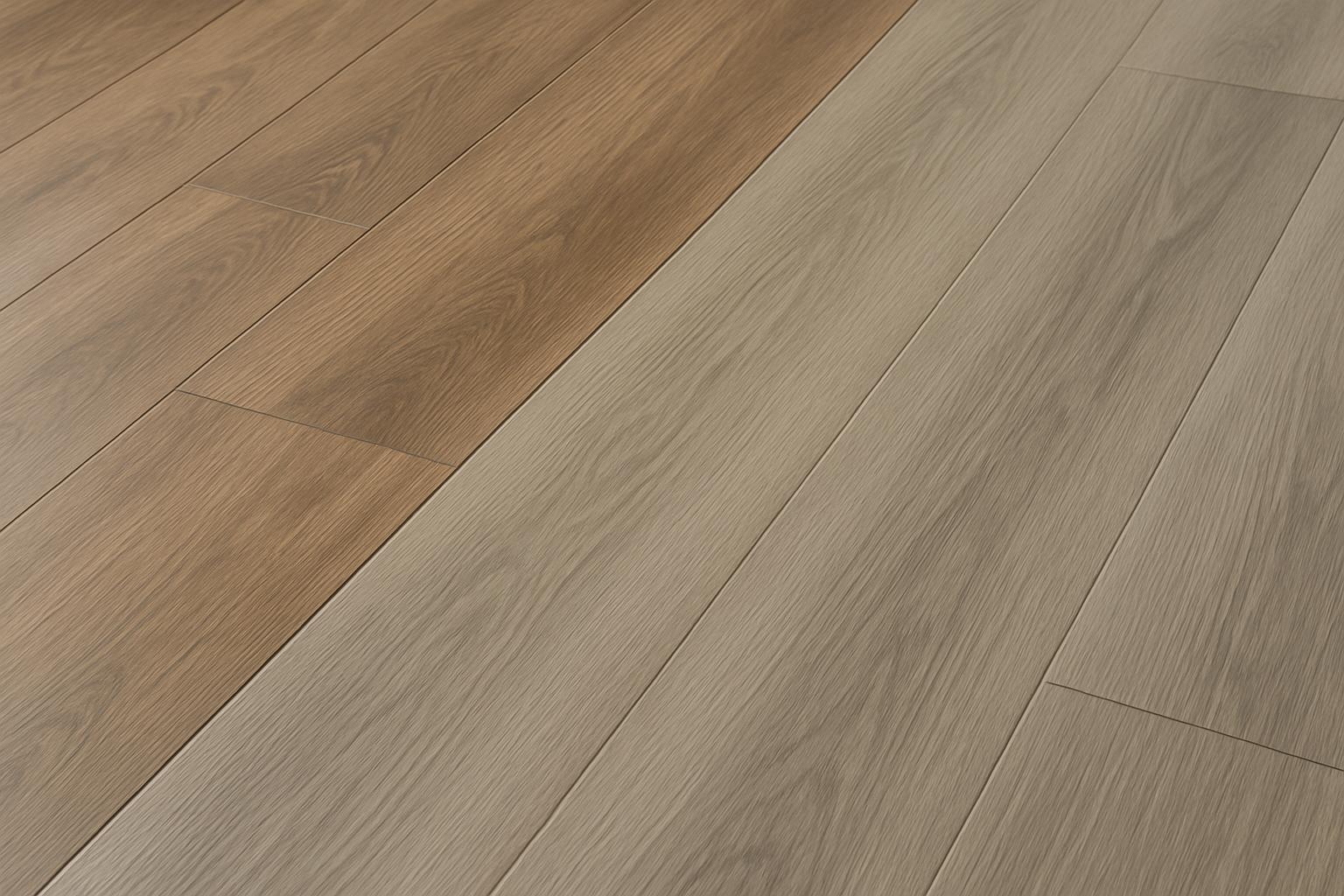
Wide, long planks show up most often in the newer luxury lines I come across on jobs these days. They read more like real sawn hardwood and show fewer seams across a room, which is a big part of why they feel more expensive. That resemblance is exactly why so many buyers end up comparing laminate against hardwood flooring before deciding which one actually belongs in their home.
EIR texture is what sells that realism. When the grain you feel matches the grain you see, the floor stops looking like a flat photo under plastic. Without it, even a wide plank looks printed.
Herringbone layouts turn up more often in the higher-end lines I'm seeing lately, giving that angled, parquet-style pattern that used to mean real wood and a big labor bill. Low-emission certification is another thing buyers ask about, like a board that's FloorScore certified, meaning an independent lab tested it for low chemical off-gassing indoors, paired with attached cork underlayment for softer, quieter steps.
Greige and Gray: the Colors Homeowners Ask For Most
Gray, greige (that gray-beige blend), white, black, and dark wood tones are the colors homeowners bring up to me most. Gray and greige lead because they go with almost any wall color and hide dust better than very dark floors. Trend-driven colors can date faster than a mid-brown oak, so think about how long you plan to keep the floor before you commit to the look of the moment.
A Verification Checklist Before You Buy
Don't take the display sample's word for any of this. Before you pay, pull the spec sheet for the exact plank you're buying and run it down against four things.
- AC rating. Find the sticker or spec sheet number, AC3, AC4, or AC5, and match it to the room traffic table above. Don't take a sales clerk's word for it; the number has to be printed on the product documentation.
- Core type. Confirm in writing whether the core is labeled waterproof or only water-resistant. Those are two different promises, and the spec sheet should spell out which one applies to that specific board.
- Warranty terms. Read the actual warranty language for that product, not a general claim on the display. According to the North American Laminate Flooring Association (NALFA), some NALFA-certified laminate lines carry warranties as long as 50 years, which shows how much warranty length swings from one product to the next, pin down the real number on your plank before you buy.
- Emissions certification. Check the box or spec sheet for a low-emission certification mark. FloorScore is one path, tested by an independent lab for low chemical off-gassing. The other is CARB2 compliance, which means the board meets the formaldehyde emission limits set by the California Air Resources Board (CARB), the standard most US retailers point buyers toward for laminate flooring. A "luxury" label on the box doesn't tell you either way; the certification mark does.
What Luxury Laminate Costs, and Whether to DIY
Luxury laminate runs about $3-$13 per square foot installed per rightstepflooringnc.com, split between materials and labor. For a 2026 figure, homewyse.com puts the installed average at $6.91-$11.81 per square foot.
| Line item | Cost per sq ft | Source |
|---|---|---|
| Materials only | $1-$5 | rightstepflooringnc.com |
| Labor only | $2-$7 | rightstepflooringnc.com |
| Installed total | $3-$13 | rightstepflooringnc.com |
| Installed average, 2026 | $6.91-$11.81 | homewyse.com |
Per-square-foot cost of luxury laminate, split into materials and labor.
Expect to pay more for basements and stairs than for an open room. Both mean extra cuts, more transition pieces, and more prep, and stairs especially eat labor hours.
On DIY, I'll give it to you straight by install type. Click-lock boards, including the 5G fold-down systems, are realistic for most handy homeowners in a simple square room. Stairs, any glue-down job, and large open-plan floors that cross a moisture transition are where I'd hire a pro, because those are the jobs that come back when they're done wrong. Getting that part right matters even more than the DIY-vs-pro call, since the rules for laminate flooring installation go well beyond what the box instructions cover.
Before a single plank goes down, check two things: that the subfloor is flat, and that it isn't holding moisture. Run a moisture test and sight across the floor for dips and humps. Lift a corner of the old floor and look underneath first. I once took a customer's word that the subfloor was fine and found a field of dried adhesive ridges once the old vinyl came up, requiring roughly four hours of scraping effort I hadn't included in my quote.
The real value here is simple: luxury laminate gets you the hardwood or stone look for a fraction of what the real material costs. Just make sure you're paying for the specs, not the sticker. If a stone look is what you're after, it's worth knowing where stone laminate flooring holds up and where it doesn't.