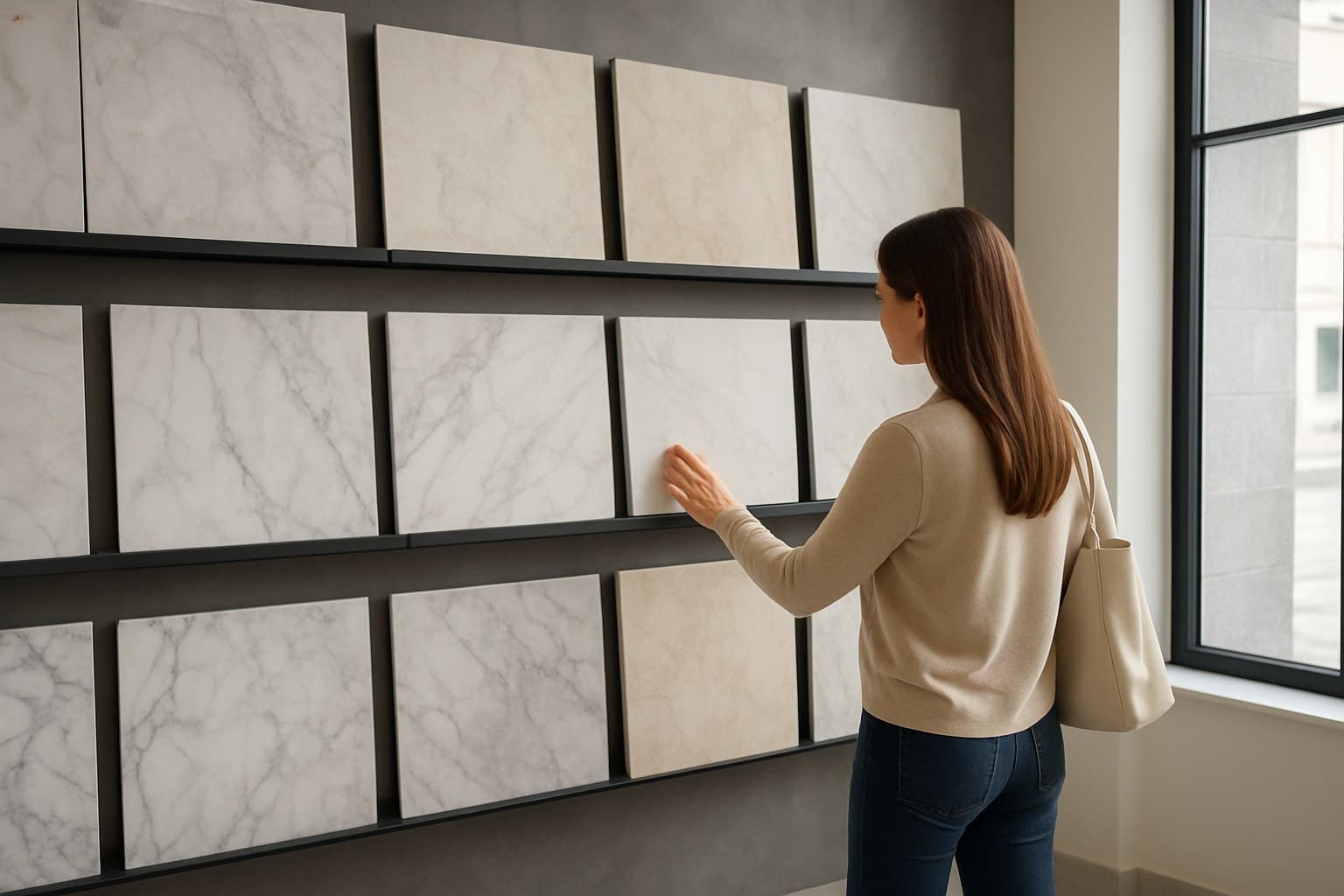
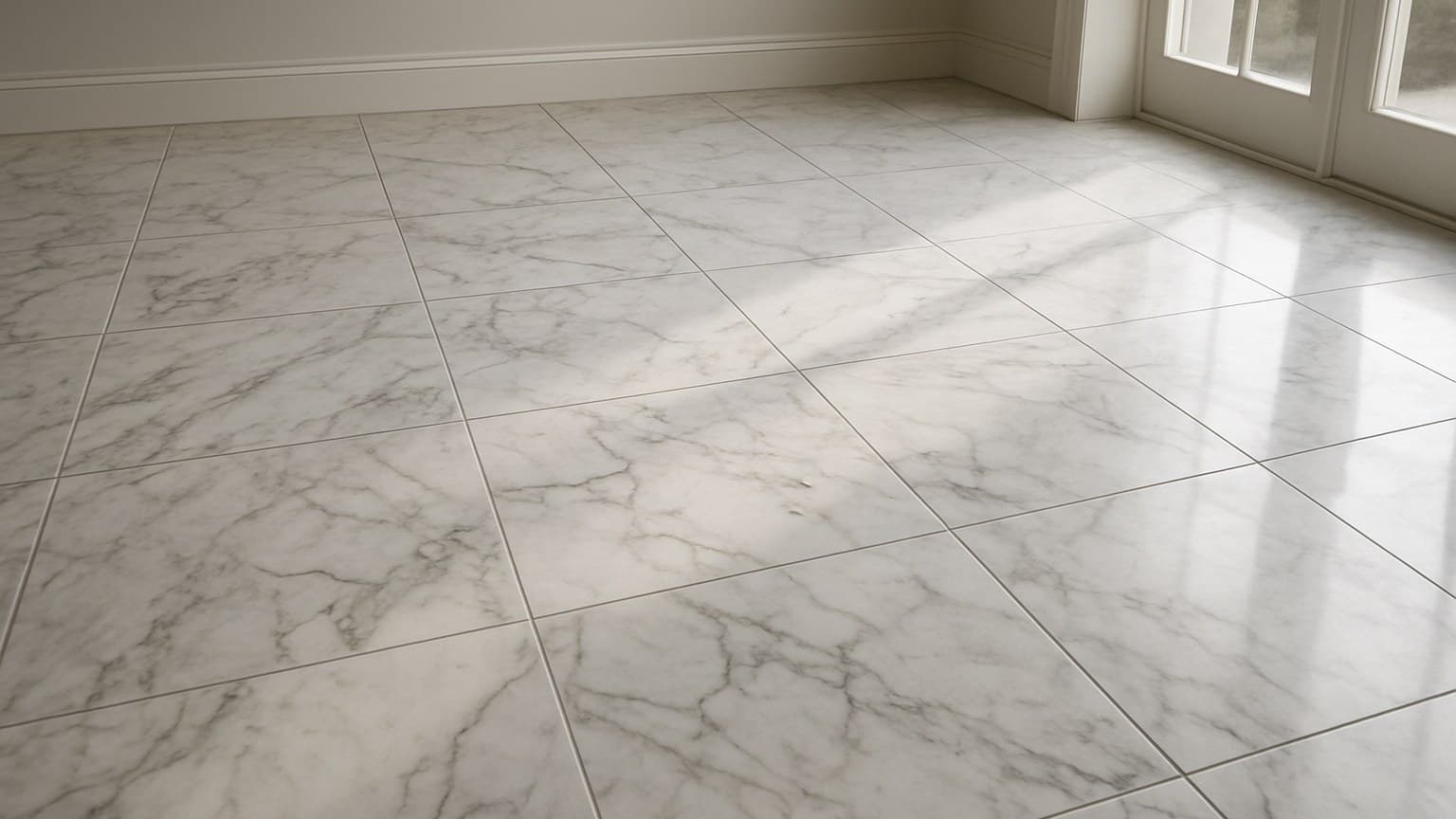
For most floors, marble-look porcelain beats real marble floor tile: it can't etch, never needs sealing, and holds up in wet, busy rooms. Real marble still earns its place in formal, low-traffic spots like a powder room. The tricky part is matching each to the right room and budget, because the wrong call shows up as etch marks and slip within a season.
Key takeaways
- Marble-look porcelain beats real marble on most floors: it can't etch, never needs sealing, and handles wet and busy rooms better.
- Real marble earns its place in formal, low-traffic rooms like powder rooms and foyers, where its depth and cool feel underfoot are the point.
- Real marble material runs about $10-21/sq ft vs roughly $3-10 for marble-look porcelain, with install labor on top of either; basements and stairs cost more.
- Pick a honed (matte) finish over polished for any floor — polished marble is slick when wet and shows every etch mark and scratch.
- Order about 10% extra tile (15-20% for diagonal or patterned layouts) and buy all your marble from one lot so the veining matches.
Real Marble vs. Marble-Look Porcelain: The Honest Scorecard
Marble-look porcelain wins most floors on etching, slip, and upkeep. Real marble wins on feel, resale cachet, and a few specific low-traffic rooms.
I score both on the five things that actually decide a floor: etching from acids, slip when wet (on porcelain this shows up as an R rating, a slip-grip score where a higher number means more grip on a wet floor), how much sealing it needs, material cost, and the look and feel underfoot.
Etching is the one most people have never heard of until it happens to them. Acid in juice, wine, or a cleaner reacts with the stone and eats the polish, leaving dull spots. Porcelain can't etch, because it's fired clay with no calcium for acid to attack. Porcelain is also denser and less porous than most stone, a property the Tile Council of North America highlights in its Tile: The Natural Choice report as part of why porcelain holds up well in wet, high-traffic rooms.
Real marble is one of several natural stone floors worth ranking by cost and upkeep, and porcelain still can't fully fake the depth and cool feel of real stone. Printed porcelain veins look close now, but they repeat across a batch. Every real marble tile is one of a kind. The same printing technology drives wood-look plank tile, which faces an identical repeating-pattern tradeoff for anyone weighing a hardwood-look tile floor instead of stone.
| Factor | Real marble | Marble-look porcelain |
|---|---|---|
| Etching from acids | Etches, acid dulls the polish and leaves marks | Can't etch, fired clay, no calcium |
| Slip when wet | Slick when polished; a honed finish grips better | Pick an R10-R11 rated finish; grips well |
| Sealing load | Seal on install, reseal when the water-drop test fails | None, the body is non-porous |
| Cost (material) | ~$10-21/sq ft | ~$3-10/sq ft |
| Feel and look | Real depth, cool underfoot, every tile unique | Printed veins, very close now, but they repeat |
Real marble vs. marble-look porcelain, scored on the five factors that decide a floor.
Which One for Which Room
Porcelain for wet and busy rooms. Real marble for formal, low-traffic spaces where spills are rare.
Is marble tile good for bathroom floors?
Yes, with one rule: use a honed finish, never polished. Honed real marble or marble-look porcelain both work on a bathroom floor. Polished marble turns into a skating rink when it's wet, so I won't put it on a floor people step onto with wet feet. A honed surface, which is matte instead of glossy, grips far better.
Kitchens, Entries, and High-Traffic Floors
Porcelain or honed-and-sealed marble only. A kitchen throws lemon, wine, and vinegar at the floor, and all of those etch polished marble. I had a homeowner near Dayton, Karen, whose polished marble by the sink dulled into a cloudy patch within a few months from lemon and dish spray. Nothing was spilled and left; it was just daily use.
Entries are the other trap. Door grit works like sandpaper, and marble is soft enough that it scratches. Porcelain takes that abuse; honed marble can too, but you'll see wear sooner. Wood-look tile holds up the same way porcelain does at a busy entry, which is why it's a common swap for anyone comparing a tile wood floor against real hardwood in that spot.
Pet and Kid Households
Porcelain wins here. Pet messes and dropped juice stain and etch real marble fast, and you don't get to decide when a toddler drops a cup. Save real marble for a powder room nobody tracks mud through, and put porcelain everywhere the daily mess lands.
The right-way call for each room, with the finish rule that keeps either floor from turning slick.
What Marble Floor Tile Really Costs
Real marble material runs about $10-21/sq ft, while marble-look porcelain is often half that, roughly $3-10/sq ft. Install labor sits on top of either one, usually $5-15/sq ft depending on the job.
The price tag hides the extras marble adds. You seal it on install and reseal it down the road. A stone floor often needs more subfloor leveling because marble is less forgiving of a wavy base. And years in, if it dulls, honing or restoration is its own bill.
Basement and stair jobs cost more than an open room. More cuts, more transitions, and extra moisture steps on a below-grade floor all push the labor line up. A flat open living room is cheaper square footage than either of those.
| Item | Range | Note |
|---|---|---|
| Real marble (material) | $10-21/sq ft | Varies by marble type and finish |
| Marble-look porcelain (material) | $3-10/sq ft | Often around half the cost of real stone |
| Install labor | $5-15/sq ft | Basements, stairs, and patterns cost more |
Marble floor tile cost split by line, materials vs. labor.
Per-square-foot ranges for porcelain material, install labor, and real marble material.
On DIY: large-format and stone tile is a hire job for most people. Leveling the floor, cutting marble clean, and keeping lippage in check, that's when one tile edge sits higher than the one next to it, leaving a trip edge and an uneven look, takes practice and the right saw. If you just want the marble look on a budget and you'd rather lay it yourself, a quality marble-look LVP tile sorted by wear-layer tier costs less, tolerates water, and click-lock versions are realistic for a confident DIYer.
The Downsides Nobody Lists on the Product Page
The big one: real marble etches. Acid eats the surface and leaves dull spots even on a sealed floor, because sealer stops stains, not etching. Those are two different problems, and people mix them up.
Staining is the second. Marble is porous, so oil, wine, and coffee soak in if a spill sits long enough. Sealing slows that down, but it's not a force field. How often you reseal depends on the specific sealer, so don't trust a calendar. Put a few drops of water on the floor, and if it darkens the stone instead of beading, it's time to reseal.
Then there's slip and softness. Polished marble is slick when wet, which is why I steer people to honed on any floor. Marble is also a softer stone, so it chips at tile edges and scratches under grit. Restoration can bring a tired floor back, but it's a real cost, not a weekend fix.
Last, the veining varies lot to lot. Order every tile you need from one lot at once, or the floor can read as two slightly different marbles meeting in the middle of the room.
What to Check Before You Buy
Finish first. Choose honed (matte) over polished (glossy) for any floor. Honed grips better when wet and hides etch marks, while polished shows every scratch and dull spot under the light.
Check the ratings next. On porcelain, look for an R rating, which measures slip grip; aim for R10-R11 on any floor that gets wet. Real marble rarely carries a PEI rating (the scale that grades a tile's surface wear) because it's natural stone, not a glazed tile, so judge marble by its finish and type instead.
Confirm the format and size before you fall in love with a photo. Marble floor tile comes in 12x12, 12x24, 24x24, hexagon, and mesh-backed mosaic sheets as well as large-format tiles. Colors run from white Carrara and soft grey to black, green, and beige. If you want the stone look without the upkeep, a limestone-look porcelain tile covers a lot of the same ground. If that hexagon shape catches your eye, it's worth knowing the layout and grout decisions specific to hexagon tile before you commit to it.
Before anyone sets a single tile, two checks decide whether the floor lasts: the subfloor has to be flat and rigid, and it has to be dry. Stone is unforgiving of a wavy or bouncy base, so flatness gets leveled and moisture gets tested first, especially on a slab or below grade. Both real marble and porcelain work over underfloor heating, and stone carries heat well.
Order samples, buy from one lot, and plan your waste. Add about 10% extra tile, or 15-20% for diagonal and patterned layouts where more cuts mean more offcuts. And where a marble floor meets wood, the transition has to let the wood side expand and contract, so that detail follows the wood floor's rules, not just the look you want.
Picking a Marble Type That Will Hold Up as a Floor
Not every slab makes a good floor. Density is the real test: a tight-grained, honed marble like Carrara keeps its surface and resists etching and scratches far longer than a soft, snow-white marble. Those dramatic white stones usually scratch and etch faster, so they're better suited to a wall or vanity top than a floor people walk on every day. When you're picking a marble for the floor, judge the slab by density and finish, not by how it photographs in the showroom.