Most folks shopping for scratch resistant hardwood flooring chase the highest hardness number and still end up with a scuffed floor inside a year. That number measures the wrong thing. The finish, the texture, and the gloss level stop visible scratches better than the Janka hardness score ever will. Here is what actually keeps marks off wood, and how to spot it before you pay.
Key takeaways
- Finish, texture, and gloss decide what scratches you actually see, more than raw Janka hardness. A hard exotic with a glossy factory coat can look worse-scratched than matte, wire-brushed oak.
- Factory aluminum-oxide finishes give the hardest surface but are tough to spot-repair. Site-applied oil finishes scratch more easily but let you fix a single board without sanding the whole floor.
- Wire-brushed texture plus a matte sheen hides fine scratches. Smooth planks with high gloss show every one under raked light.
- Engineered can match solid hardwood for surface scratch resistance. An Environmental Product Declaration gives engineered wood a 75-year functional lifespan, and NWFA-grade wear layers refinish multiple times.
- Budget for materials and labor separately, and expect basement and stair jobs to cost more per square foot than open rooms.
The Short Answer: Finish and Texture Beat Hardness
I pulled up a Brazilian cherry floor in a house outside Maple Grove that the owners swore was "the hardest wood you can buy." It was. It also showed every scuff by the front door, because the factory coat was high-gloss and the face was dead smooth. Two houses over I'd laid a softer white oak in a matte, wire-brushed finish, and it looked new after the same two years. I snapped photos of both floors that same week, side by side, standing in the same afternoon light, the cherry's scuff pattern fanning out from the entry mat, the oak barely showing a mark. I still pull those photos up on my phone when a client doubts the finish argument over the hardness number.
So here is the verdict up front: for the scratches a homeowner actually sees, the finish, the texture, and the gloss level do far more work than the Janka hardness printed on the box.
You control three levers. A hard factory finish takes the hit first. A broken-up texture like wire-brushing hides the marks that do land. And a low sheen keeps light from outlining them. Hardness helps, but it ranks last of the four.
The rest of this article settles the Janka-versus-finish debate, gives you verified species ratings, splits the real costs into materials and labor, and tells you when to quit on wood and put down vinyl plank instead.
What Actually Scratches Hardwood (Not Just Pets)
Every other guide blames the dog. The dog is not your biggest problem. Sand and grit tracked in on shoes is, because it sits under every footstep and grinds like sandpaper across the finish.
The rest of the everyday culprits have nothing to do with pets either. Furniture legs dragged without felt pads. Hard heels. Dropped toys and dishes. And rolling office chair casters, which are quiet floor-killers in any home office.
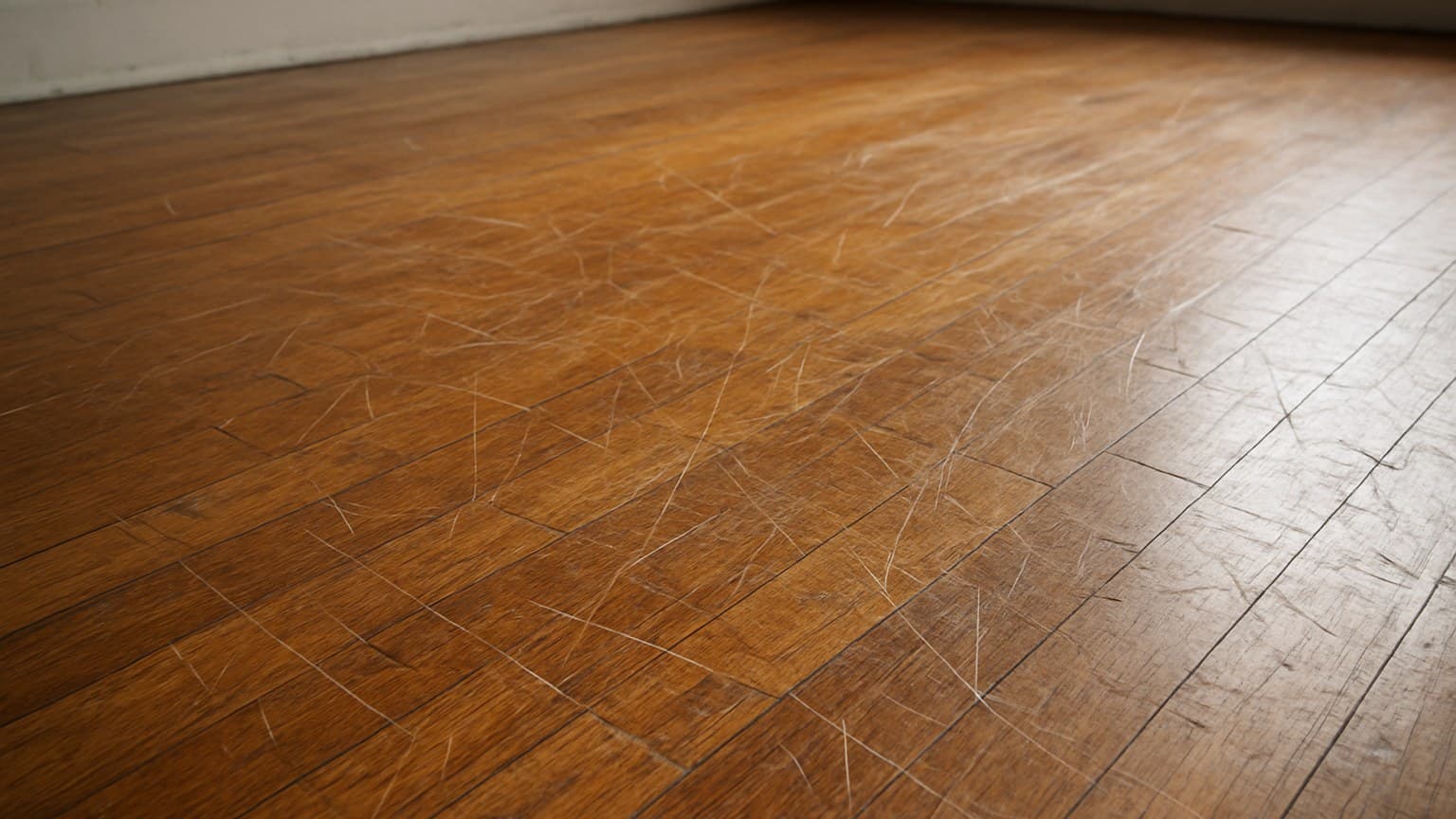
Here is the part that saves people a lot of panic: most "scratches" are surface scuffs in the finish, not gouges into the wood. A scuff sits in the topcoat and often buffs or recoats away. A true gouge reaches bare wood and needs a real repair.
That means you fight scratches on two fronts. You pick a floor that resists and hides marks, and you keep grit off it. Do both and even a mid-hardness floor holds up. Skip the second and no species saves you.
Janka Hardness Scale: What It Tells You and What It Doesn't
According to the National Wood Flooring Association's Homeowners Handbook to Real Wood Floors, Janka is a lab test that measures how much force it takes to press a small steel ball halfway into a piece of bare wood. It gets reported as a single number, and red oak at 1290 is the yardstick most of the trade compares against.
What Janka actually predicts is dent resistance. A dropped soup can, a stiletto heel, a heavy dropped tool, that is where a high number earns its keep. What it does not predict is how a finished, textured floor shows fine surface scratches, because those land in the coating, not the wood.
One thing worth clearing up: Brazilian cherry, also called jatoba, is commonly rated around 2350. Some sites throw around "nearly 3,000," but that figure is unsourced and jumps from page to page, so treat 2350 as the reliable number. It is a genuinely hard, dense wood, which is exactly why it shows up in exotic hardwood flooring lineups.
The catch is baked into the test. Janka presses on bare wood. Your floor has a finish sitting on top, and that finish is the layer a scratch hits first.
| Species | Janka rating |
|---|---|
| Eastern red cedar | 900 |
| American walnut | 1010 |
| Red oak | 1290 |
| White oak | 1360 |
| Hard maple | 1450 |
| Hickory | 1820 |
| Brazilian cherry (jatoba) | 2350 |
Janka hardness ratings for common flooring species, with red oak at 1290 as the standard reference point.
Finish Is Your First Line of Defense
The scratch a homeowner sees almost always lands in the finish, not the wood. So the topcoat is the single most important thing you pick, more than species.
Four finishes cover most of what you will meet. Factory aluminum-oxide gives the hardest surface but is the toughest to spot-repair. Ceramic-infused factory finishes run close behind. UV-cured urethane is a solid all-rounder. And site-applied penetrating oil is softer, so it scratches easier, but you can fix one board without touching the rest of the floor.
Aluminum oxide throws people off, so here it is in plain words: it is a hard mineral baked into the factory coat that makes the surface tougher. It is not something you buy in a can and brush on at home. It comes on the plank from the factory or it does not.
Here is the tradeoff nobody puts on the label. The toughest factory finishes resist scratches best, but when they finally do scratch, they are the hardest to repair without refinishing the whole floor. An oil finish gives up some scratch resistance for the ability to sand and re-oil a single board on a Saturday. If you hate the idea of ever pulling planks, that repairability is worth real money.
Finish also drives indoor air quality, since the coating is what off-gasses. If low-emission coatings matter to your household, read up on non-toxic hardwood flooring before you sign off on a topcoat. And if eco-certifications on the box matter to you as much as emissions do, our guide to sustainable hardwood flooring claims explains what those labels actually verify.
| Finish | Surface hardness | Spot repair | Best for |
|---|---|---|---|
| Factory aluminum oxide | Highest | Very hard | High-traffic rooms, pets |
| Ceramic-infused factory | Very high | Hard | Entries, kitchens |
| UV-cured urethane | High | Hard | General living areas |
| Site-applied oil (penetrating) | Moderate | Easy, board by board | Owners who want to repair, not replace |
Source: manufacturer finish data sheets I read before quoting a topcoat
How the four common hardwood finishes compare on surface hardness and how easily you can fix a scratch once it happens.
Texture and Gloss: How to Hide the Scratches You Can't Prevent
You cannot prevent every scratch, so your second job is hiding the ones that get through. A broken-up surface and a low sheen hide fine scratches. Smooth and glossy put them on a stage.
Three textures do the camouflage work. Wire-brushed means fine grooves are brushed into the grain, so a new scratch blends into grooves that are already there; that is why wire-brushed hardwood flooring is my go-to for busy homes. Hand-scraped means gentle waves are worked into the face by hand, and hand-scraped hardwood flooring hides marks the same way. Distressed means deliberate dents and dings are added at the factory, so real wear just looks like more of the same.
Gloss is the other half. A matte or satin sheen scatters light, so a scratch loses its edge and disappears. High gloss reflects light and outlines every mark under a raking sunbeam.
Color matters too. Lighter tones with busy grain hide scratches better than dark, uniform stains, which show every scuff like chalk on a blackboard. If you want a forgiving floor, light hardwood floors do a lot of the hiding for you before you even think about texture.
Solid vs Engineered: Which Actually Resists Scratches Better?
At the surface, they can be dead even. Surface scratch resistance comes from the finish on top, and a quality engineered floor carries the same factory finishes as solid. So do not assume solid is tougher on top. For the fuller picture on choosing between the two and matching a species to your room, see our guide to solid vs. engineered hardwood floors.
Engineered in plain words: a real-wood top layer, called the wear layer, is bonded to a plywood or HDF core. HDF means high-density fiberboard, a dense pressed-wood board. The species you see and touch is real wood; the core underneath is what makes the plank stable. A lot of engineered planks today ship with click-lock edges instead of glue or nails, so it's worth reading whether click hardwood flooring actually holds up before you plan a DIY install around it.
That stability is where engineered pulls ahead in the wrong rooms for solid. An Environmental Product Declaration (EPD) is a verified spec sheet on a product's lifespan, and according to the National Wood Flooring Association's Engineered Wood Flooring EPD, engineered hardwood flooring carries a 75-year functional lifespan as its industry reference service life. That figure is an industry benchmark drawn from NWFA's own EPD documentation, not a guarantee every engineered product carries. Per NWFA's refinishing guidance, how many times you can refinish a floor ties directly to wear-layer thickness: a thick wear layer refinishes several times; a thin one may not refinish at all.
An engineered plank is built in four layers stacked from the top down: the factory finish coat that takes the scratch first, the real-wood wear layer whose thickness sets your refinishes, the plywood or HDF core that gives the plank its stability over concrete, and a backing layer that balances the plank so it stays flat.
Here is how I steer it on real jobs. Over a slab or in a basement, engineered's stable core usually wins, and I've talked people off solid hardwood down there. But confirm the wear-layer thickness on the specific product before you count on ever refinishing it. What sits under the plank matters as much as the plank, so it is worth knowing what to put under hardwood flooring before you order.
I learned the underneath part the hard way on a job for Renee Ostrander in Sheboygan, Wisconsin. She wanted the crew out by lunch and waved off the moisture test, and I let her skip it against my better judgment. Within two months the boards along her exterior wall had lifted at the seams. I photographed the cupping before I pulled the first board, and when I finally ran the meter on the subfloor it read well above 14 percent, the kind of number the moisture test would have caught before we ever nailed down a plank. I went back and fixed it for free. That job is why the moisture test is no longer optional on anything I install, and it is the first check I run before any hardwood goes down.
Best Scratch-Resistant Species and How They Rank
If you want the best odds against dents, start dense: hickory at 1820 and Brazilian cherry at 2350 top the common list, with hard maple at 1450 close behind. Those resist the deep gouges. But remember, that ranks dent resistance, not how a finished floor shows surface scuffs.
White oak at 1360 is the one I recommend most, and not because it is the hardest. It takes wire-brushing beautifully, its busy grain hides marks, and it pairs with almost any finish. It is the balanced pick, hard enough plus forgiving to look at.
Hickory is a tough mainstream choice, with wild grain that hides scratches on its own. The tradeoff is that same wild grain is not to everyone's taste, and it can be harder to work.
Brazilian cherry gives you the highest hardness here, but it is usually sold smooth and glossy, which undoes some of that toughness in the scratch department. If you go exotic, push for a matte finish.
Softer species like American walnut at 1010 and cedar at 900 dent more easily, so lean on texture and a hard finish if you love the look. For the whole picture on picking a floor that resists dents and warping, see my guide to durable hardwood flooring, and if you are open to alternatives, bamboo flooring versus hardwood is worth a look since some strand bamboo out-hardens oak. If walnut's rich color has you leaning that way anyway, our breakdown of walnut hardwood flooring costs walks through what you'll actually pay for that softer, darker look.
There is also a process route worth knowing about, and it is worth knowing precisely because it proves the same point this whole article is built on: treatment can beat raw species hardness. Densified wood takes a softer, cheaper species and compresses it under heat and pressure, collapsing the cell structure so the surface reads much harder than the same species untreated, the wood itself gets the "hard finish" treatment instead of just the topcoat. Thermally modified wood is a different process and gets lumped in with it by marketers, but it is not the same claim: heat-treating mainly changes color and dimensional stability, and in some species it can actually lower hardness rather than raise it, so "thermally modified" does not automatically mean "scratch resistant." If a supplier pitches either one, ask for the tested Janka number on the modified product itself, not the raw species rating on the box, since that number is the entire point of paying for the process. See densified hardwood flooring for a fuller look at how that process compares to buying a naturally harder species.
The Best Setup for Dogs and Heavy Traffic
For a house with big dogs and constant foot traffic, the winning combo is white oak or hickory, a hard factory finish like aluminum oxide, a wire-brushed texture, and a matte sheen. That stack resists, hides, and forgives all at once.
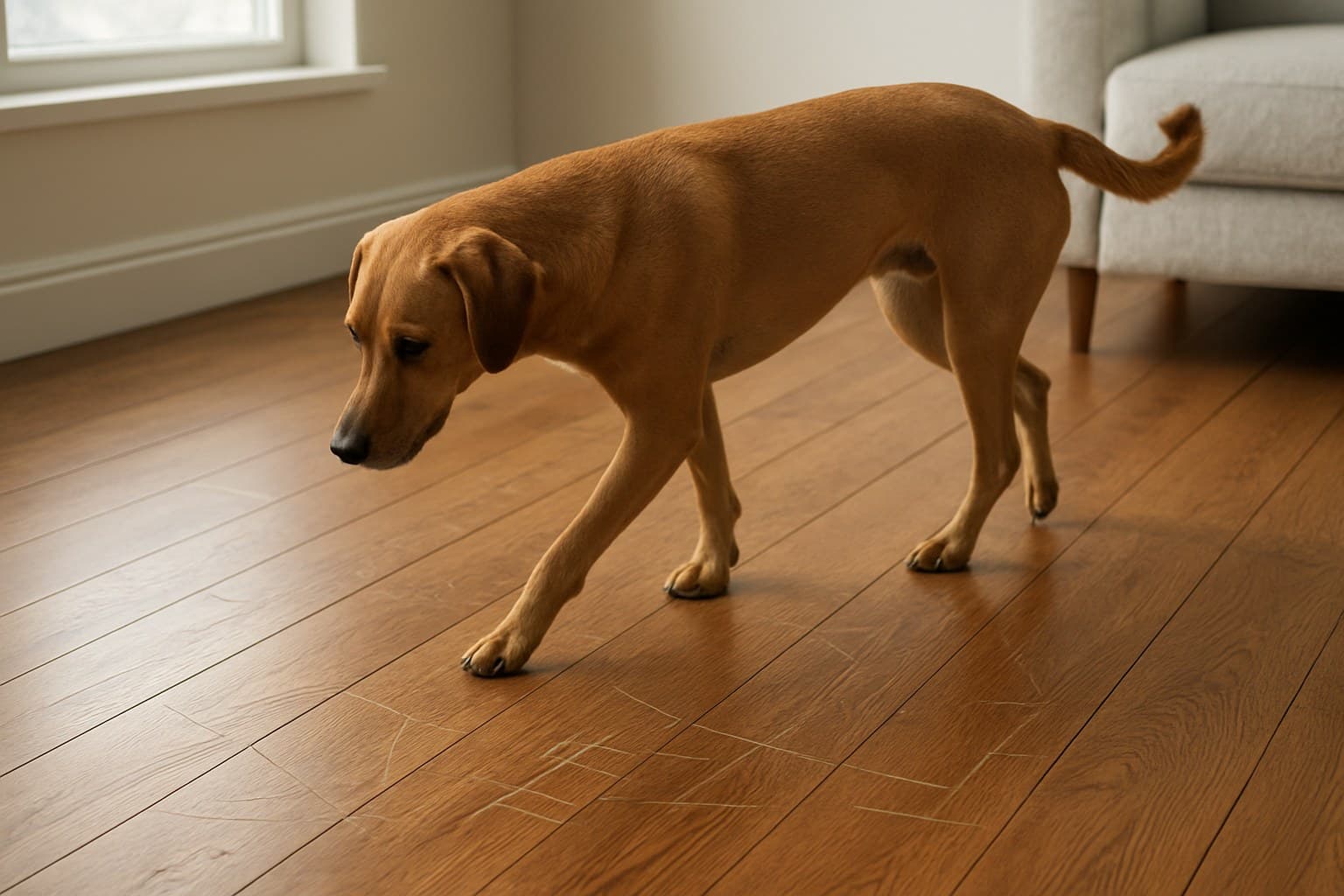
Dog nails cause fine surface scratches far more than deep gouges, which is exactly what texture and a matte finish are built to hide. The species matters less than people think; a wire-brushed white oak beats a smooth, glossy exotic for a dog household.
Keep the nails trimmed and a rug at the door, and even a mid-hardness floor holds up. Grit dragged in on paws and shoes does more damage than the paws themselves.
If you are cross-shopping, this is also the point where a lot of dog owners land on vinyl plank instead, which I get into below.
What Scratch-Resistant Hardwood Actually Costs
There is no single national number, so I split it into materials and labor. Prefinished solid oak materials commonly run about $4 to $8 per square foot, engineered runs roughly $3 to $10, and exotics like Brazilian cherry push higher. Standard nail-down installation labor lands around $3 to $6 per square foot in most markets. Treat these as starting ranges to confirm with local quotes, since region, species, and prep all move them. If a retailer's price undercuts these ranges by a lot, it's worth checking whether that hardwood flooring sale is a genuine markdown or just inflated pricing marked back down.
Two things drive the price up that flat-rate calculators do not warn you about. Glue-down installs, which you need over concrete and in many basements, cost more in labor than a nail-down over plywood. And basements cost more before a single plank goes down, because they usually need moisture testing, a vapor barrier, and sometimes leveling. If you're doing the nail-down route yourself over plywood, our row-by-row guide to nailing down hardwood flooring covers the process in detail.
Stairs are their own line item. Installers typically charge per step, not per square foot, because each tread and riser is cut, wrapped, and fit by hand. A staircase can cost more than a small bedroom.
So a simple open living room is the cheap scenario, and a basement or a staircase is where the per-square-foot number climbs. Get the quote broken into materials, labor, and prep so you can see where the money goes. For the full pros-and-cons math on whether wood is worth it for your rooms, see hardwood flooring pros and cons.
When to Skip Wood and Go LVP Instead
Sometimes the honest answer is not wood at all. Over a wet slab, in a below-grade basement, or in a mudroom that takes standing water, a good luxury vinyl plank beats hardwood on scratch and moisture tolerance for a lot less money.
This is not LVP being "better." It is the right tool for a wet, hard-use room. Hardwood gives you a real-wood look and the option to refinish, which vinyl cannot match. LVP wins on water and abuse; wood wins on looks and long-term repairability.
Watch the marketing on the vinyl side. A "waterproof core" only means the plank body will not swell if it gets wet. It says nothing about the seams and edges, and seams are where water actually gets under a floating floor.
The way I call it on jobs is the same way I call basement floors in general: I read the moisture first. If the slab reads wet, I steer people off solid hardwood entirely and often off engineered too, and vinyl becomes the sane choice. If the room is dry and upstairs, wood is usually worth it.
Keeping Grit Off: The Cheapest Scratch Insurance
The best floor still scratches if you let sand grind into it, so this is the step that protects whatever you buy. It costs almost nothing and it does more than any Janka point.
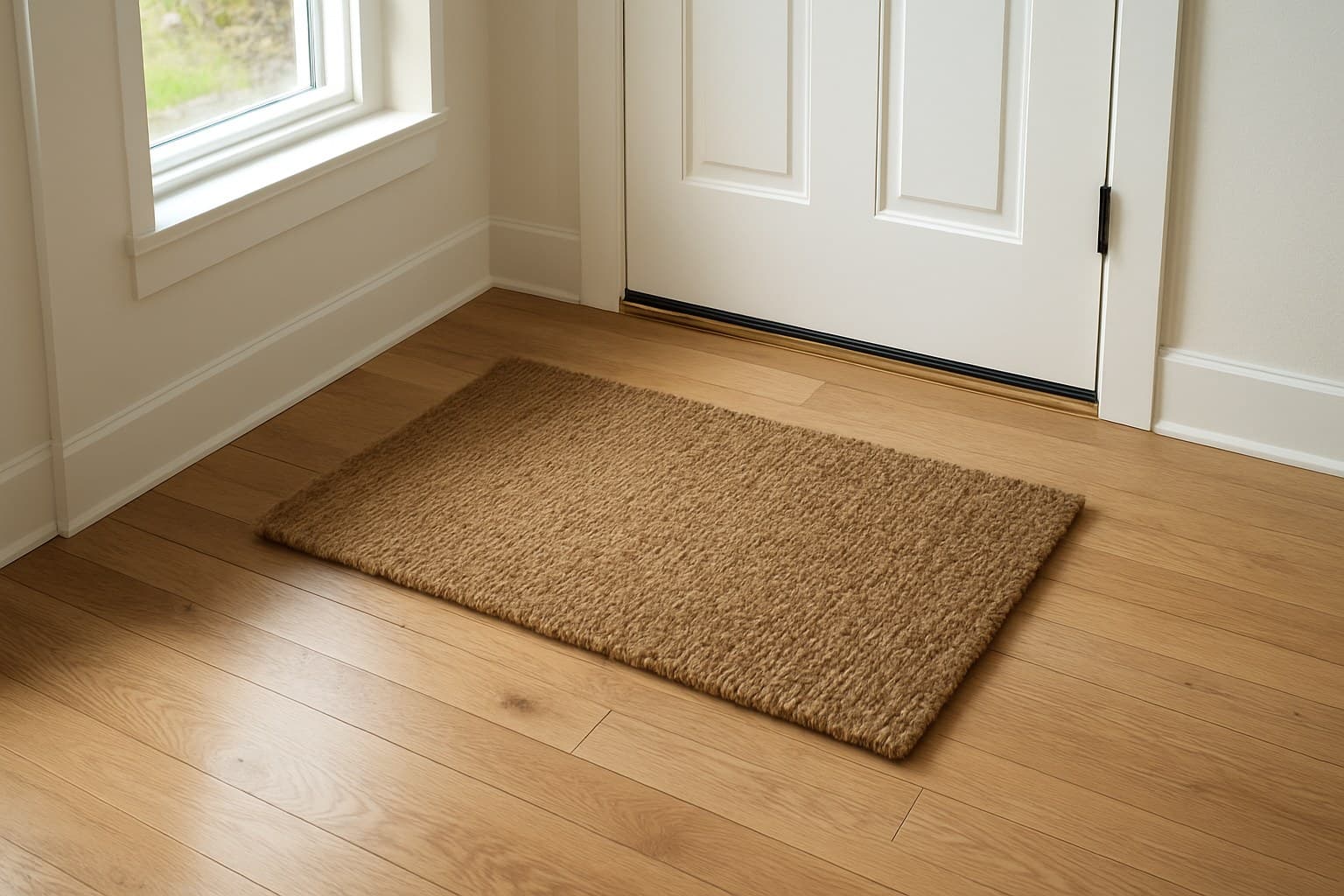
Put walk-off mats at every entry and a no-shoes habit if you can swing it, because most grit rides in on the bottom of shoes. Add felt pads under every furniture leg and check them twice a year, since a worn-off pad turns a chair into a gouge. Swap hard plastic chair casters for soft rubber ones in the office.
Sweep or vacuum the grit regularly with a hard-floor setting, never a stiff beater bar. Wipe spills quick and skip the wet mop and steam, which do their damage at the seams over time.
Do this and a mid-hardness white oak outlasts a neglected exotic. The floor you protect beats the floor you overpaid for and ignored.