
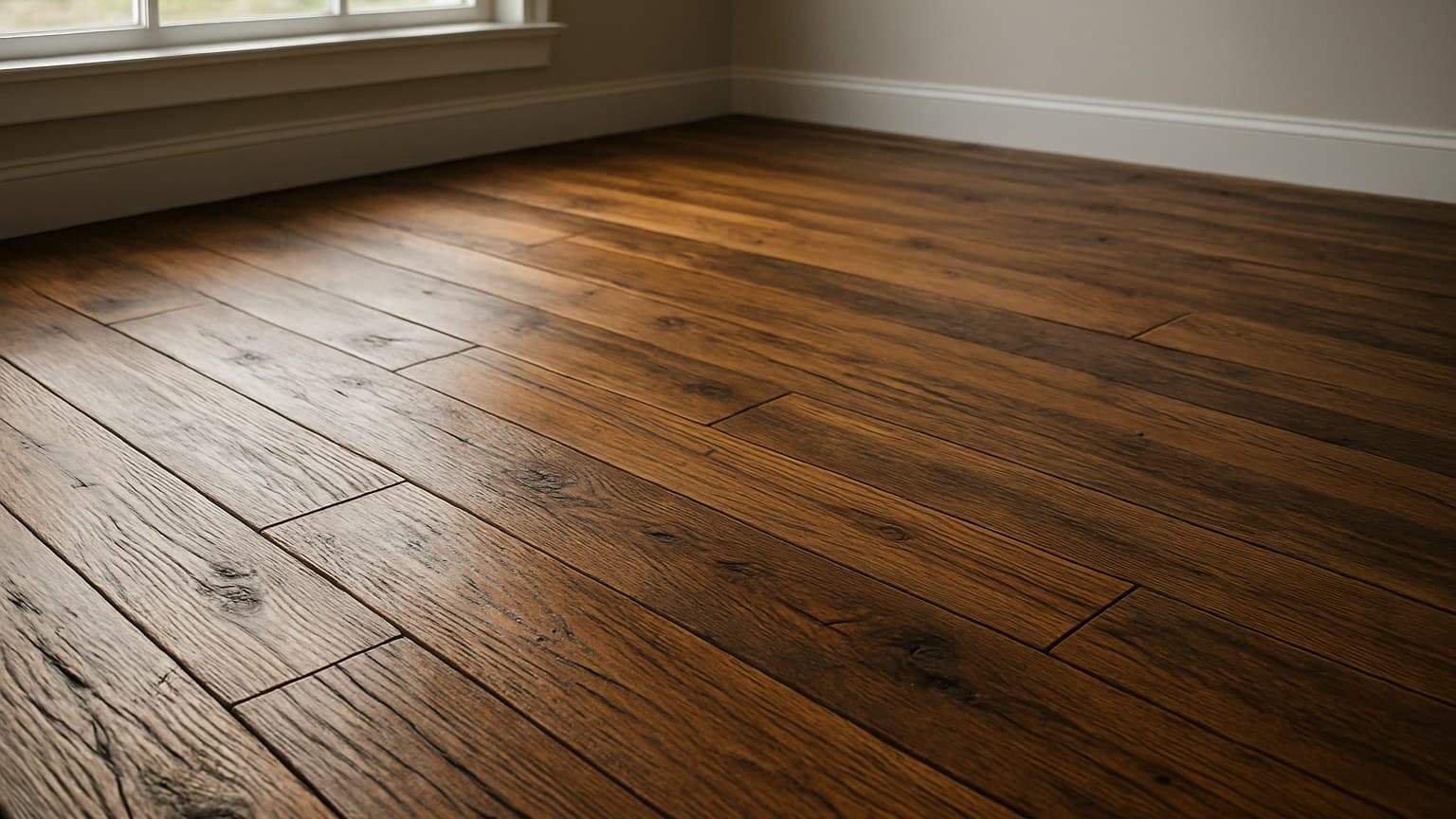
Last month, a customer in Boise had two boxes of "hand scraped hardwood flooring" open on her kitchen counter, one from a local mill, one from a big-box store, and asked me which one was the real thing. Nobody at either counter could tell her. Here's the sample check I ran before she paid for either one.
Key takeaways
- NWFA and NOFMA grading rules set no tolerance for distressed or hand-scraped surfaces, so consistency is entirely on the manufacturer, not any standard.
- Fastest fake test: lay 4-5 planks side by side; if the scrape pattern repeats board to board, it's machine-embossed, not done by hand.
- Genuine hand scraping leaves irregular gouges and soft, rolled groove edges you can feel with a fingertip; machine emboss feels crisp and uniform.
- Expect a real premium over smooth flooring of the same species: materials often run about $6-12 per sq ft plus $4-8 per sq ft labor, with stairs and basements costing more than open rooms.
- Sanding a scraped floor flat erases the texture, and on engineered boards the thin veneer limits how much you can refinish at all.
First, the Catch: No Grading Standard Backs the Word "Hand Scraped"
Here's the part that trips people up: there is no grading rule anywhere that defines "hand scraped." According to the NWFA (National Wood Flooring Association) and the older NOFMA (National Oak Flooring Manufacturers Association) grading standards for factory-finished and unfinished hardwood flooring, boards are graded on things like knots, color, and board length, and the standards set no tolerance at all for a distressed or scraped surface.
So the consistency of that scrape is entirely the maker's call. Two boxes both labeled "hand scraped" can be real hand work or a roller pressing the same texture over and over, and no standard forces either one to admit which.
That puts the whole burden on you to inspect the sample before you buy. The good news: you can run every check below on store samples in about five minutes.
What Hand Scraped Hardwood Flooring Actually Is (and How It's Made)
Hand scraped means the boards get a worn, rippled, tooled surface instead of being sanded flat. If you see "handscraped hardwood flooring" or "scraped hardwood flooring" spelled other ways, that's the same product.
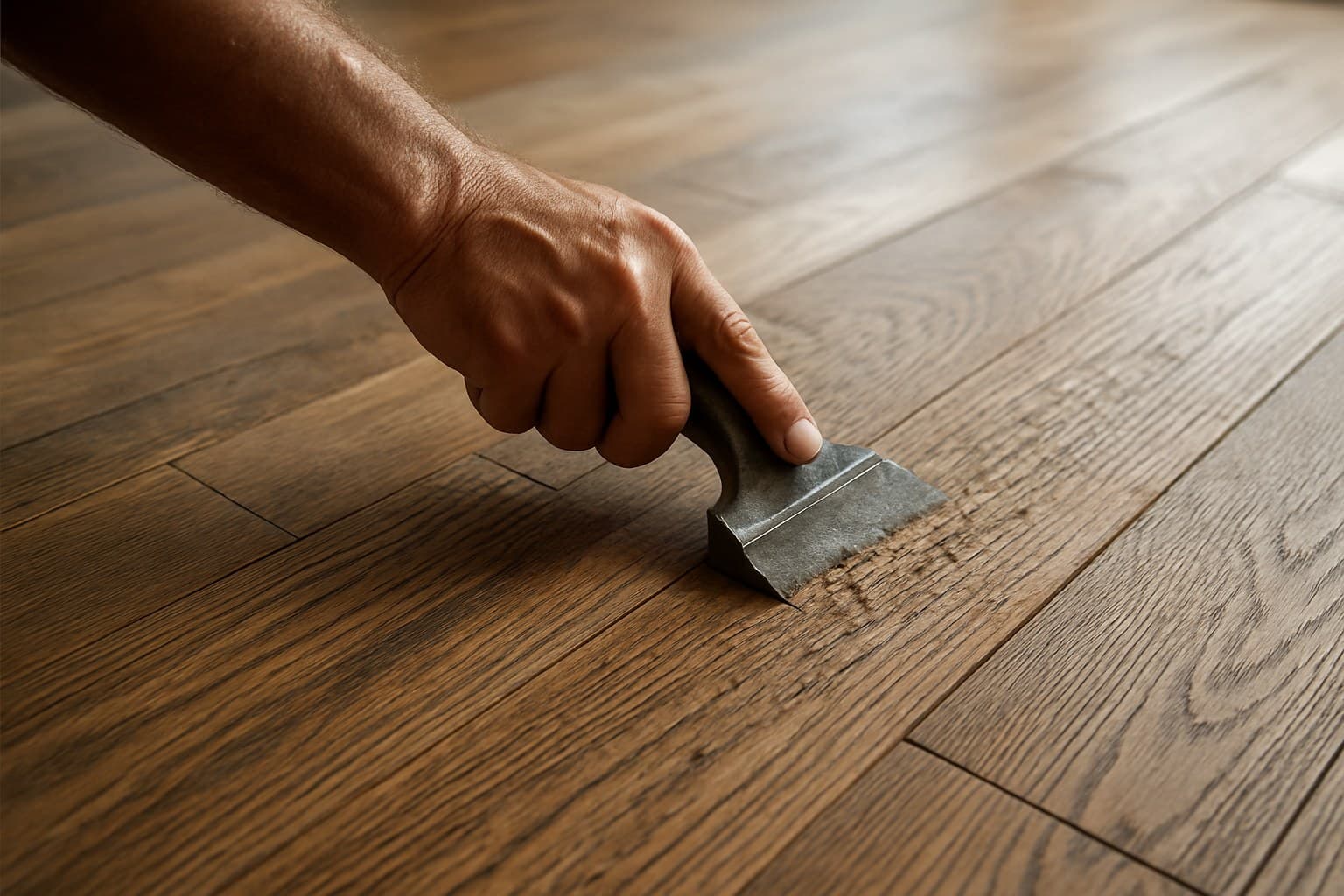
On the genuine article, a worker drags a hand scraper or a drawknife (a two-handled blade) down each board. Because a person does it, no two boards come out alike. The machine version presses or rolls the same texture on with an embossing roller or a wire brush, so the pattern repeats.
A few textures get mixed up with it, so know the difference:
- Wire-brushed pulls out the soft grain to leave fine channels.
- Hand-sculpted carves deeper, rolling waves across the whole board.
- Machine-distressed fakes dents and wormholes to look old.
The made-by-hand part matters for two reasons: it drives the price you pay, and it decides whether the floor looks truly random or quietly repeats every few boards.
5 Checks to Tell Genuine Hand-Scraped From a Machine-Embossed Fake
You can catch almost every fake with your eyes and one fingertip. Run these five in order.
Step 1: Lay 4-5 Planks Side by Side and Hunt for Repeats
Pull four or five sample planks and set them side by side, then look straight down the run. Genuine scraping varies board to board. If you spot the same scrape mark, the same little cluster of gouges, showing up every few boards, a roller stamped it. Real hand work doesn't line up that neatly.
Step 2: Run Your Fingertips Along the Groove Edges
Close your eyes and drag a fingertip across the grooves. Real scraping leaves soft, rolled edges that feel round, like the wood was pushed aside. Machine emboss feels crisp and even. Sometimes you'll even see a printed shadow sitting next to a dent instead of down inside it, a sign the "aging" was printed, not cut.
Step 3: Ask for the Wear-Layer Spec and Finish by Name
Ask for two numbers on that exact product: the wear-layer thickness and the finish type. Get a real name, not "premium finish." It should be aluminum oxide (a tough clear coat baked on), a UV-cured finish, or an oil finish. On engineered boards the wear layer also caps how many times you can ever refinish, so this number matters long after install day. If you haven't settled on a construction type yet, it's worth comparing solid vs. engineered hardwood flooring before you start weighing wear-layer numbers at all.
Step 4: Ask for the NWFA Grading Note in Writing
Ask the seller to put the grade and any scrape description in writing. Remember, per NWFA/NOFMA grading standards, no standard covers the scrape itself, so a vague answer here tells you the "hand" part is marketing. A straight answer from the maker is a sign you're dealing with a real product line.
Step 5: Price-Sanity-Check Against the Machine-Textured Look
This one settles it. A floor sold as "hand scraped" but priced no higher than plain smooth oak of the same species is almost certainly machine-textured. Real hand work costs more to make, and that shows up in the price. If it doesn't, trust the price over the label. The same real-wood-or-not question comes up constantly with big-box names, so if you're weighing a familiar brand, it's worth checking how Pergo hardwood flooring holds up before assuming the name guarantees solid wood.
The correct floor is on the left. Drawing is not to scale; it shows what to look for, not real board sizes.
What Hand Scraped Costs, and Why It Runs More
Genuine hand-scraped runs a real premium over smooth flooring of the same species, because someone works one board at a time. That labor is the whole reason the machine knockoffs exist. Sourcing plays into that premium too, so before you pick a species, take a look at sustainably harvested hardwood flooring options.
Here's how the money splits. Materials for a true hand-scraped floor often land around $6-12 per square foot. Nail-down labor usually runs about $4-8 per square foot. Treat these as starting ranges, not a fixed price, your region, the species, and how much subfloor prep the job needs all swing them hard. A machine-textured "hand scraped look" floor sits lower on materials, which is exactly why Step 5 works as a filter.
One more thing on labor: stairs and basements cost more to install than an open room. Closets, doorways, and stairs eat time the open middle of a room never does, so when a quote looks high, count those cut-heavy areas separately.
| Item | Cost per sq ft |
|---|---|
| Machine-textured "hand scraped look" (materials) | $3-6 |
| Install labor, nail-down | $4-8 |
| Genuine hand-scraped (materials) | $6-12 |
Typical material and nail-down labor ranges per square foot; region, species, and subfloor prep move these, and stairs or basements run higher than open rooms.
Pros and Cons in a Real House With Kids and Pets
The big win with hand-scraped in a busy house is that the texture hides damage. Scratches, dings, and dog-nail marks disappear into the grooves far better than they do on a smooth floor. Every board also looks a little different, so the whole floor reads one-of-a-kind, warm, and lived-in.
The trade-off is cleaning. Those same grooves catch dust and grit, so deep-cleaning takes more elbow work. Use a stiff brush to lift grit out of the low spots and a damp mop after, the NWFA's Homeowners Handbook to Real Wood Floors advises against letting standing water sit on any wood floor, scraped or smooth. And resale appeal splits people: some buyers love the rustic look, some want it gone.
Refinishing is the part people don't think through. Sanding the floor flat erases the scrape completely. You can screen-and-recoat (a light scuff and a fresh coat) to freshen the finish without touching the texture, but a full sand kills the character you paid for. On engineered boards the thin veneer limits how much you can sand anyway.
Hand-scraped fits busy family rooms and rustic looks. It's the wrong pick if you want a glassy modern floor or you hate extra cleaning.
Species, Finish, and Construction That Actually Hold Up
Pick the species for the traffic and the finish for the upkeep you'll actually do. Hickory is the hardest common choice and takes a strong scrape well. Oak is the most popular and stains nicely. Maple shows the texture less because its grain is tight, and walnut looks rich but dents easier, so if you love that look, read up on how walnut hardwood pricing and wear play out before you commit. The Janka test below is just the standard way to measure wood hardness.
On finish, a baked-on aluminum-oxide, UV-cured coat wears the hardest. Oil finishes look the most natural and spot-repair easily, but they need more upkeep. Ask which one is on your sample, and if fumes matter to you, ask whether it comes as a low-VOC or non-toxic finish.
Construction decides where the floor can go. Solid is usually 3/4 inch and belongs above grade. Engineered has a plywood-style core that stays more stable over concrete and below grade, and a click-lock engineered board is the easiest version for a DIYer to install. Whichever you pick, check the subfloor for flatness and run a moisture check first; over concrete especially, what goes under the floor matters as much as the boards on top.
| Species | Janka hardness | How it takes a scrape | Best fit |
|---|---|---|---|
| Hickory | ~1820 | Hard; holds a deep, strong scrape | High-traffic family rooms |
| Hard maple | ~1450 | Tight grain shows texture less | Lighter-traffic rooms |
| White oak | ~1360 | Takes scrape and stain well | Most rooms, most budgets |
| Red oak | ~1290 | Scrapes cleanly, warm tone | Bedrooms, living areas |
| Walnut | ~1010 | Rich look but dents easier | Low-traffic, formal rooms |
Source: Janka figures are the standard published wood-hardness ratings.
Janka hardness figures are the standard published wood-hardness ratings for each species; higher numbers resist dents better.
Sources
- NWFA/NOFMA Factory-Finished Wood Flooring Grading Standards (PDF)
- NWFA/NOFMA Unfinished Wood Flooring Grading Standard (PDF)
- NWFA Homeowners Handbook to Real Wood Floors (PDF)
- NWFA Solid Wood Flooring Environmental Product Declaration (EPD) (PDF)
- NWFA Event: Unfinished Solid Hardwood Flooring Manufacturing Overview