
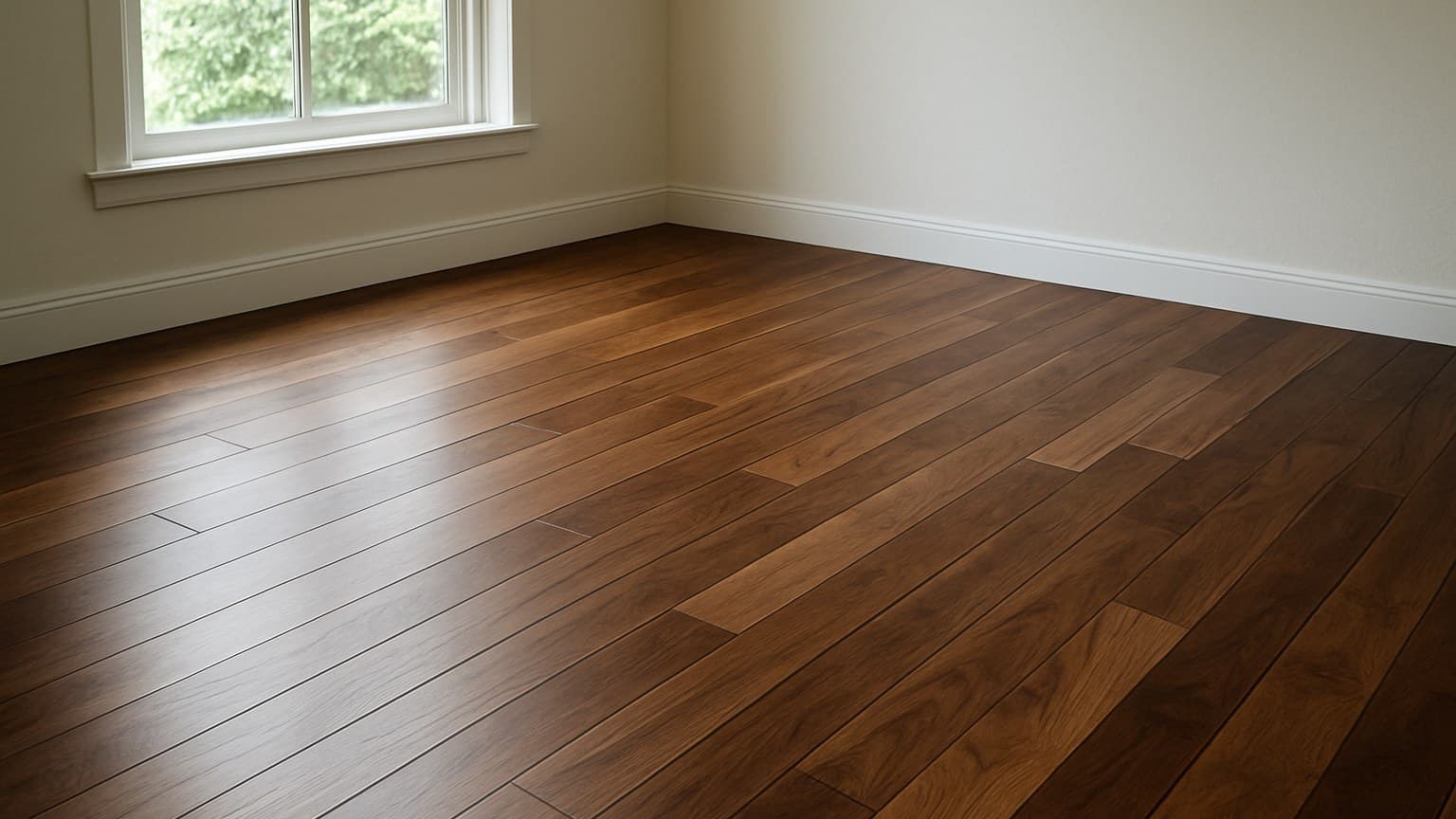
Last month I quoted a walnut hardwood job for a homeowner named Elena in Denver, and her two bids for the same 400 square foot living room landed $4,200 apart. Neither installer was cheating her, the gap came from choices she hadn't locked in yet: grade, width, solid or engineered, and how the room is built. Material alone runs $5.50-$9.50 a square foot for standard grades, up to $14-$32 for wide-plank or custom milling, and labor adds $3-$8 more per square foot. Sort those choices in order below and you can build your own number before your next quote shows up.
Key takeaways
- Standard-grade walnut runs about $5.50-$9.50 per square foot for material; wide-plank and custom-milled orders climb to $14-$32 per square foot, before any labor.
- Add roughly $3-$8 per square foot for labor, with glue-down, stairs, and basements costing more than an open nail-down room.
- Grade is the single biggest material lever: Select & Better costs the most, Character and #2 Common the least, for the same wood.
- Walnut is softer than oak (Janka around 1,010 vs red oak's 1,290), so it dents easier, but its dark tone hides fine scratches well.
- Walnut lightens with sun exposure over the years, which is the opposite of most woods that darken.
What Walnut Hardwood Flooring Really Costs (The Short Answer)
Plan on roughly $5.50-$9.50 per square foot for material on standard solid or prefinished grades, and $14-$32 per square foot once you move to wide plank or custom milling. Labor sits on top of that, not inside it.
There's no single national number for walnut, and anyone who gives you one is guessing. The price is the sum of your choices, and the rest of this article walks each lever one at a time so you can build your own figure.
Keep material and labor separate in your head from the start. A shelf price of $7 a square foot isn't an installed price, and mixing the two is how people end up shocked at the final invoice.
If you're flexible on color and lot, closeout runs can undercut standard pricing by a good margin. Check clearance and closeout hardwood deals near you before you commit to full-price stock, especially on a smaller room where one pallet finishes the job.
The wood itself: American black walnut
American black walnut is the dark, chocolate-brown wood most people picture when they say "walnut floor." It grows here in the US, it takes finish beautifully, and it carries a premium price because the trees give less clear, usable wood per log than oak does. That scarcity is why the base price starts higher. Buying from a mill that manages its walnut stands responsibly can ease that scarcity long term, and sustainable hardwood flooring guide explains what to look for on the label.
| Cost piece | Range ($ per sq ft) |
|---|---|
| Nail-down labor | $3.00 - $8.00 |
| Standard grade material | $5.50 - $9.50 |
| Wide-plank / custom material | $14.00 - $32.00 |
Floating bars show the low-to-high per-square-foot range for walnut labor and material, in dollars per square foot.
Step 1: Grade Sets Your Base Price
Grade is the single biggest material lever, and it sorts the same walnut boards by looks, not by strength. A cheaper grade isn't a weaker floor. It's a busier-looking one.
The grading definitions come from the National Wood Flooring Association and NOFMA's joint unfinished wood flooring grading standard, and in plain words they run like this. Select & Better (also called Clear) is the cleanest: even dark color, almost no knots. Then #1 Common shows a bit more color swing and small tight knots. Character and #2 Common carry the most knots, streaks, and mixed color, and they cost the least. Since those terms shift slightly between species and mills, grades of hardwood flooring guide lays out a side-by-side chart so you can compare grades before you order.
One term worth knowing: sapwood is the lighter outer wood from the edge of the tree. In a dark walnut board it shows up as pale, blond streaks. A top grade screens most of it out, which is part of what you pay for.
Here's the part people miss. Plenty of homeowners buy Character grade on purpose, pay less, and love the look. The knots and streaks read as natural and lived-in, not as a defect. If your style leans rustic, a lower grade saves you real money for a floor you actually prefer. Go a step further down that same rustic path and you land in cabin grade territory, which cabin grade hardwood flooring guide covers for anyone chasing the most character for the least money.
| Grade | The look | Effect on material price |
|---|---|---|
| Select & Better (Clear) | Even dark color, almost no knots or sapwood | Highest material cost |
| #1 Common | Some color variation, small tight knots | Mid-range |
| Character / #2 Common | Knots, streaks, mixed sapwood and heartwood | Lowest material cost |
Source: The NWFA's hardwood flooring grading rules
How the three main walnut grades compare on look and material cost.
Step 2: Solid or Engineered Walnut?
The short rule: solid walnut belongs on or above ground level, and engineered walnut is what you want over concrete or below grade. Engineered boards have a cross-layered plywood-style core that stays flatter when moisture and temperature swing, which is exactly what a basement or a slab throws at a floor. This same logic holds no matter the species, so it helps to see how choosing between solid and engineered hardwood floors plays out for other rooms and wood types too.
This choice also drives how the floor ages and what it costs to refinish. Solid walnut can be sanded down and recoated several times over its life. Engineered walnut can only be refinished as many times as its top walnut layer, the veneer, allows, and that depends on how thick that layer is. Some engineered products have a veneer thick enough to sand once or twice; some are too thin to sand at all.
So don't assume any engineered floor is a sand-it-forever floor. Check the maker's spec sheet for the veneer thickness before you buy. I've seen people plan on refinishing a floor that never had enough wood on top to take a single pass. If you're weighing a well-known engineered brand against walnut, it's worth checking whether Pergo hardwood flooring is real wood before you rule it out as a lower-cost option.
On install difficulty, engineered click-lock is the DIY-friendly path. If you're handy and the room is open, click-lock and click engineered hardwood is realistic to lay yourself. Solid walnut goes down nail-down or glue-down, and those methods usually mean hiring a pro.
Step 3: Width, Cut, and Finish
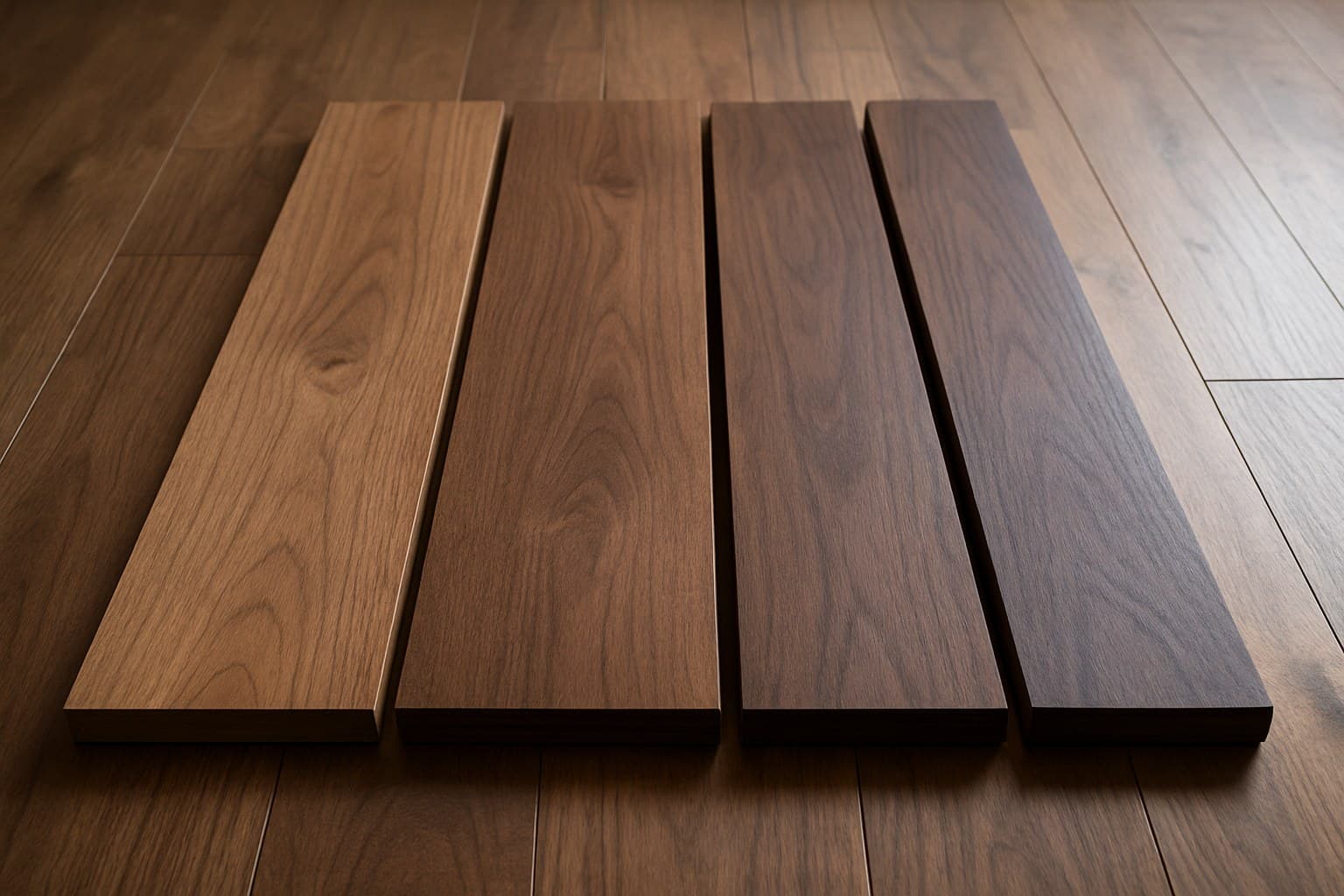
Width and finish move you along the price range as much as grade does. Standard 5-inch boards sit near the bottom. Wider boards, fancier cuts, and site finishing push you toward the $14-$32 end.
Wide plank and custom milling
Wide plank means boards roughly 7 inches and up. They use more of each log and waste more in milling, so they cost more per square foot. Rift and quartered cuts, where the mill slices the log at specific angles for a straighter, more uniform grain, also burn more wood and more labor. So does a pattern like herringbone, where every piece is cut and fit at an angle. All three are milling and install upcharges, not base features. Hand-scraped and other textured surfaces work the same way, an extra step you pay for. If you want that look, read up on hand-scraped hardwood before you order, because the texture also changes how the floor cleans and wears.
Unfinished vs prefinished
Prefinished walnut ships with the stain and topcoat already applied at the factory, under the NWFA/NOFMA factory-finished wood flooring standard that governs how those coatings are tested and rated. You can walk on it the day it goes down, and the finish is usually tougher than a site-applied one. Unfinished walnut goes down bare, then gets sanded, stained, and coated in your home. That lets you match a color exactly and get a seamless surface, but it adds sanding labor, coating labor, and days of dry time before the room is usable. Prefinished saves time and mess; unfinished buys you control.
Step 4: Add Labor by Install Method and Room
Labor runs roughly $3-$8 per square foot, and the method sets where you land. Nail-down is typically the cheapest. Glue-down over concrete costs more because of the prep and the adhesive. Floating floors vary by product.
Before a single plank goes down, the subfloor gets checked two ways: flatness and moisture. A floor that isn't flat telegraphs every dip, and a slab or crawlspace that reads wet on a moisture meter, the handheld tool that measures how much water is in the concrete or subfloor, changes the whole plan. A wet basement often forces engineered walnut plus a moisture barrier under it. Deciding what goes under hardwood flooring is part of the labor cost, not an afterthought.
Room shape is where quotes climb. Basements and stairs both cost more than an open room. Stairs are priced per step, not per square foot, because each tread and riser is a small custom job. Basements pile on the moisture barrier and often the switch to engineered. And the real time trap is cut-heavy space: closets, doorways, and a bay window eat hours the open middle of a room never touches. I used to quote flat by the square foot until a job for a customer in Aurora, Colorado, a house full of closets and a bay window, ate a whole extra day. Now I count the cut-heavy areas separately, because that's where the labor hides. Herringbone and other patterns add cutting time on top of all of it.
Put It Together: Price Your Own Floor
Here's the whole thing in one line:
(material $/sf + labor $/sf) x square feet x 1.10 for waste.
Work one example. Say a 150 square foot bedroom, engineered click-lock, at $6 material and $3 labor. That's $9 a square foot, times 150 is $1,350, times 1.10 for waste is about $1,485 installed. Swap in your own numbers from the steps above and you have a real estimate before any installer walks the room.
The 1.10 is a 10 percent waste allowance for offcuts and bad boards. Bump it higher, toward 15 percent, for herringbone or a room with lots of cuts.
| Your room and method | Material $/sf | Labor $/sf | Installed, with 10% waste |
|---|---|---|---|
| 150 sf bedroom, engineered click-lock | $6 | $3 | ~$1,485 |
| 300 sf living room, prefinished solid #1 Common, nail-down | $7 | $4 | ~$3,630 |
| 600 sf open plan, wide-plank prefinished, nail-down | $16 | $5 | ~$13,860 |
| 400 sf basement, engineered glue-down | $8 | $6 | ~$6,160 |
Source: How I quote once I've counted the closets and doorways as their own line
Four common room-and-method combos priced end to end with 10 percent waste added.
Is Walnut Worth the Premium? Hardness, Color, and Style
Walnut is softer than the woods people compare it to, and that's the honest catch. Its Janka rating, the standard test for how well a wood resists denting, sits around 1,010. Red oak is about 1,290 and hickory is around 1,820. So yes, walnut dents more easily than either.
But softness on paper isn't the whole story on a real floor. Walnut's deep brown tone hides fine scratches and everyday scuffs far better than a pale floor does. A light maple or oak shows every hairline mark; a dark walnut swallows most of them. For a lot of homes, that trade is worth it.
One quirk to plan around: walnut lightens under sunlight over the years. Most woods darken with age and sun, but walnut goes the other way, softening toward a warmer brown. If you set a rug or a heavy sofa in one spot for years, you can end up with a darker patch where the sun never reached. Move things around now and then, or plan the layout knowing the floor will shift.
So here's the trade-off: if you want that rich dark look and you'll baby it a little, walnut earns its premium. If the room takes a beating from dogs, kids, and dropped gear, oak gives you more hardness for less money, and hickory gives you the most dent resistance of the three.
| Wood | Janka hardness | Color behavior | Relative price |
|---|---|---|---|
| Black walnut | ~1,010 | Dark brown, lightens in sun | Premium |
| Red oak | ~1,290 | Golden, warms and darkens over time | Moderate |
| Hickory | ~1,820 | Light with bold grain variation | Moderate |
Source: The Janka hardness scale
Janka hardness, color behavior, and relative price for three common floor woods.