Most people settle LVP (luxury vinyl plank) vs hardwood by whichever sample feels nicer in the store. That is how you end up with cupped wood in a damp basement, or vinyl in a room that deserved oak. The real tradeoff is simple: LVP costs less and shrugs off water, while hardwood looks better, refinishes, and lasts longer, which one wins depends on the room, not the showroom floor.
Key takeaways
- The room decides, not the sample: LVP for basements, kitchens, and slab floors with moisture risk; hardwood for dry upstairs living rooms and bedrooms.
- Installed cost runs about $4-13/sq ft for LVP and $8-23+/sq ft for hardwood, and basements and stairs cost more than open rooms.
- Check subfloor flatness and moisture before you buy anything; prep is what the manufacturer's warranty quietly depends on.
- LVP's core can be waterproof, but most planks are only water-resistant at the seams, so standing water still finds the edges.
- Hardwood can last 50-100+ years and refinish 5-8 times, while LVP runs 15-25 years, but no material guarantees a fixed service life or resale bump.
Step 1: Start With the Room and What's Actually Under It
LVP tolerates water and costs less. Hardwood looks better, refinishes, and lasts longer. The winner changes room by room. There is no floor that wins every room in the house.
Name the room's moisture reality first. A basement, a kitchen, or any floor sitting on a concrete slab is a water-risk room. An upstairs bedroom or living room over a wood subfloor usually is not. That one fact settles most of these fights before you ever look at a sample.
A quick primer on what you're actually comparing. Solid hardwood is one piece of wood top to bottom. Engineered hardwood is a real-wood top layer bonded over a plywood-style core. Luxury vinyl plank, or LVP, is a printed vinyl plank built on an SPC (stone-plastic composite) or WPC (wood-plastic composite) core, with a clear top layer called the wear layer, measured in mils (thousandths of an inch). Choosing between those first two options comes down to your subfloor and room type, which the solid vs. engineered hardwood guide breaks down species by species.
Most LVP vs hardwood pages skip the middle ground: engineered hardwood. It handles slabs and below-grade rooms where solid wood is risky, so it's often the real answer when someone thinks their only choices are solid oak or vinyl. If that sounds like your room, the full engineered hardwood breakdown is worth a read.
| Material | Construction | Wear and refinish | Lifespan | Best fit |
|---|---|---|---|---|
| Solid hardwood | One solid piece of wood | Sand and refinish several times | 50-100+ years | Dry rooms above grade; bedrooms, living rooms |
| Engineered hardwood | Real-wood veneer over a plywood-style core | Refinish limited by veneer thickness (sometimes once, sometimes not) | 30-80 years | Slabs and below-grade rooms where solid wood is risky |
| LVP | Vinyl plank on an SPC or WPC core with a clear wear layer | Not refinishable; replace planks | 15-25 years | Basements, kitchens, baths, high-moisture rooms |
How the three materials compare on build, refinishing, lifespan, and the rooms each one actually suits.
Step 2: Test the Subfloor for Flatness and Moisture Before You Buy
Before you buy a single plank, test the subfloor. On any floating or glued floor, the finished product only lasts as long as the prep under it. Manufacturer warranties often hinge on flatness and moisture, not on which plank you picked.
Start with flatness. Lay a 6 to 10 foot straightedge across the floor and look for daylight under it. Most makers want the floor flat within about 3/16 inch over 10 feet. High spots get ground down. Hollows get filled with patch or leveler. Skip this and planks rock, pop apart at the seams, or telegraph every lump through the finish.
Then check moisture. On a concrete slab, use a calcium chloride test, which measures the moisture coming off the slab, or an RH (relative humidity) probe, which reads the humidity inside the slab itself. On a wood subfloor, use a moisture meter. These methods line up with ASTM (American Society for Testing and Materials) test standards, the agreed lab procedures the flooring industry uses, so a number means the same thing to you and to the manufacturer.
I learned this one the hard way. Early on I nailed solid oak into an older place outside Dayton that sat over a crawlspace I never checked. By spring the whole floor had cupped along the exterior wall because moisture was venting up through the joists. That redo is exactly why the under-floor answer often pushes a room toward LVP or engineered wood instead of solid. If you want the moisture and flatness steps in full detail, the engineered hardwood install guide walks through every test.
Step 3: Match the Room to Water Tolerance vs Refinish Life
Water tolerance on one side, refinish life on the other, that's what actually decides this step. Be honest about the waterproof claim. Many SPC and WPC cores are genuinely waterproof, so the plank itself won't swell from a spill. But the seams and edges are usually only water-resistant. Standing water in a kitchen or basement still finds the joints and runs down to the subfloor below. Fine for splashes, not for a floor that sits wet. Knowing what those SPC and WPC letters actually stand for, and which core builds tend to fail at the seams first, is exactly what the guide to decoding LVP's letters walks through.
Hardwood's edge is the opposite. A real-wood surface can typically be sanded and refinished multiple times over its life, accounts vary, with some putting the number at five to eight sandings, which is part of how solid wood can reach 50 to 100-plus years of service. On engineered wood, the refinish count depends on how thick the top veneer is, so it's worth confirming that spec with the manufacturer before assuming a floor can be refinished at all. LVP can't be refinished at all. When it wears out, you pull planks and replace them, and because vinyl flooring isn't biodegradable, that replacement cycle adds to landfill volume over time, a lifecycle impact the EPA has quantified for vinyl flooring specifically.
Does the grain actually look and feel real?
Good LVP gets close, and the thing to look for is EIR, short for embossed-in-register. That means the surface texture lines up with the printed grain, so the dip you feel matches the line you see. Cheaper vinyl prints a photo and stamps a random texture over it, and your eye catches the mismatch fast. Real wood still wins on feel underfoot and on the way light moves across it, especially in wide planks. If look is your priority, it's worth browsing deeper wood-look options like white oak flooring before you commit.
Scratch, dent, and daily life
Harder wood species shrug off daily traffic and pet claws better than soft ones. A dense species like Brazilian cherry takes a beating that would dent a softer wood. LVP resists scratches well on the surface but can dent under a heavy point load, like a dropped pan or a furniture leg with no pad. Buyers still read real wood as a premium, National Wood Flooring Association's (NWFA) own consumer research comparing real wood to look-alike flooring backs that perception up, which matters for resale, but in a rental or a kid's playroom a solid LVP holds up fine and nobody is refinishing it anyway.
Step 4: Run the Real Cost (Hardwood vs LVP, Material and Labor Split)
Don't trust a single flat number. Costs split into material and labor, and the split is where the real difference shows. LVP runs about $2-8 per square foot for material and $2-5 to install, so roughly $4-13 installed. Hardwood runs about $6-15 per square foot for material and $4-8 to install, so roughly $10-23 or more installed. Another retailer I cross-check puts installed LVP nearer $3-7 and hardwood $8-15, so treat these as ranges to confirm with local quotes, not fixed prices.
At project scale the gap is real money. For a 500 to 800 square foot area, choosing LVP over hardwood can save roughly $5,000 to $12,000 up front.
| Floor | Material | Installation | Installed total |
|---|---|---|---|
| Hardwood | $6-15 | $4-8 | $10-23+ |
| LVP | $2-8 | $2-5 | $4-13 |
Cost per square foot for each floor, split into material, labor, and installed total.
Material and labor ranges per square foot, LVP in red and hardwood in blue.
One more thing the per-square-foot numbers hide: not every room costs the same to install. Basements, bathrooms with moisture transitions, and stairs run higher per square foot than open rooms because of extra prep, more cuts, and stair nosings. Budget for the hard rooms separately.
DIY or hire it out?
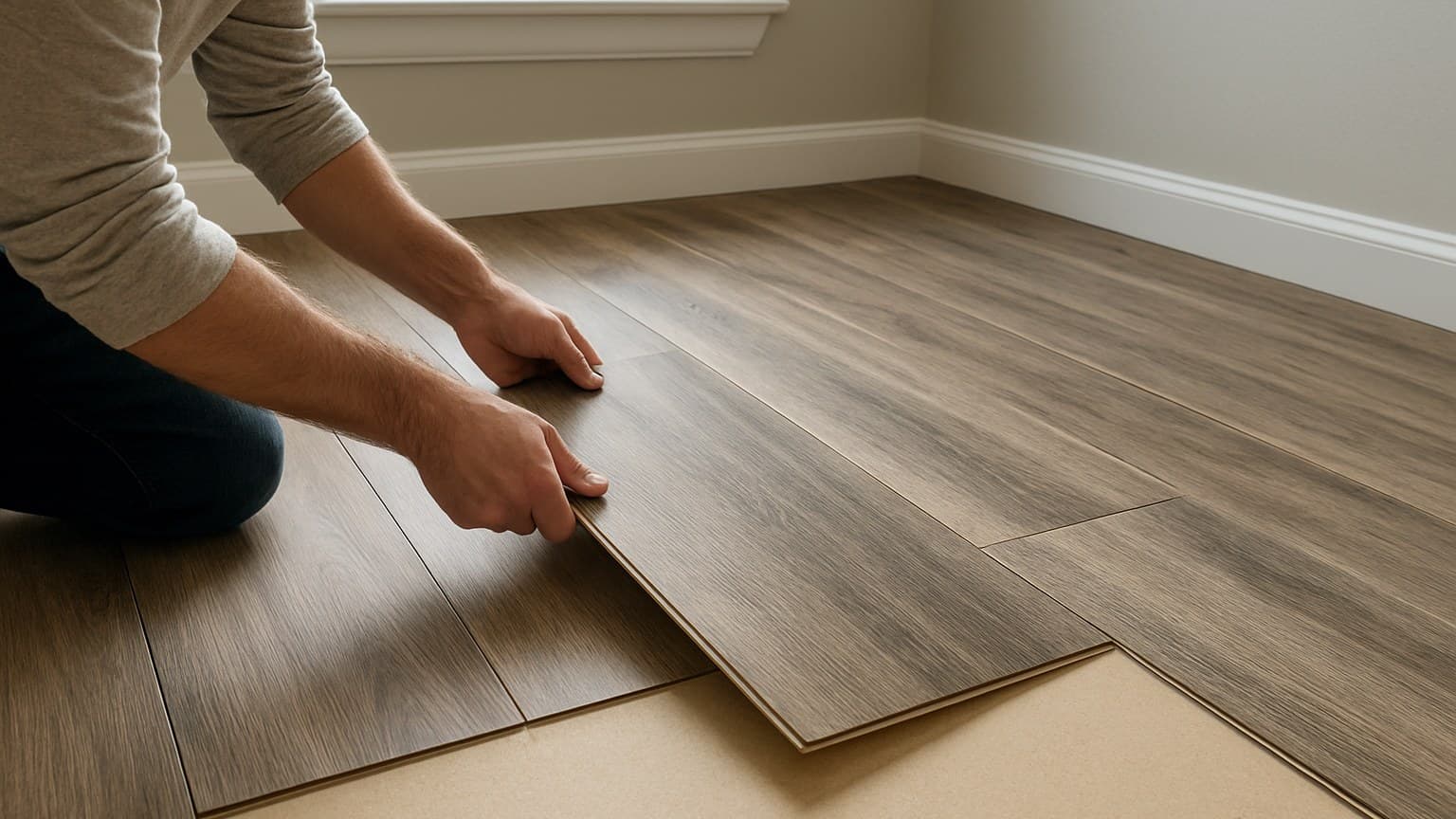
Click-lock LVP is realistic for most DIYers. It floats, it cuts with a utility knife, and a careful weekend gets a bedroom done. Where I tell people to hire out: glue-down LVP, nailed or glued hardwood, anything on stairs, and large open-plan floors with moisture transitions between rooms. Those are the jobs where a mistake shows up as a repair bill, and the labor you save isn't worth the floor you ruin.
What the Research Says About Long-Term Value (and What It Can't Promise)
According to the National Wood Flooring Association's Life Cycle Cost Analysis (LCCA), commissioned with the Tile Council of North America (TCNA), researchers compared 18 flooring types over a 75-year horizon. The NWFA's framing is straightforward: real wood's long-term value holds up well against other categories, largely because you refinish it instead of replacing it, so one floor spans several decades of other floors.
Tie that back to your own room. Over 75 years an LVP floor gets torn out and replaced multiple times, while a solid wood floor often gets sanded and recoated and keeps going. That math favors hardwood in a dry, stable room you plan to keep.
What the research can't promise is a fixed service life or a guaranteed resale bump for your specific house. Lifespans are ranges, not warranties, and resale value depends on your market and your buyers. Use the study as a frame for the long game, not as a number to bank on.
For the full cost-over-time math and a species-by-species hardness breakdown, the hardwood pros and cons guide is the right next read before you lock in a budget.