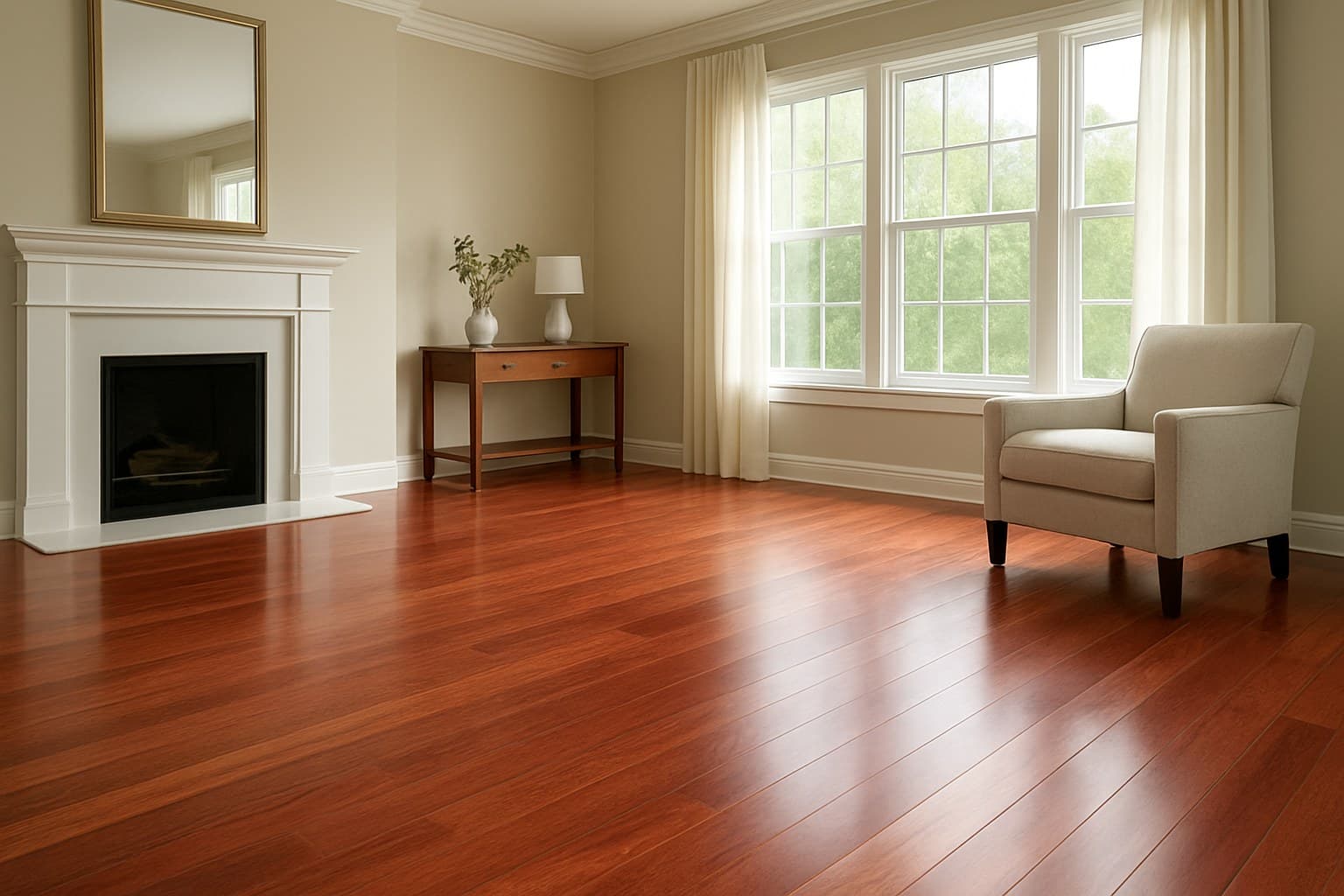
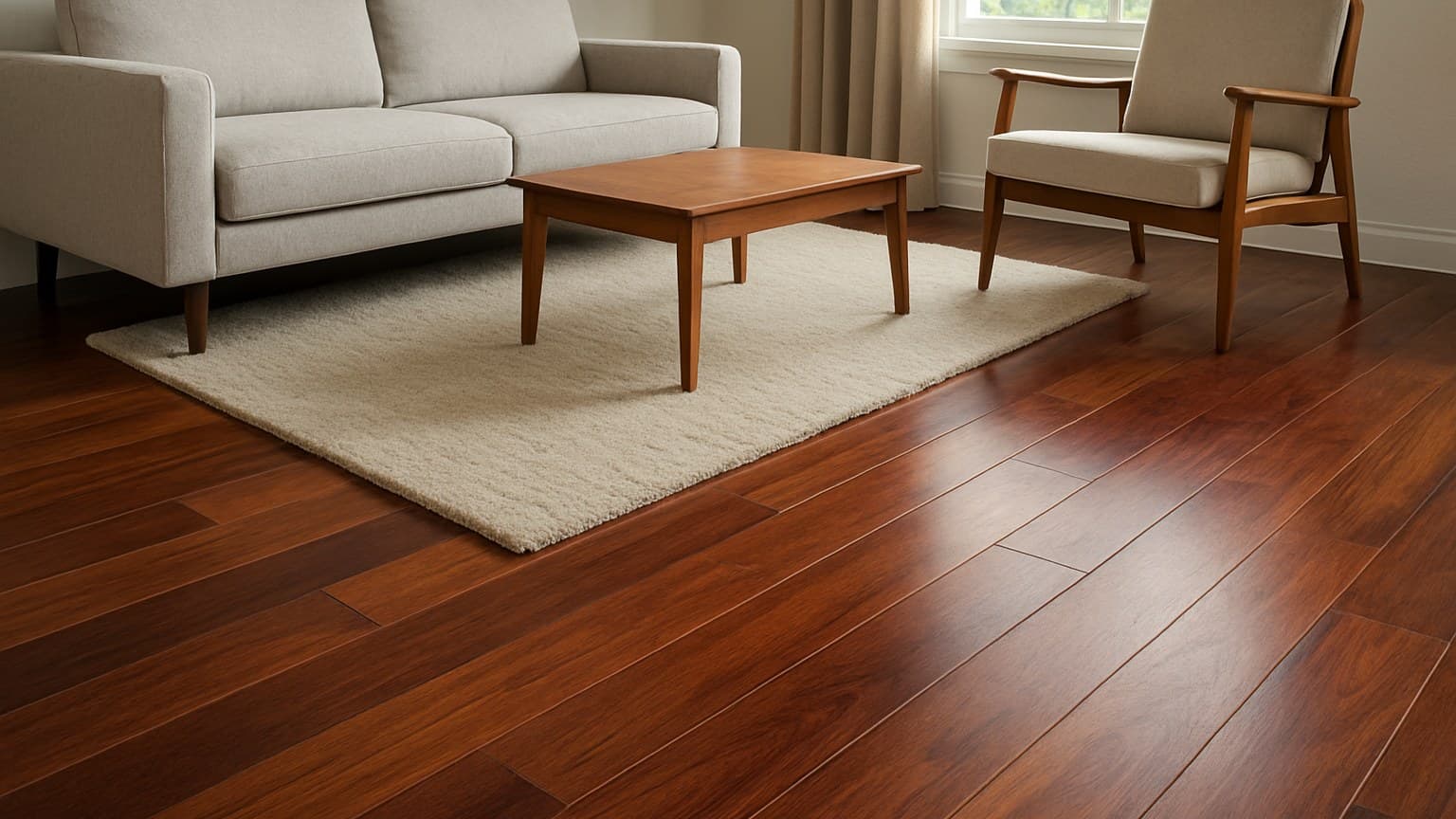
Brazilian cherry (Jatoba) darkens on its own and can leave pale ghosts under rugs. Here's the UV fix, the real Janka number, and cost split.
Key takeaways
- Brazilian cherry (Jatoba) darkens from orangey-red to deep red-brown within about a year, driven by UV light, so don't lay rugs or set heavy furniture until the color settles evenly.
- Prevent blotchy patches: leave the floor uncovered for the first few months, rotate rugs and furniture, and use UV-filtering window film on sun-facing glass.
- Its Janka hardness is 2350, nearly double red oak's 1290, which resists dents but dulls saw blades fast and forces pre-drilling before nailing.
- Split the cost: material commonly runs about $5-10 per square foot, plus roughly $4-8 per square foot for nail-down labor; stairs and basements cost more.
- Over a slab or in a basement, engineered Brazilian cherry is the safer call than 3/4-inch solid.
What Brazilian Cherry Flooring Actually Is
Brazilian cherry is a trade name for Jatoba, a dense tropical hardwood from South America, and it is not related to true cherry wood at all. New boards come out of the box orangey to reddish-brown, with dark streaks and a lot of grain change from one plank to the next. That wild variation is part of the look people buy it for, and it's one reason so many buyers are choosing to showcase it in wide plank flooring's current style comeback, since broader boards put more of that dramatic grain shift on display in every room.
Here is the one thing to know before you spend a dime: this wood keeps changing color after it is down. That single fact drives almost every decision below, from when you can lay a rug to whether you buy prefinished or raw.
The raw wood color is the whole selling point of Brazilian cherry, so it makes no sense to fight it with stain. You just have to plan around how it shifts.
Why It Keeps Getting Darker After You Install It
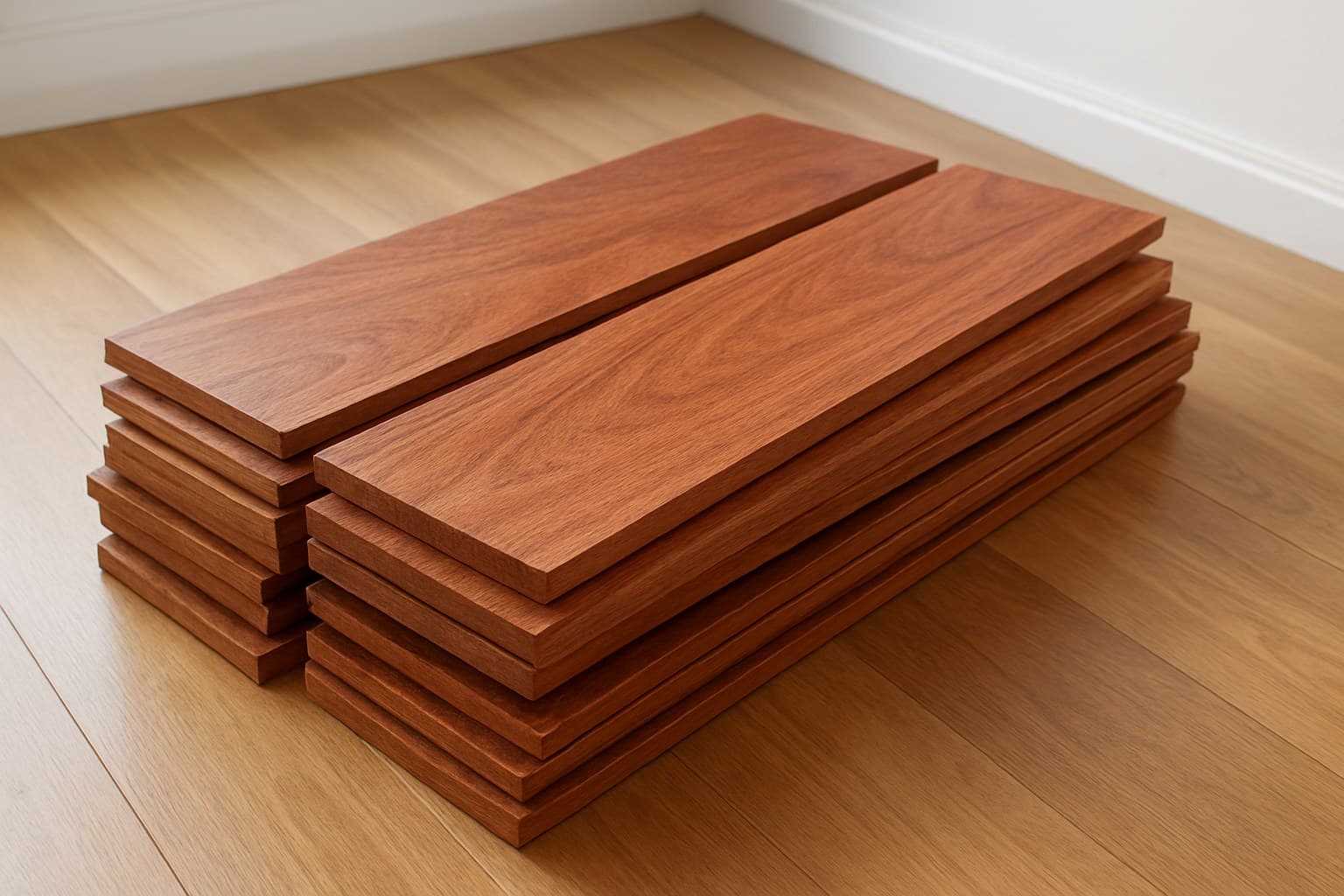
Jatoba is photosensitive, which means UV light in daylight deepens the color over the first several months up to about a year. It moves from bright reddish toward a deep, warm red-brown. This happens whether a room gets blasting direct sun or just normal daylight bouncing around.
Think of it like skin tanning: the spots getting the most light darken fastest, while shaded spots lag behind. A floor only tans evenly if the light hits it evenly.
This color change is normal and permanent, not a defect. Nobody sanded the wrong board and nobody sold you a bad batch. It just means the sample you carried home from the store will not match your floor a year later, so pick the color you want it to become, not the color it is on day one. If that kind of dramatic shift isn't what you're after, it's worth looking at keeping blonde floors from yellowing as a lighter option that stays much closer to its original shade over time.
My Rug Rule: How to Dodge the Pale Ghost Patches
My rule is simple: I never let a customer lay a rug on a fresh Brazilian cherry floor until the color has settled evenly, usually a few months in. Cover a strip of tanning wood and you lock in a pale rectangle that shows the second you move the rug.
Here is how I keep a floor even while it darkens:
- Leave the floor bare for the first few months so the whole surface tans together.
- Once it is settled, still rotate rugs and shift furniture now and then so no area stays shaded far longer than the rest.
- Put UV-filtering window film or shades on sun-facing windows. It slows the change and, more important, spreads it out so one hot patch of sun doesn't race ahead of the room.
When people ignore this, the mismatch is obvious. You get sharp shadow lines around furniture legs and a pale ghost rectangle under the rug you finally decided to move. Those patches do eventually catch up if you uncover them and give them light, but that can take months, and in the meantime your floor looks patchy. Easier to just not create the problem.
How Hard Is It, Really? Janka 2350 vs Oak, Maple and Walnut
Brazilian cherry rates about 2350 on the Janka hardness scale, which makes it one of the harder floors you can put in a home. The Janka number measures how much force it takes to press a small steel ball into the wood, so higher means tougher to dent.
Here is how that stacks up against the common domestic woods people compare it to:
| Wood | Janka rating |
|---|---|
| Black Walnut | 1010 |
| Red Oak | 1290 |
| Hard Maple | 1450 |
| Brazilian Cherry (Jatoba) | 2350 |
Janka hardness ratings for four common flooring woods, on the standard Janka scale.
That hardness is why the wood shrugs off dents from dog nails, dragged chairs and hard heels. In a busy hallway or a house with big dogs, it takes abuse that would leave dimples in walnut or even oak — go the opposite direction on hardness, like wide plank pine flooring, and those same dents and dings become part of the look rather than a flaw to fight.
One honest limit: hardness fights dents, not scratches. A scratch lives in the finish on top of the wood, so scratch resistance comes down to the topcoat, not the raw Jatoba underneath. A hard floor with a worn finish still shows scuffs.
Subfloor Flatness and Moisture: The Step That Decides Longevity
Before any talk of laying boards, I get down on the floor with a long straightedge and a light behind it. The gaps that light shows me, the low and high spots, tell me more about how the job will go than the fancy box the customer already bought. A hard, heavy board like Jatoba will bridge a low spot and click or flex until it works a fastener loose.
Flatness tolerance and moisture limits come from the flooring maker's install instructions for that product, not a rule of thumb. Those numbers govern, so read them and hit them.
Never skip the moisture test on a slab to save a day. I learned to hold that line because the one time you skip it is the one time the floor cups on you months later, long after the crew has gone home. Cupping is when the edges of each board curl up higher than the center, so the floor feels wavy underfoot and you can see a shallow trough running down the middle of every plank. It happens when the underside of the board picks up more moisture than the top and swells unevenly, and wider boards move more than narrow ones, which is why our 12-inch wide plank flooring cupping guide is worth a look if you're considering going extra-wide with a hardwood like this. A meter reading takes minutes and settles the whole gamble.
And every solid or floating wood floor needs an expansion gap around the perimeter, because the wood moves with the seasons. Skip that gap and the boards have nowhere to push into, which can drive cupping or, in dry months, pull boards apart into visible gaps where you can see daylight or subfloor between planks. Go wider than a standard strip and these same movement problems get worse, not better — our breakdown of wide plank flooring's real drawbacks ranks which ones actually cause trouble. The exact gap size is on the product sheet, so leave it, then hide it under the baseboard.
That Same Hardness Makes It a Tougher Install
The density that resists your dog's nails also fights back the whole time you are laying the floor, and the catalog listings never mention it. This is not a beginner nail-down job.
Blades dull fast on this stuff. Plan on carbide-tipped saw blades and expect to swap them more often than you would cutting oak. A cheap blade turns brown and burns the cut halfway through the job.
Nail-down installs usually need pre-drilling. The wood is so hard that fasteners want to split it or bend instead of driving clean, so you drill a pilot hole first. That is slow, careful work across a whole floor.
Acclimation matters too, and it follows the maker's install sheet for your exact product and room, not a generic leave-it-a-day rule. A tropical hardwood coming into a dry heated house needs time to settle to your home's humidity before it goes down, and if you're leaning toward boards wider than standard strip flooring, our guide to extra wide plank flooring and cupping risk lays out how much width pushes that moisture swing into visible cupping.
Add the tool wear, the pre-drilling and the sheer weight of the boards together, and this is one of the strongest reasons to hire a pro rather than rent a nailer for the weekend. If you do want to swing the hammer yourself, go in knowing it will fight you.
Solid vs Engineered Brazilian Cherry: What's Under the Floor Decides
Over a concrete slab or in a basement, engineered Brazilian cherry is the safer call than 3/4-inch solid. Solid wood moves with moisture and humidity, and a slab keeps feeding moisture from below for years, so solid boards over concrete are asking to cup or gap. If moisture is the real worry, it's also worth knowing that a lot of what's marketed as bamboo flooring is actually vinyl — our breakdown of products sold as bamboo vinyl flooring explains which one you're actually getting, and a true waterproof vinyl core can outperform any real hardwood, engineered included, in a damp basement. If you love Jatoba's rich grain but need that vinyl-level moisture resistance, it's worth seeing how convincingly a plank can fake a wood species in our hickory vinyl plank flooring guide.
Going down, engineered doesn't fight the crew the same way a nail-down solid job does, because it isn't nailed at all. Most engineered Jatoba is a click-together, floating product: the planks lock edge to edge and rest on a foam or cork underlayment over the slab or subfloor, with no fasteners driven into the wood. Some engineered lines are instead set as a glue-down, where the installer spreads a flooring adhesive on the slab and beds each plank into it, which anchors the floor solidly and cuts down on the hollow feel a floating floor can have underfoot. Which method applies is a property of the specific product, not a choice you make on site, so check the box before you buy if you have a strong preference either way.
The tradeoff between the two comes down to how many lives the floor has. Solid can be sanded and refinished more times, so it rides out decades of wear and the odd bad scratch. Engineered has a thin real-wood wear layer over a stable core, and that layer limits how many times you can sand it. The maker states the wear-layer depth per product, so check the spec sheet before you count on refinishing an engineered floor at all.
For a normal room on a wood subfloor above grade, either can work and it comes down to budget and how long you want the floor to last. Below grade or over slab, let the subfloor make the call for you.
For the full breakdown of when to pick solid over engineered and which species suits which room, our guide to solid vs. engineered hardwood and the right species for your room walks through it room by room.
Prefinished vs Unfinished, Widths, Thickness and Finish
Prefinished planks come sealed from the factory, so the color and topcoat are locked in when they arrive. Unfinished boards get sanded and finished on site after they are nailed down, which lets you match a look but adds days of dust and dry time to the job — our guide to sanding and finishing unfinished hardwood on site walks through what that process actually involves.
Common widths run roughly 2.25 to 5 inches, with 3/4 inch a typical thickness for solid boards. Narrower boards move less with humidity and are more forgiving. Wider boards show off more of that dramatic grain but react more to moisture swings, so they lean harder on good subfloor prep — for a species where this tradeoff is even more pronounced, see our wide plank hickory flooring cost and movement guide.
Most prefinished Brazilian cherry carries an aluminum oxide or polyurethane topcoat for scratch resistance. Any specific durability or warranty claim belongs to that product's own spec sheet, not to the species as a whole, so read the box you are actually buying.
There is a timing catch with unfinished Jatoba. Raw boards start tanning under UV before they are ever sealed, so if they sit in a sunny room half-installed, they can darken unevenly before the finish goes on. Keep raw boards covered and out of direct light until you are ready to seal them.
What Brazilian Cherry Flooring Costs
There is no honest single price, so split it into materials and labor. Material commonly runs roughly $5-10 per square foot, with premium prefinished lines landing near the top of that range, get an exact quote from the retailer for the specific product you want, since prices vary by seller and shift over time. Then add roughly $4-8 per square foot for nail-down labor from a pro, and more where the pre-drilling and blade changes slow the crew down. If you want to see those per-square-foot numbers turned into an actual project total, our 12x12 room hardwood cost breakdown walks through the full 144 square foot math line by line.
| Cost piece | Range ($ per sq ft) |
|---|---|
| Material | $5 - $10 |
| Nail-down labor | $4 - $8 |
Typical material and nail-down labor ranges per square foot for Brazilian cherry, before room-specific extras. Not drawn to a real scale.
Basement, stair and small-room jobs cost more per foot than open rooms. Stairs and tight rooms mean more cuts, more transitions and slower, careful going, and this hard wood punishes every one of those cuts.
One reality check on shopping "near me" or at a big-box home center: prices and available widths swing a lot by seller. Price the exact product you want, not the species in general, because two Jatoba floors on two shelves can be dollars apart per foot.
Pros, Cons and Whether It's Worth It
The pros are real: hardness that holds up to busy homes and pets, a deep warm red-brown color that's hard to match with a domestic wood, and a floor you can refinish, solid more times than engineered. It's a floor that takes a beating and still looks rich.
The cons are just as real. The color-change surprise catches people off guard, the price sits above domestic oak, and the install dulls tools and needs pre-drilling. None of that is a dealbreaker if you know it going in.
My bottom line: it is worth it if you genuinely love that deep red-brown and you will manage the darkening with bare-floor time and rotated rugs. Skip it if you want a color that stays put, or if this was going to be your first DIY nail-down — if a lighter, more stable look actually appeals to you more, our blonde maple vs. blonde oak vinyl plank comparison is worth a look before you commit to a hardwood that keeps shifting color. And since Jatoba is a tropical species, ask your supplier about sourcing and look for responsibly harvested stock rather than the cheapest pallet you can find.
If you are still weighing this against oak, maple or an engineered option for your specific room, the solid vs. engineered hardwood and species-by-room guide lays the choices side by side so you can match the wood to what is under your floor.