
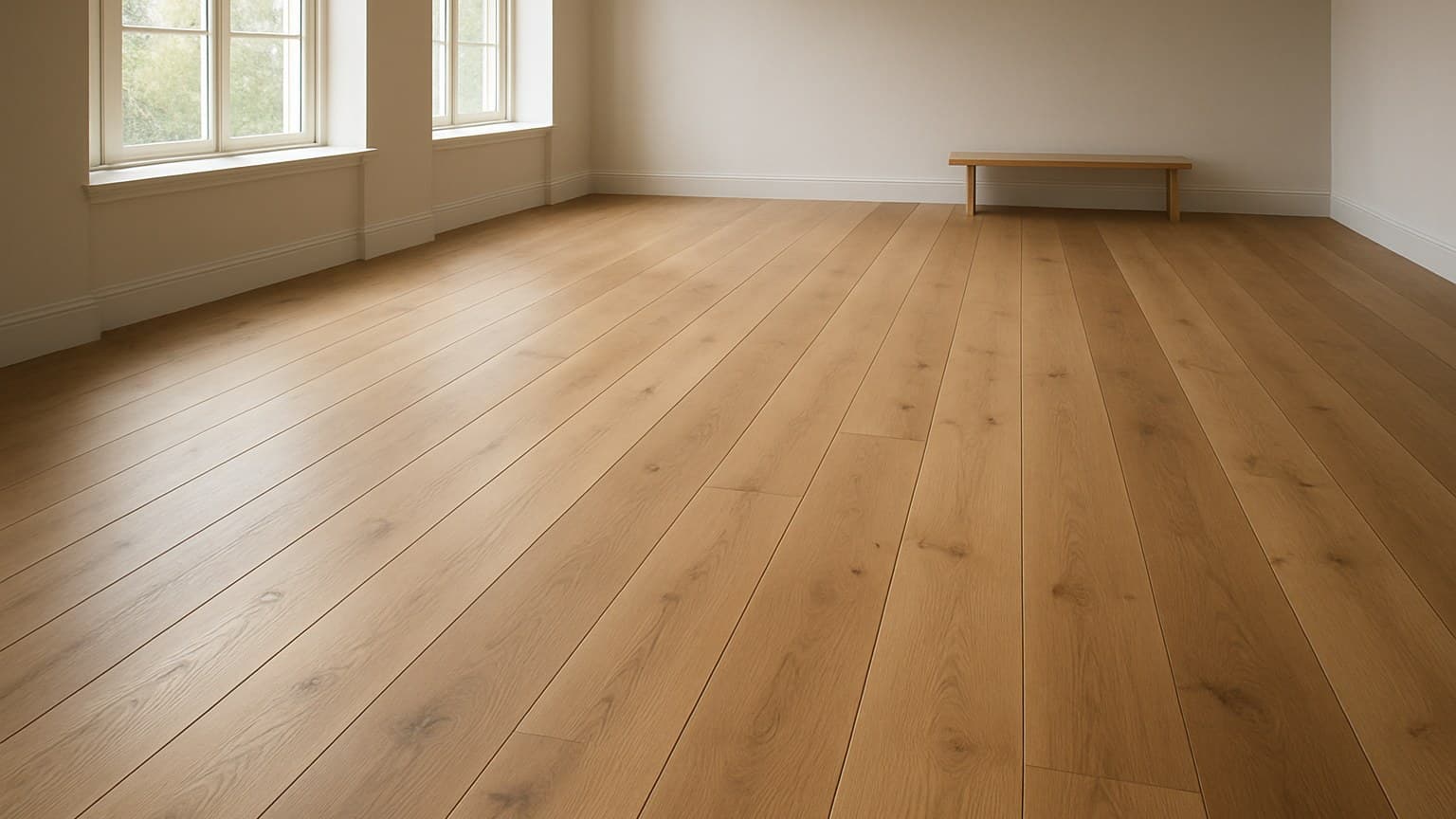
I quoted a 9-inch white oak floor for a family's living room in Round Rock, Texas last month, and their first question was whether "extra wide" plank was even a real size. It isn't, there's no official "extra wide" class, so the same board reads as premium in one store and plain stock in the next. Go wider and the floor moves more every season, which is where a nice install can turn into a cupped, gappy mess.
Key takeaways
- The NWFA sizes boards by width: strip is under 3 inches, plank is 3 to 5 inches, and wide plank is anything over 5 inches. 'Extra wide' is trade slang for the 7 to 14 inch boards, not an official class of its own.
- Every extra inch of board width means more seasonal movement, so wider planks gap and cup more than narrow ones when moisture isn't controlled. Acclimation and hitting the maker's moisture-content target matter far more here than on a strip floor.
- Engineered handles extra-wide better than solid over concrete, basements, and radiant heat, because its plywood-style core stays put while a wide solid board swells and shrinks across its face.
- Real installed cost splits into materials and labor: budget engineered extra-wide runs about $4-8/sq ft in materials, wide solid white oak $8-15+, with labor adding roughly $3-8/sq ft depending on glue-down and subfloor prep.
- Before any planks go down, check subfloor flatness and take moisture readings with a meter (the tool that reads how wet the wood and subfloor are). Skipping that is where wide-plank callbacks come from.
What "Extra Wide" Actually Means (and Who Decides)
There is no separate "extra wide" grade. The National Wood Flooring Association (NWFA) sizes boards by width, and "extra wide" is just trade slang installers use for the widest end of that range, roughly 7 to 14 inches.
Here's the part most pages skip. According to the National Wood Flooring Association's (NWFA) published installation guidelines, boards fall into three width classes: strip is under 3 inches, plank is 3 to 5 inches, and anything over 5 inches is wide plank. That's it. When a website tells you "5 inches and wider," that number comes from a real standard. When another says "extra wide" with no number at all, that's marketing, and you can't compare it to anything.
So a 7-inch board and a 12-inch board can both wear the "extra wide" label even though they behave very differently once they're down.
| Class | Width | Notes |
|---|---|---|
| Strip | Under 3 inches | Most seams, most stable, classic look |
| Plank | 3 to 5 inches | The common middle ground |
| Wide plank | Over 5 inches | Official cutoff for "wide" |
| "Extra wide" (trade slang) | About 7 to 14 inches | No official class; widest boards, most movement |
Source: the NWFA's published width classes for strip, plank
NWFA width classes compared with the informal "extra wide" term as it's used on the sales floor.
One more thing worth knowing: engineered boards push widest, commonly up to 12 inches and some lines to 14 or more — if you're specifically eyeing 12 inch wide plank flooring, that's the engineered end of the range you'll be shopping. Solid extra-wide is rarer and moves more. Wider is a look-and-movement tradeoff, not a straight upgrade. The rest of this article is about managing that tradeoff.
Why Homeowners Keep Going Wider
The pull is simple. Fewer boards means fewer seams across the floor, a more open feel, and long unbroken runs of grain that show off the wood. On white oak especially, a 9-inch board lets the grain stretch out instead of getting chopped up every few inches.
Wide-and-light is also having a real moment right now. Extra-wide boards in softer, matte finishes are what I'm asked to quote more than anything else lately. If you're weighing whether that look has staying power, it's worth reading up on whether wide plank floors are still in style before you commit, and where flooring trends are heading in 2026, so you're buying a floor you'll still like in ten years, not just this year.
One myth worth killing: wide boards do not make a room look smaller. Fewer seams read as calmer and more open, not busier. I laid 10-inch white oak plank in a small guest bedroom for a customer in Cedar Park, Texas, and it looked bigger, not cramped.
The catch is the one thing the showroom won't dwell on: all that width comes with more seasonal movement to manage. That's the next section.
The Wider It Gets, the More It Moves
Wood swells and shrinks across its width, not its length. So a 10-inch board moves across its face more than three times as much as a 3-inch strip in the same house. That's the whole reason gapping and cupping risk climbs with every extra inch of width, and it's even more pronounced with harder species — the wide plank hickory flooring guide breaks down exactly how much more hickory moves compared to oak.
Two terms worth defining plainly, because they're what actually goes wrong:
- Gapping is winter shrink. The heat comes on, the air dries out, the boards lose moisture and pull apart at the seams. Wider boards leave wider gaps.
- Cupping is when the edges of a board rise higher than its center. It happens when the underside takes on more moisture than the top, so the bottom swells and pushes the edges up. On a wide board a small moisture imbalance shows up as a big cup.
You control both with the same two levers. First, acclimation, but only if the product's own sheet calls for it. Some engineered lines say don't bother, some solid products want days in the room first. The box governs, not a rule of thumb you read online. Second, and this is the big one, hit the manufacturer's moisture-content target before a single plank goes down, checked with a moisture meter (the tool that reads how wet the wood and the subfloor are).
And it all starts under the floor. The NWFA's Homeowner's Handbook to Real Wood Floors is direct about this: check subfloor flatness and take moisture readings first, every time. On a wide-plank job for a customer in Pflugerville, Texas, the slab felt dry to the hand but read wet on the moisture meter, I caught it before a single board went down. Width just makes a bad subfloor impossible to hide once the boards are wide enough to show every dip and damp spot.
Solid vs. Engineered for Extra-Wide Boards
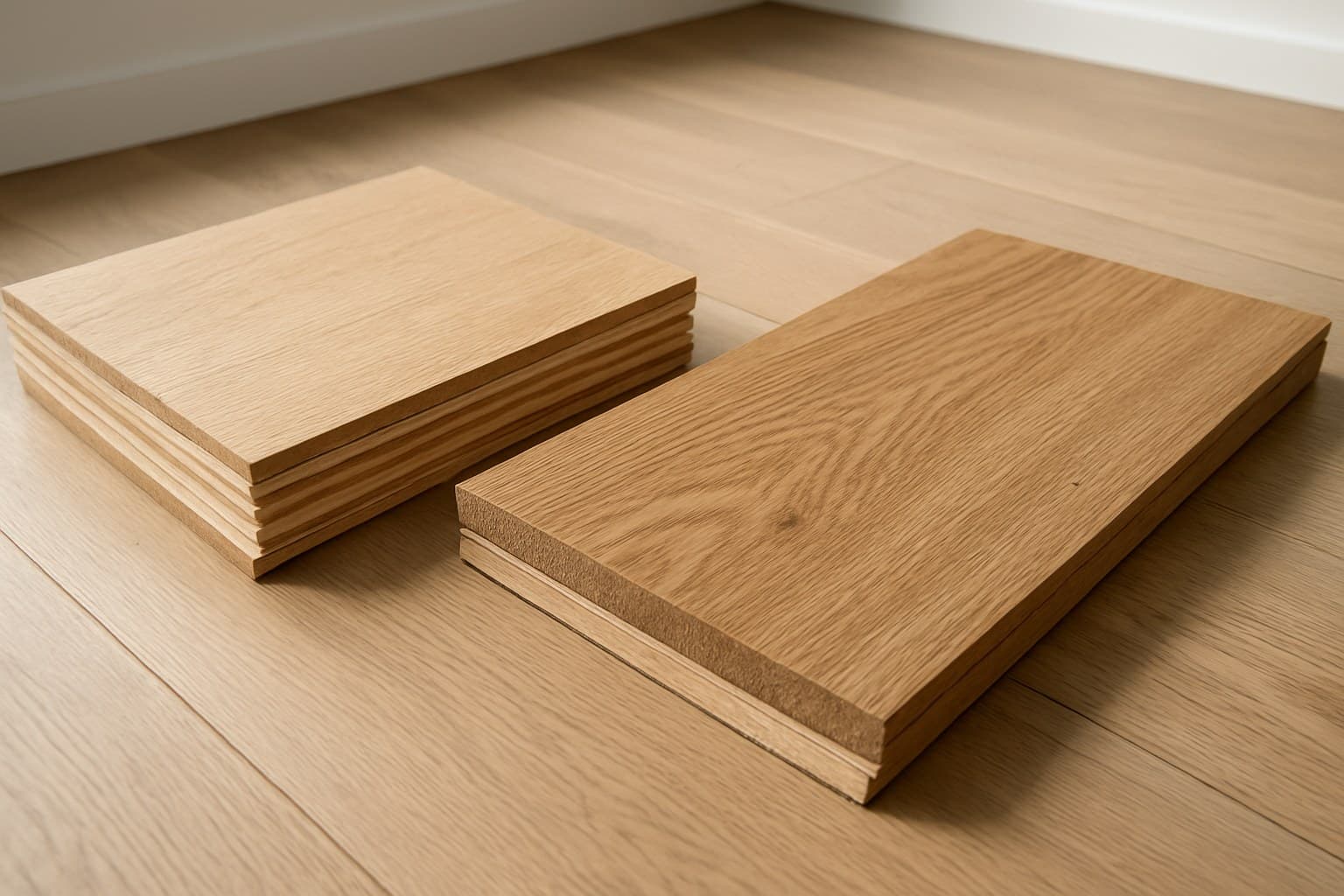
At extra-wide sizes, engineered usually handles a real, lived-in home better. Its plywood-style core is built up in layers that pull against each other, so it resists the big across-the-face swelling and shrinking a wide solid board goes through.
That doesn't make solid wrong. It makes location the deciding factor:
- Solid extra-wide belongs over a wood subfloor, above grade, in a house with steady humidity. Its payoff is that you can sand and refinish it many times over its life.
- Engineered extra-wide is the call over concrete, in basements, and over radiant heat, where solid generally isn't recommended at all, let alone in wide boards.
On refinishing, don't trust a blanket answer. What you can sand later depends on the wear layer, meaning the real-wood veneer on top, and its thickness is a number the maker publishes for that specific product. A thick veneer might take a couple of sandings; a thin one takes none. So "can I refinish this?" is a spec question you answer off the sheet, not a yes or no.
If you want the deeper decision walked through, I laid it all out in the full solid vs. engineered hardwood breakdown. For extra-wide specifically, though, the short version holds: the wider you go and the closer you get to concrete or radiant heat, the more engineered earns its keep.
What Extra Wide Plank Costs, by Width and Species
There's no single price, and any page that gives you one flat number is guessing. Real cost splits into materials and labor, and both move with species, construction, and how much work your subfloor needs. Basement and stair jobs run higher than an open room, because of tighter cuts, transitions, and moisture control.
Here's how the pieces stack up per square foot:
| Option | Materials | Labor | Note |
|---|---|---|---|
| Engineered extra-wide (budget) | $4-8 | $3-6 | Click-lock or glue-down |
| Solid wide white oak | $8-15+ | $4-8 | Nail-down over wood subfloor |
| Wide walnut | $10-18+ | $4-8 | Premium species, softer than oak |
| Reclaimed extra-wide | $10-20+ | $5-9 | Extra prep, more waste |
| Subfloor prep (add-on) | $0.50-2 | $1-3 | Leveling and moisture control |
Installed cost per square foot, split into materials and labor, by species and construction.
Now let me price a real room so you can do yours. Say you've got a 300 square foot living room and you pick budget engineered extra-wide, glue-down over a wood subfloor.
- Materials: 300 sq ft x $6 = $1,800
- Labor: 300 sq ft x $4 = $1,200
- Subfloor prep (leveling a couple of low spots): 300 sq ft x roughly $2 all-in = $600
- Rough total: about $3,600, or $12 per square foot installed
Swap in solid wide white oak at $12 materials and $6 labor and that same room jumps to about $5,400 before prep. Same size room, very different bill, down to what you put in it. Glue-down and any moisture-transition areas push labor toward the top of its range; a clean, flat, dry subfloor keeps prep near the bottom.
Is Extra Wide Plank Right for Your Room?
Quick verdict framework. An open living or dining room above grade, in a house with steady humidity, is the easy yes for extra-wide, solid or engineered. Basements, slabs, radiant heat, and swingy climates push you to engineered. And if you're chasing the look because it's the most trending flooring right now, that's a fine reason, just buy for your room's conditions, not the photo.
Over concrete or radiant heat, go engineered and confirm the exact product is rated for that use on its own spec sheet. Rated matters. A wide engineered board not built for radiant heat will still move.
On DIY versus hire, I'll be straight. Click-lock engineered extra-wide is doable for a careful DIYer who takes the prep seriously. Glue-down, stairs, and big open-plan floors with moisture transitions are where I'd hire out, because those are the jobs where a small mistake spreads across a wide board and shows.
Before you fall for a wide floor, it's worth knowing the real downsides of wide plank flooring so nothing surprises you after it's down. My rule on every quote: hit the manufacturer's moisture-content target and confirm the subfloor flatness spec before the first board goes down. Do that and a 9-inch or 10-inch floor holds tight for years; skip it and you'll see gaps show up by the first winter.