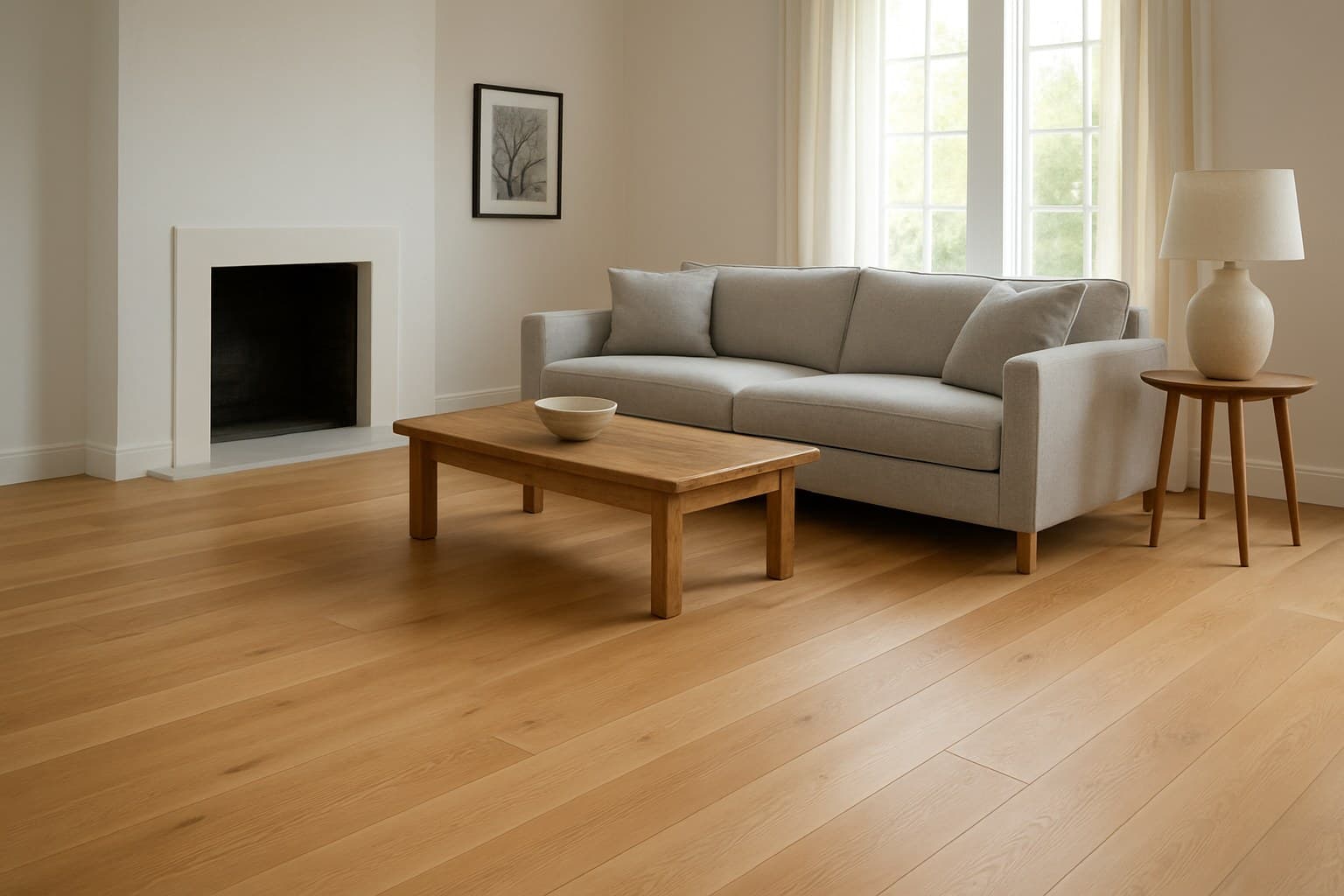

On a wide-plank maple job for Renee Sutter in Dayton, Ohio, she asked me twice if maple was too soft for boards this wide. Softness wasn't the real risk on her job, whether her subfloor and humidity could handle a 7-inch board was. That mix-up between a hardness fear and the real movement risk is what turns a good-looking maple floor into a callback.
Key takeaways
- Maple is actually harder than oak: hard maple sits around 1450 on the Janka scale versus white oak at 1360 and red oak at 1290, so softness is not the real worry.
- The true wide-plank risk is movement, not hardness. Boards over 5 inches (the NWFA's actual 'wide plank' cutoff) cup in humid months and gap in dry ones far more than narrow strips.
- For wide maple over concrete, in basements, or over radiant heat, engineered construction is the safer bet; solid wide maple needs a tightly controlled, dry room.
- Acclimate the wood to within about 2% of the room's moisture (often 8-10 days) and check subfloor flatness and moisture before laying a single board.
- Budget roughly $4-10 per sq ft for material by grade, plus $3-8 per sq ft labor. Wide boards, basements, and stairs push you toward the top of the range.
The Real Gamble With Wide Plank Maple
Maple is not too soft for wide boards. It is harder than the oak most people already trust, so hardness is the wrong thing to be nervous about. If you're curious how a genuinely soft species compares, the wide plank pine flooring guide breaks down whether that softness is actually a dealbreaker.
The real gamble is movement. A wide board has more width across its face to swell in humid months and shrink in dry ones, so it moves more than a narrow strip. That movement is what you see later as edges lifting (cupping) or thin lines opening between planks (gapping).
Wide maple holds up well when you control moisture and pick the right construction. It fails when people rush past acclimation and subfloor checks. Below I settle the hardness myth with numbers, give the real definition of "wide plank," walk through the stability tradeoff, split the honest costs, and help you decide if it fits your room.
Is Maple Really Harder Than Oak? The Janka Numbers Settle It
Yes. According to the National Wood Flooring Association (NWFA), hard maple rates about 1450 on the Janka scale, white oak sits around 1360, and red oak around 1290. Maple wins the dent test. If you want a wood that rates even higher on that same scale, the wide plank hickory flooring guide covers a species that pushes well past maple's number.
The Janka scale is simple once you know what it measures. It is a dent test: how much force it takes to press a small steel ball halfway into the wood. A higher number means the surface shrugs off dents better.
Here is the catch the vendor pages skip. A high Janka number tells you about dents and nothing about seasonal movement, and movement is the whole wide-plank question. So maple beating oak on hardness does not make a wide maple board more stable. Those are two different problems.
One more thing to check on the spec sheet: the flooring people mean by "maple" is hard maple, also called sugar or rock maple. Soft maple is a separate, softer group of species. If the sheet does not say hard maple, ask. Cherry buyers run into the same labeling confusion, which is why the cherry vinyl plank shades guide walks through telling the different shades apart before you order.
| Species | Janka rating (lbf) |
|---|---|
| Walnut | 1010 |
| Red oak | 1290 |
| White oak | 1360 |
| Hard maple | 1450 |
| Hickory | 1820 |
Janka hardness ratings for five common flooring woods, showing hard maple edging out both oaks.
What Actually Counts as 'Wide Plank' Maple (And Who's Stretching It)
By the industry line most sellers never cite, wide plank means boards over 5 inches. According to the NWFA's Homeowner's Handbook to Real Wood Floors, flooring is sorted into strip (under 3 inches), plank (3 to 5 inches), and wide plank (over 5 inches).
So watch the marketing. A shop calling 4-inch boards "wide" is stretching the word. Anything 5 inches or under is plank, not wide plank, no matter how the tag reads.
True wide plank maple has real appeal: fewer seams across the room, a cleaner and more modern look, and that bright, open feel maple is loved for. On a big open floor, the difference between narrow strips and 7-inch boards is easy to see. For a warmer-toned option that carries its own risk of looking dated if you pick the wrong shade, the cherry laminate flooring guide walks through which cherry finishes still read as current.
But the wider you go, the more each board expands and contracts across its face. That is why width, not species, drives the stability decision you make next.
Why Wide Maple Moves: Cupping and Gapping Explained
Wood breathes. It takes on moisture when the air is humid and gives it back when the air is dry. A wide board has more width to move than a narrow one, so the same swing in humidity shows up bigger on a 7-inch plank than on a 2-inch strip.
Cupping is when a board's edges rise above its center. It happens when the underside is wetter than the top, common in humid summers or when moisture creeps up from a slab or crawlspace below.
Gapping is the opposite. In dry winter heat the boards shrink and pull away from each other, leaving thin lines between planks. Some seasonal gapping is normal; wide open lines mean the wood lost more moisture than it should have.
A nailed or floating floor's warranty quietly hinges on humidity control and the prep beneath it, not on the plank you picked off the sample board. Get the room and subfloor right and maple behaves. Skip that and the width works against you.
An acclimated board (left) beside the two ways wide maple fails when moisture is not controlled.
Solid vs. Engineered Maple for Wide Boards
For wide maple, engineered is usually the safer bet. Its plywood-style core resists movement, and the NWFA's Installation Guidelines note that solid wood generally is not recommended over concrete, in basements, or over radiant heat, situations where engineered construction is the better choice.
Solid wide maple still has its place. In a stable room at or above ground level with humidity you actually keep in check, it works and it can be sanded and refinished several times over its life. If you're weighing solid versus engineered construction across species more broadly, the hardwood floors solid vs. engineered guide walks through how to match each option to your room.
The refinishing question is a spec question, not a simple yes or no. An engineered board can only be sanded down to its wear layer, and that veneer thickness is published by the maker. Some thick-veneer engineered floors sand a few times; thin ones cannot be sanded at all, so read the sheet before you assume you can refinish later.
My take: once you pass 6 to 7 inches wide, lean engineered unless you can hold the room's humidity steady year round. If you are weighing another soft, wide species alongside maple, the wide plank walnut flooring guide lays out the same tradeoffs side by side.
| Factor | Solid | Engineered |
|---|---|---|
| Best subfloor | Wood subfloor at or above grade | Wood or concrete, including basements |
| Humidity stability | Moves more, needs controlled RH | More stable across seasons |
| Radiant heat | Generally not recommended | Compatible with many products (check the spec) |
| Refinishing | Can sand several times | Limited by veneer thickness, sometimes not at all |
| Wide-board (6 in.+) suitability | Only with tight humidity control | The safer default |
Source: the NWFA's guidance on solid versus engineered wood over concrete
How solid and engineered wide maple compare across the factors that decide where each one belongs.
Acclimation and Subfloor Prep Before You Lay a Board
Acclimation means letting the wood settle to the room before it goes down. Per the NWFA's Installation Guidelines, the rule of thumb is to bring the flooring within about 2% of the room's own moisture level, which often takes 8 to 10 days. Always follow the product's own sheet, since some maple products ask for more time and a few ask for none.
Then the two checks nobody should skip. Run a long straightedge across the subfloor to find humps and dips, because a flat floor is what keeps wide boards from rocking and separating. And read the slab or subfloor with a moisture meter, a handheld tool that shows how wet the surface is, before a single board goes down.
Leave the expansion gap the maker specifies around the edges of the room. That gap around the perimeter is what gives a wide floor room to move without buckling. Cover it later with baseboard or shoe molding.
I'll be straight with you: on more than one job, a slab felt fine to my hand but told a different story on the moisture meter, or a hump I'd talked myself into ignoring showed up later as cupped boards. Running both checks up front costs you an afternoon. Skipping them costs you a floor.
What Wide Plank Maple Really Costs
Budget in two parts, never one flat number. Material runs roughly $4 to $10 per square foot depending on grade and whether it is solid or engineered, and installation labor adds about $3 to $8 per square foot.
These grade names generally follow the NWFA/NOFMA grading conventions for wood flooring, which rank boards from Clear and Select down to #1 Common and rustic grades. Grade drives the material price. A rustic or #2 grade shows more color streaks and small knots and sits at the low end. Clear or select grades, with even color and few marks, cost more, and wide engineered boards in a nice veneer land near the top.
| Grade / type | Material ($/sq ft) | Install labor ($/sq ft) |
|---|---|---|
| Rustic / #2 maple | $4 - $6 | $3 - $5 |
| Select | $6 - $8 | $4 - $6 |
| Clear or wide engineered | $8 - $10 | $5 - $8 |
Material and labor cost ranges for wide plank maple by grade; figures vary by region and shop.
Two things push you toward the top of the labor range. Basements cost more than open rooms because the concrete needs moisture testing and often a moisture barrier or subfloor first. Stairs cost more too, since each tread and riser is cut and fit by hand. An open living room with a flat wood subfloor is the cheapest maple you will ever install.
Does Wide Plank Maple Fit Your Room?
Wide maple fits best in dry, stable, main-level rooms: living rooms, dining rooms, bedrooms, and hallways where humidity stays fairly even. That is where its bright, open look pays off and the movement risk stays low.
Be more careful in kitchens, over basements, and anywhere moisture swings hard. In those spots go engineered, keep the boards on the narrower side of wide, and stay on top of humidity. Full bathrooms and laundry rooms are where I steer people away from real wood entirely. If you love hickory's bold grain but need something that shrugs off water in those rooms, the hickory vinyl plank flooring guide breaks down how closely it passes for the real thing.
If a moisture-prone room is exactly where you want the maple look, a wood-look vinyl plank is a fair swap. The maple vinyl plank flooring guide covers how well it copies real maple, and the blonde maple vs. blonde oak vinyl plank comparison helps if you are choosing between light wood looks. It is not the same as sanding real wood, but in a basement or bath it saves you the cupping fight.