
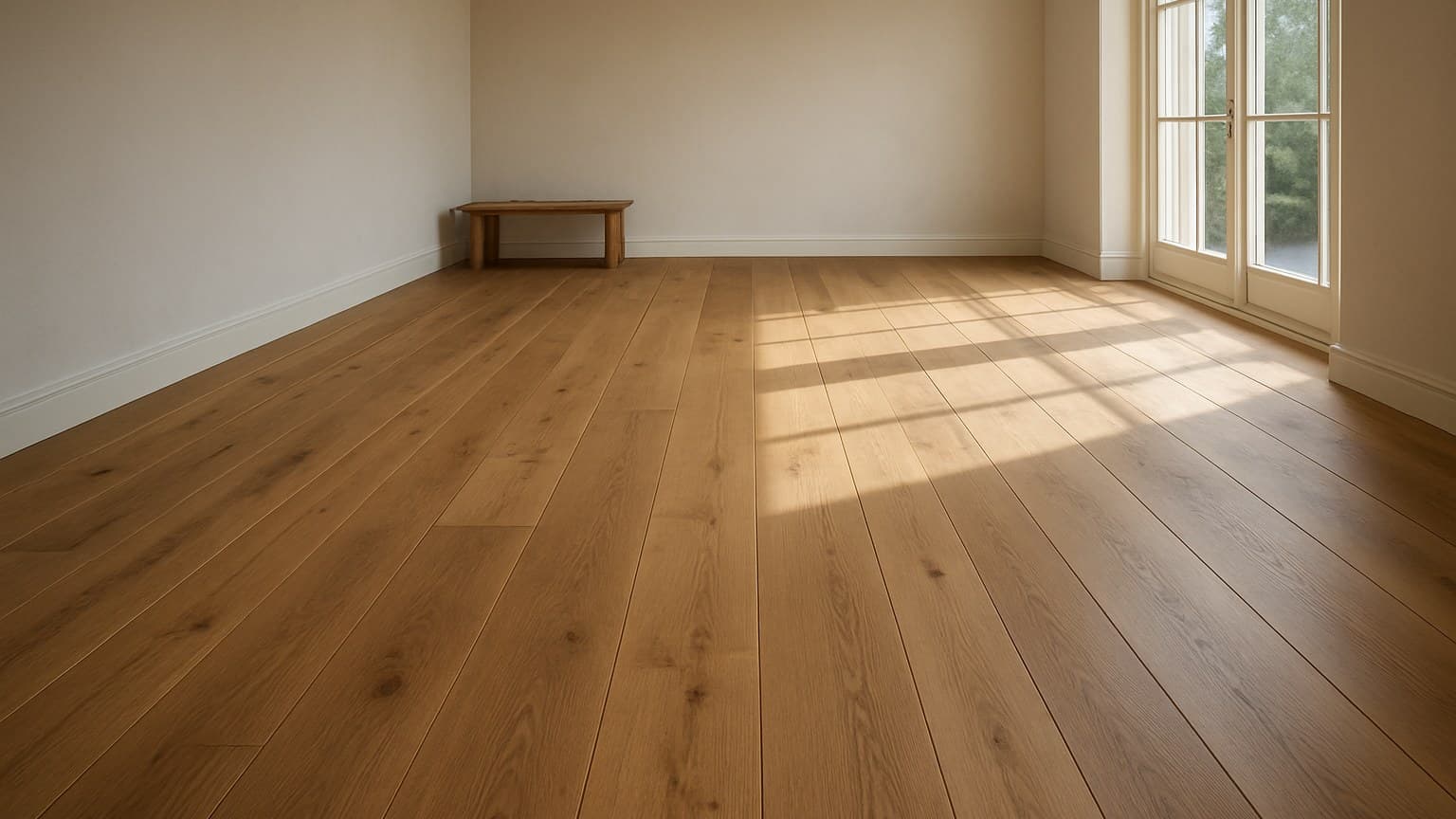
When Teresa in Columbus asked me to lay 12-inch wide plank oak through her open-concept living room, I told her the width was the real risk, not the finish. A 12 inch wide plank flooring board fights humidity every season. Get one detail wrong and it cups or gaps within a year. Here's what actually decides which way yours goes.
Key takeaways
- A 12-inch board moves roughly twice as much across its face as a 6-inch board in the same humidity swing, so width, not looks, decides whether it stays flat.
- Engineered planks with a cross-ply core hold flatter at 12 inches than solid wood, especially over concrete or radiant heat.
- Stable species and cuts (white oak, walnut, quartersawn or rift-sawn) cup less at this width than plainsawn maple.
- Get the wood's moisture content right at install (near your region's balance point, roughly 6-9% per NWFA) and acclimate per the maker's sheet, or you'll get gaps and cupping.
- Budget material and labor separately: wide-plank material often runs $8-20+ per sq ft and install $3-10 per sq ft, with stairs and basements costing more than open rooms.
Why Plank Width Is the Whole Story at 12 Inches
A 12-inch board can stay flat for decades. But it moves about twice as much across its face as a 6-inch board in the same humidity swing, so you have far less room for error.
Here's the part that trips people up. Wood swells and shrinks across the grain, not along its length, as the air gets damp or dry through the year. The wider the board, the more that swelling and shrinking adds up. On a narrow strip you barely notice it. On a 12-inch board, the same percentage of movement turns into a visible cup (edges lifting) or a gap between planks.
According to the NWFA's Homeowner's Handbook to Real Wood Floors, boards are sorted by width like this: strip is under 3 inches, plank runs from about 3 inches up, and "wide plank" generally starts around 5 to 7 inches. That puts 12 inches firmly in extra-wide territory. That's not the ceiling, though, reclaimed and custom-milled boards go wider still, with 16- to 20-inch-plus planks turning up in specialty and salvage lots for buyers chasing an even bolder look. Standard-production wide plank tops out well below that, so anything past 12 inches usually means custom or reclaimed sourcing, and the sizing, cost, and moisture demands only get steeper as you climb toward that range. For a closer look at boards in that upper range, extra wide plank flooring options breaks down what changes once you cross into that territory.
At this width, four things decide whether your floor stays flat: the core (solid or engineered), the species and how it was cut, the moisture content when it goes down, and how you acclimate it. The finish and the photo that sold you have nothing to do with it.
The relationship looks roughly like this (approximate figures, for illustration):
| Board width | Movement vs a 6-inch board |
|---|---|
| 3-inch strip | 0.5x |
| 6-inch plank | 1.0x |
| 8-inch plank | 1.3x |
| 12-inch plank | 2.0x |
Relative wood movement across the face of a board as width grows, measured against a 6-inch board set at 1.0, an illustrative approximation to show the trend, not measured data from a specific published study.
Solid vs Engineered at 12 Inches: What Actually Stays Flat
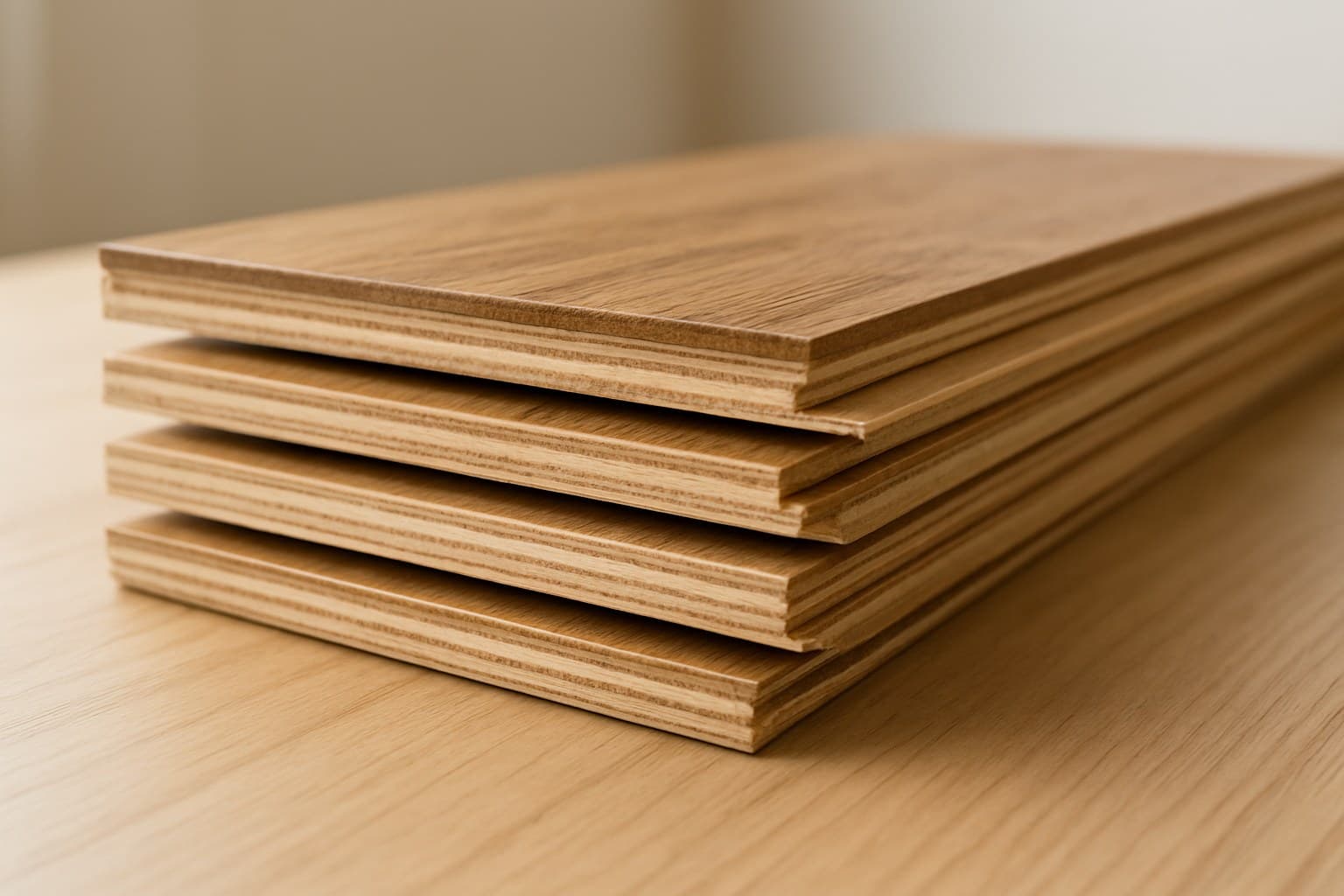
At 12 inches, engineered is usually the safer bet. Its cross-ply core, layers of wood glued so the grain in each runs at right angles to the next, pushes back against the cupping a single wide slab of solid wood is prone to. Not every engineered board is built the same, though, and best engineered hardwood flooring options is worth a look before you buy at this width.
Solid wood struggles wide for a simple reason. One solid piece moves as one piece, so a 12-inch solid board pours all of that seasonal swelling and shrinking into its two long edges. That's exactly where cupping and gaps show up.
Where each belongs comes down to the room. Engineered handles concrete slabs, below-grade rooms like basements, and radiant heat far better, because that layered core stays put when a solid board would move. Solid is fine over a stable wood subfloor in a climate-controlled room, but at this width it's a bigger gamble. If you're still weighing the two, our full engineered hardwood vs hardwood comparison lays out the tradeoffs room by room.
Engineered isn't automatic, though. A thin, cheap core can still telegraph problems up through the surface, and how many times you can refinish it depends on the veneer thickness the maker publishes, not a guess. That veneer limit also shapes the cost to refinish hardwood floors down the road, since a thinner wear layer means fewer sandings before you're through it. I ran into that exact problem sanding a 12-inch engineered floor for a customer in Dayton, the veneer had almost nothing left to take off, so now I check that number before I ever touch a sander.
For the full rundown on that choice in any room, see our guide to picking solid vs. engineered hardwood.
Best Species and Cut for a 12-Inch Floor
Some woods forgive extra width better than others. White oak and walnut are the more stable, forgiving picks at 12 inches. Hickory is very hard but moves more, so if that's the look you're after, wide plank hickory flooring guide breaks down the cost, grades, and how much movement to expect, and maple looks clean but is one of the twitchier species this wide, meaning it swells and shrinks more with humidity.
The cut matters as much as the species. Quartersawn and rift-sawn boards, sawn so the grain runs more up-and-down through the thickness instead of in flat arcs, cup far less than plainsawn boards (the common flat-grain cut). That's why the quartersawn or rift upcharge is worth paying at 12 inches. If you take one thing from this section, let it be that the cut beats the species.
Softer species like pine, fir, and reclaimed chestnut give you that character farmhouse look. They dent more, but denting is part of the charm on those floors, and they've been laid wide for a couple hundred years. If that's your look, our wide plank pine flooring guide walks through whether "soft" is a dealbreaker or the whole point.
Wondering if wide boards are even the right call for the look you want? Here's where they land in whether wide plank floors are still in style.
Moisture and Acclimation: The Numbers That Decide It
Moisture at install is where wide-plank problems usually start, more than the wood itself. This is where the floor is won or lost.
The target is to bring the wood close to the moisture content it will actually live at year-round. That balance point varies by climate and region, so rather than install to one fixed number, the NWFA's Homeowner's Handbook to Real Wood Floors recommends checking both the planks and the subfloor with a moisture meter, a handheld tool that reads how much water is in the wood, before anything goes down. If the readings are off or don't match closely enough, you stop and wait.
Subfloor flatness comes before the first plank too. A 12-inch board bridges dips and rocks over high spots, so you flatten the low and high spots first, either by sanding the humps or filling the hollows.
Acclimation is where the internet steers people wrong. Some products want days sitting in the room first, and some engineered lines say it's unnecessary and can even hurt. Follow the box's own instruction sheet, not a rule of thumb someone repeated online.
And leave the expansion gap. Every nailed or floating wide floor needs a gap around the perimeter, sized by the maker's instructions, because a 12-inch board needs somewhere to grow when the humid season hits. Skip it and the floor pushes against the walls and buckles.
Nail-Down vs Glue-Down vs Screw-and-Plug
At 12 inches, how firmly you hold the whole board down matters more than it does with narrow strips. A wide board has more face to lift, so the fastening method is part of whether it stays flat.
Nail-down is the standard for solid boards over a wood subfloor. It's fast, but a nailed wide board can still cup between the fasteners if the moisture was wrong going in. It's not an option over concrete.
Glue-down is the go-to for engineered and for slabs. Full-spread adhesive bonds the entire plank face to the floor, which holds it flat and quiets the floor underfoot. The tradeoff is more labor, more mess, and more skill.
Screw-and-plug is the old-school wide-board method: you screw the board down, then hide each screw head with a small wood plug. It's the most secure hold there is, and also the most labor and the priciest.
That's also the crux of a real disagreement in the wide-plank trade. Dealers like Old Wood argue standard tongue-and-groove nailing is the wrong joint at 12 inches in the first place, the tongue is a thin sliver of wood holding down a much larger, harder-pulling face, and they say it's prone to shearing or simply losing its grip before the board even gets the chance to cup or gap on its own. Their fix is to skip reliance on the tongue-and-groove altogether and screw straight through the face, then plug over the heads, so the fastener never depends on that thin edge holding. There's real logic to that: a screw through the face holds regardless of what the tongue does underneath it. But it's not the only way to solve the same problem, glue-down bonds the whole face to the subfloor without leaning on the tongue either, and a nailed floor installed at the correct moisture content with a proper fastener schedule holds flat in the large majority of jobs I've done. Where I'd side with the tongue-and-groove skeptics is on the widest, thickest, most traditional reclaimed boards, where the tongue really is undersized for the leverage a board that size can put on it. For a standard 12-inch engineered or solid plank installed correctly, screw-and-plug is a legitimate upgrade, not the only legitimate method.
Be honest with yourself on DIY. A click or nail-down job is realistic for a confident DIYer. Glue-down at this width, stairs, and open-plan floors that cross from one room's moisture level into another are where hiring a pro usually pays for itself.
| Method | How it works | Best for | Downside at 12 inches |
|---|---|---|---|
| Nail-down | Cleats or staples through the tongue into a wood subfloor | Solid boards over plywood or OSB in a stable room | Can cup between fasteners if moisture is wrong; not for slabs |
| Glue-down | Full-spread adhesive bonds the whole plank face down | Engineered planks, concrete slabs, radiant heat | More labor, mess, and skill; slower to install |
| Screw-and-plug | Screwed down, screw heads hidden with wood plugs | Thick solid or reclaimed wide boards, traditional look | Most secure but the most labor and the priciest |
Source: the nail, glue, and screw-and-plug wide-board jobs I've installed and pulled up
How the three fastening methods compare specifically for a 12-inch board.
What a 12-Inch Wide Plank Floor Costs
Budget material and labor as two separate numbers, because they move for different reasons. Wide-plank material often runs about $8 to $20 or more per square foot, and install typically runs about $3 to $10 per square foot depending on method and prep.
Here's the arithmetic on a 300-square-foot room. Multiply your square footage by the material rate, then by the labor rate, then add them:
- Material: 300 sq ft x $8 to $20 = $2,400 to $6,000
- Labor: 300 sq ft x $3 to $10 = $900 to $3,000
- Total: roughly $3,300 to $9,000
| Cost piece | Per square foot | 300 sq ft room |
|---|---|---|
| Material (wide plank) | $8 - $20+ | $2,400 - $6,000+ |
| Labor (install) | $3 - $10 | $900 - $3,000 |
| Combined | $11 - $30+ | $3,300 - $9,000+ |
Source: the wide-plank quotes I've written for clients' rooms
Estimated ranges for a 12-inch wide plank floor, split into material and labor.
Two things push the labor end up. Glue-down and screw-and-plug cost more than a straight nail-down. And a basement or a staircase costs more per foot than an open room, because slabs need moisture prep and more cut-heavy work, while stairs are slow, fussy handwork. I stopped quoting flat per-foot rates years ago after a wide-plank job for a homeowner in Springfield, Ohio, where closets, doorways, and a bay window ate an extra full day. The open middle of a room is never where the time goes.
If the price has you second-guessing the width itself, weigh it against the downsides of wide plank flooring before you commit, so you know the tradeoffs going in.