
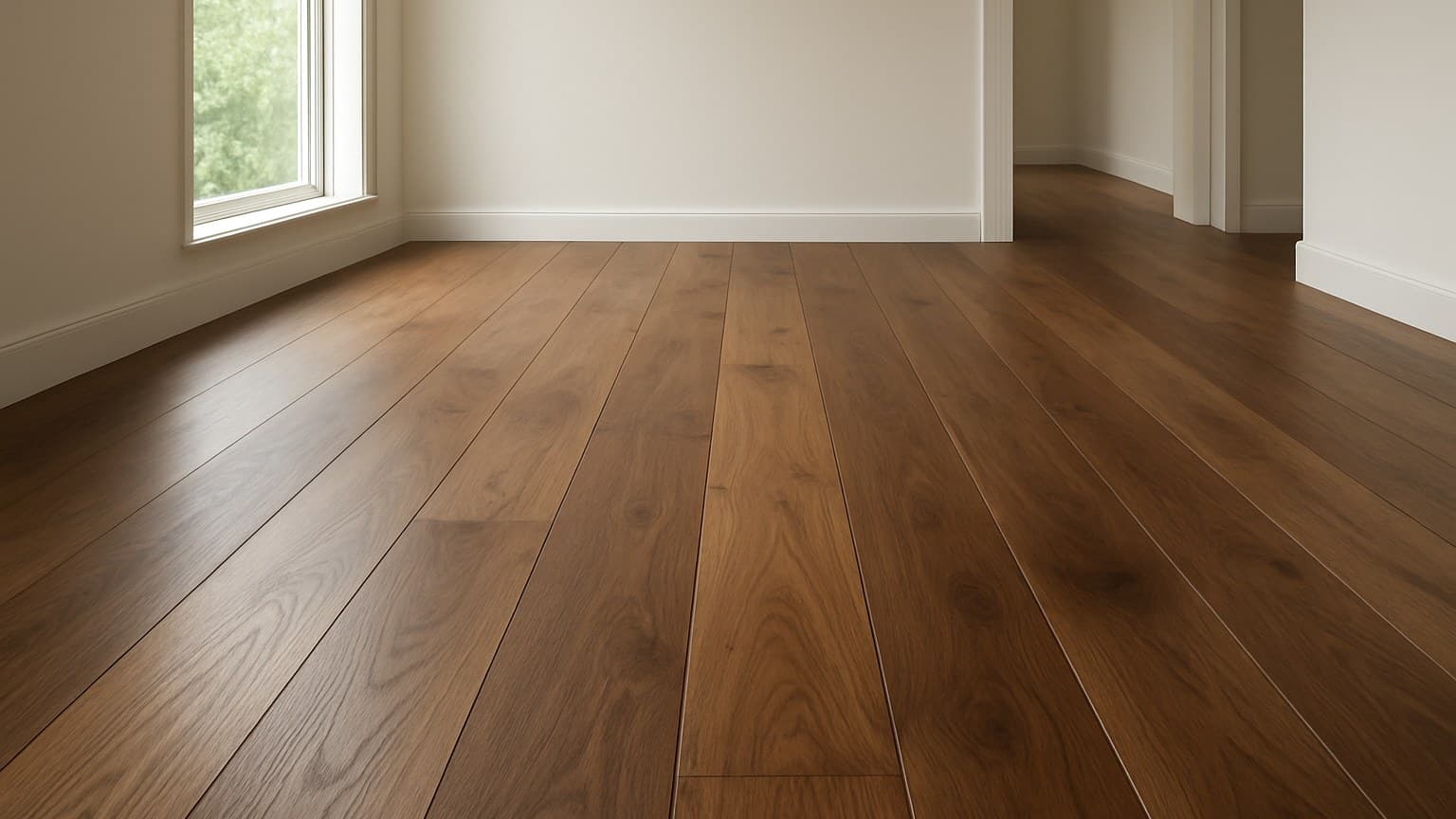
In Aurora, Colorado, a homeowner named Priya asked me why two "wide plank walnut" listings she'd bookmarked looked nothing alike once samples showed up. Wide plank walnut sells on its photos, and the photos never warn you how soft the wood is or how loosely the words "wide plank" get thrown around. Two sellers can hand you boards that share a name and almost nothing else. Here are the seven things that decide whether you'll love this floor or fight it.
Key takeaways
- The NWFA only calls a board 'wide plank' above 5 inches wide, yet some sellers label 3-inch walnut as wide plank, so measure the face before you buy.
- American black walnut rates about 1010 on the Janka hardness scale, softer than red oak (1290), hard maple (1450), and hickory (1820), so it dents more easily.
- Dark, wide planks show dust, pet hair, and fine scratches more than lighter narrow floors; a matte or wire-brushed finish hides far more than gloss.
- Materials run roughly $5-14 per square foot by grade, and labor adds about $3-8 per square foot; stairs and basements cost more than open rooms.
- Engineered walnut is the safer pick over concrete, in basements, or with radiant heat; wide solid walnut moves more with humidity.
1. "Wide Plank" Has a Real Definition, and a Lot of Walnut Ignores It
A standard strip runs 3 to 5 inches across the face. According to the NWFA/NOFMA Unfinished Wood Flooring Standards, "wide plank" flooring is anything wider than 5 inches, the National Wood Flooring Association (NWFA) is the trade group that sets these grading and width benchmarks. So measure the face of the board before you trust the label. That same width threshold decides what counts as wide plank in other species too, which is why my maple wide plank flooring guide uses the same 5-inch cutoff before calling a board wide.
I've seen 3-inch walnut marketed as "wide plank" more than once. That's a strip board with a nicer sticker. If the listing won't give you a face-width number, treat the word as marketing, not a spec.
Watch the name too. "Brazilian walnut" is ipe, a completely different tree, and walnut-stained oak is oak wearing walnut's color. Neither ages or prices like real American black walnut. Genuine extra-wide walnut, 7 inches and up, looks stunning but moves more with the seasons, which matters for how it's built and installed. The same bait comes up with "Brazilian cherry," a name that actually points to jatoba rather than true cherry, and my Brazilian cherry vinyl plank flooring guide untangles that mix-up before you shop.
2. Walnut Is Soft, Softer Than Oak, Maple, and Hickory
American black walnut lands around 1010 on the Janka scale, a test that measures how well a wood resists denting. That's below red oak, white oak, hard maple, and hickory. In plain terms, chair legs, dog nails, and a dropped pan leave a mark faster than they would on those harder species.
People choose walnut for its deep color and straight, rich grain, not for toughness. That's a fair trade if you go in with open eyes. If you want the hardest common wide-plank wood instead, read my wide plank hickory flooring guide for how the other end of the scale behaves.
Janka hardness of American black walnut against four common hardwoods; higher numbers resist denting better.
3. Dark and Wide Means Every Speck Shows
Dust, crumbs, and pet hair stand out on a dark floor far more than on a light or medium one. A wide, dark plank also catches side light across its face, so fine scratches and scuffs read as bright lines you can see from the doorway. If that upkeep sounds like more than you want to sign up for, it's worth seeing how the LVP colors trending in 2026 stack up, since several of the popular dark tones mimic walnut's depth without showing every scuff.
The finish does most of the hiding. A matte or wire-brushed surface (wire-brushed means the soft grain is gently scraped out to leave a subtle texture) masks scratches and dust far better than a smooth high-gloss floor, which shows every mark like a mirror. Skip the gloss on walnut unless you enjoy cleaning. That's also why matte and low-sheen finishes keep landing near the top of flooring trends ranked by how they age, while glossy floors tend to fall out of favor fast.
Plan on more upkeep, too. Dry-mop a dark walnut floor every few days rather than once a week, put felt pads under every chair and table leg, and lay rugs in the spots that take the most foot traffic. None of that is hard, but it's the price of the look.
4. Solid vs Engineered Decides How It Handles Humidity
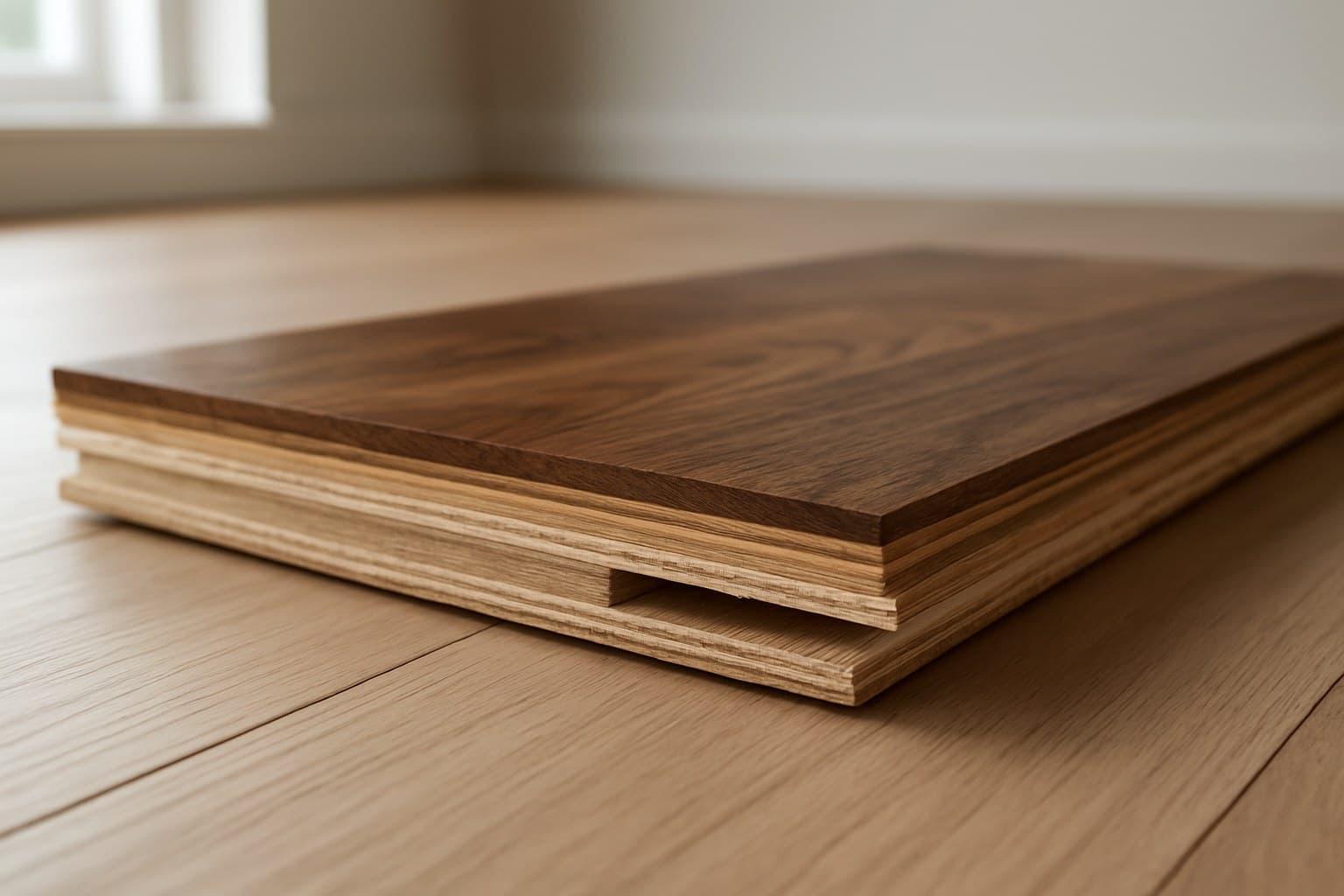
Wide solid walnut is one plank of wood all the way through, so it swells in humid months and shrinks in dry ones. Go wide enough and that movement can open seasonal gaps or cup a board. Engineered walnut, built on a cross-layered plywood-style core, fights that movement and stays flatter over concrete, in basements, and with radiant heat underneath. The NWFA's installation guidelines call for acclimating solid wood flooring to the job site's temperature and humidity before installation for exactly this reason, and they recommend engineered flooring over concrete slabs, below grade, and with radiant heat systems. This same solid-versus-engineered logic holds across other species too, so my guide to solid vs. engineered hardwood floors is worth a look before you commit to a species and build.
Refinishing is the other half of the choice. Solid walnut has a thick wear layer you can sand several times over its life. Engineered walnut only has the veneer on top to work with, so how many times (if any) you can refinish it comes straight off the maker's published veneer thickness, not a rule of thumb.
That veneer is not endless. On a solid oak floor in a 1950s ranch in Wichita, the homeowner wanted it sanded one last time, and I caught it cutting down to the tongue in a corner before it blew through. Walnut's wear layer deserves the same respect, and engineered's is thinner still.
Bottom line for anything below grade or on a slab: choose engineered walnut, not solid. If moisture is a bigger worry than wood grain, a maple-look luxury vinyl plank sidesteps the veneer-thickness question entirely, and my maple vinyl plank flooring guide covers what else to check before you buy.
5. Grade Changes the Look and the Price
Grade describes how a board looks, not how sound it is. Under the NWFA/NOFMA grading rules, Select and Better gives you uniform, dark boards with very little of the pale sapwood (the lighter wood from the outer part of the tree), while Character and #1/#2 Common grades allow more knots and streaks that run from light to dark.
Here's the myth worth killing: a Common board is just as strong and just as durable as a Select one. It only looks busier. You're paying for consistency, not quality, when you buy up the grade.
That light-and-dark range often comes from the same tree, because walnut sapwood is pale and its heartwood is rich brown. On finish, unfinished boards let you stain and seal on site to match a room, while prefinished boards arrive with a hardened factory coat you can walk on the day they go down.
6. What Wide Plank Walnut Really Costs
There's no single national price, so ignore any "call for quote" that hides behind one. Split it into materials and labor, because walnut hardwood flooring cost swings with grade and install method. Materials run roughly $5 to $14 per square foot depending on grade and whether it's solid or engineered, and labor typically adds $3 to $8 on top.
| Line | Per square foot |
|---|---|
| Solid, Select & Better (materials) | $8-14 |
| Solid, Character/Common (materials) | $5-9 |
| Engineered wide walnut (materials) | $7-13 |
| Labor, nail-down solid | $3-6 |
| Labor, glue-down engineered | $4-8 |
| Stairs / basement premium | add to open-room labor |
Source: The spread my own walnut jobs have quoted at, with material off supplier invoices and labor from my bids
Materials and labor ranges for wide plank walnut, split by grade and install method, per square foot.
Stairs and basements always cost more than an open room, so don't let a flat square-foot number fool you. I used to quote flat until a remodel for a client in Overland Park, full of closets, doorways, and a bay window, ate a whole extra day, and now I count the cut-heavy areas separately. Ask for an itemized quote that names materials, labor, and any stair or transition charges on their own lines.
7. Where Wide Plank Walnut Actually Holds Up
Walnut earns its keep in low-traffic rooms with no standing water: bedrooms, formal living rooms, and dining rooms. Those spaces let the color shine without grinding grit into a soft, dark floor. For the kitchens, entries, and basements where walnut's softness and water sensitivity take it off the table, my pine vinyl plank flooring guide walks through picking a version that holds up instead of looking fake.
Kitchens, entries, and mudrooms are the hard rooms. They bring grit underfoot and water near the floor, and both wear walnut faster than harder woods. Stairs are their own job: the nosings (the rounded front edge of each step) show wear first, and stairs cost more to install than open floor. With pets and kids it's still doable, just expect visible dings, so lean on a matte finish and rugs. For those same wet, high-traffic spots, it's worth checking whether a hickory vinyl plank flooring can give you the hardwood look without walnut's water risk.
If you're still weighing whether the wide look is a safe long-term bet, read Are wide plank floors still in style? next, because it settles the resale-and-trend question this guide only touches.