
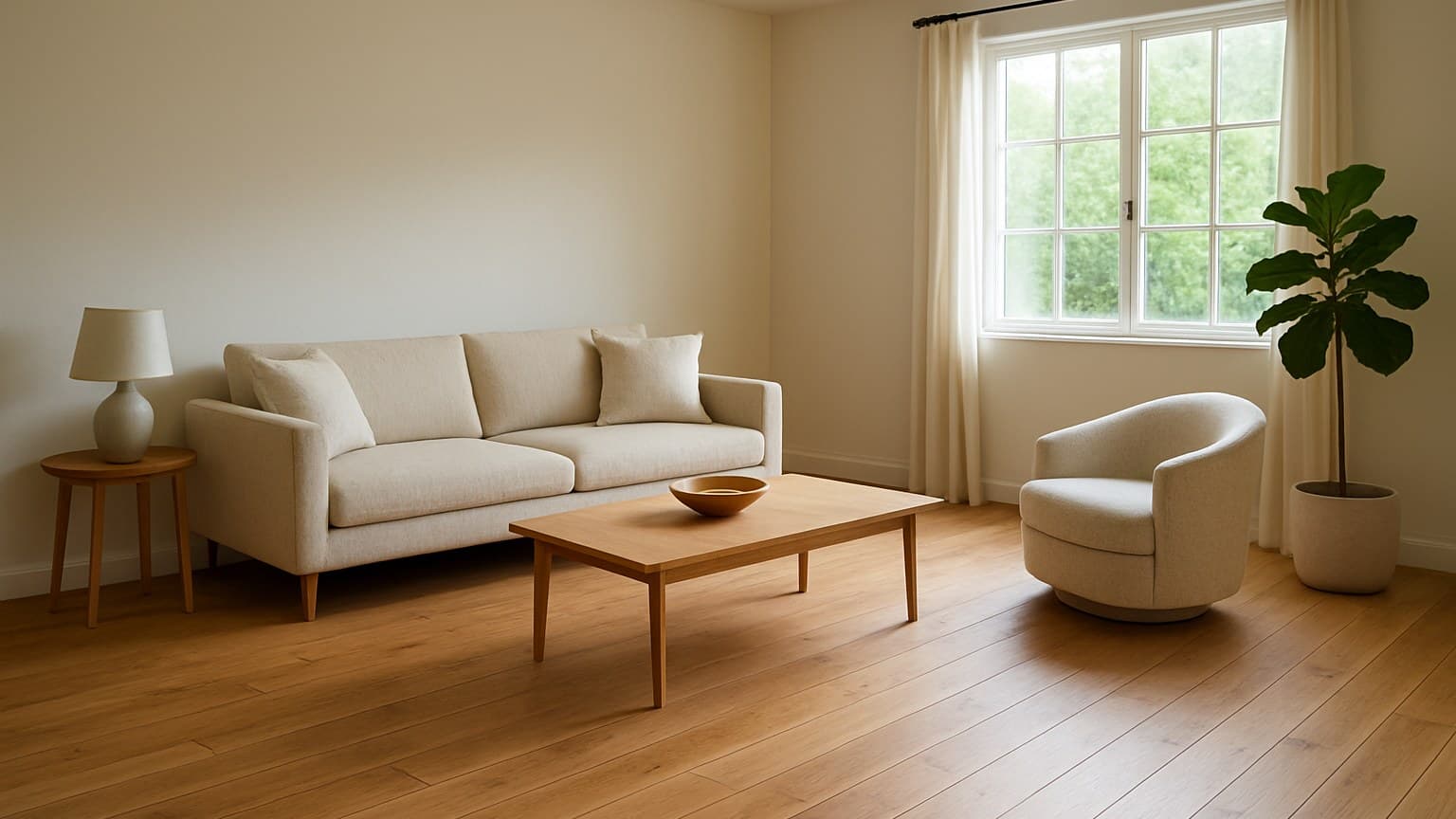
The trending flooring for 2026, ranked by real demand data plus a will-it-date verdict, so you know which trends are safe money and which are hype.
Key takeaways
- Warm wood tones (and warm-toned wood-look LVP) have clearly overtaken cool gray as the safest trend money right now.
- Tile demand is actually softening, not surging: TCNA reports U.S. ceramic tile consumption fell 4.9% in 2025 to 2.57 billion sq ft, with imports at 72.4% of that.
- Waterproof-core LVP is the fastest-rising trend and the safest for wet rooms, but the seams and edges are water-resistant, not waterproof, so most failures happen there.
- Herringbone, wide planks and matte finishes are low-risk to date; loud checkerboard and bold statement tile are the trends most likely to look tired in 3-5 years.
- The safest money is a trend that also holds resale value: warm-toned hardwood and neutral wood-look LVP beat any bold visual you'll want gone by the next sale.
What "Trending" Actually Means (Real Demand vs. Style Buzz)
A trend can be all over Pinterest and still be selling less every year. Another can be quietly in half the houses I walk into and never get called a trend at all. Those are two different things, and mixing them up is how homeowners end up chasing a look that's already on its way out.
So I judge every trend by two plain questions. Is real demand rising, meaning it's moving off the shelf and into actual jobs, not just racking up saves online? And will it still look right in five years, or will you want it gone before you sell?
I've watched trend lists push a look while the numbers behind it said the opposite, like the loud statement tile a supply house rep tried to sell me last fall, right as ceramic tile shipments were actually falling nationwide. So I'm bringing sales numbers where they exist, like the Tile Council of North America's ceramic shipment data below, and where they don't exist, I'm telling you what's actually getting installed on the jobs I run. I'll say plainly where that line falls: for hardwood and vinyl, I don't have an equivalent published shipment index, something like an NWFA hardwood report or a Vinyl Institute resilient-flooring number, to point to here, so those demand reads stay field-based, from what's moving through my jobs and local suppliers, not from tonnage data. I'd rather flag that gap than dress up a field observation as something it isn't.
One more thing. This is a single ranking across wood, vinyl, tile, carpet and laminate, not one material pretending its whole category is "the trend." A floor competes with every other floor for your room and your money, so that's how I ranked them.
The Demand Signal + Will-It-Date Framework I Use
Every trend below gets two reads. A demand-signal read: rising, flat, or softening. And a dating-risk read: low, medium, or high. Put those together and you get a simple two-question test, which is the whole point of this article.
The demand read comes from what's genuinely moving. What I'm buying for jobs, what the supply houses can't keep in stock, what customers walk in already asking for, plus market shipment data where a group like the Tile Council of North America actually publishes it.
The resale angle matters more than people admit. A floor you'll want to replace before you list the house isn't a safe investment, no matter how many likes it got. Warm neutrals and clean wood looks read as "move-in ready" to a buyer. Bold color reads as "another thing I have to redo." I'll be honest about where this claim comes from, too: it's my field read from walking houses before and after a sale, not a cited resale study, I don't have a NAR-style appreciation figure to attach to "warm wood floors add X% to resale" the way I can attach a hard number to tile's decline, so treat it as installer experience, not statistical proof. If you want the numbers behind that claim, our look at how much hardwood increases home value sorts out what's documented versus what's just field experience.
Use it like this. Rising demand plus low dating risk is safe money, spend there. Buzzy but softening demand means wait or skip. A bold look with high dating risk is only worth it if you'll love it anyway and you're not banking on resale. Match a rising, low-risk trend to your room's moisture and traffic, and your budget, and you're done.
1. Warm Wood Tones Have Finally Beaten Gray
This is the number one trend and the safest bet on the whole list. Warm oak, honey, and natural brown tones have clearly overtaken the cool gray wave that ran the 2010s. Gray isn't just less popular now, it actively dates a room on resale, the way brass fixtures did in the '90s. Before you commit to a species and tone, it's worth checking current hardwood flooring prices so the warm look actually fits your budget.
The look works across materials, which is what makes it safe. You can get it in real warm-toned hardwood for a living room or bedroom, and in warm wood-look luxury vinyl plank (LVP) or laminate for kitchens, baths, and busy hallways where solid wood is a bad idea. Same warm floor, matched to what each room can handle. If you want a read on where the color and grain direction are heading, what flooring is on trend in 2026 digs into that in more detail.
Will it date? Low risk. Warm neutrals have read as timeless for decades, and buyers respond to them, which is why hardwood in bedrooms can help home value when the tone is right.
On cost, real warm-toned engineered hardwood runs about $3 to $9 per square foot in materials, solid oak or maple $4 to $12, with install labor of roughly $3 to $8 per square foot on an open room. Stairs and basements cost more, always, because of the cuts, the transitions, and the moisture prep. Whether you go engineered or solid isn't a style call, it's about where the floor goes: engineered's plywood-style core is more stable over concrete and below grade, where solid generally isn't recommended. If you're still sorting out which construction and species fits your room, picking solid vs. engineered hardwood walks through that decision.
If you're ripping out gray to chase warm tones, you're not being trendy. You're getting ahead of the floor that already dates the room. If you're shopping replacements, a rundown of the best engineered hardwood flooring options is a solid place to start for a stable, warm-toned board.
2. Wide Planks and Large-Format Tile
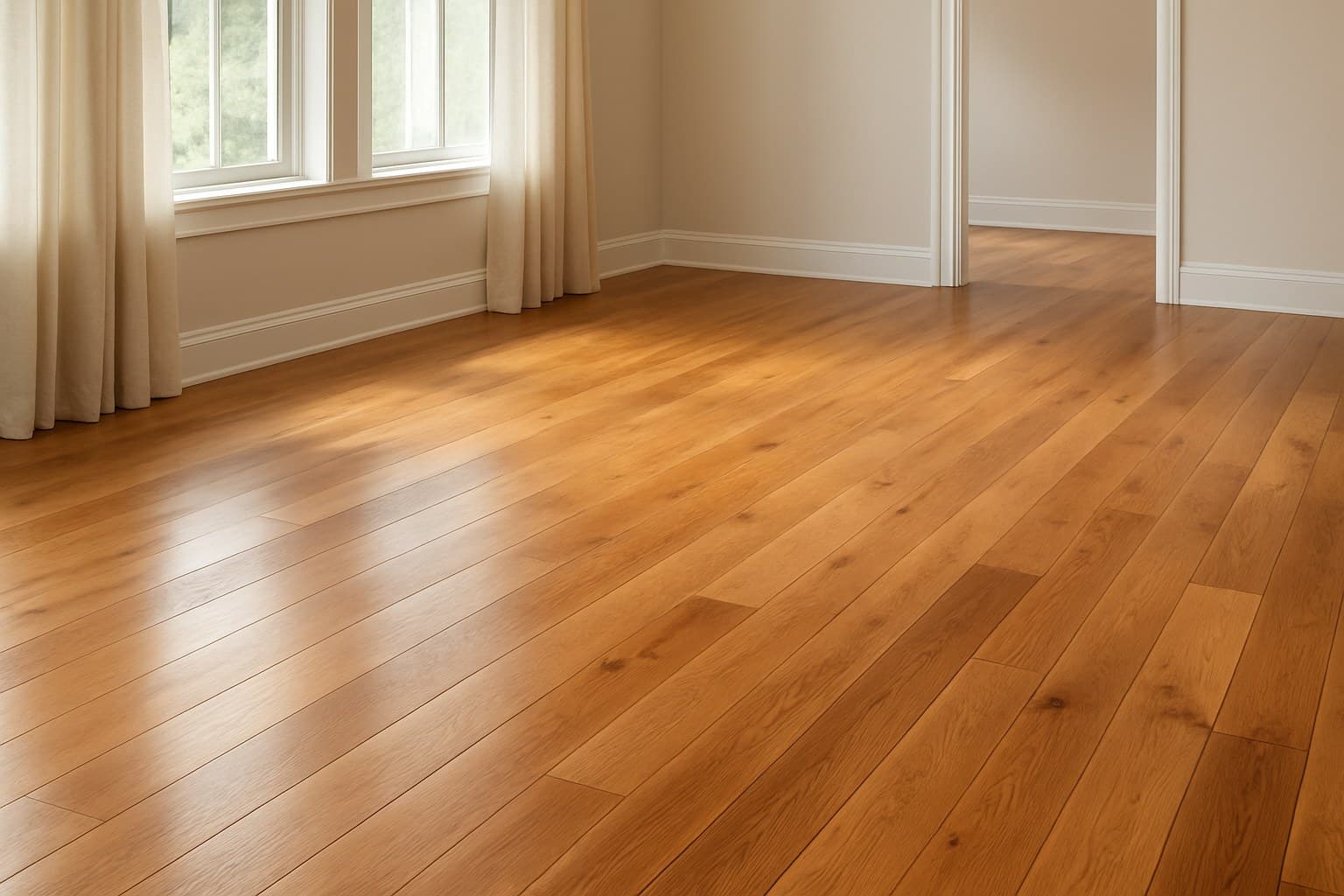
Wider boards and bigger tiles are both rising for the same reason: fewer seams and a cleaner, more open look. A 7 or 9-inch plank shows far fewer joints across a floor than an old 2-inch strip, and a large tile does the same on a bathroom or kitchen floor. Hickory is one of the species I see most often in this wider format, and if you're weighing it, the wide plank hickory flooring guide covers cost, grading, and how much it moves with the seasons.
The verdict splits by how far you push it. Standard wide planks are low dating risk and a safe buy. Extra-wide boards and large-format tile are still fine looks, but they're unforgiving: they telegraph every hump and dip in the subfloor. The bigger the piece, the flatter the floor underneath has to be.
That's the install reality nobody photographs. Before a single board or tile goes down, the subfloor has to be checked for flatness and moisture, and with wide and large-format that check matters more, not less. A hump you could hide under narrow strips will rock a big tile or leave a wide plank with a visible gap at the seam. I've torn out wide-plank jobs where the seams gapped across half the room, and every time the culprit was a hump in the subfloor nobody checked before the planks went down.
If you're weighing how wide to go, are wide plank floors still in style covers the look, and the downsides of wide plank flooring covers the tradeoffs honestly. For specific widths, see 12 inch wide plank flooring and extra wide plank flooring.
3. Pattern Play: Herringbone, Chevron and Checkerboard
Not all patterns date the same, so rank them. Herringbone and chevron are low dating risk and rising steadily. Loud checkerboard is a high-risk statement bet that photographs great and gets old fast.
Here's the difference by eye, since people mix them up. Herringbone planks are cut square and meet at a right angle, so you get that staggered, broken zigzag. Chevron planks are cut at an angle so the ends meet in a clean point, making continuous V-shapes. Chevron costs more to mill and cut, herringbone is more forgiving to install.
Either way, pattern costs more than straight-lay, two ways. You waste more material on the angled cuts, usually 5 to 15 percent extra, and you pay for a lot more labor time. Expect installers to add roughly $2 to $5 per square foot over a straight-lay rate for a herringbone or chevron layout, more on a small, cut-heavy room.
Room fit matters. Pattern reads best in an entry, a kitchen, or a smaller feature room where the eye can take it in. In a sprawling open plan it can get busy and, frankly, seasick. Checkerboard tile in a bold color is the one I'd only lay if you truly love it and don't care what the next buyer thinks.
4. Matte, Textured and Low-Sheen Finishes
Matte is rising and low dating risk, and the reason is practical: it hides scratches, scuffs, and foot traffic far better than the old high-gloss look. Gloss shows every hair, every footprint, and every scratch under raking light. Matte just doesn't, which is why it's become the safe default almost everywhere.
The texture tech is worth understanding on LVP and laminate. "Embossed-in-register" means the surface texture lines up with the printed wood grain, so the dips you feel match the grain you see. That's what separates a plank that reads like real wood from one that looks like a photo under plastic.
There's one honest tradeoff. Deep texture traps dirt down in the grooves, and in a busy kitchen that can be harder to keep clean than a smooth matte surface. It's not a dealbreaker, just know it before you pick the deepest-embossed product for a high-mess room.
For room fit, matte and low-sheen work almost anywhere and read current instead of dated. Gloss is now the risky, older-looking choice. If you want the current look that ages well, matte is the one that hides the scratches and still looks right in five years.
5. Waterproof LVP and Laminate Advancements
This is the fastest-rising trend on the list and the safest for wet rooms, driven by waterproof-core vinyl. It's why LVP is going into so many kitchens, baths, laundry rooms, and basements right now.
Two core types run the category, in plain words. SPC is stone plastic composite, which is denser and harder, so it's more stable and dent-resistant but louder and firmer underfoot. WPC is wood plastic composite, which is softer and warmer to walk on but a little less tough. Neither name is a spec you can trust blindly, the numbers that matter are on that specific product's sheet.
Now the line that saves you a callback: a genuine waterproof-core LVP won't swell if water sits on top of a plank, that part is real on quality products. But even on a product with that spec, the seams and edges where planks lock together are only water-resistant, and that's where real-world failures start. Water gets down through a bad seam, sits on the subfloor, and now you've got a problem the core never promised to solve. Sealing transitions and around toilets, tubs, and dishwashers is what actually keeps a wet room dry.
On DIY versus hire, be honest with yourself. Click-lock LVP over a flat, dry, prepped subfloor is realistic for most DIYers, it's the one floor I tell people they can genuinely tackle. Glue-down, stairs, and big open-plan floors with moisture transitions are where hiring out pays off, because that's where the mistakes get expensive.
6. Sustainable and Natural Materials
Natural and low-fume materials are rising with low dating risk, and the look isn't going anywhere. The players are cork, bamboo, wool carpet, reclaimed wood, and low-VOC products, meaning low volatile organic compounds, the fumes that off-gas from some flooring and adhesives.
Two labels get thrown around, so know what they mean. FloorScore certifies that a product meets limits for low indoor air emissions, that's a floor-level spec you can actually use. LEED is a whole-building green rating, not a stamp on your plank, so a "LEED" claim on a single floor tells you little. And a green label is not a durability rating: check the real wear numbers on that specific product, because "natural" and "tough" aren't the same thing.
On cost, materials vary a lot by species and source, and labor is separate. Reclaimed wood in particular carries a real price and prep premium, because boards come in varying thickness and condition and take extra sorting, planing, and hand-fitting on site. Budget added labor for that, not just the higher board price. If you're drawn to it, reclaimed wide plank flooring covers what you're really buying.
Here's the materials-only range for the natural options, before labor:
| Material | Materials cost (USD per sq ft) |
|---|---|
| Bamboo | $2 - $6 |
| Cork | $3 - $8 |
| Wool carpet | $5 - $15 |
| Reclaimed wood | $6 - $15 |
Materials-only cost per square foot for four natural flooring options, shown as low-to-high ranges. Labor is separate and reclaimed wood adds a prep premium on top.
7. Statement Tile and Bold Color
Verdict: high dating risk. Bold statement tile, encaustic-look color, and busy geometric patterns photograph beautifully and are the trend I get called back to rip out most. It reads fresh for a couple of years, then it reads "that phase we went through."
Separate the safe part from the risky part, because they're not the same thing. Large-format neutral tile lasts, that's the low-risk half. Loud color and heavily patterned tile are the high-risk half, and the bolder the color, the faster it dates. A bright feature floor also fights with whatever you put in the room next, so you're locked into decorating around it.
And here's the demand number the trend lists skip. Tile as a category is actually softening, not surging. According to the Tile Council of North America's Q1 2026 market report, U.S. ceramic tile consumption fell 4.9 percent in 2025 to 2.57 billion square feet, with imports accounting for 72.4 percent of that volume. That doesn't mean don't tile your bathroom, tile is still the right call for a wet floor. It means "everyone's rushing to tile" isn't what the shipment data shows.
If you want the tile look with less dating risk, go large-format in a warm neutral and put your bold color somewhere you can swap cheaply, like paint, a rug, or a backsplash. Those come out with a weekend and a bucket. A statement floor comes out with a demo bag and a callback.
The Ranking, Safest Money First
Putting the two-question test to work, here's how the trends stack up from safest money to most speculative:
- Warm wood tones (and warm wood-look LVP). Rising, low dating risk. The safest spend on the list, and it holds resale value.
- Waterproof-core LVP for wet rooms. Fastest-rising, low risk, just seal the seams and edges since that's the weak point, not the core.
- Matte and low-sheen finishes. Rising, low risk, hides wear and reads current.
- Wide planks and standard large-format tile. Rising, low risk if your subfloor is flat, higher risk the wider you push it.
- Herringbone and chevron. Rising, low risk, worth the extra labor in the right room.
- Natural and sustainable materials. Rising, low risk on looks, check the real durability numbers per product.
- Checkerboard, statement tile, and bold color. Buzzy but high dating risk, only if you'll love it regardless of resale.
The pattern is simple: the safest money is a trend that also holds value when you sell. Warm hardwood and neutral wood-look LVP beat any bold visual you'll want gone by the next listing. If your budget is the deciding factor, what it costs to hardwood a 12x12 room walks through the real numbers before you commit.
Sources
- Tile Council of North America: Q1 2026 U.S. Ceramic Tile Market Report
- TCNA: Tile, The Natural Choice, 2026 Edition
- TCNA: Tile, The Natural Choice, 2025 Edition
- TCNA Press Release: 2025 U.S. Ceramic Tile Market Update (March 2026)
- TCNA: Q2 2025 U.S. Ceramic Tile Market Update