
For the Delgado family in Reno, I opened two boxes both stamped "cherry" that looked like different woods once the light hit them. That is the trap with cherry vinyl plank flooring: the name on the box tells you almost nothing about the color you will actually live with. Here is how to read the plank itself instead of the label.
Key takeaways
- "Cherry" is a printed photo on the plank's film layer, not a real wood, so undertones swing from bright red to near-black between brands, even with the same name.
- Red-leaning shades (Brazilian, American Cherry) glow in warm light but fight cool north rooms; brown and near-black shades read modern but show every crumb and dust bunny.
- Materials run about $2-7 per square foot and labor about $1-4 per square foot; click-lock is DIY-friendly, while glue-down, basements, and stairs are where hiring out pays off.
- Never trust a wear-layer or waterproof number by shade name alone; pull the exact SKU's spec sheet, since two "Dusk Cherry" boxes can carry different cores and warranties.
- Cherry vinyl does not darken with age the way real cherry does; strong sun can slowly fade the print, so plan rugs and UV film in bright rooms.
First, Learn to Read the Undertone (Because "Cherry" Means Nothing)
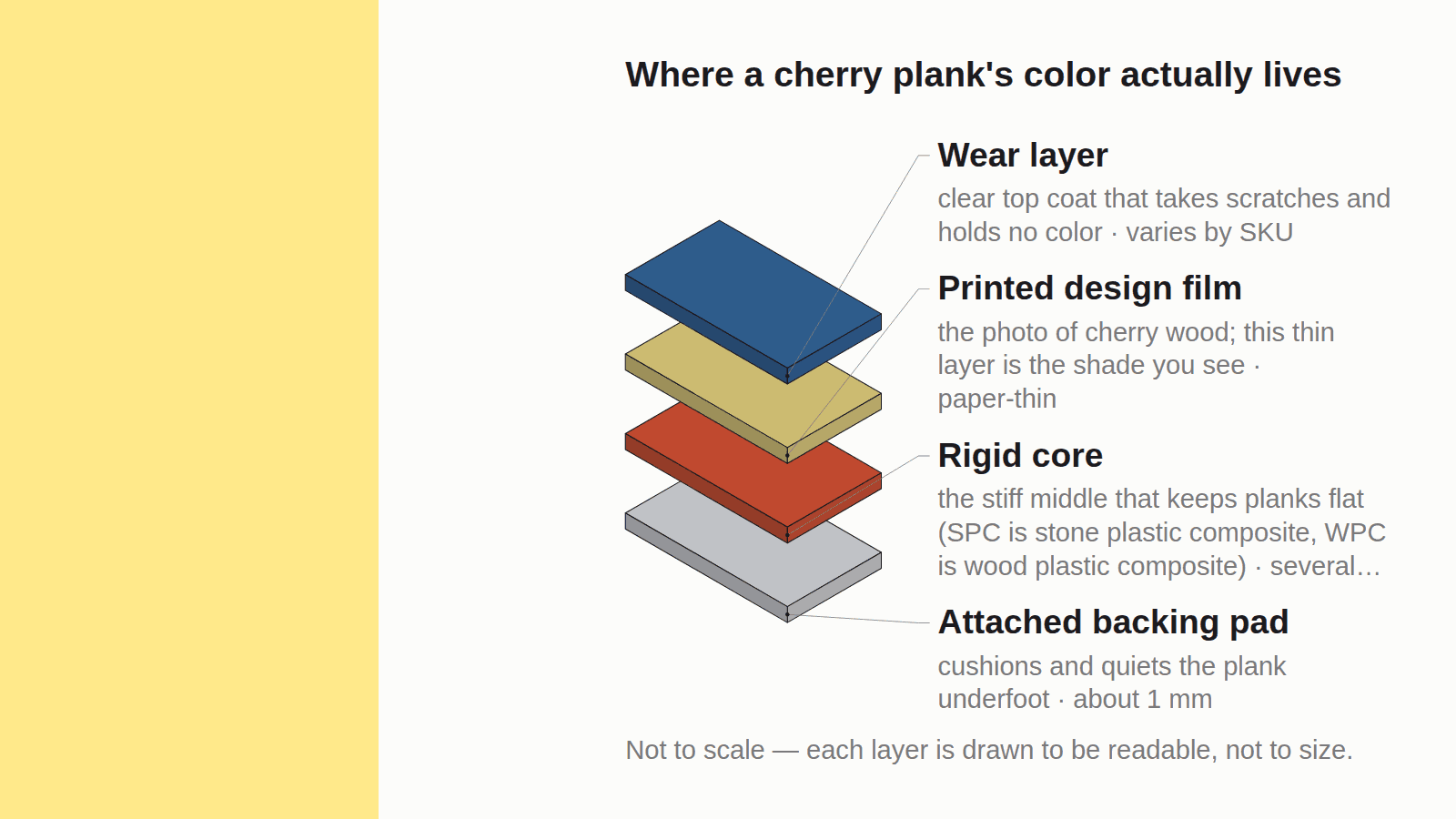
Cherry vinyl is a printed photo. The color you see lives in a paper-thin design film near the top of the plank, not in any real wood. That is why two floors with the same "cherry" name can look like different trees, and why the online photo often lies. If you'd rather work with the real material instead of a printed film, our breakdown of picking solid vs. engineered hardwood floors covers how genuine wood species actually age and cost.
So skip the name and read the undertone. Hold the plank and ask one question: does it lean red, orange-amber, plain brown, or near-black? Then check it under your own room's light, not the store's showroom bulbs, which are usually warmer and richer than what you have at home. If your search is leading you toward something paler than any cherry shade, the same undertone test applies when comparing blonde maple against blonde oak vinyl plank.
That single step stops most wrong orders. People buy the box because the website photo looked warm, then get it home under cool north-facing light and the red they wanted has drained out.
The stiff middle of the plank is either SPC (stone plastic composite, a denser core) or WPC (wood plastic composite, a lighter, slightly softer core). That core decides how the plank feels and holds flat, but it has nothing to do with the shade. The shade is all in that printed film.
Here are all seven shades side by side before we get into each one.
| Shade | Undertone | Flattering light | Pairs with |
|---|---|---|---|
| Dusk Cherry | Deep brown-red, reads near-black in low light | Bright, warm rooms | White or cream trim, lighter walls |
| Tinted Cherry | Medium red-brown, balanced | Most rooms | Greige walls, wood or white cabinets |
| Brazilian/Jatoba-look | Strong red, some orange | Warm south/west light | Cream trim, avoid cool gray walls |
| American Cherry | Amber-red, classic warm | Warm and neutral light | Traditional oak or white cabinets |
| Red-leaning cherry | Brightest red | Sunny rooms only | Neutral walls, simple trim |
| Brown-leaning cherry | Muted brown with a red hint | Cool north light works | Gray-blue walls, modern cabinets |
| Near-black cherry | Espresso with red depth | Bright rooms with contrast | Light walls, pale rugs |
Source: I read these off Home Depot and Lowe's cherry LVP spec sheets and checked each against how it landed in the rooms where I laid it
The seven cherry vinyl shades compared by undertone, the light each one needs, and the trim and cabinet colors that flatter it.
1. Dusk Cherry: Deep Brown-Red That Reads Almost Black in Dim Rooms
Dusk Cherry is a dark red-brown that looks rich in sun and goes flat, almost black, in a dim hallway or a north-facing room. If you love the deep look, know that the red is the first thing to disappear when the light drops.
Give this one bright, warm light or it stops looking like cherry at all. In a low-light space it just reads as a dark floor.
Lift it with white or cream trim and lighter walls so the floor does not swallow the whole room. Dark floor plus dark walls in a small room feels like a cave fast.
On the name: Lifeproof Dusk Cherry is sold at Home Depot. Do not assume a wear layer or warranty by that name. Pull the exact SKU's spec sheet for the box you are holding, because Lifeproof runs different cores and wear layers across its lines.
2. Tinted Cherry: The Medium Red-Brown Middle Ground
Tinted Cherry is the safest, most forgiving of the bunch. It is a balanced red-brown that does not scream red or wash out to plain brown, which is why I steer nervous clients toward it.
It works in most rooms, including kitchens with mixed lighting where under-cabinet bulbs and window light fight each other. That flexibility is its whole selling point.
Pair it with greige walls (a gray-beige mix) and either wood or white cabinets. It plays nice with far more decor than the bold shades do.
Tinted Cherry shows up in Home Depot lines. Before you commit, check the box for the wear layer and whether it is click-lock or glue-down, since that decides both durability and how hard the install is.
3. Brazilian Cherry (Jatoba-Look): The Red-Leaning Exotic
This is the most saturated red of the group, printed to mimic real jatoba wood, sometimes with streaks of orange. It is the boldest cherry you can buy.
Warm south or west light makes it glow. Cool gray north light makes it look loud and slightly off, like the color is fighting the room.
Pair it with cream trim and warm walls, and keep it away from cool gray walls that clash with the red.
Here is the difference to remember: real jatoba darkens and deepens with age, but a vinyl print does not change. It can only fade lighter if strong sun hits it day after day. If you want that red to hold, read my deeper walk-through on keeping Brazilian cherry vinyl from fading gray before you order.
4. American Cherry: The Classic Warm Amber-Red
American Cherry is the shade most people picture when they hear the word: a warm amber-red that feels timeless rather than trendy. It is the traditional look. If you want that same traditional warmth but with bolder, more rustic grain movement, hickory vinyl plank flooring is worth comparing before you commit to cherry.
It flatters warm and neutral light, and it is a strong pick for traditional-style rooms and older homes where a cool gray floor would feel wrong.
Pair it with traditional oak or white cabinets and simple trim. This is the shade that suits a colonial or a craftsman, not a stark modern kitchen.
Names like "American Cherry Legacy" show up across several brands, so confirm the plank size and wear layer on the specific product in front of you, not the family name. Two products sharing a name can carry very different specs. If you're chasing that same wide-board look in solid hardwood rather than a printed vinyl film, the sizing and finishing tradeoffs are covered in this guide to maple wide plank flooring installation.
5. Red-Leaning Cherry: Bright, Traditional, and Demanding
Red-leaning cherry is the brightest red option. You will sometimes see it labeled "light cherry" or "dark cherry," but the giveaway is that it stays red-forward no matter the shade.
It needs sunny rooms. In a dim space that bright red starts to look artificial and dated in a hurry.
Keep walls and trim neutral so the floor is the star. Busy walls plus a bright red floor is too much going on in one room.
Honest warning: this is the shade that reads "1990s builder-grade." Choose it on purpose, not by accident. If the room is not flooded with warm light, one of the browner families below will age better.
6. Brown-Leaning Cherry: The Modern, Muted Take
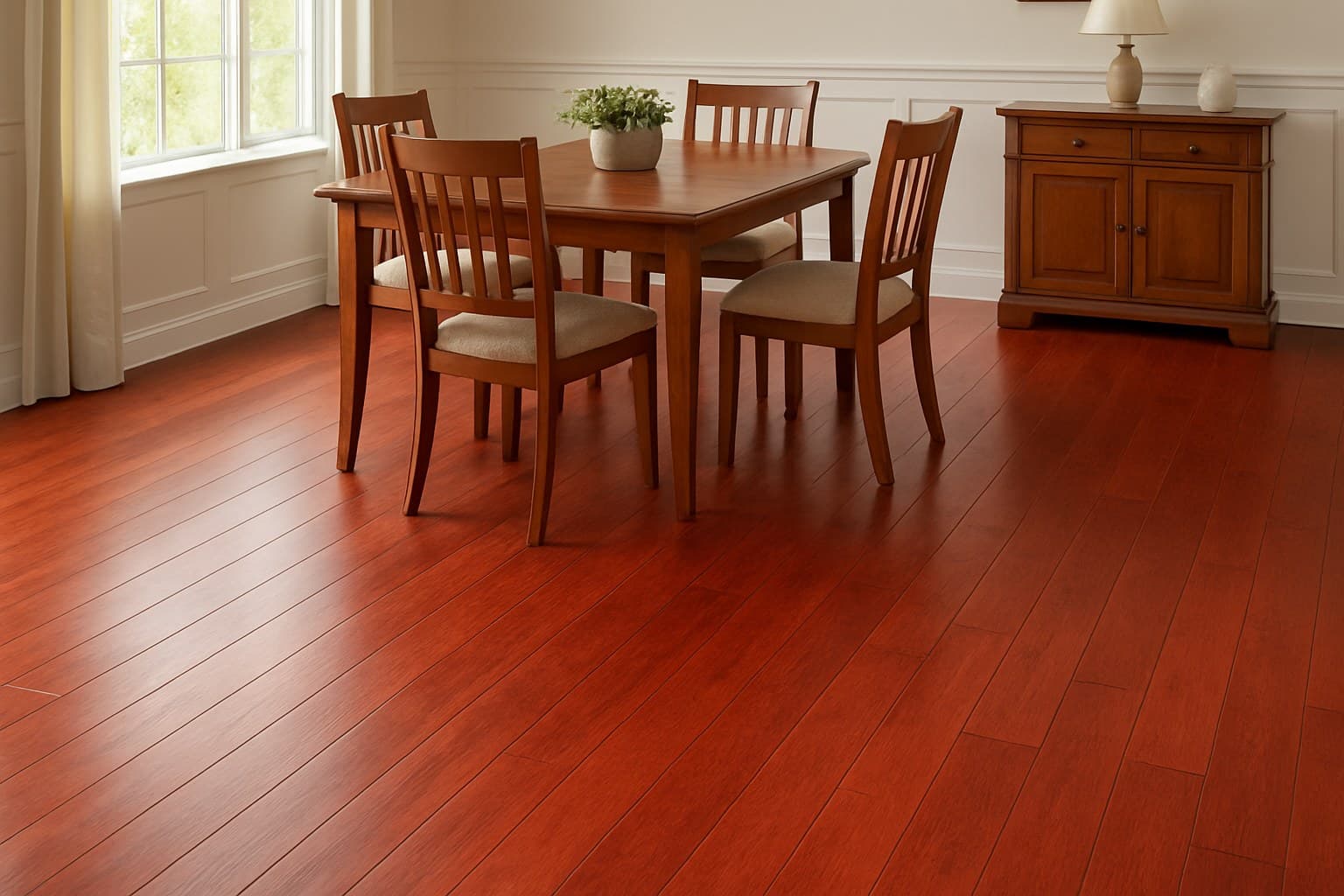
Brown-leaning cherry is muted brown with just a whisper of red. It is the shade for people who want the warmth of cherry without the actual red, and it fits today's neutral trend.
It is a cherry family that holds up in cool north light without looking cold or flat. That makes it easy to place in a modern home.
Pair it with gray-blue walls and flat-front modern cabinets. It bridges old cherry warmth and the current neutral look.
Watch for this: brands often use a brown-leaning "cherry" to quietly modernize an old line, so read the photo, not the name, to catch it. If you want to go even lighter and skip red altogether, a maple vinyl plank reads warm without any cherry tone at all.
7. Near-Black Cherry: Espresso With Red Depth
Near-black cherry is the deepest option, an espresso brown with red buried in the grain that only shows itself in good light. In a dim room it just reads flat black.
Give it bright rooms and light walls so the contrast lets that red depth come through. Pale rugs help too.
On a near-black cherry job I did last winter for a customer in Spokane, the floor looked showroom-clean on install day and needed a morning sweep by week two: dark floors show every crumb, hair, and dust bunny fast. If a spotless-looking floor matters to you, read why dark vinyl looks dirty so fast before you commit, because a matte finish helps and a gloss finish makes it worse. If you like this depth but want a browner read, a dark walnut vinyl plank gives a similar mood with less red.
Wear Layer Thickness: What "Check the Spec Sheet" Actually Means
I keep telling you to check the spec sheet for the wear layer on Dusk Cherry, Tinted Cherry, and American Cherry Legacy without saying what number you are hunting for. Here is the number, and what it buys you.
The wear layer is measured in mils (thousandths of an inch) and it is the clear top coat protecting that printed cherry film from scuffs, grit, and UV fade. This is the one spec that ages the color you picked, more than the shade name ever will.
| Wear layer | Typical use case | What it means for a cherry floor |
|---|---|---|
| 6-8 mil | Rentals, closets, guest rooms | Thinnest protection; the printed cherry film scuffs and dulls fastest under foot traffic and sun |
| 12 mil | Standard residential, low-to-moderate traffic | The floor most homeowners land on for a living room or bedroom; holds color reasonably well with normal care |
| 20 mil | Kids, pets, kitchens, high-traffic homes | Noticeably more scratch and scuff resistance; the printed layer stays sharper longer under daily abuse |
| 28+ mil | Light commercial, rental turnover, heavy households | Toughest residential-grade protection available; overkill for a quiet spare room but worth it for a mudroom or busy kitchen |
Source: I built these from the material prices and install rates I quote on residential cherry LVP jobs
General mil-thickness classifications as commonly published across major LVP manufacturers; exact wear-layer numbers still vary by SKU, so confirm the mil rating on the specific box in front of you rather than assuming it from the shade name.
Thicker wear layers do not change the undertone or how the color reads in your light, but they do buy the printed film more years before scuffing and sun exposure dull it. When you pull the spec sheet on a named SKU like Dusk Cherry or Tinted Cherry, this mil number is the line to look for, not just the presence or absence of a warranty.
What Cherry Vinyl Plank Really Costs
Cherry vinyl runs about $2-7 per square foot for materials and about $1-4 per square foot for labor, but the room decides where you land in that range. An open living room is cheap to lay; a cut-heavy kitchen or a basement is not.
I learned that the hard way quoting flat rate by the square foot until a job full of closets, doorways, and a bay window ate a whole extra day. The open middle of a room is never where the time goes.
| Job type | Materials (per sq ft) | Labor (per sq ft) |
|---|---|---|
| Open living room, click-lock | $2-5 | $1-2 |
| Kitchen with lots of cuts | $3-6 | $2-3 |
| Basement (needs moisture prep) | $3-7 | $2-4 |
| Stairs | $3-7 | Often $40-70 per step |
Source: I built these from the material prices and install rates I quote on residential cherry LVP jobs
Basements cost more than open rooms because the concrete slab needs a moisture check and often more leveling before a plank goes down. Stairs get priced per step, not per square foot, because every tread is hand-cut and wrapped. Both run well above a plain open floor, so budget for them separately.
Before Any Install: Flatten and Check Moisture First
The floor only lasts as long as the prep under it. Every click-lock cherry plank I have laid rides on the subfloor being flat and dry, and the manufacturer's warranty quietly hinges on both.
Check flatness first. Most floating floors want the subfloor flat within the maker's stated tolerance over a set span, so lay a long straightedge across the room and grind down high spots or fill low ones. A bump you ignore becomes a soft, clicking spot you feel underfoot for years.
Then check moisture, especially on concrete and in basements. A moisture meter (a small handheld tool that reads dampness in the slab or wood) tells you if the slab is dry enough. Skip this on a basement floor and you can trap damp under the vinyl, which lifts seams.
That is the same order every install follows: flat, then dry, then plank. Never skip straight to laying boxes.
DIY or Hire: Where the Line Really Is
Click-lock cherry vinyl is realistic for most DIYers in a simple, open room. The planks snap together, the cuts are straightforward, and the biggest risk is rushing the subfloor prep. Pine vinyl plank follows the same click-lock logic, though our guide to choosing pine vinyl plank flooring covers why the softer look needs its own wear-layer checks.
Hire out for the harder jobs. Glue-down installs, stairs, and large open-plan floors with moisture transitions between rooms are where a pro earns the money, because a rushed seam or a bad transition on those jobs turns into a lifted edge or an open gap within the first year.
If you are still deciding between cherry and another wood-look entirely, my broader vinyl flooring buyer's guide walks through wear layers, cores, and what actually makes a floor last 5 years versus 20.