
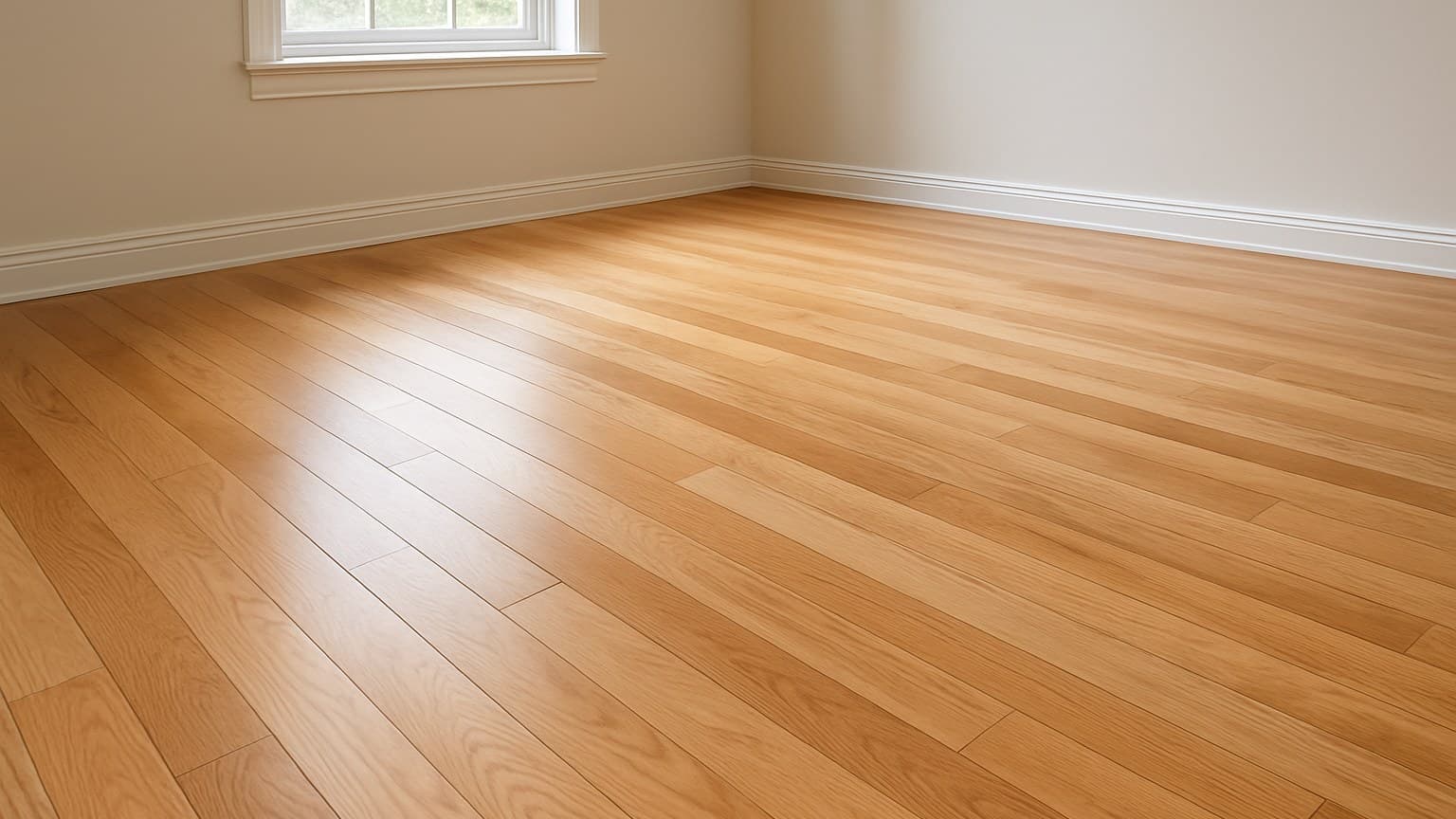
Janka numbers, official grade definitions, and honest big-box vs. custom maple flooring prices, plus room-by-room cautions before you buy.
Key takeaways
- Hard sugar maple rates about 1450 on the Janka hardness scale, harder than red oak (1290) and white oak (1360), yet it still dents at the surface and takes stain blotchy.
- Big-box prefinished maple runs roughly $4-8 per sq ft in materials; custom wide-plank unfinished runs $10-18 per sq ft, plus $3-6 per sq ft labor in open rooms and more on stairs or basements.
- Solid maple can be sanded and refinished about 4-6 times over its life; engineered maple's thin veneer often takes one sanding or none.
- Maple is humidity-sensitive: skip it in full baths and below-grade basements, and moisture-test any concrete slab before you buy.
- Yes, natural maple ambers (turns more yellow) over years, fastest in direct sun.
What Maple Flooring Actually Is: Hard vs. Soft Maple
When someone says "maple flooring," they almost always mean hard maple, also called sugar maple (Acer saccharum). It's the same wood under basketball courts and bowling lanes, so it's genuinely tough. Softer cousins like red and silver maple cost less and dent more easily. If you'd rather trade some of that hardness for a wood with more natural color movement, it helps to read what to know before buying acacia flooring before you compare species side by side.
The look is the draw: pale, creamy, with a tight, subtle grain and few knots. It reads clean and modern. But that plainness cuts both ways. Busy oak grain hides dents and pet scratches; smooth maple puts them on display. Dark, dense species like black walnut hardwood flooring hide the same marks even better, which is why it comes up so often for households with dogs.
Here's the trade-off that drives this whole search. Maple is hard against rolling and sliding wear, but its closed grain drinks stain unevenly and can blotch. That's why most maple hardwood flooring is left natural or finished with a clear coat instead of stained dark.
One warning: store labels get loose with the word "maple." Before you pay a hardwood price, confirm you're buying true hard sugar maple, not a soft-maple mix that dents like a softer wood but costs like the real thing.
Maple vs. Oak: The Hardness Numbers That Settle It
Maple beats both oaks on dent resistance. On the published Janka scale, which measures how hard a wood resists a dent, hard maple sits around 1450, above white oak at 1360 and red oak at 1290.
But harder isn't scratch-proof. Maple resists dents slightly better, yet its plain surface shows the scratches it does get, while oak's grain camouflages them. So the harder wood can end up looking more worn from across the room.
For context on the softer end, pine flooring runs roughly 380-870 and dents as part of its character. On the hard end, strand-woven bamboo flooring can top 3000. Maple lands in the durable middle. If you want something noticeably harder than maple without jumping to an exotic species, hardwood flooring hickory options typically land in the 1800s on the same scale.
The number is only half the story, though. Finish quality and grade decide how the floor looks after a few years, not Janka alone.
| Species | Janka | What it means |
|---|---|---|
| Hard/sugar maple | 1450 | Harder than both oaks; shows scratches on its plain face |
| White oak | 1360 | Grain hides wear well; more water-tolerant |
| Red oak | 1290 | Busy grain, easy to match |
| Soft/red maple | 950 | Cheaper maple look, dents noticeably easier |
| Eastern white pine | 380 | Soft; dents are part of the character |
Source: Pulled from the published Janka hardness ratings for each species
Maple Flooring Grades, Straight From the Standard
Grade decides how clean or busy your floor looks, and buyers often underrate it. Grade controls how much color streaking, mineral marks, and small knots show up, which is exactly the thing you notice when you walk in the room.
The trade standard spells it out. Under the NWFA-NOFMA maple rules, set by the National Wood Flooring Association and the now-merged National Oak Flooring Manufacturers Association, the top tier has a "face practically free of all defects." That's the most uniform, palest, and priciest maple you can buy.
Walk down the tiers in plain terms. Top grade is nearly clear and even. Middle grades allow more color variation and small mineral streaks. Character or lower grades mix in streaks, tight knots, and darker heartwood.
Here's the money angle. Dropping one grade can cut material cost while still looking great, as long as you actually like some color movement. Match the grade to the look you want, not to the highest label on the box.
| Grade | What shows in the face | Best for |
|---|---|---|
| First Grade (Select & Better) | Face practically free of all defects; most uniform, palest color | Clean, modern, high-uniformity look |
| Second & Better | Some color variation and small mineral streaks | Good value with light character |
| Third / Character grade | Streaks, tight knots, darker heartwood mixed in | Rustic look and lowest material cost |
Source: Quoted from the NWFA-NOFMA solid maple grading rules
How each maple grade reads in the finished floor, top tier to character grade.
Solid vs. Engineered Maple, and How Often You Can Refinish
The room drives this choice. According to the NWFA's Homeowners Handbook to Real Wood Floors, solid maple is best suited to at-grade and above-grade rooms, nailed down to a wood subfloor, while engineered maple is the safer pick over concrete or below grade because its plywood-style core moves less when humidity swings. That same solid-versus-engineered calculus holds true across species, so it's worth reading a broader guide to choosing hardwood floors before you settle on a construction type for any room in the house.
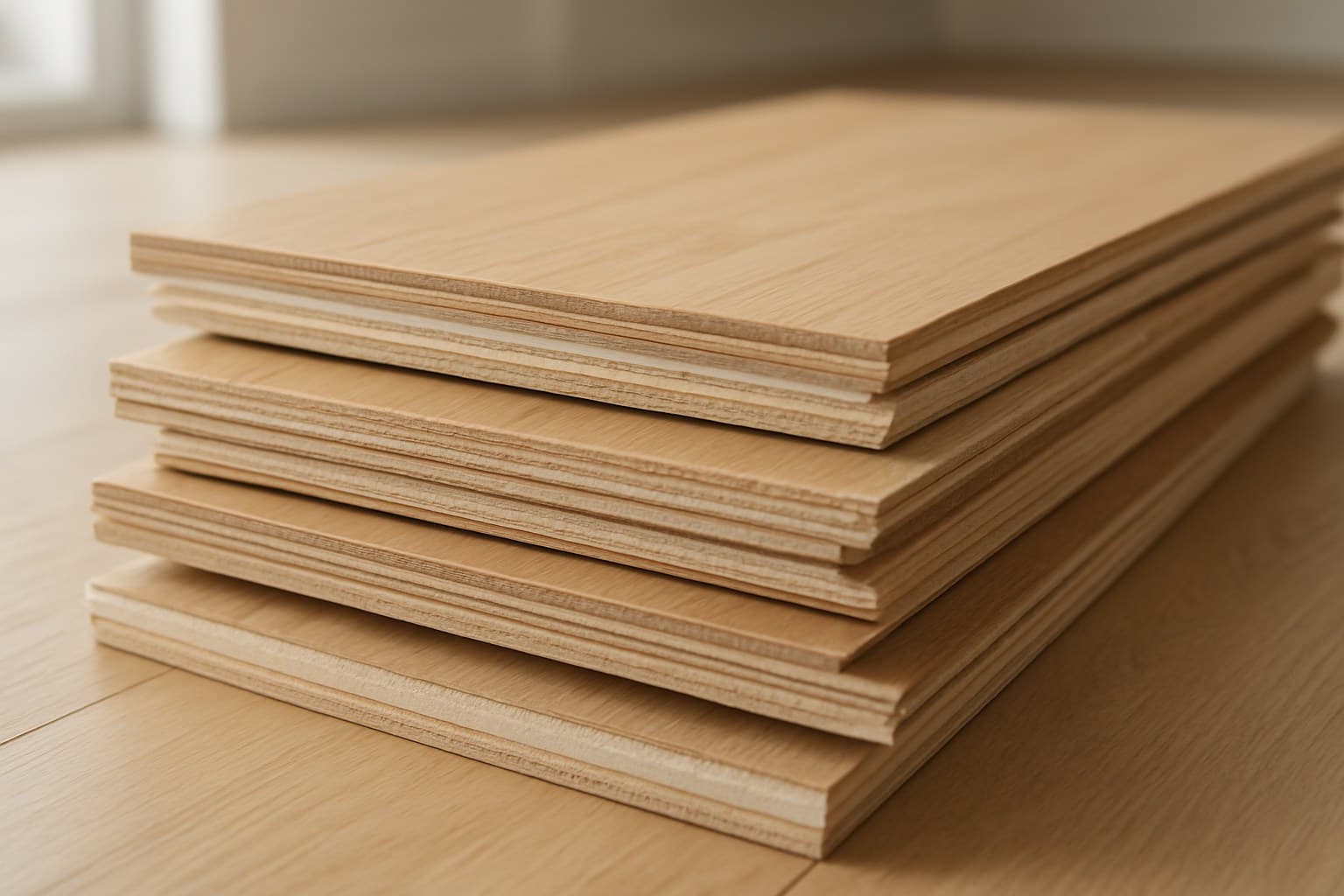
An engineered plank is built in layers: a real maple wear veneer on top that you see and can refinish, a cross-layered plywood or fiberboard core in the middle that fights humidity movement, and a thin balancing backer underneath that keeps the plank from cupping.
Tie refinishing to the spec, not a slogan. Solid maple can usually be sanded and refinished several times over its life, though the exact number depends on the plank's thickness. An engineered board depends on its wear veneer thickness, which the maker publishes, some engineered maple lines use quite thin wear layers, which may allow only one light sanding, or none at all.
That refinish math is also the backbone of the industry's own life-cycle case for the wood. The NWFA's Solid Wood Flooring Environmental Product Declaration builds its sustainability data on a 75-year functional unit, meaning the certified environmental figures assume a solid maple floor stays in service, through its normal cycle of sanding and resealing, for 75 years before it's replaced. That's the number behind claims that solid wood flooring is a long-life, low-replacement material: it isn't a marketing line, it's the assumption baked into the EPD's own math, and it's a big part of why the refinishing schedule above matters more for solid maple's lifetime value than it does for most other flooring categories.
Keep the water talk honest. Neither solid nor engineered wood is waterproof. Even when the surface finish holds, standing water still swells the seams and edges where boards meet, and that's where floors fail.
Kitchens deserve the same caution as baths, even though they don't get talked about as much. A dishwasher supply line or a sink leak at the toe-kick pools quietly under cabinets and swells seams long before you'd see a stain on the surface, so if you want maple in a kitchen, go engineered rather than solid, keep a rug pad at the sink instead of a rubber-backed mat that traps moisture, and wipe up spills fast rather than letting them sit.
In basements, the call usually comes down to the slab, not the wood. I've steered people off both maple types when the moisture reading came back bad, because no plank survives a wet slab underneath it.
What Maple Flooring Really Costs (Big-Box vs. Custom Mill)
The big price gap is real, and it isn't a mistake. Mass-market prefinished maple materials run roughly $4-8 per square foot, while custom wide-plank unfinished maple runs $10-18. The difference is board width, length, and grade, not a markup you should fight.
Now split labor out. Budget about $3-6 per square foot to install in open rooms. If you buy unfinished, add another $3-5 per square foot to sand, stain, and seal it on site.
Stairs and basements cost more than open rooms. Stairs mean more cuts and nosings; basements mean moisture prep before a board goes down. A single whole-house number hides where the money goes.
Here's a worked example for a 200 sq ft bedroom you can copy:
| Cost piece | Big-box prefinished | Custom unfinished |
|---|---|---|
| Materials ($/sq ft) | $4-8 | $10-18 |
| Install labor ($/sq ft) | $3-6 | $3-6 |
| Site finish labor ($/sq ft) | included (prefinished) | $3-5 |
| 200 sq ft materials | $800-1,600 | $2,000-3,600 |
| 200 sq ft labor | $600-1,200 | $1,200-2,200 |
Source: The gap I see between big-box and custom-mill quotes on the maple jobs I bid
Real material and labor ranges for maple flooring in a 200 sq ft open room; stairs and basements run higher.
Confirm these with two local quotes before you budget. Species, region, and how much subfloor prep the old floor needs move these numbers more than any online average.
Before laying a single board, check two things: per NWFA installation guidelines, is the subfloor flat within the manufacturer's tolerance, and is moisture in range? On concrete, that means an actual slab moisture test. I let Tom in Dayton talk me out of that test on his basement rec room to save an afternoon. The floor cupped before the season was out, and I relaid it on my own dime. That's the day I stopped treating the test as optional.