
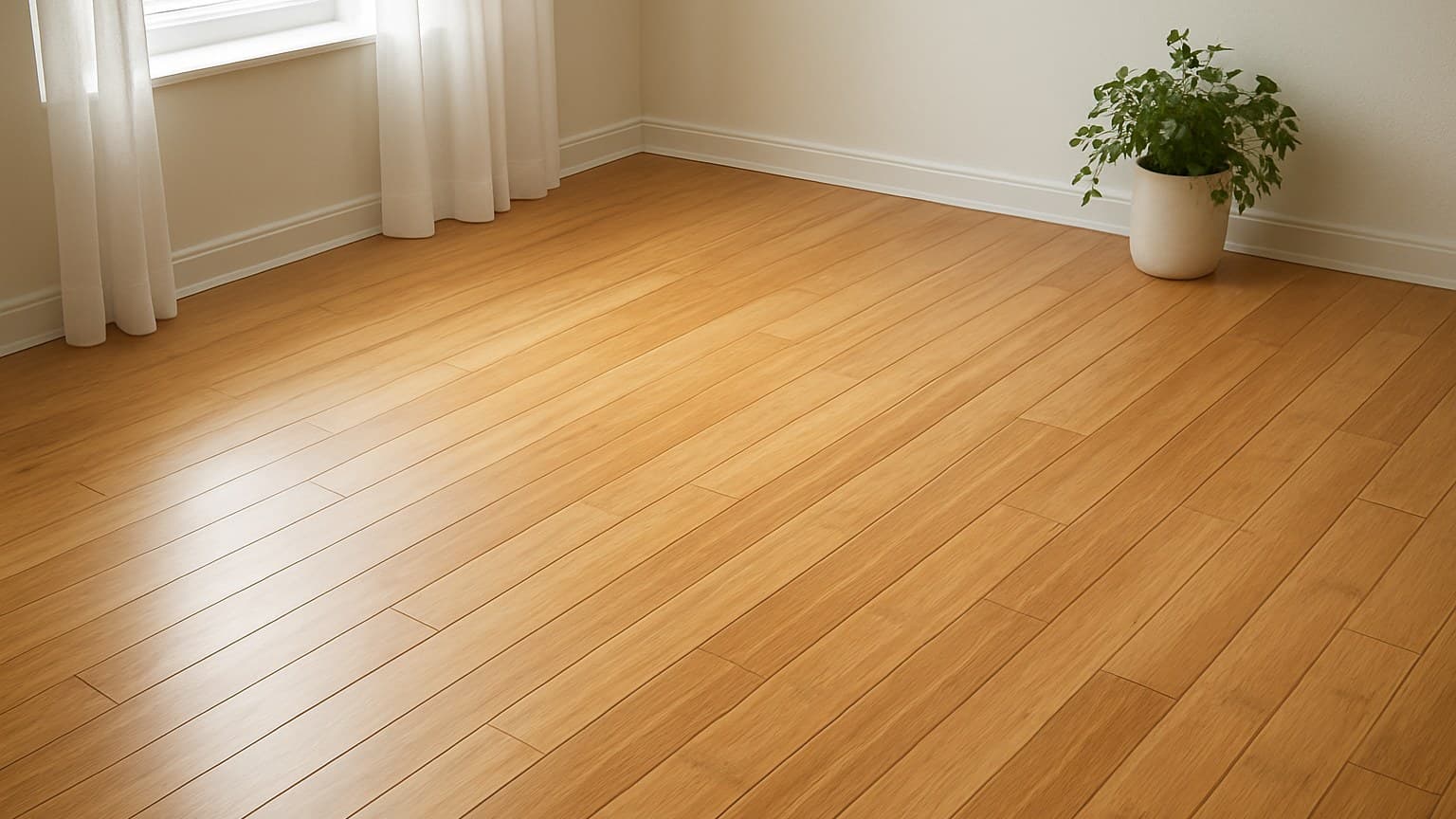
Four months after I installed a floor for Priya in Round Rock, Texas, she called with cupped boards along her sliding glass door. The "bamboo hardwood" her big-box store sold her turned out to be the soft carbonized kind, laid where damp air rolls in every time that door opens. Bamboo flooring is really three different products sharing one name, and the box rarely tells you which one you're holding. Pick the wrong one for your room and it dents, cups, or voids its own warranty inside a season. Here's the order I check things in on a job so that doesn't happen to you.
Key takeaways
- The word "bamboo" covers three real products: strand-woven solid, horizontal/vertical carbonized, and engineered, and they don't perform the same.
- Strand-woven is the hard one, with a Janka hardness far above soft carbonized bamboo that dents under a dropped can.
- Plan on roughly $3-9/sq ft for materials (strand-woven $3-6, engineered $4-9) plus $2-6/sq ft labor, with stairs and basements costing more than open rooms.
- Check subfloor flatness with a 6-8 ft straightedge and run a moisture check before you buy a single box.
- Click-lock engineered is realistic DIY for most homeowners; glue-down, stairs, and basement moisture transitions are usually worth hiring out.
Step 1: Figure Out Which "Bamboo" You're Actually Buying
Before anything else, ask the salesperson which construction you're buying. The word "bamboo" hides three products that don't perform the same, and the price tag alone won't tell them apart.
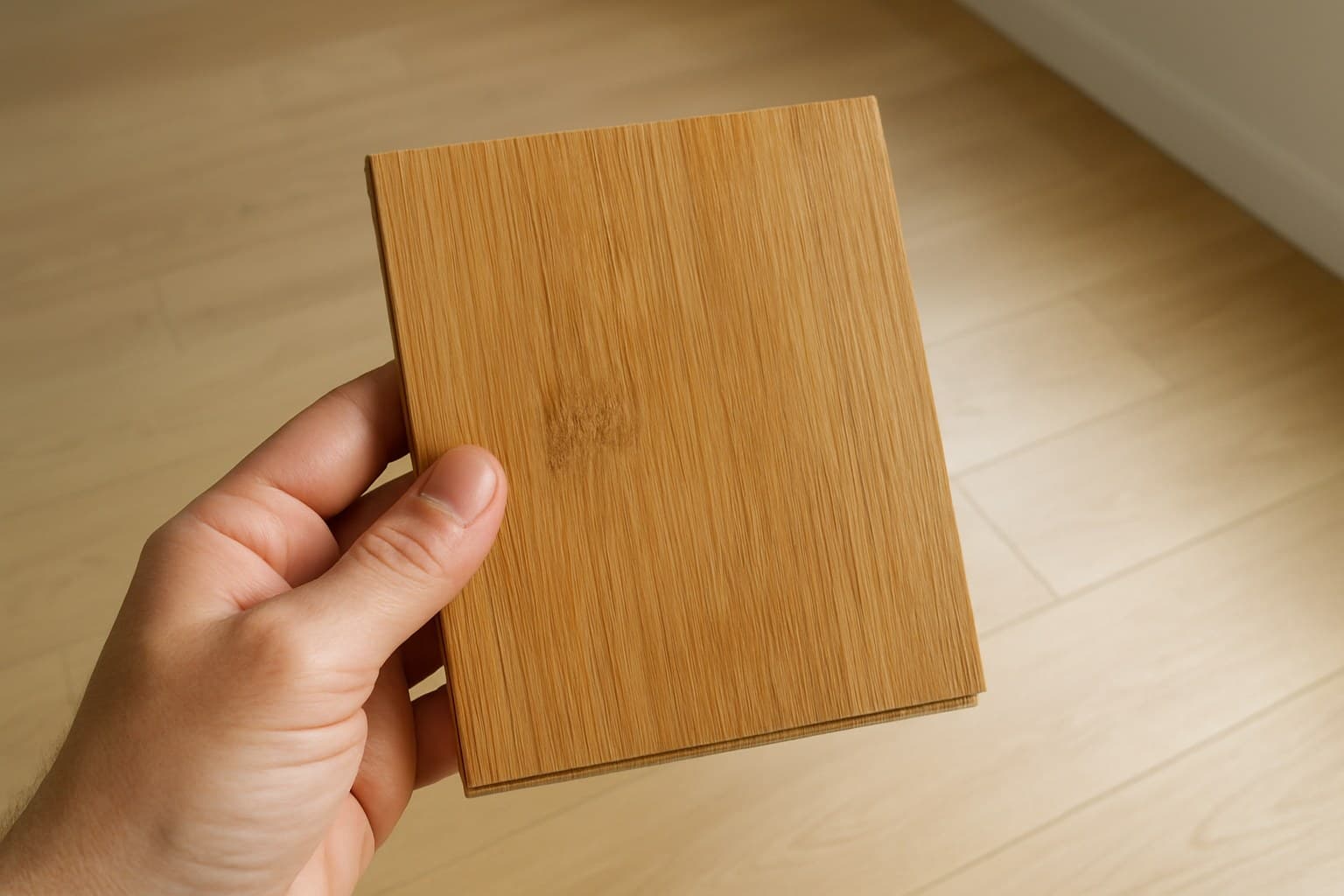
The three are strand-woven solid, carbonized (horizontal or vertical), and engineered. Strand-woven is the hard one: shredded bamboo fibers pressed together under heat and resin into a dense board. Carbonized is the soft, pretty one. Engineered is a thin bamboo veneer glued over a plywood-style core, usually with a click-lock edge so it floats. If a solid softwood board sounds more appealing than an engineered veneer, a solid pine flooring option gives you that same straightforward warmth in a single-species board.
Here's a trap worth knowing. "Carbonized" just means the bamboo was heat-treated to a darker, richer color. That same heat softens it. So with carbonized bamboo, a darker board is often a weaker board, easier to dent and quicker to scratch.
Strand-woven vs. carbonized vs. engineered
| Type | Construction | Hardness | Refinish | Water tolerance | Materials cost | Best room |
|---|---|---|---|---|---|---|
| Strand-woven solid | Shredded fibers compressed under heat and resin | Very hard (Janka often 3,000+) | Usually 1-2 light sandings if the wear layer allows | Core resists dents; seams still let water in | $3-6/sq ft | High-traffic, pets, kitchens with fast cleanup |
| Horizontal/vertical carbonized | Strips glued flat or on-edge, then heat-darkened | Soft (dents easily) | Rarely; veneer too thin | Low; swells and cups | $3-5/sq ft | Low-traffic bedrooms only |
| Engineered bamboo | Bamboo veneer over plywood-style core, often click-lock | Depends on the veneer | Once at most, if at all | More stable over concrete; check the seam rating | $4-9/sq ft | Basements and slabs (floating) |
Source: Janka figures from the manufacturers' published spec sheets.
The three constructions sold as bamboo flooring, with typical hardness, refinish limits, and material cost per square foot.
How bamboo hardness compares to real wood
Janka hardness is the standard test for how well a floor resists dents. Red oak, the wood most floors get measured against, sits around 1,290. Hard maple lands near 1,450 and hickory near 1,820. The hardest exotics, like Brazilian walnut, run around 3,680.
Good strand-woven bamboo often tests 3,000 or higher on the maker's own spec sheet, which puts it up near those exotics. Carbonized bamboo can drop back toward red oak or below, soft enough to ding under a dropped can. The two floors share a name and not much else. If you want a natural wood in the same durability class, acacia is worth a look too.
The label rarely spells this out. So make "which construction is this?" your first question, it drives price, durability, and where the floor can safely go.
Step 2: Match the Grade to the Room and the Moisture
Match the grade to the room first, looks second. Strand-woven for kitchens and busy areas, engineered floating for basements and over concrete, carbonized only in dry, low-traffic bedrooms. Get that pairing right and a lot of callbacks disappear. If it's that carbonized bedroom look you're chasing, wide-plank heart pine flooring delivers a similar rustic warmth without bamboo's heat-softened durability trade-off.
Solid bamboo, including strand-woven, does not belong in a bathroom or laundry room. And here's the part the ads skip: even a floor sold as "waterproof bamboo flooring" is usually talking about the core, not the seams. Water gets in where the boards meet, and that's where the swelling and cupping start.
Bamboo also moves with the humidity in your house. A floor that behaves fine in a stable, climate-controlled home can gap in a dry winter or cup in a damp basement. That's not a defect, it's the material breathing, and it's why room and region matter as much as the grade you picked. Solid hardwoods like hickory face that same humidity-driven movement, so if you're weighing that option too, hickory flooring guide walks through picking boards that won't cup or gap in your specific climate.
If you own dogs or run a heavy-traffic house, go straight to strand-woven. Carbonized scratches and dents fast enough that you'll see the wear inside a year. And if your basement stays genuinely damp, be honest with yourself: a stone-look product like the cherry-toned Lifeproof LVP lines may serve that room better than any bamboo, because vinyl doesn't care about a slab that reads a little wet.
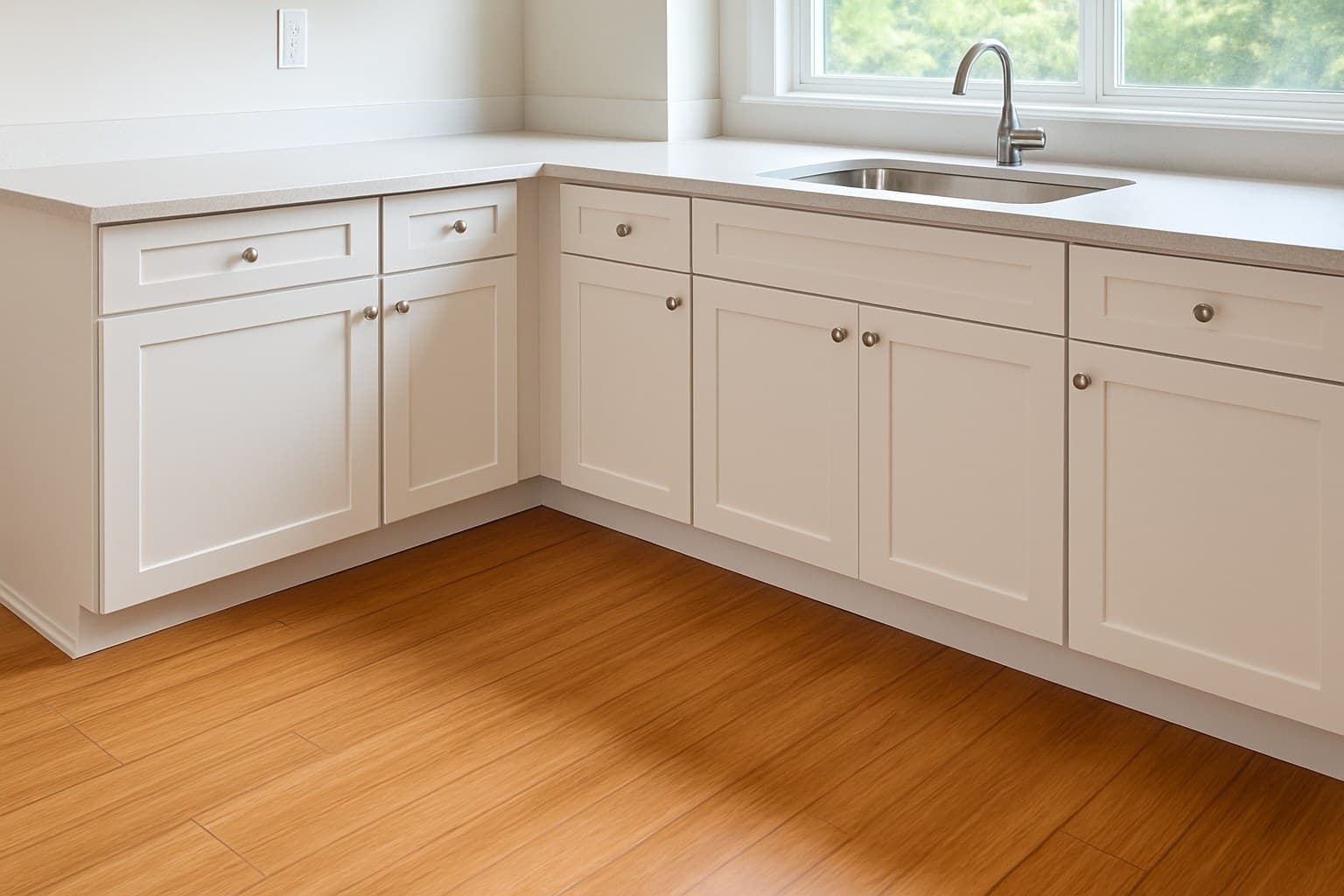
Step 3: Check the Subfloor Flat and Dry Before You Commit
Do this before you buy a single box, not after the pallet shows up. According to the National Wood Flooring Association's (NWFA) installation guidelines, subfloor flatness and moisture content are among the most common culprits behind flooring failures, and on most floating floors, the maker's warranty depends directly on getting both right, not on the plank you chose. Skip the check and you can void the coverage while the box sits sealed.
Start with flatness. Lay a straight metal or aluminum bar, 6 to 8 feet long, across the floor in several directions and look for daylight underneath. Grind down the high spots and fill the low ones with leveling compound. If you don't, the floor flexes as you walk, and a floating bamboo floor with a dip under it will tick and click for years.
Then check moisture. A moisture meter is a small handheld tool that reads how wet the subfloor is; press it to the wood and read the number against the maker's limit. Over concrete, run a simple slab moisture test too, because bamboo laid on a damp slab will cup no matter how good the plank is.
One more thing while you're planning the layout. Nearly every floating bamboo floor needs an expansion gap left around the edges of the room so it can move without buckling. The exact gap size is on that product's own instruction sheet, not some universal number, so read the box and set your spacers to match it.
Step 4: Read the Wear Layer and Warranty on That Exact Box
Don't trust the shelf sign. Read the spec sheet on the specific product you're buying, because the wear layer thickness, the warranty term, and any waterproof claim only apply to that one named box. The floor two bins over can have completely different numbers.
Waterproof core vs. water-resistant seams
These are two different promises, and stores blur them. A "waterproof core" claim means the guts of the board won't swell if they get wet. It says nothing about the seams and edges where the boards lock together, and that's exactly where real failures tend to start. Look for language that covers the seams and edges specifically, and treat a warranty that only mentions the core as a floor that can still fail at the joints.
Formaldehyde and off-gassing red flags
Cheap imported bamboo can off-gas formaldehyde, the glue smell that lingers in a closed room, a hazard the EPA has documented in its research on emissions from composite wood products. You cut that risk by buying a floor with a named low-emission certification printed on the box, like CARB Phase 2 (a California air-quality standard for wood products) or FloorScore (an independent certification confirming the product meets strict indoor air-quality emission limits). A no-name import with no emissions info anywhere on the carton is a pass for me.
Last, don't assume you can sand it down later. Engineered and carbonized bamboo often can't be refinished at all because the top layer is too thin. So "I'll just refinish it in ten years" is a spec question you answer at the store, not a promise the material makes for you.
Before you buy, run this box check:
- Which construction it is: strand-woven, carbonized, or engineered
- Wear layer thickness for that exact product line
- Whether the warranty covers seams and edges, not just the core
- A named emissions certification (CARB Phase 2 or FloorScore)
- Whether it can be refinished, and how many times
- The required expansion gap and acclimation time on the sheet
Source: The box checks I run on every bamboo job before I open a single carton
The verification list I run on every bamboo carton before opening it.
Step 5: Price It Out, Materials vs. Labor
Split materials from labor, because one flat number hides where your money actually goes. Materials run about $3-6 per square foot for strand-woven and $4-9 for engineered. On top of that, labor runs roughly $2-4 per square foot for a floating install and $3-6 for glue-down.
Basements and stairs cost more than open rooms, and it's not the installer padding the bill. I used to quote flat by the square foot until a job full of closets, doorways, and a bay window ate a whole extra day. The open middle of a room is never where the time goes. Cut-heavy areas and per-step stair work are, so expect those to bump the labor end.
Here's the arithmetic so you can read your own case off it. The formula is simple:
Total = (materials per sq ft + labor per sq ft) x square footage
| Job (200 sq ft room) | Materials | Labor | Total |
|---|---|---|---|
| Strand-woven, glue-down | $4/sq ft x 200 = $800 | $4/sq ft x 200 = $800 | $1,600 |
| Engineered, click-lock floating | $6/sq ft x 200 = $1,200 | $3/sq ft x 200 = $600 | $1,800 |
| Carbonized, floating (bedroom) | $4/sq ft x 200 = $800 | $3/sq ft x 200 = $600 | $1,400 |
Source: Labor from my own per-square-foot bids on bamboo jobs
Worked cost examples for a 200 sq ft room, materials and labor split out, at mid-range per-square-foot rates.
Plug your own room size and your quoted rates into that formula and you'll land close. Add a premium on top for stairs (priced per step) and basements (extra prep and moisture work).
One more angle worth doing in your head: cost per year. A hard strand-woven floor that lasts 20-plus years spreads its cost thin. A cheap carbonized floor you dent up and replace in five or six years costs more over time, even though the sticker looked friendlier at the store.
Step 6: Decide Whether to DIY or Hire It Out
Be honest about which job you're taking on. Click-lock engineered bamboo over a flat, dry subfloor is a realistic weekend DIY for most homeowners who can measure carefully and leave the expansion gap. That's the one I tell people to try themselves. That same solid-versus-engineered decision drives a lot more than installation difficulty when you're picking a species elsewhere in the house, and our guide to solid vs. engineered hardwood floors breaks it down room by room.
Glue-down is where it gets unforgiving. The adhesive gives you one shot, and a board set crooked in wet glue doesn't lift back out clean. Stairs are their own trade, with each tread cut, glued, and finished with a rounded front edge called a nosing that has to be fastened right so nobody trips. And a big open-plan floor that runs from a stable living room into a damp basement crosses a moisture line that needs the right transition and often a moisture barrier.
Those three, glue-down, stairs, and open-plan moisture transitions, are where hiring a pro usually pays for itself. Not because you can't learn it, but because the redo costs more than the install would have. If you're weighing bamboo against a natural hardwood for the same room, the acacia flooring guide walks through a similar hardness-versus-install tradeoff and is a useful next read before you commit.