
A customer in Beaufort, South Carolina, called me out to price a dining room in heart pine because her contractor pitched it as "harder than oak." I ran the numbers with her on the spot: according to the NWFA's Homeowner's Handbook to Real Wood Floors, antique heart pine tests around 1225 on the Janka hardness scale, while red oak sits at 1290. Heart pine gets close to oak, but it isn't harder, and that gap is where buyers overpay.
Key takeaways
- Antique heart pine tests around 1225 on the Janka hardness scale, just under red oak at about 1290, so the common 'harder than oak' sales line does not hold up.
- True reclaimed heart pine is old-growth longleaf pine pulled from 100-plus-year-old buildings; new-sawn pine sold under the same name is softer and cheaper.
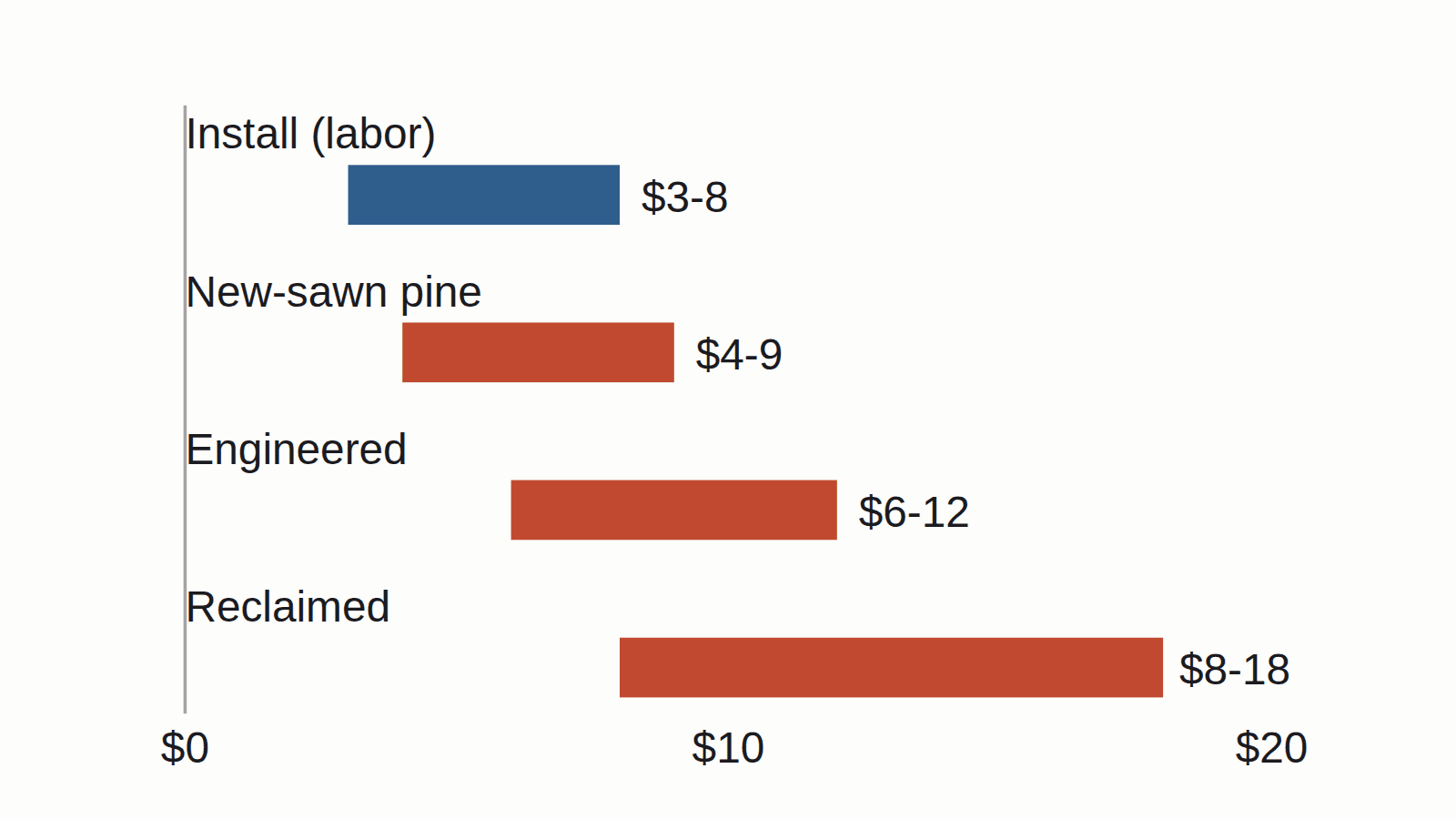
- Reclaimed material runs roughly $8-18 per square foot, new-sawn pine $4-9, and engineered $6-12, with pro install adding about $3-8 per square foot on top.
- Verify authenticity by grain density (15-30+ rings per inch), sourcing paperwork, and old nail-hole patina, not by the word 'heart' on the invoice.
- Heart pine is soft enough to dent, so it shows character fast; flatten and moisture-check the subfloor first, because wide pine planks move.
What Heart Pine Flooring Actually Is
Heart pine is the dense inner core, the heartwood, of longleaf pine (Pinus palustris). It is not the pale outer sapwood, and it is not the fast-grown modern pine that gets sold under the same friendly name.
The value comes from age. Old-growth longleaf grew slowly over 100 to 400-plus years, which packed the growth rings tight and left the wood dense and stable. That slow growth is what you can't fake with young pine.
One thing I warn every customer about: the color moves. Heart pine ambers and deepens toward orange-brown as light and time work on it, so the floor you install isn't the color you keep a few years later.
It sits inside the broader pine family covered in pine flooring guide, but heart pine is a specific, premium slice of it, not the whole tree.
Hardwood or Softwood? The Janka Number Settles It
Botanically, heart pine is a softwood, because all pines are. But old-growth heart pine performs like a light hardwood, which is why sellers blur the line.
Here's the myth worth killing. The Janka scale is a standard test, the same category of testing standard ASTM maintains for wood products, that measures how much force it takes to dent the wood. Per the NWFA's Homeowner's Handbook to Real Wood Floors, antique heart pine tests around 1225 on that scale, while red oak sits near 1290. So heart pine is close to oak, but it isn't harder than it, no matter what the showroom says. If hardness numbers are what sway you, know that bamboo swings even more wildly by manufacturing process, so it's worth learning how to choose bamboo flooring for hardness before you compare it to pine on paper alone.
| Wood | Janka rating |
|---|---|
| New southern yellow pine | 870 |
| Teak | 1070 |
| Antique heart pine | 1225 |
| Red oak | 1290 |
| White oak | 1360 |
| Hickory | 1820 |
Source: the NWFA Homeowner's Handbook Janka ratings
Heart pine (1225) and red oak (1290) figures are per the NWFA Homeowner's Handbook to Real Wood Floors; other species are shown for general reference.
Janka hardness for heart pine against common flooring woods; higher numbers dent less.
Day to day, that means heart pine dents and shows wear. In a home, that reads as character. Just don't buy it expecting the toughest floor on the market, because it isn't. If dent resistance is the priority, it's worth comparing heart pine against how to pick hickory flooring before you settle on a species.
Reclaimed vs New-Growth: How to Tell What You're Buying
This split decides everything about price and performance. Reclaimed heart pine is old-growth wood pulled from old mills, warehouses, and barns. New-growth is replanted pine, softer, with wider-spaced rings, and it sometimes gets relabeled to ride the reclaimed name.
Ring density is your best tell. Genuine old-growth shows many tight rings per inch, roughly 15 to 30 or more, while fast modern pine shows only a few wide ones. Grab a board and count them at the end grain.
Then check the paper and the surface. Ask for sourcing paperwork that names the mill or building the wood came from, and favor suppliers listed among NWFA-certified manufacturers when you can. Look for a weathered face, old nail holes, and bolt marks milled right into the boards. Real heart pine also runs amber all the way through, not just as a surface stain, and a genuine board feels noticeably heavy when you lift it.
Why sweat all this? Reclaimed costs more and performs harder, so paying reclaimed money for reclassified new pine is the exact trap buyers fall into.
Grades and Widths, From Clear to Naily
Grade sets the look and the price, and the terminology traces back to NWFA/NOFMA grading and factory-finished standards. In plain terms: clear or heirloom has few knots and the cleanest face; knotty shows more character; naily or buckshot leaves old nail marks in for the most rustic look. Quartersawn is a fourth term worth knowing, and it isn't just about looks.
Quartersawn means the log was cut so the grain runs straight up and down the board. That straight vertical grain moves less with humidity, so those boards stay flatter than flat-sawn ones. If your room swings between damp and dry, quartersawn is the safer buy.
Heart pine shows up in everything from 3-inch strips to 12-inch-plus plank. Wider boards look stunning, but they also move more with the seasons, and soft pine changes the math on how far you can push width. Our wide plank pine guide walks through how wide you can really go before movement becomes a problem.
Solid vs Engineered Heart Pine
The core difference is simple. Solid heart pine is one piece of pine top to bottom. Engineered is a heart pine veneer over a plywood-style core that stays more dimensionally stable. That same tradeoff plays out across species, and our guide to solid vs. engineered hardwood floors walks through how to choose between them for any room.
Where the floor goes should drive the choice. Solid heart pine is generally not recommended over concrete or below grade, while engineered handles those spots better. And refinishing is a spec question, not a yes-or-no: solid can be sanded several times, but an engineered floor's veneer thickness caps how many times, if at all.
| Feature | Solid | Engineered |
|---|---|---|
| Core | One solid piece of pine | Pine veneer over plywood-style core |
| Over concrete / below grade | Generally not recommended | Better suited, more stable |
| Refinishing | Can sand several times | Limited by veneer thickness |
| Movement with humidity | Moves more, can cup | More dimensionally stable |
| Typical entry cost | Higher, especially reclaimed | Lower to get into |
Source: engineered pine floors I've laid over both slab and plywood subfloors
Solid versus engineered heart pine across core, placement, refinishing, movement, and entry cost.
What Heart Pine Really Costs
There's no single number, so split it. Material and labor are two different buckets, and reclaimed, new-sawn, and engineered each sit at a different price.
| Item | $ per sq ft |
|---|---|
| Professional install (labor) | 3 - 8 |
| New-sawn pine (material) | 4 - 9 |
| Engineered heart pine (material) | 6 - 12 |
| Reclaimed heart pine (material) | 8 - 18 |
Material and labor cost ranges per square foot; blue is labor, the red bars are material by type.
Reclaimed sits at the top for good reasons: limited supply, extra milling, and the slow work of pulling old nails all pile labor on before the wood ever reaches your floor.
Before any planks go down, flatten the subfloor and run a moisture check with a meter, a handheld tool that reads how wet the wood or slab is. Pine is soft, so it telegraphs every hump, and wide planks move with humidity. And price the room honestly: basement and stair jobs cost more than an open room, because of the cutting, the tricky moisture, and the slower pace.
On the DIY question, most heart pine goes down nailed or glued, which is finicky work. Click-together floors are realistic for a weekend installer, but nail-down pine over an uneven subfloor, stairs, and any slab moisture transition are where hiring a pro usually pays for itself.