
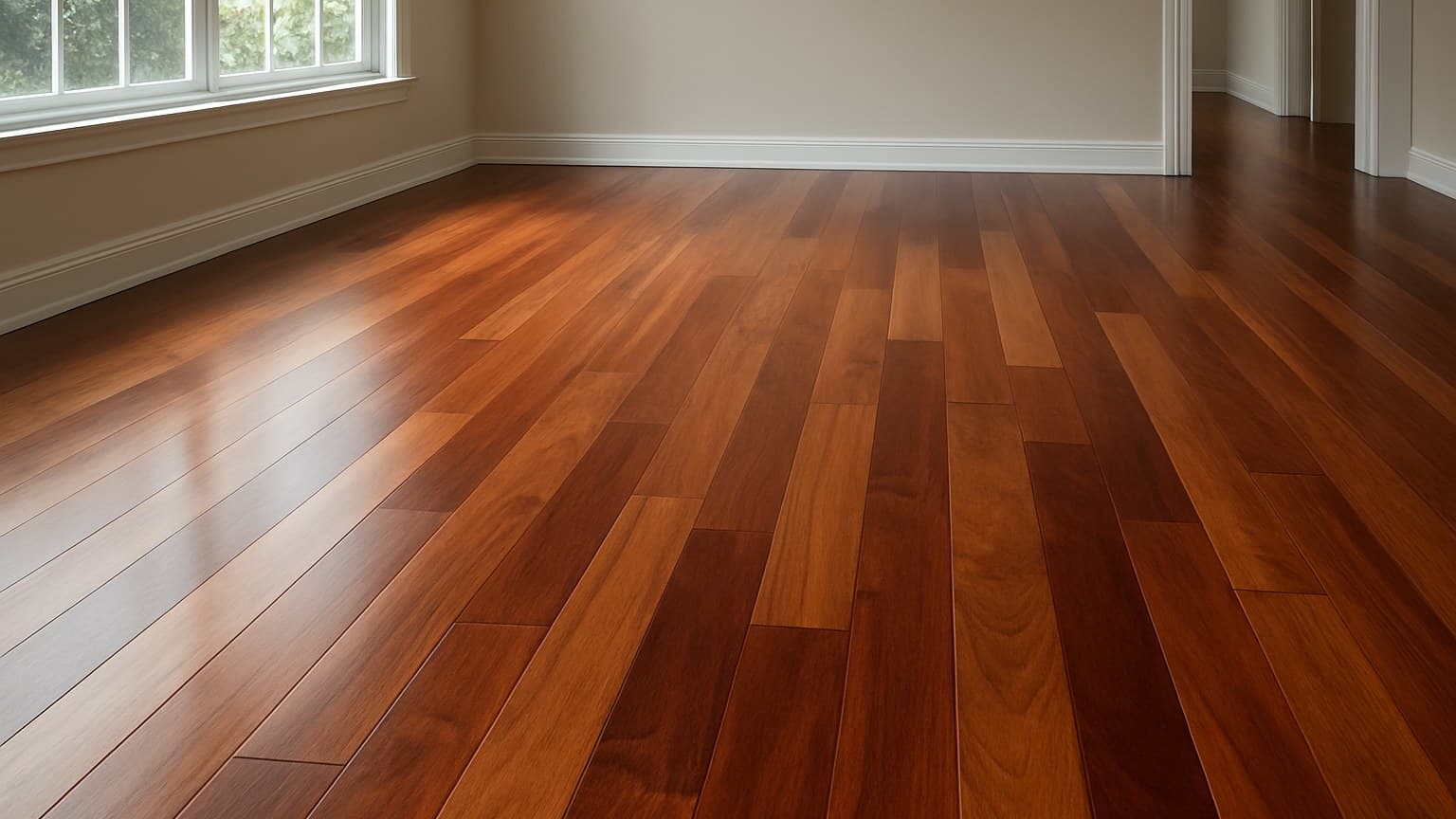
I stood in Denise Carroll's dining room in Council Bluffs, Iowa, looking at a pallet of engineered Brazilian cherry she'd already bought before asking me a single question about it. That's backwards, and it's how most Jatoba jobs go wrong. Where the floor goes, how it shifts color, and whether you can sand it later matter more than the sample board in your hand. Settle these eight things before you pay.
Key takeaways
- Engineered Brazilian cherry (Jatoba) can go on or below grade over concrete where solid usually can't, but the moisture check under it decides whether it lasts, not the plank.
- Jatoba darkens on its own from light. Fresh planks look orange-red and deepen to a rich red-brown over months, so rugs and furniture left in place leave pale ghost patches.
- Real Janka is around 2350, harder than red oak (1290) and maple (1450), so it resists dents but is a tougher, slower install.
- Expect roughly $4-9 per sq ft for the material and $3-7 per sq ft for labor, with basements and stairs costing more than open rooms.
- Whether you can refinish it later is a spec question tied to veneer thickness, not a yes or no. The NWFA Engineered Refinishable Program lists brands whose engineered floors can be sanded.
1. Whether Engineered Jatoba Will Actually Hold Up Over a Concrete Slab
Yes, engineered Brazilian cherry (the wood's real name is Jatoba) can go over a concrete slab, on grade or below grade, where a solid Jatoba plank usually shouldn't. The core is cross-layered plywood or HDF (high-density fiberboard, a compressed wood panel), so it stays flatter and moves less against concrete than a single solid board would. That same solid-versus-engineered tradeoff plays out across species, so it's worth working through solid vs. engineered hardwood floors before you settle on a construction type for any room in the house.
But "can go over concrete" isn't "skip the moisture check." I put engineered Jatoba in a split-level outside Cedar Rapids where the family room sat below grade, and the only reason it's still tight today is the slab tested dry first. Run the moisture test the maker's install guide calls for before anything goes down. The NWFA's Homeowner's Handbook to Real Wood Floors makes the same point for any wood floor going over concrete: test the slab's moisture before you commit to a locked-down installation.
Keep one thing straight: the core being stable isn't the same as waterproof. This is still wood. Standing water gets in at the seams and edges long before it bothers the plank face, so a below-grade room needs the moisture handled at the slab, not hoped away. If a room's risk goes beyond what careful moisture management can cover, the waterproof engineered hardwood options are built to handle standing water in a way this core simply isn't.
Basement air swings and slab moisture are the real risk here, not the species. A below-grade job also costs more than an open main-floor room because of the prep and the moisture work. If you want something that shrugs off water entirely, compare wood against vinyl in the engineered hardwood vs LVP guide before you commit.
2. Radiant Heat: The One Spec That Can Kill the Deal
If you have radiant heat under the floor, stop and check the spec sheet, because not every engineered Jatoba is approved for it. Dense exotic woods move with heat cycles, and a floor the maker never rated for radiant can gap or check (fine surface cracks) once the heat runs through a winter.
When a product is approved, the maker spells out how to do it: bring the heat up slowly at startup instead of blasting it, and stay under the maximum floor-surface temperature the sheet lists. That stated number is the one that matters, not a rule of thumb you read online.
Radiant jobs almost always float or glue down rather than nail. So before you pair Jatoba with radiant heat, confirm the exact product is rated for it, plan for the slow warm-up, respect the max temperature, and skip nail-down. Miss the rating and the warranty won't cover what happens next.
3. The Darkening Nobody at the Store Mentions
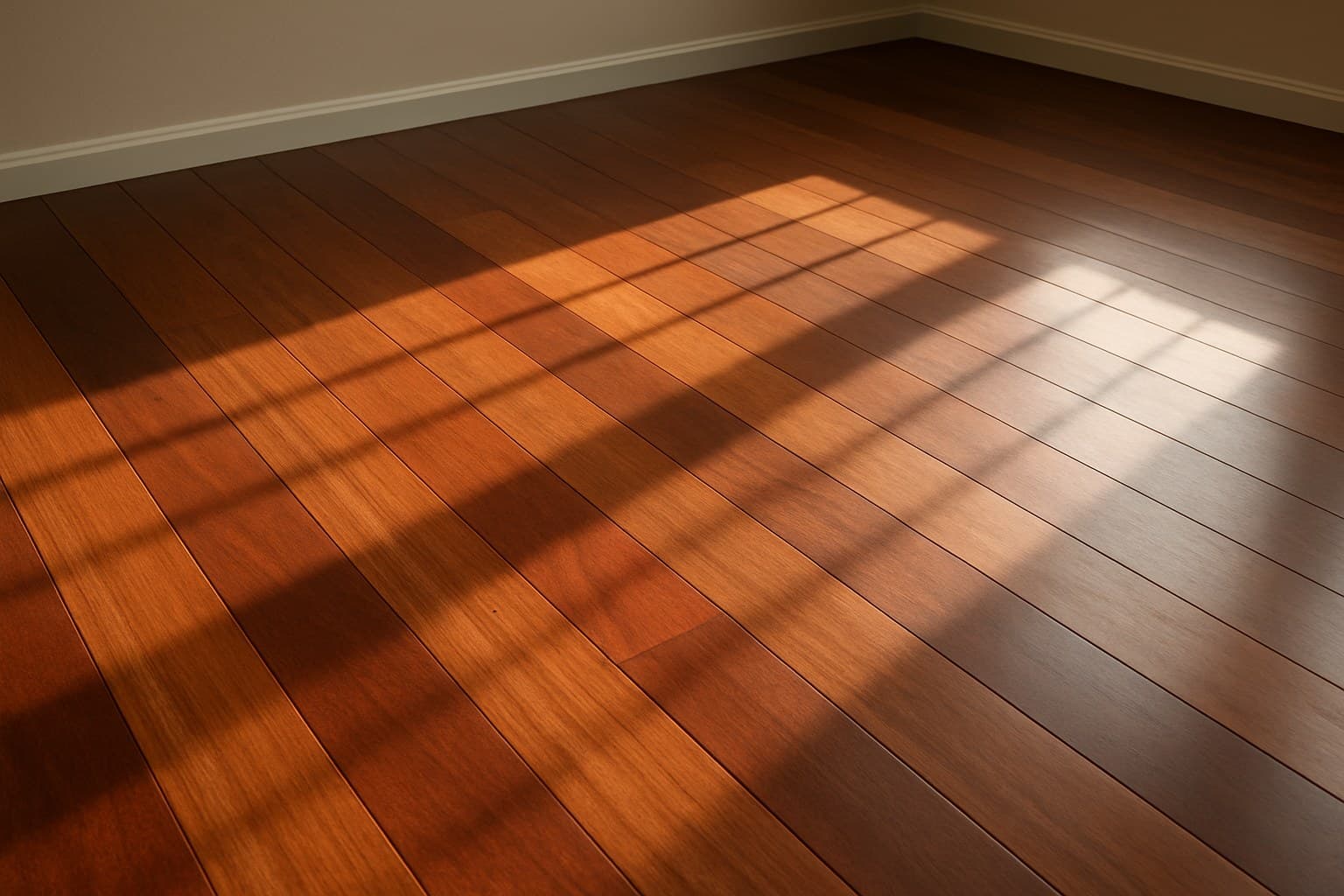
Brazilian cherry doesn't fade, it deepens, on its own. It's called photo-oxidation, and it means light changes the wood's color over time. On install day the planks look bright orange-red. Over weeks and months they settle into a rich, dark red-brown. This is normal, not a defect.
Here's the trap. Anything left sitting in one spot blocks light. A rug, a couch, a stack of moving boxes left for a month, all of it leaves a pale ghost patch when you finally move it, because the wood underneath never caught up with the rest.
So rotate rugs early for the first few months, and hold off on your final furniture layout until the floor has evened out. Expect the change and plan around it. Ignore it and you get blotches. If you want the full science, I broke down why Brazilian cherry keeps darkening in its own piece.
4. Janka Hardness: The Real Number vs the Showroom Pitch
Brazilian cherry lands around 2350 on the Janka scale, with some sources citing higher. The Janka number measures how well a wood resists denting. For reference, red oak sits near 1290 and hard maple near 1450, so Jatoba is a lot harder than the floors most homes already have.
What that buys you is real dent and traffic resistance. It's a good pick for busy households, kids, and dogs, because it takes a beating without showing much. For homeowners who'd rather the wear just blend into the design from day one, the distressed engineered hardwood flooring guide covers finishes built to hide those dents on purpose.
The tradeoff is one every installer feels in their arms. That same hardness makes the boards heavier to cut, harder on saw blades, and slower to nail down. That extra effort is part of why the labor line runs higher than it would on a softer floor.
| Species | Janka rating |
|---|---|
| Black walnut | 1010 |
| Red oak | 1290 |
| Hard maple | 1450 |
| Hickory | 1820 |
| Brazilian cherry (Jatoba) | 2350 |
Janka ratings for common flooring woods, showing Brazilian cherry well above domestic species.
5. Wear Layer, Finish, and Plank Size
The single spec that decides your floor's future life is the veneer, the real Jatoba wood on top of the core. On many engineered Jatoba lines, the veneer runs roughly 2-4 mm, and that thickness, not the overall board height, is what sets whether you can sand it later. Read that number off the product sheet, not the marketing, it moves from line to line and manufacturer to manufacturer.
Most engineered Jatoba comes with a UV-cured aluminum oxide finish. In plain terms, that's a hard, clear coat baked on at the factory that resists scratches. So "aluminum oxide" just means a tough, pre-finished top you don't have to seal yourself.
Plank size is where people get surprised. Engineered Jatoba often runs in 3-5 inch widths, so if you're picturing big, wide boards, check what's actually stocked before you fall for a look you can't buy. For that hunt, start with the wide-plank engineered options.
Confirm every one of these against the product's own sheet. Wear layer, finish, and width all shift from line to line, and two floors that look the same in the rack can be built very differently.
6. Whether You Can Ever Refinish It
Engineered floors can be refinished, so drop the myth that they're a one-and-done throwaway. How many times comes down to that published veneer thickness. A thick veneer might take a couple light sandings over its life; a thin one might allow a single pass or none at all.
Proof this is brand-specific and not a flat "no": the National Wood Flooring Association (NWFA) runs an Engineered Refinishable Program, which lists manufacturers, including names like AHF, Mirage, Vintage, and Preverco, whose engineered products are verified as sandable and refinishable. If a maker's floor is on that program's list, refinishing is genuinely on the table.
The field reality still calls for caution. I once had Gary Ostrander in Waterloo ask for his solid oak floor to be sanded a fourth or fifth time, and one corner went down to the tongue before I caught it. Even a solid floor runs out of wood. On engineered, there's far less to give, so ask for the veneer thickness up front if sanding it down the road matters to you. To shop lines built to be refinished, compare the best engineered hardwood lines.
7. What It Really Costs, Split Out
Engineered Brazilian cherry isn't a single price tag, the table below splits material and labor into the actual ranges I quote, broken out by install method. There's no honest single flat number, because the labor half swings hard on how the floor goes down.
A simple float over a flat subfloor is the cheapest install. Glue-down over concrete and nail-down over wood both cost more, and stairs and basements add to the material and the labor. A below-grade room, with its moisture prep, is never priced like an open main-floor room.
The other thing that moves a quote is cut-heavy space. I used to bid flat by the square foot until a job full of closets, doorways, and a bay window ate a whole extra day. The open middle of a room flies; the transitions, corners, and closets are where the hours hide. That's why two rooms of the same size can quote differently. If you want to see how that up-front price stacks up over decades of ownership, NWFA's Life Cycle Cost Analysis compares long-term value across flooring price tiers.
| Line item | $ per sq ft |
|---|---|
| Labor (float) | 2 - 4 |
| Labor (glue-down / nail) | 3 - 7 |
| Material (engineered Jatoba) | 4 - 9 |
Typical residential ranges, split so you can see where the labor half moves.
For a whole-house estimate broken down room by room, work through the full engineered hardwood cost breakdown before you sign anything.
8. Jatoba vs Cumaru vs Ipe vs Santos Mahogany
Buyers cross-shop these red-brown exotics all the time, and they aren't interchangeable. Jatoba (Brazilian cherry) is the most common and the one that darkens the most dramatically. Cumaru (Brazilian teak) and Ipe (Brazilian walnut) are harder and heavier still, which makes them even tougher installs. Santos mahogany runs closer to Jatoba in hardness with a deeper, more chocolate tone and less of that fire-red shift.
| Wood | Also called | Color | Approx. Janka | Notes |
|---|---|---|---|---|
| Jatoba | Brazilian cherry | Orange-red to deep red-brown | ~2350 | Darkens the most; widest availability |
| Cumaru | Brazilian teak | Golden to reddish brown | ~3300 | Very hard, harder to work |
| Ipe | Brazilian walnut | Dark olive-brown | ~3680 | Hardest of the four; heavy, slow install |
| Santos mahogany | Cabreuva | Deep red to chocolate brown | ~2200 | Rich tone, less dramatic color change |
Source: the exotic-species spec sheets I pull up when a client wants a red-brown floor
Approximate Janka and color for the four exotics buyers most often compare against Brazilian cherry.
If you love the classic warm red that matures dark, Jatoba is the pick, and it's usually easier to source and install than the other three. Reach for the others when you want a specific tone or a harder surface, and budget more labor when you do.