
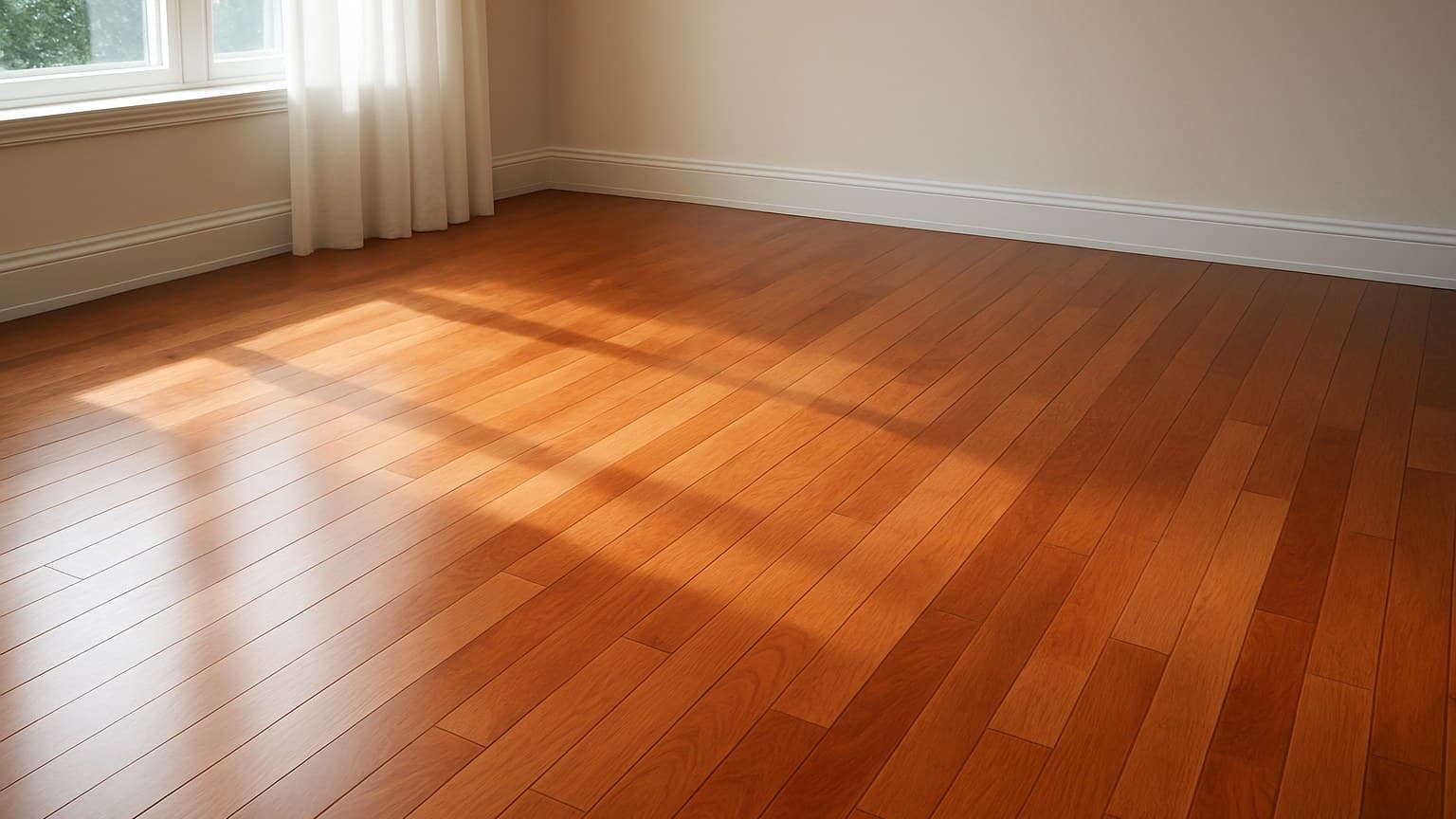
Rosa Delgado's dining room in Naperville, Illinois, is where I saw this trip people up firsthand. She picked her rug and cabinet stain to match a deep red-brown sample board, then watched the fresh cherry planks go down pink to salmon instead. Most people buying cherry wood hardwood floors don't realize those are the same product a few months apart, and they set their cabinets and rugs to the wrong one. Plan for the change instead of fighting it.
Key takeaways
- Cherry installs pink to salmon and photo-oxidizes to deep red-brown within about 6 months; most of the change is done by then, with slight further darkening over 1-2 years.
- American cherry is soft (Janka around 950, softer than red oak at 1290), so it dents in busy rooms; it does best in bedrooms, formal living rooms, and offices.
- Keep area rugs off for the first 6-12 months or you'll get a pale outline where sunlight couldn't reach the wood.
- Budget roughly $5-10 per sq ft for solid cherry material plus $3-6 per sq ft install labor; Brazilian cherry runs higher and is much harder.
- Over concrete or below grade, engineered cherry is the safer pick than solid.
The Cherry You Buy Isn't the Cherry You'll Live With
Fresh cherry comes out of the box pale. Think pink to salmon, sometimes almost blond in spots. It is not the rich red-brown you saw in the showroom photo, and no stain made it that color. Cherry darkens on its own after it's down.
Here's the general pattern on timing, even though exact timelines vary by source and by light exposure: much of the color change tends to happen within roughly the first six months. After that, the floor often keeps deepening slightly for another year or two, then largely holds. So the big shift is fast, and the long tail is subtle, treat the exact months as rough ranges, not guarantees.
The catch is the change is uneven if light hits the floor unevenly. A rug, a couch, or a sunny window will each write themselves onto the wood. Where you put things on day one matters, because the floor is recording it.
| Stage | What it looks like | When |
|---|---|---|
| Day one (fresh install) | Pale pink to salmon, sometimes near-blond | Install day |
| First few weeks | Pink warms toward light red, the fastest visible shift | Weeks 1-4 |
| Around six months | Deep red-brown, most of the change is finished | ~6 months |
| One to two years | Settles into a mature reddish-brown, darkening only slightly more | 1-2 years |
Why Cherry Darkens: Photo-Oxidation in Plain Words
Cherry tans, the same way skin does. Put it in the light and it reacts and goes darker. The important part: the color develops inside the wood itself, not just in the coating on top, so you can't sand it off or wipe it away.
The precise name is photo-oxidation. It's driven mostly by UV light, the same part of sunlight that fades a curtain. That's why a room facing south or west changes faster and harder than a shaded hallway.
A clear finish slows this down a little but does not stop it. Even indirect daylight keeps the reaction going. You can't pick a "final" color off a sample board either, because the sample is still changing in its own light too.
The practical move: keep area rugs off a new cherry floor for the first 6 to 12 months. If you drop a rug down early, the wood under it stays pale while everything around it reddens, and you get a ghost outline when you move it. If you must use a rug, lift and rotate it every few weeks so the floor evens out.
How Soft Is Cherry, Really? Janka 950 in Context
American cherry rates about 950 on the Janka hardness scale, the standard dent test where a higher number means a harder wood. That puts it below red oak (1290) and well under hard maple. In plain terms, cherry is a soft hardwood. If red oak's higher number on that scale has you weighing it as the safer pick instead, red oak prefinished hardwood flooring lays out grades, widths, and cost next to white oak.
On a real floor that means dropped pans, dog nails, and chair legs leave marks more easily, and busy walking paths show wear sooner. It's not fragile, but it's not a floor you abuse.
Don't confuse American cherry with Brazilian cherry, sold as jatoba. That's a completely different tree and a much harder floor, around 2350 Janka. If a listing says "cherry" and brags about being tough, it's almost certainly the Brazilian kind, not the soft domestic one.
| Wood | Janka rating |
|---|---|
| American Cherry | 950 |
| Black Walnut | 1010 |
| Red Oak | 1290 |
| Hard Maple | 1450 |
| Brazilian Cherry | 2350 |
Janka hardness ratings for American cherry against four common flooring woods, higher meaning harder.
The softness fear has a real answer, and it's placement, not panic. Cherry does great where life is gentle and struggles where it isn't. More on which rooms below.
Cherry Grades Decoded: One Table Across Vendors
Grade names are the biggest source of confusion when you shop, and most of it is just two vendors using different words for the same idea. "Select & Better" and "Prime" describe overlapping wood. "Common" and "Country" or "Rustic" describe another overlap. They aren't different products, just different labels. That same labeling confusion shows up brand to brand too, which is why it's worth checking a guide like what to know before buying Johnson Hardwood before you assume one seller's terms match another's.
The honest anchor is the National Wood Flooring Association grading system (NWFA, formerly NOFMA). According to the NWFA/NOFMA unfinished wood flooring standard, higher grades yield fewer knots, more even color, and longer boards, while rustic grades show the most knots, the most character, and the widest color swing from board to board.
| NWFA/NOFMA grade | Other vendor names | What you get |
|---|---|---|
| Select & Better (First Grade) | Prime / Clear / Natural | Few knots, uniform color, longest boards |
| #1 Common | Character / Standard | Visible knots, more color streaking, mixed board lengths |
| #2 Common | Country / Rustic / Cabin | Heavy knots and character, shortest boards, widest color swing |
Source: the NWFA/NOFMA (National Wood Flooring Association) hardwood grading standards
One thing worth knowing with cherry specifically: its natural color streaking is heaviest in the lower grades. That matters less than with other woods, because the whole floor is going to darken and blend anyway. A lot of the streaks that look loud on day one calm down once everything reddens together.
Solid vs Engineered Cherry (and Wide-Plank Options)
The tradeoff is simple. Solid cherry can be sanded and refinished more times over its life. Engineered cherry handles concrete and below-grade rooms where solid isn't recommended. Pick based on where the floor is going as much as how it looks. If you're weighing solid versus engineered for a different species entirely, our broader breakdown of solid vs. engineered hardwood floors walks through the same tradeoff room by room.
When Engineered Cherry Is the Right Call
Engineered planks have a plywood-style core under a real cherry top layer. That core barely moves when humidity swings, so it stays flat over a slab and in basements where solid wood would cup or gap. If your subfloor is concrete or the room sits below ground, engineered is the safer pick, and it's the same logic behind waterproof-rated engineered wood for damp-prone spaces.
How many times you can refinish engineered depends on the veneer thickness the maker publishes, not a guess. Thin wear layers may only take one light sanding, or none. So "can I sand this later" is a spec-sheet question every time. That same spec-sheet habit is exactly how we ranked the best prefinished hardwood flooring brands, by checking wear-layer numbers instead of marketing claims.
I learned to check remaining thickness the hard way, even on solid. A homeowner in Rockford wanted her solid oak refinished a fourth or fifth time, and it sanded down to the tongue in one corner before I caught it. A floor can look fine on top with almost nothing left to take off, so measure the edges before anyone fires up a sander. If you're weighing that against a factory coating, our take on prefinished versus unfinished hardwood breaks down which finish survives longer.
Cherry Wide Plank Flooring: What Wider Boards Change
Wider cherry boards read more formal and calm, but they also show more color movement across each plank, so the darkening looks bigger and more dramatic. Board width and length categories come from NWFA standards, not marketing. If you like that broad, upscale look, wide plank hardwood options covers how width changes both the price and the install.
What the EPD Data Actually Shows
The two NWFA Environmental Product Declarations linked in Sources are third-party-verified life-cycle assessments, not marketing copy, and they cover solid and engineered wood flooring separately because the manufacturing paths differ, engineered's plywood-style core adds a production stage that solid milling doesn't have. Each declaration reports a manufacturing-stage global warming potential figure tied to a "declared unit" (typically a set area of flooring, expressed in CO2-equivalent), along with impact categories for resource use, water, and waste from log intake through final finishing. Rather than reprint a number here that could be superseded the next time NWFA revises either document, treat the two PDFs as the primary source: search each for its "declared unit" and "global warming potential" rows, that's where the per-square-foot manufacturing footprint for solid versus engineered is actually spelled out. One point that doesn't require digging: wood keeps the carbon a tree absorbed while growing locked inside the board for as long as the floor stays installed, which is the underlying reason these EPDs frame solid and engineered wood flooring's footprint differently than flooring materials that don't store carbon at all.
What Cherry Wood Floors Cost
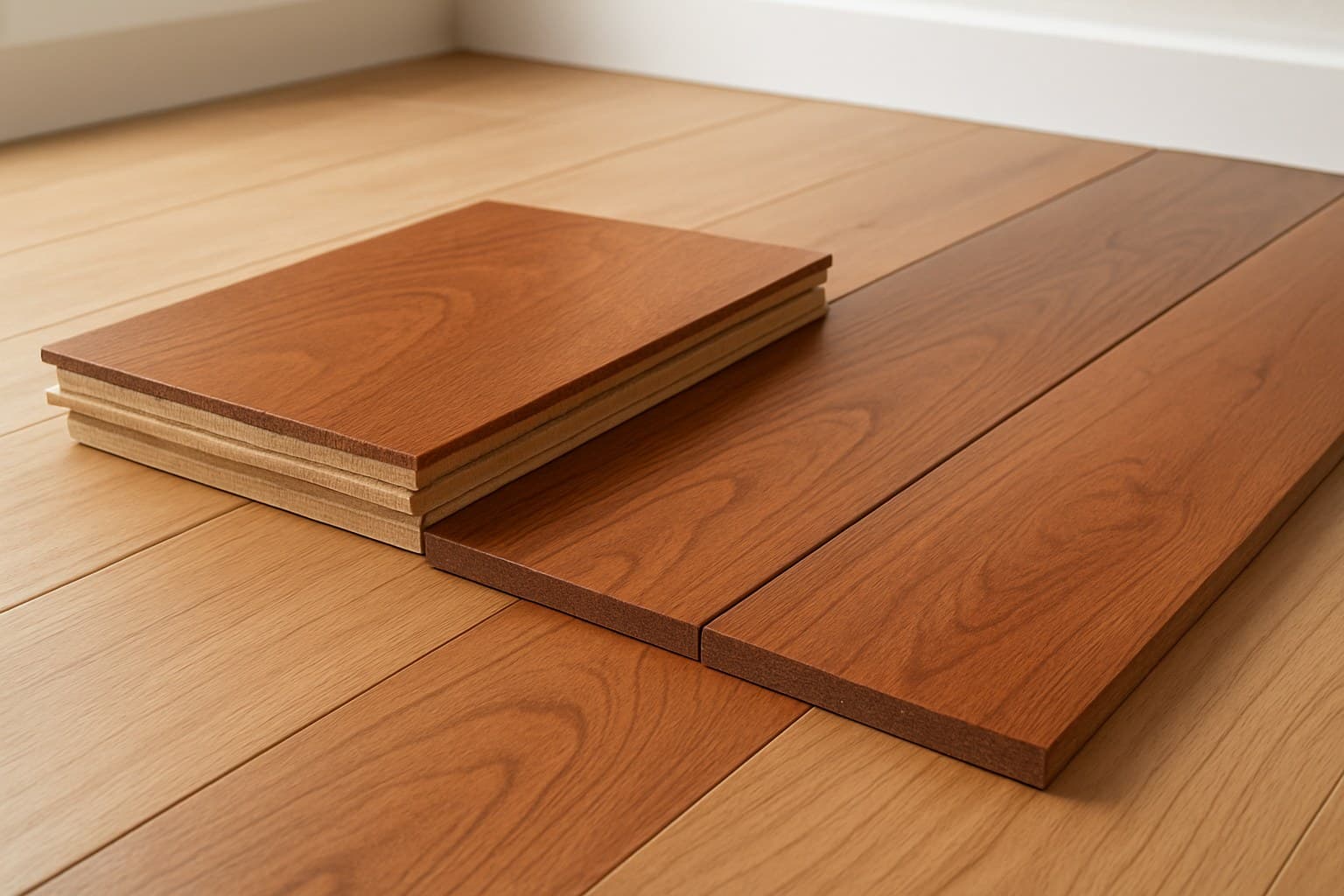
There's no single number, so ignore any site that gives you one. Split it into material and labor. Solid cherry material runs around $5 to $10 per square foot, engineered around $4 to $9, and Brazilian cherry higher at roughly $6 to $12. Install labor runs about $3 to $6 per square foot, and if you buy unfinished wood, site sanding and finishing adds roughly $3 to $5 more.
| Item | Low ($/sq ft) | High ($/sq ft) |
|---|---|---|
| Site sand & finish (labor) | 3 | 5 |
| Install labor | 3 | 6 |
| Engineered cherry (material) | 4 | 9 |
| Solid cherry (material) | 5 | 10 |
| Brazilian cherry (material) | 6 | 12 |
Per-square-foot cost ranges for cherry flooring, blue bars are material and red bars are labor.
Two things move the price beyond these ranges. Stairs cost more per foot because every tread is cut and fit by hand, and basements cost more than open rooms because of the extra moisture prep and transitions a slab demands. I used to quote flat rate by the square foot until a remodel for the Alvarez family in Peoria, full of closets, doorways, and a bay window, ate a whole extra day. The open middle of a room is never where the time goes, so count the cut-heavy areas separately.
For whole-house math and square-footage tables, work through our 500 to 2,500 sq ft hardwood cost guide and the deeper hardwood pricing breakdown by cost factor instead of trying to size it from these per-foot bands alone.
Best Rooms for Cherry, and Where to Skip It
Cherry does well in calm, dry rooms and struggles anywhere with grit and water. That single rule answers the softness fear better than any hardness number.
Put it in formal living rooms, dining rooms, bedrooms, and offices. These rooms see light traffic, so the soft surface stays clean-looking and the color has room to show off. Watch chair casters in an office, since rolling wheels chew a soft floor over time.
Skip kitchens, entries, and mudrooms. Dropped cans, tracked-in sand, and splashes near a sink are exactly what dents and wears cherry fastest. Treat sunrooms or big south-facing windows as the danger zone for fading, not just wear. That's where the color shifts fastest and most unevenly, and it's only worth it if you add UV-blocking film or shades and rotate anything sitting on the floor.
Whatever room you land on, the floor only lasts as long as the prep under it. Per NWFA installation guidelines, the subfloor has to be flat and dry before any cherry goes down, and moisture should be verified with a meter, a handheld tool that reads how wet the wood or slab is. Skip that and the maker's warranty stops covering you outright, no matter how nice the planks are. Our step-by-step hardwood install guide walks through the flatness and moisture checks in order, which is the useful next read before you buy a single box.
Everyday Cleaning and Maintenance
Beyond protecting the color, cherry needs the same basic care every soft hardwood does, just followed a little more strictly. Sweep or dust-mop it regularly, and if you vacuum, use the bare-floor setting or a soft-brush head, a spinning beater bar scuffs the finish and, over years, that scuffing telegraphs into the wood underneath. Wipe up spills right away; cherry's softness makes it easy to dent, but standing water is the bigger long-term threat, since it works into the seams between boards and causes cupping well before it does anything to the color. Clean with a product labeled safe for finished wood floors, a pH-neutral hardwood cleaner applied lightly with a microfiber mop is the safe default. Skip vinegar, ammonia, oil soaps, wax-based polishes, and steam mops, all of them either dull a factory or site-applied finish or push moisture down into the seams. Felt pads under furniture legs and a mat at each entry point cut down on the grit that scratches a soft floor fastest, and they pair with the rug-rotation and UV-film habits above rather than replacing them.