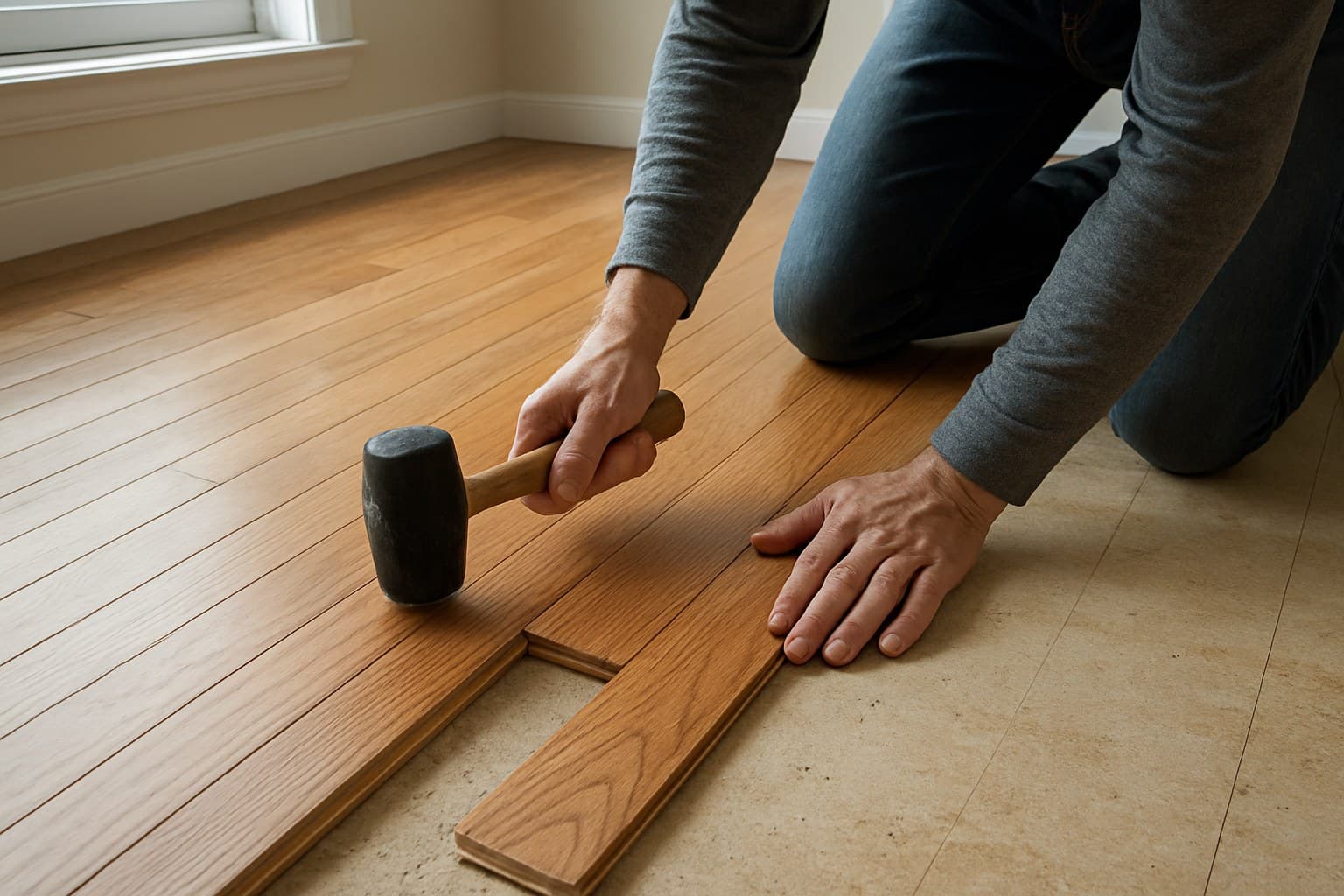
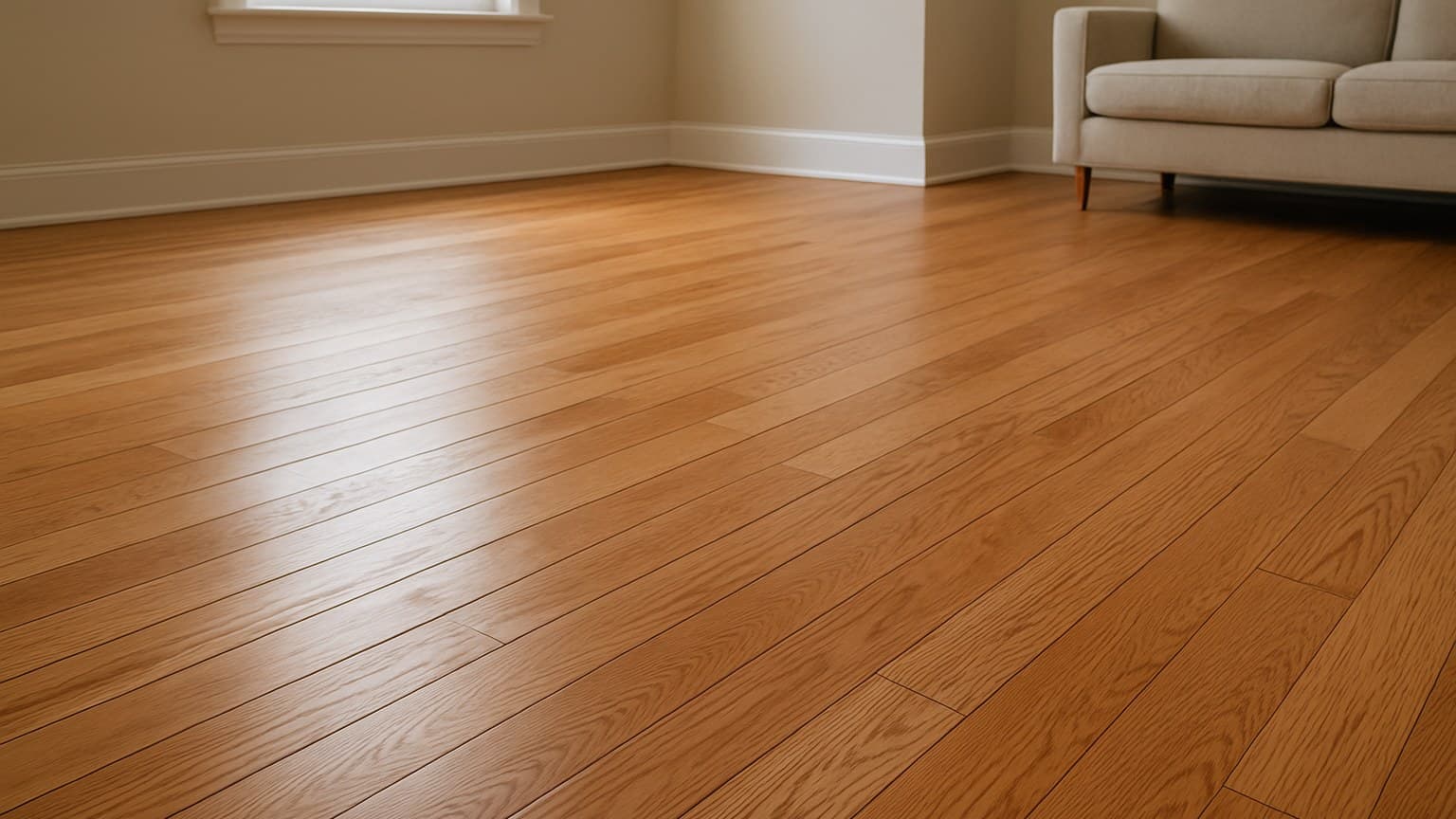
I floored a 1960s brick ranch in Columbus where the owners had priced white oak and nearly gave up on real wood over the cost. We laid red oak instead, and a year later, with two dogs in the house, they couldn't tell the difference. That's the verdict: red oak is the value oak white oak's rising price created, but only if you nail four choices under the species: grade, plank width, solid versus engineered, and finish. Miss one and you pay for it in seasonal gapping, scuffs, or a floor that fights the room.
Key takeaways
- Red oak sits at 1290 on the Janka hardness scale versus white oak's 1360, a gap too small to feel underfoot but big enough to show up in the price.
- Four choices decide your floor: grade (Select & Better vs Character), plank width (2¼" to about 7"), solid vs engineered, and the finish.
- Expect roughly $3-7 per sq ft for the material and another $3-6 per sq ft for nail-down labor, before stairs or a basement push it higher.
- Factory aluminum-oxide prefinished floors are harder and faster to install than site-finished, but the seams sit slightly open and can't be sanded dead flat.
- Choose engineered over solid when you're going over concrete or below grade; solid ¾" red oak is fine on a wood subfloor above grade.
The Honest Verdict: Red Oak Is the Value Oak White Oak Priced You Out Of
In a 1960s brick ranch I floored in Columbus back in the spring of 2019, the owners had already priced white oak and were half a step from giving up on real wood over the number. We laid red oak in the same natural finish instead, and when I went back to walk the floor with them a year later, they could not tell you why anyone pays the white oak premium in a house with two dogs.
That is the honest call: as white oak prices climbed, red oak became the value pick that still wears like a workhorse in a lived-in house.
But the species is only the start. The buy really comes down to four choices you have to nail before you pay: the grade, the plank width, solid versus engineered, and the finish. Get those right and red oak carries the room. Get them wrong and no species saves you.
On toughness, red oak sits at 1290 on the Janka scale, the standard test that measures how well a wood resists scratches and dents. White oak is 1360. That's a real gap on paper, but it's not one you feel walking across the floor. If your decision is mostly about money over time, the long-run cost of hardwood flooring per year is worth reading alongside this.
Choice 1: The Grade (Select & Better vs Character vs Choice)
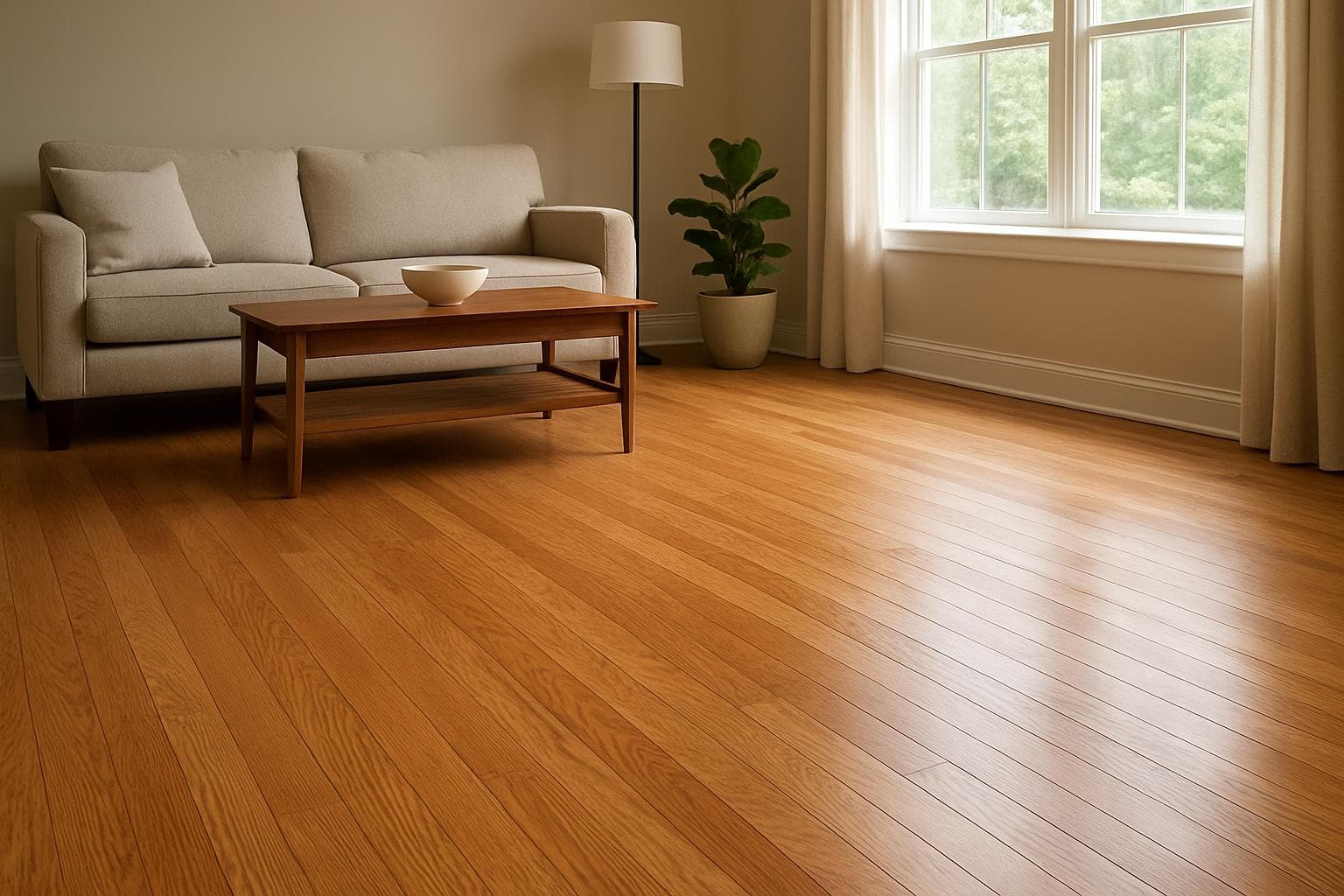
Grade sells you a look, not a quality tier. A lower grade is not a defective floor. It just shows more of the tree.
Select & Better is the clean, light, uniform one, with few knots and longer average boards. Character grade, also sold as #1 Common, shows knots, swings in color, and mineral streaks, which are the dark natural lines that run through the grain. It also comes in shorter boards, so you handle more pieces.
Those board-length and appearance rules come from the NWFA/NOFMA Factory-Finished Flooring Grading Standards, co-published by the National Wood Flooring Association (NWFA) and the National Oak Flooring Manufacturers Association (NOFMA). A lower grade means shorter, busier boards by design, not damaged ones.
Here's the tradeoff I give every customer. Character costs less and hides scuffs, dog nails, and kids far better because the wood is already busy. Select & Better looks formal and even, but it shows every ding you put in it. Choice, or a mixed run, blends the two for the lowest price.
For a formal front room, go Select & Better. For a busy family room or a rustic look, Character earns its keep. Grade is just one of several calls you need to lock in before you order, and the things to settle before buying prefinished hardwood walks through the rest of them in order.
| Grade | Look | Boards | Best for | Price |
|---|---|---|---|---|
| Select & Better | Clean, light, uniform, few knots | Longer average boards | Formal rooms, uniform modern look | Highest of the three |
| Character / #1 Common | Knots, color variation, mineral streaks | Shorter average boards, more pieces | Busy family rooms, rustic look, hides wear | Mid to low |
| Choice / mixed grades | Blend of clean and character boards | Varies by mill run | Budget jobs wanting some variation | Lowest |
Source: NWFA/NOFMA grade definitions
This compares the three common red oak prefinished grades on look, board length, best use, and relative price.
Choice 2: Plank Width (2¼" Strip to 7" Wide Plank)
Width changes both the look and how much the floor moves with the seasons. Narrow reads traditional and behaves itself. Wide reads current and asks more of your subfloor.
The common widths run from 2¼" and 3¼" strip, up through 4" and 5", into 6" and 7" wide plank. Narrow strip is the cheapest per square foot and the most forgiving over a subfloor that isn't dead flat. Wide plank looks modern, but a wider board also swells and shrinks more across its face, so you see more seasonal gapping in a dry winter and a little cupping in a wet summer.
Most homes land in the 4" to 5" middle ground, and that's where I steer people who are unsure.
The real warning is about flatness. The wider you go, the flatter the subfloor has to be first, because a wide plank telegraphs every hump and dip as a rocking board or an open seam. If you're set on the biggest boards, read the wide-plank hardwood flooring breakdown before you order, because that's where prep stops being optional.
Choice 3: Solid vs Engineered Red Oak
Solid ¾" red oak, the thickness standard set out in NOFMA's flooring grading rules, is one single plank of wood, nailed down over a wood subfloor above grade. It sands and refinishes many times, so it can outlive you if you keep it dry.
Engineered red oak is a real red oak wear layer bonded over a plywood-style core. That cross-layered core is far more stable over concrete and below grade, which is exactly where solid wood isn't recommended. The catch is refinishing: the veneer, meaning the thickness of real oak on top, is set by the specific product and caps how many times, if at all, you can sand it. So "can I refinish this later" is a spec-sheet question, not a yes or no you can answer from the species. For a deeper dive into that tradeoff across species, the solid vs. engineered hardwood guide walks through picking the right one room by room.
Radiant heat is the other condition that pushes this choice, and it's not just a basement problem, I've seen it specified on above-grade main floors too. A solid ¾" board fights the repeated heating and cooling cycles a radiant system puts through the subfloor, so it's one of the few cases where I won't run solid even when the room is dry and above grade. Engineered's cross-layered core handles that expansion and contraction far better, but not automatically: check the manufacturer's spec sheet for a radiant-heat rating and stay under the surface temperature limit they list, because pushing past it will crack the wear layer the same as it would split solid.
For any basement or slab job, the decision comes down to the moisture readings, not the label on the box. I learned that the hard way on a slab job for a homeowner in Dayton in the summer of 2021. She talked me out of a moisture test to save an afternoon, and I let her. The floor cupped before the season was out, and I relaid it on my own dime rather than argue about whose call it was. Now the meter, the tool that reads how wet the slab is, comes out first every time. If you're weighing wood over concrete, the engineered options built for moisture are the honest starting point.
Choice 4: The Finish (UV-Cured Aluminum Oxide)
A prefinished factory finish is layers of aluminum oxide, a very hard mineral, cured rock-hard with UV light before the plank ever reaches your house. That's the whole selling point of red oak prefinished hardwood flooring: the tough part is already done. If you're weighing specific factory-finished lines against each other, the things to know before buying Johnson Hardwood is worth a look before you commit to one.
According to NWFA's Homeowner's Handbook to Real Wood Floors, factory-applied finishes are typically harder and more consistent than most finishes brushed on at the job site, and the floor is ready to walk on the day it's laid. No sanding dust in your house, no three days of fumes and staying off the floor.
Here's the catch nobody at the store mentions. Prefinished boards have a small angled groove along each edge called a micro-bevel. It hides tiny height differences between boards, but it also means the seams read slightly open, grit collects in them, and a spot repair is harder than on a site-finished floor you can sand flat and blend. Site-finished floors give you a seamless, sanded-flat surface; prefinished trades that away for speed and a harder coat. Neither wins outright, and the prefinished versus unfinished tradeoff lays out which fits which house.
One rule that matters: any wear rating or "waterproof" claim belongs to a specific product line, not to red oak as a category. Read that product's own sheet before you believe the number.
What Red Oak Prefinished Flooring Actually Costs
Split every quote into two numbers: material and labor. For red oak prefinished, plan on roughly $3 to $7 per square foot for the material, depending on grade and width, and another roughly $3 to $6 per square foot for standard nail-down labor over a wood subfloor. Treat these as rough planning numbers, actual pricing varies by region, retailer, and current lumber markets.
Run it for a real room. A 300 square foot living room works out to about $900 to $2,100 in material plus $900 to $1,800 in labor, so somewhere near $1,800 to $3,900 installed before extras. Character grade and narrow strip pull you toward the low end; wide Select & Better plank pushes you to the top.
Two things blow that range up. Stairs are priced per step, not per square foot, because each tread and riser is slow hand-work. And a basement or slab job costs more than an open main-floor room, because you're usually moving to engineered, running a moisture test, and sometimes adding a subfloor or leveling first. For the full spread by house size, the 500 to 2,500 sq ft hardwood cost breakdown has the room-by-room numbers.
Red Oak vs White Oak vs Engineered Oak: The Comparison
The short version: red oak wins on price and on hiding wear, white oak wins on a cooler, straighter look that takes gray and modern stains, and engineered is the only one of the three you should put over concrete.
Red oak has a pinkish tone and a busy, swirly grain, and that busy grain is exactly why it hides scuffs so well. White oak runs cooler and straighter, which is why it drinks up gray and greige stains that turn muddy on red oak. On hardness they're close, 1290 against 1360, so durability isn't the reason white oak costs more. Supply and demand is. That price gap is the whole case for red oak as the value play.
| Factor | Red oak | White oak | Engineered oak |
|---|---|---|---|
| Janka hardness | 1290 | 1360 | Same as its wear-layer species |
| Grain / tone | Pinkish, busy grain, hides scuffs | Cooler, straighter, takes gray stains | Matches the oak veneer used |
| Over concrete / below grade | Not recommended solid | Not recommended solid | Yes, if moisture checks pass |
| Refinishing | Many times (solid) | Many times (solid) | Limited, set by veneer thickness |
| Relative cost | Value pick | Higher | Varies by wear layer |
This compares red oak, white oak, and engineered oak on the factors that actually change the buy.
Here's where red oak sits against the other woods people cross-shop, on the same Janka scratch-and-dent scale.
Rather than list those hardness numbers again, look at the chart below. It plots red oak against the other woods people cross-shop, walnut, white oak, hard maple, and hickory, on that same Janka scratch-and-dent scale, so you can see exactly where it lands.
Janka hardness of common flooring woods, with red oak highlighted. Drawing is not to scale.
Installing It: DIY or Hire
Nail-down solid red oak isn't the easiest DIY floor. It needs a pneumatic flooring nailer, a rented saw, and a subfloor you've already checked for flatness and moisture before a single board goes down. Skip those checks and the floor tells on you within a season.
I tell most homeowners to hire out solid nail-down, stairs, and any job that crosses from a dry room onto a slab. Those are where a floor goes wrong fastest, and where a pro earns the labor number above. A confident DIYer with a rented nailer can handle a single flat, above-grade room, but a whole main floor is a long weekend that punishes small mistakes.
Either way, the prep is the job. If you want to see what "flat and dry enough" actually means before you commit, the step-by-step hardwood install walkthrough covers the checks in order, so you can judge honestly whether it's your weekend or a pro's. If you'd rather compare finished products first, the best prefinished hardwood lines worth buying is the place to start.