
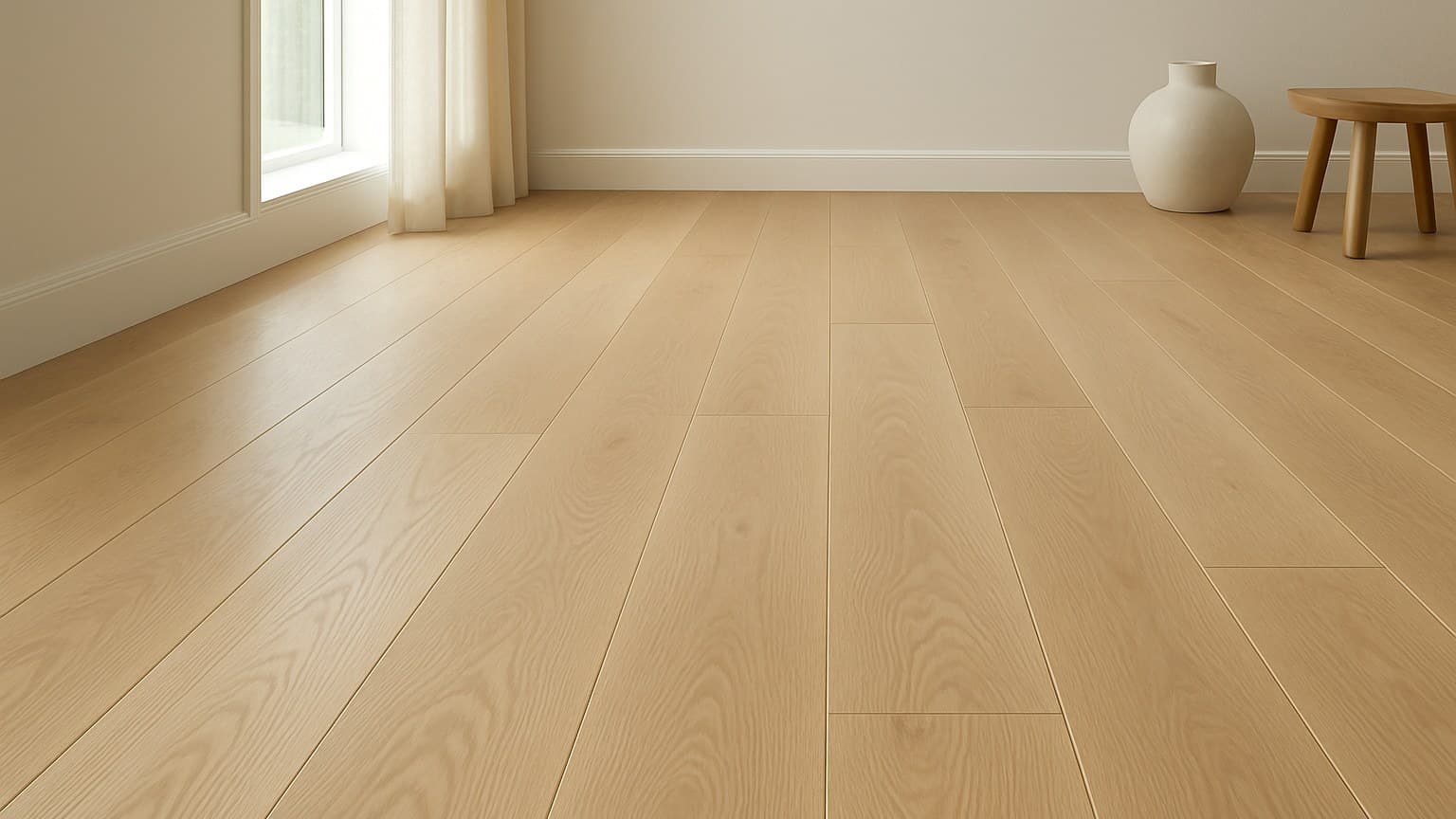
White oak engineered flooring is where I see the most buyer's remorse, and it almost always comes down to wear layer thickness, the slice of real oak on top of the plank that decides how many times you can refinish it before you're buying a new floor instead. No showroom prints that number on the price tag. Two planks can sit on the same rack, one with a 4mm sawn top and one with a 2mm peeled veneer, and perform nothing alike once you get them home. This guide walks through that spec and seven more that decide whether your white oak floor lasts just a few years or several decades. If you want the wider lay of the land before narrowing in on white oak, hardwood flooring guide covers the basics across every species and construction type.
Key takeaways
- Wear layer is the one spec that sets refinish life: a 4mm sawn top like Hurst Hardwoods' 5/8" line sands 2-3 times, while a thin peeled veneer under about 2mm usually sands zero.
- Engineered white oak runs roughly $4.39-$7.85 per sq ft for stock lines and $13-$28 per sq ft custom-milled (Vermont Plank Flooring); the gap is grade, cut, and texture, not just quality.
- White oak rates about 1,360 lbf on the Janka hardness scale, and its cross-stacked core makes it stable over concrete and in basements where solid oak isn't recommended.
- Install labor typically adds a few dollars per square foot, and basement and stair jobs cost more than open rooms.
- Engineered wood is not waterproof: the core is stable, but seams and edges still swell, so treat it as water-resistant at best.
Spec 1: Wear Layer Thickness (The Number Nobody Prints)
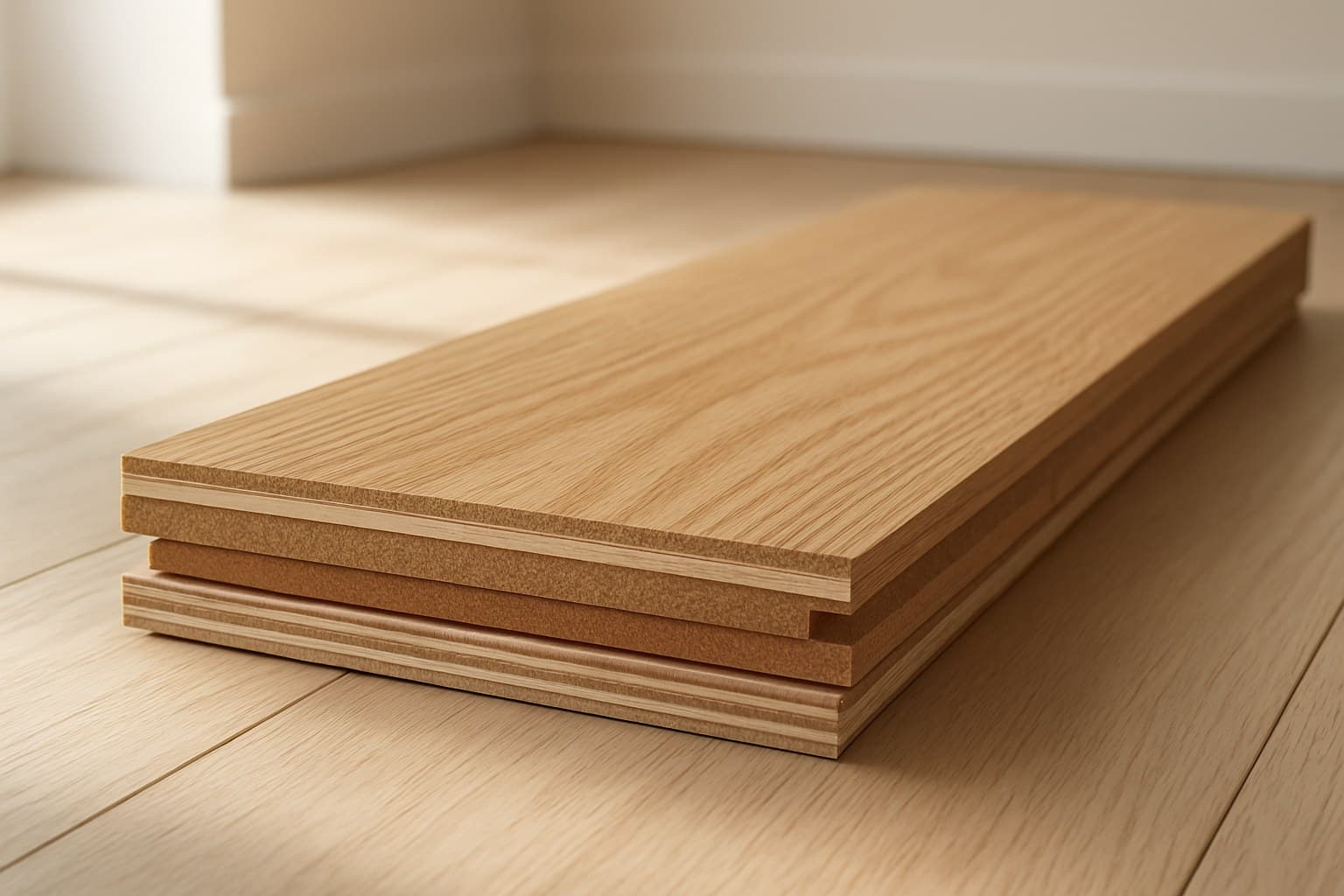
The wear layer is the real white oak on top of the plank, measured in millimeters, and it decides how many times you can sand and refinish the floor. Everything under it is plywood you never see.
A thick sawn top buys you a second life. Hurst Hardwoods lists a 4mm sawn top on its 5/8" engineered white oak, good for 2-3 light sandings. Vermont Plank Flooring goes thicker, citing about a 5.2mm sawn white oak layer.
Go thin and you lose that option entirely. A rotary-peeled veneer at roughly 2mm or less usually sands zero times, so when it wears you replace the floor instead of refinishing it. The best you can do on a thin veneer is a screen-and-recoat, a light buffing of just the finish layer followed by a fresh coat, with no sanding into the wood itself. That freshens the shine for a few years, but it won't fix deep scratches or spots worn through to bare wood. Between those recoats, a dedicated product like Weiman hardwood polish and restorer can keep that thin finish looking fresh without you ever touching sandpaper.
If refinishing down the road matters to you, look for products enrolled in the National Wood Flooring Association (the trade group that writes wood-floor standards) and its Engineered Wood Flooring Refinishable Program, which certifies that the wear layer is thick enough to sand.
| Wear layer | Refinish life |
|---|---|
| ~4 mm sawn (Hurst Hardwoods 5/8" engineered white oak, 9-ply baltic birch core) | 2-3 light sandings |
| ~5.2 mm sawn (Vermont Plank Flooring, birch plywood core) | 2-3+ light sandings |
| Thin peeled veneer, roughly 2 mm or less | 0 (screen-and-recoat only, no sanding) |
Wear layer thickness against how many times each plank can be refinished.
That one number is the difference between a floor you can refinish for decades and one you'll tear out in just a few years, which is also why, per the National Wood Flooring Association's Environmental Product Declaration for engineered wood flooring, the industry models real wood floors on a 75-year functional service-life assumption that depends on the wear layer holding up to repeated refinishing.
Spec 2: Core Construction and Ply Count
The core is the stack of plywood under the oak, and its cross-stacked layers are what make engineered white oak more stable than solid oak. Each ply runs at a right angle to the one above it, so the plank fights the urge to cup or swell.
Cores aren't standardized, so ply count is worth asking about. Hurst Hardwoods builds on a 9-ply baltic birch core, which is stiffer than a thin three- or five-ply birch plywood base. More plies generally means a flatter, quieter floor.
This is the spec that lets engineered oak go where solid oak can't: over concrete and in basements. Early in my career I nailed solid oak down near an open crawlspace in a Dayton rental and never checked what was venting up through it. The whole floor cupped along the outside wall by spring, and I had to pull it. A stable engineered core would have ridden that out. If you're still deciding which construction suits your room, this breakdown of picking solid vs. engineered hardwood walks through the tradeoffs by room and species.
For the full engineered-versus-solid breakdown, see the engineered hardwood guide.
Spec 3: Grade (Select & Better, Character, Clear Oak)
Grade is about looks and price, not durability. A Character-grade floor is not a weaker floor.
Select & Better is clean and uniform, with few knots and even color. Character shows more knots, mineral streaks, and color swing, which many people now want. Clear Oak is the cleanest and the priciest, with almost no knots at all. That knottier, more varied look is essentially what rustic hardwood flooring guide is built around, grade labels aside.
These are defined standards with published grading photos in the National Wood Flooring Association's (NWFA) NOFMA (National Oak Flooring Manufacturers Association) grade-photo reference, not showroom marketing words. Pick the look you like and let your budget sort the rest. The oak flooring guide walks through each grade and the red-versus-white question in more depth.
Spec 4: Cut (Plain Sawn, Rift, Quartersawn)
The cut is how the log was sliced, and it changes both the grain and the price. Plain sawn shows the wavy cathedral grain and costs the least. Rift sawn gives tight, straight lines. Quartersawn adds the flaky ray fleck white oak is known for.
Rift and quartersawn cost more and move less with humidity, so they're standard upgrade offerings on white oak. That's a big reason two planks that look similar on the rack can price differently.
Spec 5: Width and Length (Where Wide Plank Earns Its Price)
Width drives both the look and the subfloor work. Engineered white oak runs from about 4 inches up to 12 inches wide, with lengths reaching 14 feet or more on custom lines like Vermont Plank, so 7-inch and wider boards are common upgrades.
Wide plank costs more per square foot, and it needs a flatter subfloor. A wide board telegraphs every dip under it, where a narrow strip hides the same dip.
Check your floor for flatness before you fall in love with a wide board. Wide plank laid over a wavy subfloor gaps at the ends and squeaks when you walk it. Longer average board lengths also read as more custom and push the price up.
Spec 6: Overall Thickness (5/8" vs 3/4")
Don't confuse overall thickness with wear layer. A 5/8" plank with a 4mm sawn top can refinish more times than a 3/4" plank built over a thin veneer, because only the oak on top ever gets sanded.
Both 5/8" and 3/4" are common thicknesses on engineered white oak like Hurst Hardwoods carries. Overall thickness matters most for how the floor meets your other rooms and clears the bottom of your doors. Judging quality by thickness alone is the mistake the showroom nudges you toward.
Spec 7: Finish Type (Unfinished, Finish-Ready, Prefinished)
There are three ways the plank arrives. Prefinished comes sealed from the factory and you walk on it the day it's laid. Finish-ready is sanded at the mill but you coat it on site. Unfinished is sanded and then finished in your home for a seamless, no-gap look.
The costs stack up from there. Vermont Plank prices finish-ready at about $2 per square foot over unfinished and prefinished at about $6 per square foot over unfinished, with surface textures adding $1 to $5.
The tradeoff is time against looks. Prefinished is faster and the factory aluminum-oxide coat is tough. Site-finished looks seamless because the finish flows across the seams, but it adds days and sanding dust to the job.
Spec 8: Installed Price (Materials vs Labor)
The price spread on engineered white oak is huge, and it comes mostly from grade, cut, width, and texture, not quality alone. Stock lines from Hurst Hardwoods run $4.39 to $7.85 per square foot for the material. Custom-milled white oak from Vermont Plank runs $13 to $28.
Labor typically adds a few dollars per square foot on top. Basements and stairs cost more than an open room, because transitions, moisture prep, and cutting each stair tread eat time.
Be honest about DIY. Click-together engineered planks are realistic for most handy homeowners, but check the subfloor for both flatness and moisture before you start, a flat, dry subfloor is what makes that click-lock seam hold up. Glue-down over concrete, stairs, and big open-plan floors with moisture transitions are where I'd hire it out, since a pro can test for and fix both flatness and moisture problems before any glue goes down.
| Tier | Material | Labor | Installed |
|---|---|---|---|
| Stock engineered (Hurst Hardwoods) | $4.39-$7.85 | $3-$8 | about $7-$16 |
| Custom-milled (Vermont Plank Flooring) | $13-$28 | $3-$8 | about $16-$36 |
Per-square-foot material and labor for engineered white oak, split so you can see where the money goes.
Before you price anything, nail down your square footage with the flooring measuring guide so you're buying the right amount with a waste allowance.