
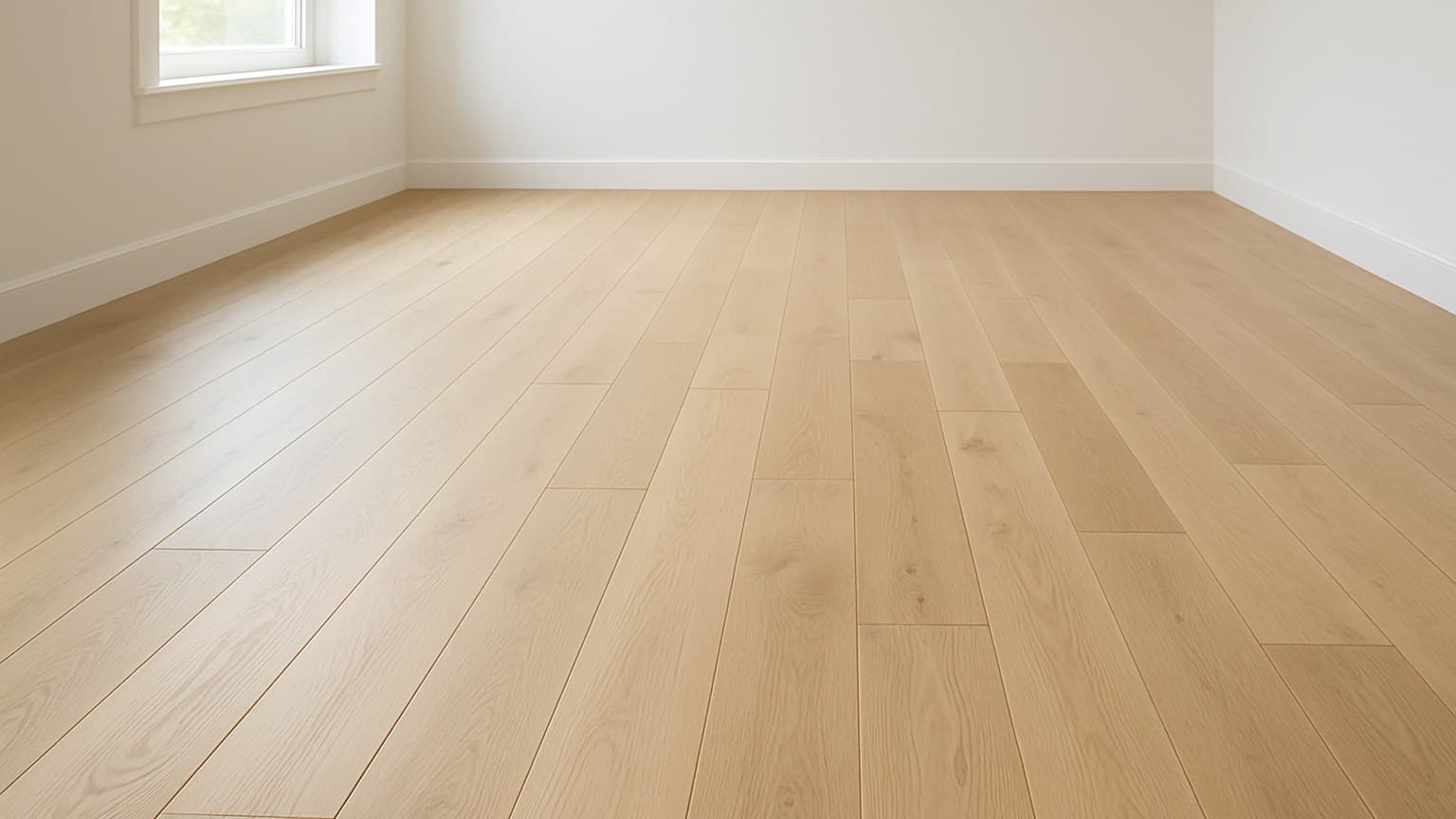
A white oak flooring quote can read $5 a square foot from one shop and $25 from the next, and the sample board in your hand won't tell you which one is fair. Two boards cut from the same log can sit four times apart on price. The reasons hide in three specs nobody points at on the showroom floor. If you're still deciding on a species before zeroing in on oak, the wooden floor guide lays out how different woods and finish colors compare on cost and look.
Key takeaways
- Three things move white oak's price: grade, saw cut, and solid vs engineered construction. The species alone does not explain the $4-$28 gap.
- Materials run about $4-$6/sf for #1 Common plain-sawn strip up to $13-$28/sf for custom-milled wide plank; install labor adds roughly $3-$8/sf, and stairs cost more.
- NWFA/NOFMA oak grades run Clear (cleanest, priciest), then Select & Better, #1 Common (Character), and #2 Common (Cabin).
- White oak (Janka ~1360) handles water better than red oak (~1290) because its pores are closed, which is why it holds up in kitchens.
- Click-lock engineered white oak is realistic for most DIYers; nail-down solid, wide plank, and stairs are usually worth hiring out.
The Three Levers That Set the Price
Three things move a white oak price: the grade (how clean the wood looks), the saw cut (how the board was cut from the log), and the construction (solid or engineered). Finish and plank width stack on top of those. Get those four straight and almost any quote makes sense.
Here's the part the other guides skip: the species isn't the variable. Every board I just described is Quercus alba, the same tree. Yet the installed cost can quadruple depending on how that tree was graded, sawn, and built into a floor.
According to NWFA's "Future of White Oak" industry session, white oak demand has climbed over the last several years, which is part of why the spread looks so wide right now. The cleaner, wider, tighter-grain material gets bid up the most. Part of that shift away from reddish exotics traces back to complaints like the ones covered in why Brazilian cherry floors keep darkening, which pushed a lot of buyers toward oak's more predictable tone.
Every section below is one of those levers. The cost table near the end lets you add your own up.
Grade: What Clear, Select, and Character Really Mean
Grade is about looks, not strength. A knotty board is just as hard as a clean one. The grading comes from the National Wood Flooring Association (NWFA) and its NOFMA standard, short for the National Oak Flooring Manufacturers Association, the old group whose grading rules the industry still uses. Per the NWFA/NOFMA Unfinished Standard and NOFMA's official grade photos, boards are sorted by how much knot, color swing, and mineral streak they carry.
Clear Oak is almost all heartwood with very few knots and even color, so it sits at the top of the price range. Select & Better allows some sapwood and small color shifts. #1 Common, often sold as Character, has visible knots and wider color swing. #2 Common, or Cabin grade, has heavy knots, some splits, and a big color range.
A lower grade isn't lower quality. It's just more character. If you want a rustic floor, #1 Common can be exactly the look you want for a lot less money than Clear.
| Grade | What you see | Typical use |
|---|---|---|
| Clear | Mostly heartwood, very few knots, uniform color | Formal, consistent look; top of the price range |
| Select & Better | Heartwood and some sapwood, small color variation, minimal knots | The most common homeowner choice |
| #1 Common (Character) | Knots, mineral streaks, wider color swing | Rustic look at a lower cost |
| #2 Common (Cabin) | Heavy knots, some splits, big color range | Budget and high-character rustic floors |
Source: NWFA/NOFMA oak grading standards
Grading rules like these set the price tiers you'll see on any quote, which is why the next section breaks that cost down by tier.
Saw Cut: Plain, Rift, Quarter, and Live Sawn
How the board is cut from the log changes the grain look, how much it moves with the seasons, and the price. Plain-sawn is the cheapest and most common cut, and it shows that wavy cathedral grain. Rift-sawn and quarter-sawn give straight, tight lines, but they waste more of the log, so they cost more.
Quarter-sawn also brings out the ray fleck, a shimmery figure across the grain. Live-sawn takes one straight pass through the log, mixes all the patterns, and gives that wide European look with less waste than rift or quartered.
This matters most on a wide plank or over radiant heat. Rift and quartered boards move less across the seasons, so they cup and gap less. I had a homeowner near Dayton crank the heat the day after a wide plank install to "help it settle," and the boards shrank and opened lines across the room that first dry week. On a wide board, the cut you pick is part of what keeps that from happening.
| Cut | Grain look | Seasonal movement | Relative price |
|---|---|---|---|
| Plain-sawn | Wavy cathedral pattern | Moves the most of the four | Lowest |
| Rift-sawn | Straight, tight lines, no flecks | Very stable | Higher (more waste) |
| Quarter-sawn | Straight grain with ray fleck figure | Very stable | Higher (more waste) |
| Live-sawn | A mix of all three patterns | Moderate | Mid (less waste, wide-plank look) |
This table compares the four common saw cuts of white oak by grain look, seasonal movement, and relative price.
Solid vs. Engineered White Oak
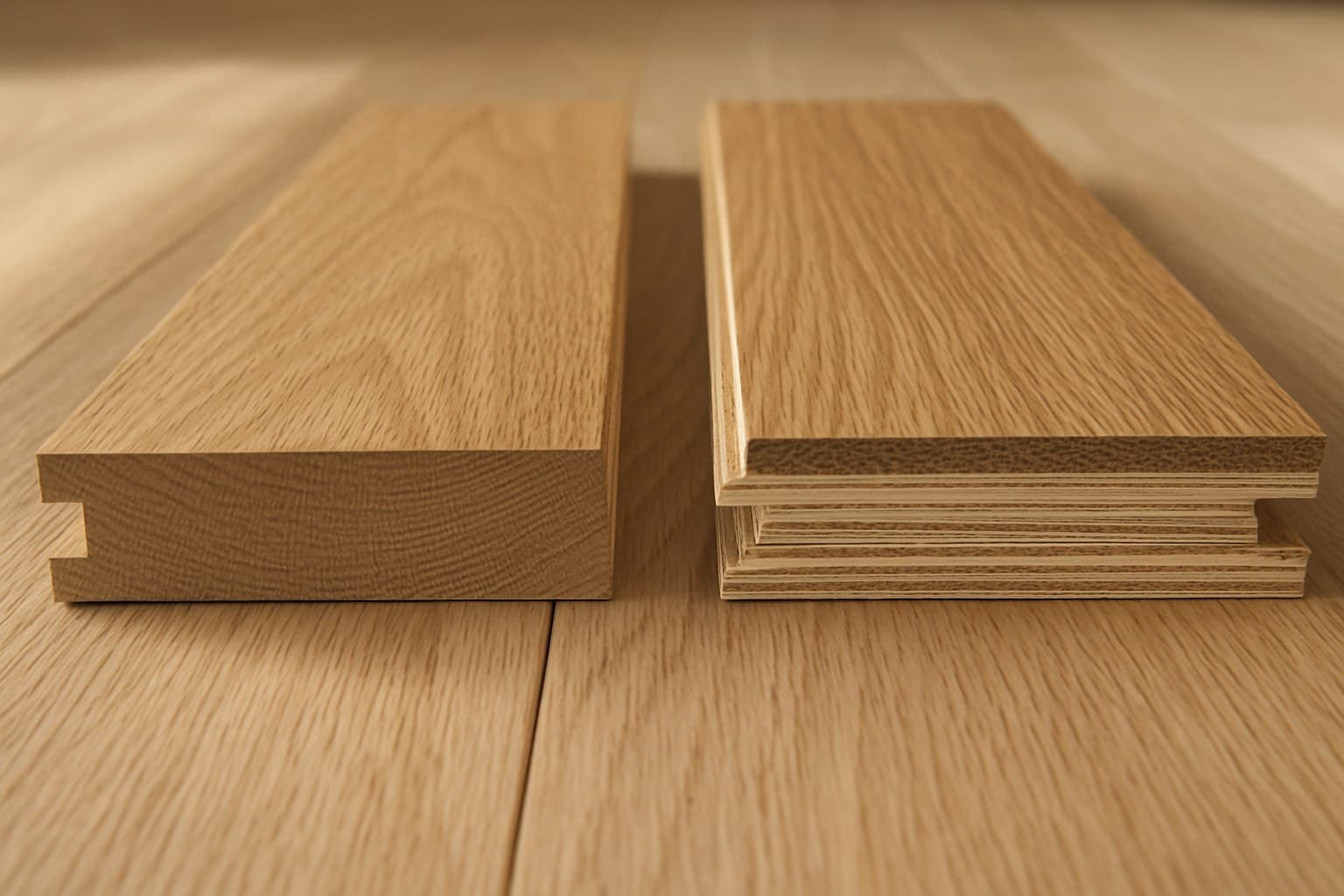
Solid white oak is one piece of oak you can sand many times over its life. Engineered white oak is a real oak veneer over a plywood or HDF core, and it stays flatter over concrete and below grade where solid tends to cup. The right pick depends on where the floor is going. For a fuller walkthrough of that decision, including how to match species to the room, see this solid vs. engineered hardwood flooring guide.
Solid belongs on or above grade over a wood subfloor. Engineered is the call for a slab, a basement, or radiant heat. Before either one goes down over concrete, check the slab for flatness (most makers want it flat within about 3/16" over 10 feet) and run a moisture test on it. Skip that and the flattest, priciest oak in the world will still telegraph every hump and pop its seams.
One thing people get wrong: engineered isn't automatically sandable. Its refinish life is set by the veneer thickness the maker publishes, so "can I sand it later" is a spec question, not a given. To put numbers on that: solid white oak boards are milled at about 3/4" thick (roughly 19mm), which is what gives a solid floor room for several sandings over the decades. Engineered boards vary a lot more, the wear layer, the real oak skin on top of the core, commonly runs from about 1.5mm up to 6mm. The 2mm-to-4mm range (roughly 1/16" to 3/16") is the most common spec on everyday click-lock product, while the better engineered lines built for repeat refinishing use a thicker 5mm-6mm veneer. Anything under 2mm usually tolerates one light screen-and-coat at most, not a real sanding. The spec sheet or box will list this in millimeters, check it before you buy if refinishing down the road matters to you. If that matters to you, the deeper engineered hardwood flooring guide walks through veneer thickness and core types.
On install: click-lock engineered white oak is realistic for most DIYers. Nail-down solid, glue-down, and wide plank are usually worth hiring out, since those are where lippage and gapping show up on a first-timer's floor.
Why the Price Runs $4 to $28 a Square Foot
Stack the three levers and the whole range appears. The floor of it is a #1 Common, plain-sawn, solid strip you finish on site. The ceiling is a custom-milled wide plank, live or quarter-sawn, finish-ready oak. Same species, four times the cost.
| Tier | Materials $/sf | Install labor $/sf |
|---|---|---|
| #1 Common, plain-sawn, solid, unfinished strip | $4-$6 | $3-$5 |
| Select grade, plain-sawn, solid, prefinished | $6-$9 | $4-$6 |
| Rift & quartered or wide plank, Select/Clear | $10-$18 | $5-$8 |
| Custom-milled wide plank, live/quarter-sawn, finish-ready | $13-$28 | $6-$10+ |
This table splits white oak cost into materials and install labor across four common spec tiers. These ranges are approximate and will vary by region, mill, and supplier.
This chart plots the materials-only cost per square foot for each tier as a floating bar from its low to its high price.
Finish changes the material number too. Finish-ready oak adds about $2 a square foot over bare wood, and prefinished adds about $6, because the factory finish and labor are baked in. Texture work like wire-brushing adds another $1-$5.
Labor climbs on stairs, herringbone, and any tricky layout, so a staircase run costs more per square foot than an open bedroom. Before you price anything, work out your real square footage with the flooring quantity guide so you're pricing the right number, plus waste.
White Oak vs. Red Oak
Red oak is the value oak. It usually runs a dollar or two less per square foot than white oak, and it isn't weaker in any way that matters for a normal home floor. If budget is the deciding factor, red oak earns a real look.
The differences are small but real. As NWFA's white oak vs. red oak comparison notes, white oak is a touch harder (Janka around 1360 versus red oak's 1290), and its pores are closed instead of open, which is why it shrugs off water better and holds up in kitchens. The color is the bigger split: white oak reads brown with a greige, slightly gray cast, while red oak carries a pink to red tone.
That tone is a big part of why white oak is getting bid up. It takes the gray, greige, and natural stains people want right now, where red oak's pink fights those same colors. If you lean red oak, the fuller red oak prefinished flooring breakdown covers its grades, widths, and cost in detail.
| Spec | White oak | Red oak |
|---|---|---|
| Janka hardness | ~1360 | ~1290 |
| Color | Brown with a greige, gray cast | Pink to red cast |
| Pores | Closed (better water resistance) | Open |
| Typical price | $1-$2/sf more | $1-$2/sf less |
This table compares white oak and red oak on hardness, color, pore structure, and typical price.