
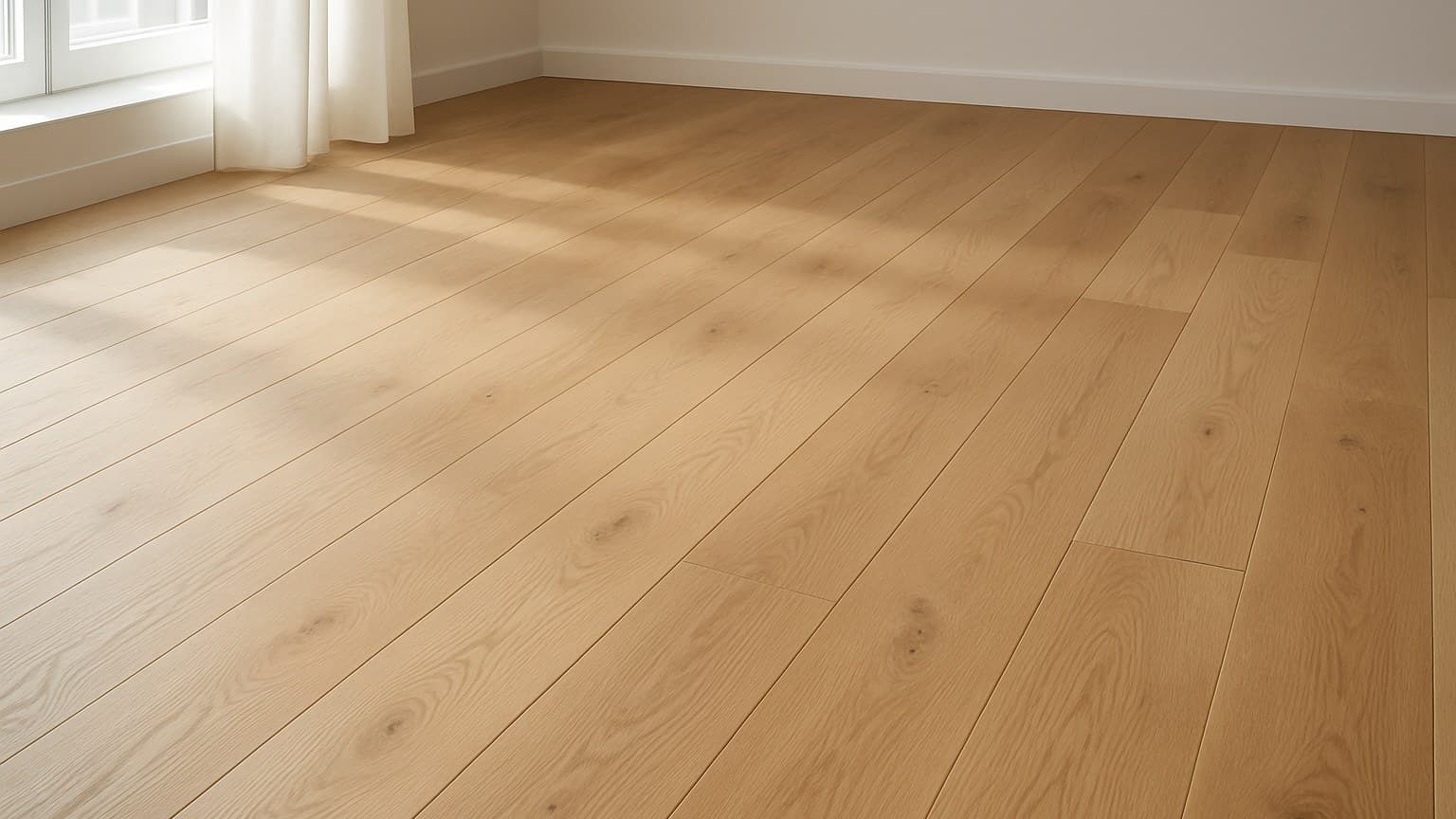
I've watched buyers pick "natural white oak" off a tiny sample, then get a floor that looked nothing like it at home. That single word is covering three separate decisions at once: the species (white oak itself), the finish (stained or left raw), and the grade (how much color and knot variation the boards carry). Mix those up and you end up paying for the wrong color, grade, or price. Here's how each of the three reads on the tag before you order. One more decision that tag won't settle for you is whether to buy solid or engineered boards in the first place, which is its own set of tradeoffs covered in our guide to solid versus engineered hardwood flooring.
Key takeaways
- 'Natural' on a white oak sample means one of three different things: the species (Quercus alba), an unstained or clear finish, or the Natural grade/sort. Check which one before you order.
- Raw white oak is light brown with soft tan and beige tones and a faint olive-gray undertone. It is not white, and it skips the pink cast you get from red oak.
- Unstained white oak ambers, warming to a golden tone, over months and years. An oil-based polyurethane speeds that up; a water-based or UV-cured clear coat slows it.
- White oak's Janka hardness is about 1360 lbf, slightly harder than red oak (around 1290) and more water-friendly because its pores are closed off.
- A Natural or Character sort shows sapwood, color streaks, and small knots. Grade, cut, and solid-vs-engineered all shift the 'natural' look as much as the finish does.
1. "Natural" Is Doing Three Different Jobs on That Sample Tag
A tag that reads "Natural White Oak" is answering three questions at once, and most shoppers only hear one of them. "Natural" can mean the species, the finish, or the grade, and a single sample can be all three in different combinations.
The species part is simple: white oak is the wood itself, Quercus alba. The finish part means the board is unstained or clear-coated, so you see raw wood color instead of a stain. The grade (some sellers call it a sort) is where "Natural" or "Character" signals a board that allows color swing, sapwood, and small knots.
Two floors both labeled "natural white oak" can look completely different and sit two dollars a square foot apart, because one is talking about finish and the other about grade. Before you order, read the tag in three passes: the wood name, the finish word, and the grade name. If you're just starting to compare options at a big-box retailer, our wood flooring colors and buying guide walks through what you'll actually find on the shelves at places like Home Depot.
| Use | What it points to | How to confirm |
|---|---|---|
| The species | White oak, the wood itself (Quercus alba) | Wood name reads "white oak" |
| The finish | Unstained or clear-coated, so you see the raw wood color | Says "natural finish," "unstained," or "clear"; no stain color named |
| The grade/sort | A Natural or Character sort that allows color swing, sapwood, and small knots | Grade name like Natural, Character, or #1 Common |
The three separate meanings the word "natural" carries on a white oak flooring tag.
Once you know which "natural" you're buying, the rest of this list decodes the floor you'll actually get.
2. The Color You Actually Get Is Brown, Not White
Raw natural white oak is light brown. It has soft tan and beige tones with a faint olive-gray undertone, and the one thing it does not have is pink. The name fools people into expecting a pale, whitish board, and that's not what shows up.
That lack of pink is why installers reach for white oak when a buyer wants a cool, modern floor. Red oak, the oak most older homes already have, carries a pink or salmon cast. When you put a gray or greige stain over red oak, that pink keeps fighting through and muddies the color. White oak takes cool grays and light, washed stains cleanly because there's no pink underneath to argue with. Red oak's own pricing swings just as wildly as its color does, with quotes ranging from under $2 to over $20 a square foot depending on grade and finish, a spread the red oak flooring price guide breaks down in detail.
If you want to see how far unstained white oak can be pushed with color, the stain and tone options are worth their own look in white oak hardwood flooring guide. Here, just know the raw starting point: brown with a quiet gray-green undertone, not white.
| Trait | White oak | Red oak |
|---|---|---|
| Base color | Light brown with tan/beige, faint olive-gray undertone | Lighter, with a pink or salmon cast |
| Grain | Straighter, tighter, longer rays | Busier, more open, wilder swirls |
| Janka hardness | ~1360 lbf | ~1290 lbf |
| Water resistance | Better; pores closed off by tyloses | Open pores soak up more |
| Gray/cool stains | Take cleanly, no pink | Pink tends to fight cool colors |
Unstained white oak compared with unstained red oak across the traits buyers weigh most.
3. The Grain Runs Straighter and Tighter Than Red Oak
White oak's grain is calmer than red oak's. The lines run straighter and tighter, and you'll see longer medullary rays, the ribbon-like flecks that stripe across some boards. That fleck pattern shows up strongest on quarter-sawn boards, boards a mill cuts at a steep angle to the tree's growth rings instead of flat across them, which is the more common and cheaper way to cut a log. Red oak by comparison looks busier, with more open pores and wilder swirls.
White oak handles water better than red oak, and it comes down to a word called tyloses. These are tiny natural plugs that seal off the wood's pores. Red oak's pores stay open, so it drinks up spills and moisture faster. That closed-off structure is why white oak shows up in kitchens, entries, and anywhere a wet shoe is likely.
On hardness, white oak runs about 1360 lbf on the Janka scale, the standard test for how well a wood resists denting, a figure the National Wood Flooring Association's (NWFA) own Homeowner's Handbook to Real Wood Floors confirms for the species. That's a touch harder than red oak at roughly 1290 lbf. In plain terms: it still dents under a dropped can or a stiletto heel, but it holds up fine in busy rooms with kids and dogs. For deeper cut-and-grade detail, the oak flooring grades and cuts breakdown goes further than I will here.
| Wood | Janka hardness (lbf) |
|---|---|
| Eastern white pine | 380 |
| American walnut | 1010 |
| Red oak | 1290 |
| White oak | 1360 |
| Hard maple | 1450 |
| Hickory | 1820 |
Janka hardness in pounds-force for six common flooring woods; white oak sits in the comfortable middle. Not to scale.
4. A "Natural" Sort Shows the Sapwood-to-Heartwood Swing
A Natural or Character sort means the boards will not match. Under the NWFA/NOFMA grading standards, appearance grades like Natural, Character, Select, and Clear exist specifically to spell out how much of that color and knot variation a given sort is allowed to carry. This grade mixes heartwood, the darker tan-brown wood from the center of the tree, with sapwood, the paler cream wood that grows near the bark. On a cleaner Select or Clear sort, mills pull most of that swing out. A Natural sort leaves it in.
So board to board, expect real variation. You'll get cream sapwood sitting right next to tan-brown heartwood, mineral streaks running through, small tight knots, and a bit more grain movement than a uniform floor. It reads as a lively, lived-in floor rather than a flat sheet of one color.
That variation is a feature if you want character and a headache if you pictured one even tone across the whole room. Order a larger sample, or a few boards, not a three-inch chip, the real range only shows up across square footage. If the rustic, mixed look is what you're after, rustic hardwood flooring guide walks through how far that character can go.
5. Unstained White Oak Ambers as the Years Go By
Raw, unstained white oak does not stay pale. It warms toward a soft golden tone over months and years, and the change is strongest in rooms that get a lot of sun. The pale blonde board in the showroom is a starting point, not the color you keep.
That slow shift is why the first year or two matters. A rug or a couch that never moves will leave a lighter "shadow" patch, because the wood underneath hasn't caught up with the exposed floor around it. I had a customer over in a sunroom near Dayton who left a big area rug down for a full year, then pulled it for a party and found a pale rectangle sitting in a floor that had gone honey-gold everywhere else. It evened out, but it took a few more months.
This is normal aging, not a defect, and it settles out in the open where light hits evenly. Some species move harder than this. Brazilian cherry, for instance, darkens dramatically, which we dig into in our piece on why Brazilian cherry floors keep getting darker. White oak's drift is gentler and warmer. The simple fix for year one: shift your rugs and furniture around every few months so the floor ages at the same pace.
6. The Finish Decides Whether the Raw Look Survives
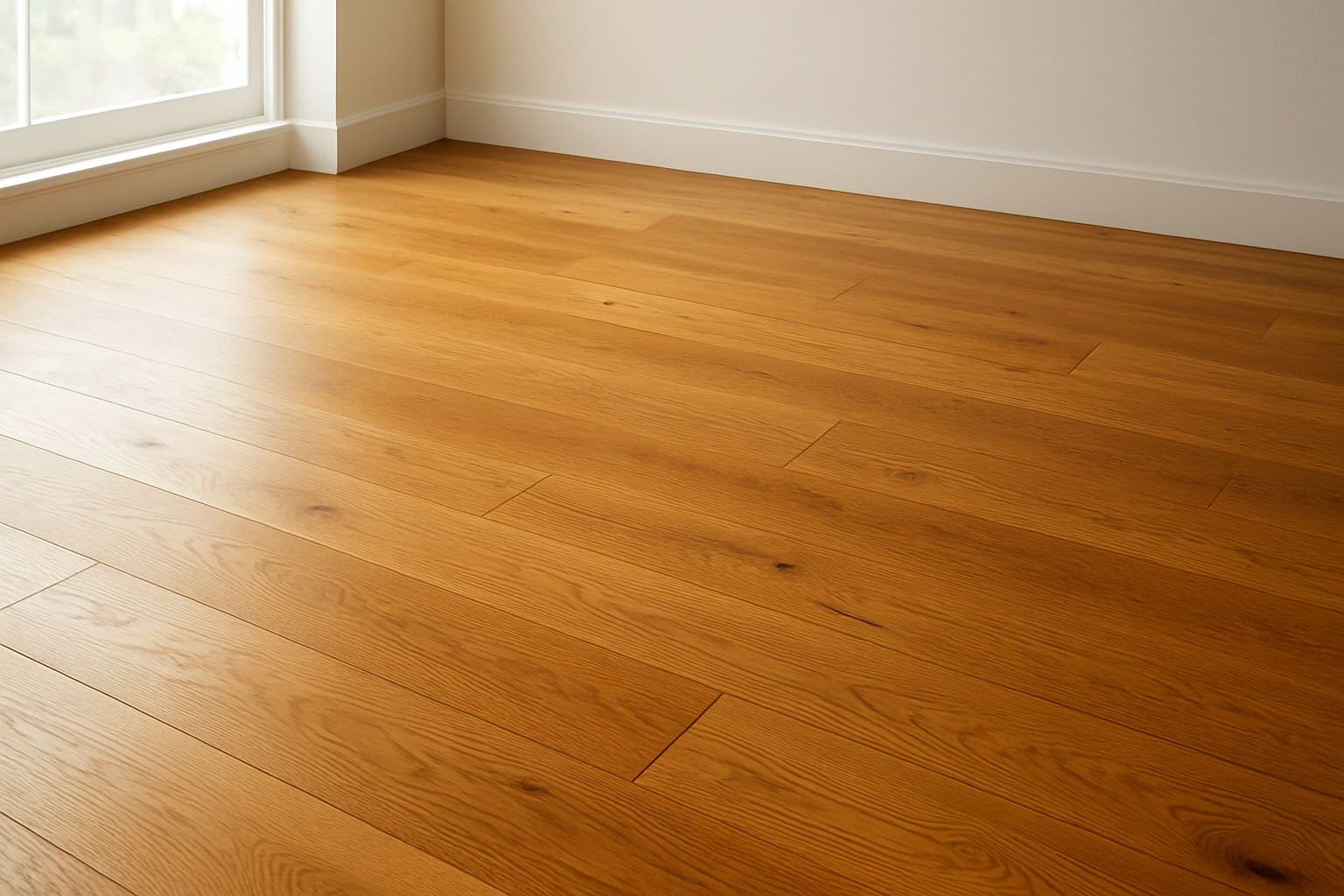
Finish is what locks in, or gives up, that pale raw tone. An oil-based polyurethane adds a yellow-amber cast the day it goes down and keeps deepening it for years. Water-based polyurethane and UV-cured factory clears dry nearly colorless and hold the floor much closer to raw. If you fell in love with the blonde board, the finish is where you win or lose that look.
Some products go further and fight the ambering on purpose. UV inhibitors in certain factory prefinishes slow the warming, and white-pigmented hardwax oils drop a faint white tone into the wood to hold a blonde look. Name the specific product and read its own sheet, because these claims live at the SKU level, not across the whole category.
Before any of this, the subfloor comes first. The floor only lasts as long as the prep under it, and that means two checks, not one. Flatten the subfloor to within the maker's own flatness spec, and run a moisture test on the slab or wood subfloor before a drop of site finish goes down. Skip either and you're inviting cupping, gaps, or a finish that won't bond.
| Finish | Effect on color | Keeps the raw look? |
|---|---|---|
| Oil-based polyurethane | Adds a yellow-amber cast right away, deepens over years | No, warms it |
| Water-based polyurethane | Dries nearly clear, keeps the pale raw tone | Mostly yes |
| UV-cured factory prefinish | Clear and consistent; UV inhibitors slow ambering | Mostly yes |
| Hardwax oil | Low sheen, natural feel; white-pigmented versions fight ambering | Yes, with pigment |
How four common finishes change, or preserve, the raw color of unstained white oak.
On DIY versus hiring out: a factory-prefinished click-lock or nail-down white oak floor is a realistic weekend job for a confident DIYer, since the color and coating are already done. Site-sanding and finishing raw white oak is a different animal, and it's usually worth hiring out, because one bad pass with a drum sander or a blotchy coat shows forever. If you want to stay fully blonde, unfinished white oak deep dive covers the raw-board route in detail.
7. Grade, Cut, and Solid-vs-Engineered Shift the Look as Much as Finish
The finish gets the attention, but grade, cut, and construction change the "natural" look just as much. Cut just means the angle a mill saws the board from the log, and it's one of the distinctions the NWFA/NOFMA grading standards define alongside appearance grade. Plain-sawn, the cheapest and most common cut, slices flat across the log and shows wide, flame-shaped grain. Rift-and-quarter-sawn boards are cut at a steeper angle, which tames that flame pattern into straighter lines and shows more of the fleck grain, but costs more. A plain-sawn Natural sort looks busy and varied; a rift-and-quarter-sawn Select board looks straight and calm, even though both are unstained white oak. Same species, same "natural" label, two very different floors.
Construction matters most for where the floor is going. Solid white oak is one piece of wood, and it belongs on or above ground over a wood subfloor. Engineered white oak has a real white oak veneer over a plywood-style core, which makes it far more stable over concrete and below grade, like a basement. I learned that the hard way early on: I nailed solid oak down near a vented crawlspace without checking what was coming up through it, and the floor cupped along one outside wall by spring. Now I ask what's under the joists before I pick solid or engineered. Engineered hardwood guide spells out that core difference.
Cost tracks all of this, and it splits two ways. White oak sits in the mid-to-upper range for hardwood: figure roughly $5 to $12 per square foot for the material on common solid and engineered lines, plus about $3 to $8 per square foot for professional installation, depending on your area and how much subfloor prep the job needs. Basements and stairs run higher than an open room, because of moisture control, trim-out, and the slow handwork stairs demand. Those are starting ranges to confirm with local quotes, not a fixed price. When you're ready to price your own room, the how much flooring do I need guide helps you nail the square footage before you call for bids.