
Walk into any showroom and half the planks sold as a wooden floor aren't wood at all. The question that sorts the real thing from the convincing copies is simple: is this plank cut from an actual tree, or is it a photo or a slab of plastic wearing a wood costume? Ask that before price, color, or your room ever come up.
I've pulled up enough "hardwood" that turned out to be printed plastic to know the label on the box tells you less than you'd hope. On every job, I figure out what you're actually standing on first, then match it to the room, the moisture, and the budget.
Key takeaways
- The National Wood Flooring Association counts only solid and engineered as real wood; laminate, LVP and bamboo are wood-look, not wood.
- Engineered's plywood-style core holds up over concrete and below grade, where solid hardwood generally isn't recommended.
- Solid hardwood can last a century or more with refinishing; an engineered floor's 3mm-6mm veneer caps how often, if ever, you can sand it.
- Most floating-floor jobs that come back are prep failures, not product failures, so subfloor flatness and a moisture check come before any plank.
- Installed solid hardwood runs roughly $8-15 per square foot, so a 1,000 sq ft floor lands near $8,000-$15,000, with basements and stairs costing more.
Is It Actually Wood? The Question That Sorts Every Floor
Ask one thing: is this made from sawn timber? According to the National Wood Flooring Association (NWFA), the US trade group that writes the standards for wood floors, only two products meet its official definition of real wood flooring: solid hardwood and engineered wood. Both are cut from actual trees.
Everything else in the "wood" aisle is a wood-look. Laminate is a printed photo of wood over a dense fiberboard core. Vinyl and LVP (luxury vinyl plank) are plastic. Bamboo is a grass, not a tree, no matter how hard the finished plank feels.
Why does the label matter past bragging rights? Only real wood can be sanded and refinished when it wears, and only real wood is priced and warrantied as wood. A wood-look can be a smart buy, but you're buying the look, not the board. When that day comes, a rented drum sander and the right grit sequence make a DIY refinish doable, which floor sander rental guide walks through step by step.
So the decision runs in that order. Decide real versus wood-look first. Then match the floor to your room, your moisture, and your budget. The rest of this guide walks that sort.
Solid Hardwood vs Engineered Wood: Both Real, Built Differently
Both are real wood. The difference is how they're built, and that build decides where each one belongs. For the full rundown on species, grades, and how to weigh them against each other, hardwood flooring guide covers it all in one place.
Solid is one piece of wood, usually 5/8 inch to 3/4 inch thick, straight through. Engineered is a thin layer of real wood, often 3mm to 6mm, glued over a plywood-style core.
That core is the whole point. The layered base under engineered stays stable when the air and the slab swing wet and dry, so it holds up over concrete and below grade, like a basement. Solid hardwood generally isn't recommended down there, because a single slab of wood cups and gaps when moisture moves through it.
Refinishing is a spec question, not a yes-or-no. Solid can usually be sanded several times across its life. An engineered floor is capped by its veneer: the maker publishes that thickness, and a thin one may sand once or never. If refinishing for decades is the goal, that number matters more than the brand name. There's more on cores and veneers in engineered hardwood guide.
Radiant heat is the other split-decision, and it comes up on almost every basement or slab job I quote. Engineered wood's cross-layered core handles the steady, mild temperature swings of radiant heat well, which is why it's the common pick over a heated slab. Solid hardwood can sit over radiant heat too, but it's the riskier of the two: a single piece of wood moves more as the heat cycles on and off, so if radiant heat is in the plan, check that specific product's radiant-heat rating before you buy it, not just its species.
| Factor | Solid hardwood | Engineered wood |
|---|---|---|
| What it is | One piece of wood, 5/8"-3/4" thick | Real wood veneer 3mm-6mm over a plywood-style core |
| Over concrete / below grade | Generally not recommended | Yes, the core stays more stable |
| Over radiant heat | Possible, but riskier; check the product's rating | Generally the safer pick |
| Refinishing | Usually several times over its life | Limited by veneer; a thin veneer may sand once or never |
| Lifespan | Many decades, sometimes a century, with refinishing | Decades, depending on veneer thickness |
| Typical install | Nail-down over wood subfloor | Nail, glue, or float |
How the two real-wood types compare on build, location, and lifespan.
The Wood-Look Floors: Laminate, LVP, and Bamboo
These three copy wood without being wood, and each copies it a different way.
Laminate is a high-resolution printed image of wood, sealed under a clear wear layer, sitting on a fiberboard core. It can look convincing, and the better ones read as real wood from standing height. But you can't sand a photo, so when the wear layer goes, the plank goes.
LVP, luxury vinyl plank, is plastic all the way through. That's why it shrugs off water better than wood. But keep two claims apart: a waterproof core is not the same as water-resistant seams. The core can sit in a puddle and not swell, while water still creeps into the edges and under the planks. The LVP failures I'm called back for tend to start at the seams, not the surface.
So what's the tradeoff between the two? Laminate usually gives a more realistic wood look for less money. LVP wins where moisture is the risk: bathrooms, basements, mudrooms. Neither one is a universal pick. If you're weighing wood-look against the real thing, LVP vs hardwood guide breaks the cost and feel down side by side.
Bamboo is the odd one. It's technically a grass, and strand-woven bamboo is genuinely hard underfoot, but it falls outside the NWFA's real-wood definition. It's marketed as a wood-look, so treat it as one.
Styles, Patterns, and Colors: Plank Widths to Herringbone
Once you know what the board is, the look is the fun part, and it's mostly two choices: shape and tone.
Plank widths and patterns
Width sets the feel of the room. Narrow strip (under 3 inches) reads traditional and busy. Wide plank (5 inches and up) reads calm and modern, and shows off the grain, on my last ten wide-plank quotes, seven were white oak, more than any other species. If you're leaning toward that look, wide plank hardwood flooring guide covers how wide you can realistically go and what it demands from your subfloor.
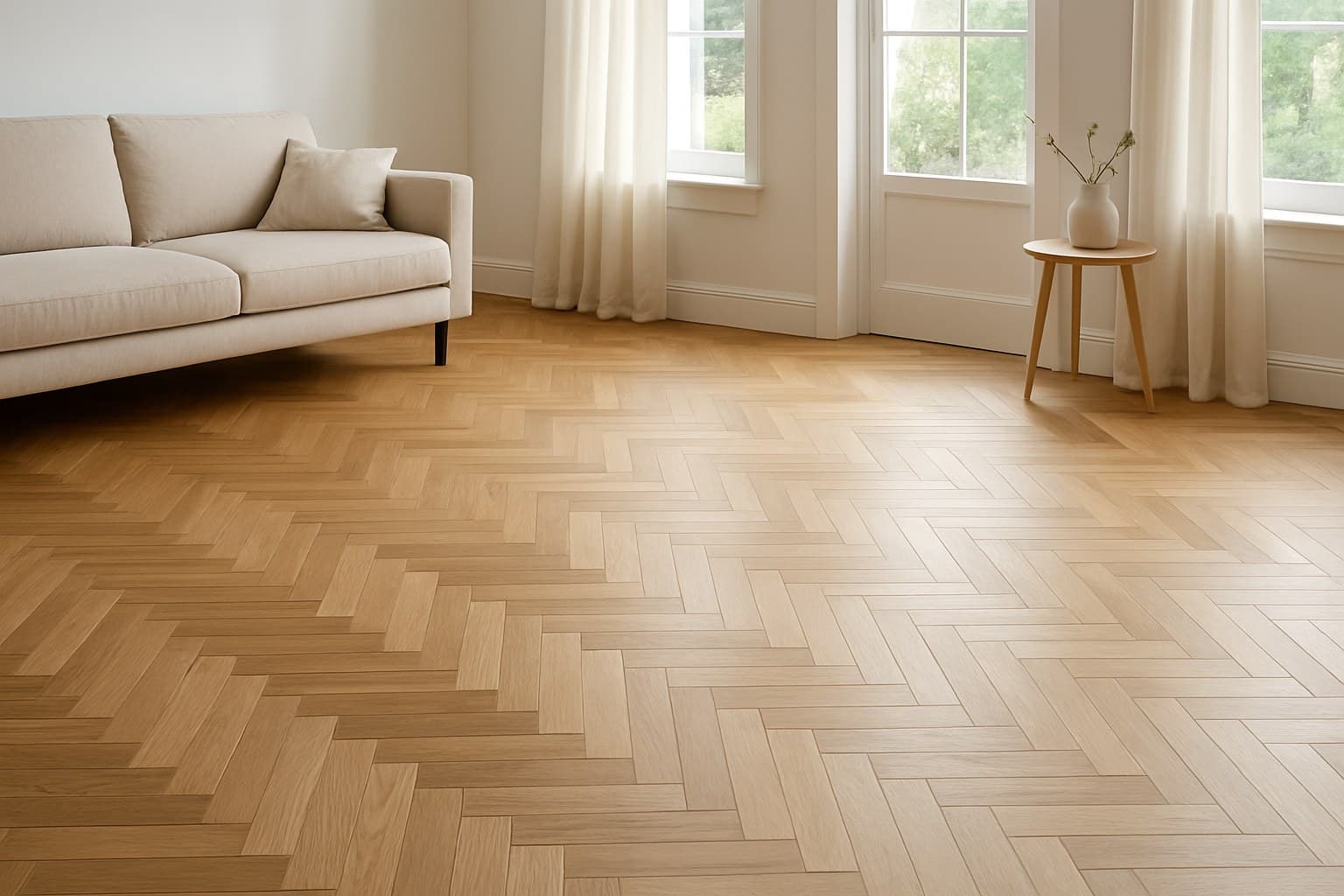
Then there are the named patterns. Parquet is wood laid in a repeating geometric pattern, like squares or baskets. Herringbone and chevron both lay planks in a zigzag, and people mix them up constantly. The plain-word difference: herringbone planks are cut square and staggered so the ends make a broken, stepped line; chevron planks are cut at an angle so they meet point-to-point in a clean, continuous V. Parquet flooring guide covers how each one installs and what it costs to cut.
Colors and tones by species
Color starts with the species, before any stain. Blonde and white oak tones keep a room light and open; white oak also takes gray and natural finishes cleanly, which is covered in white oak flooring guide. For dark rooms, walnut runs a soft brown-gray, and Brazilian cherry runs a deep red that keeps shifting after install, something I get asked about a lot and dig into in why Brazilian cherry floors keep getting darker. If you want full say over that final shade, buying it unfinished and finishing it after install is the way to go, and unfinished white oak hardwood flooring guide covers what that process involves.
Reclaimed and rustic looks aren't a separate material, just a grade and a finish choice. Character grades leave in the knots, streaks, and color swings that cleaner grades sort out, so you get more movement for usually less money.
Why Floating Floors Come Back: Prep, Acclimation, and Moisture
Most homeowners never hear this part: the floating floors that come back as problems are almost never product failures. They're prep failures. The maker's warranty only holds up if you did the prep work right before the first plank went down.
Two checks come before any plank. First, flatness: lay a long straightedge or level across the subfloor and look for humps and hollows. Most instructions give you a flatness tolerance, a maximum gap they allow, and anything past it gets ground down or filled before you lay a board. Second, moisture: take a reading on the slab or subfloor. A dry-looking concrete floor can still push moisture up for months.
Per the NWFA's Installation Guidelines, acclimation means letting the planks sit in the room long enough for the wood's moisture level to match the air before you nail or glue anything down. It's where the internet lies to people. Requirements vary by product. Some ask for days of acclimation in the room, some say it's unnecessary, so the sheet in the box governs, never a rule of thumb you read somewhere. I had a homeowner outside Dayton crank the heat the day after install to "help it settle." The boards dried too fast and opened gaps across the whole living room inside a week. Rushing the humidity is how you buy a floor full of lines by January.
On DIY versus hiring out: click-lock LVP and laminate are realistic for most DIYers, and I tell people to go for it. Nail-down solid hardwood, stairs, and large open-plan spaces with moisture transitions are where I'd hire a pro. Those are the jobs where a small prep mistake turns into a floor-wide redo.
What a Wooden Floor Costs, and Choosing by Room and Budget
Installed, a real wooden floor runs more than a wood-look, and the gap is mostly in the material. Below is the split I quote, materials versus labor, per square foot. These figures come from the quotes and job invoices I write for homeowners around Dayton, Columbus, and Cincinnati, not a published national price list, so read them as a real-world range to check against bids you get locally, not a fixed number.
| Floor | Materials | Labor | Installed |
|---|---|---|---|
| Laminate | $1-3 | $2-4 | $3-7 |
| LVP | $2-4 | $1-3 | $3-7 |
| Engineered wood | $4-9 | $3-4 | $7-13 |
| Solid hardwood | $4-8 | $4-7 | $8-15 |
Installed cost per square foot by floor type; real wood in blue, wood-look in red. Not to scale on a national basis; confirm with local quotes.
How the number moves by room
Those are open-room numbers. Basements and stairs run higher, every time. A basement adds moisture work: a reading, sometimes a barrier, often floor-leveling on a slab that was never meant to be flat. Stairs are slow hand-work, with each tread and riser cut, wrapped, and nosed, so installers price them per step, not per square foot.
Work the math on an open 1,000 square foot main floor in solid hardwood. At $8-15 installed, that's roughly $8,000-$15,000 all in. Split it out and the material is about $4,000-$8,000 and the labor about $4,000-$7,000. Drop to laminate at $3-7 and the same room lands near $3,000-$7,000. That's the spread between real wood and wood-look.
Wood versus tile, at a high level: porcelain tile often lands in a similar installed range to engineered wood, but the labor leans higher because of setting, grout, and prep, while the material can be cheaper. Tile wins on water; wood wins on warmth and refinishing.
So turn the sort into a decision. Basement or anything on concrete: engineered wood or LVP. Dry main floor you want to keep and refinish for decades: solid hardwood. Budget leads and moisture is low: laminate. Match the build to the room and you stop paying for a floor that was never going to survive there. If you want the fuller breakdown of solid versus engineered by species before you commit, our guide on picking solid vs. engineered hardwood floors walks through that choice room by room.
Where to buy it
Big-box shelves and local dealers aren't selling the same thing at two prices. The big-box "hardwood" is often a thinner engineered veneer in a short run of colors, stocked for DIY pickup, with the install subbed out. A local flooring dealer usually carries thicker veneers, more species and grades, and will quote material and labor as one crew that owns the result.
Check three things wherever you buy: the exact species and grade, the veneer thickness if it's engineered, and whether the install is their own crew or a sub. Those three tell you more than the sticker price. If you're torn between a real floor and a look-alike, our LVP vs hardwood guide is a useful next read, since it puts the long-term cost of each against the upfront price.