
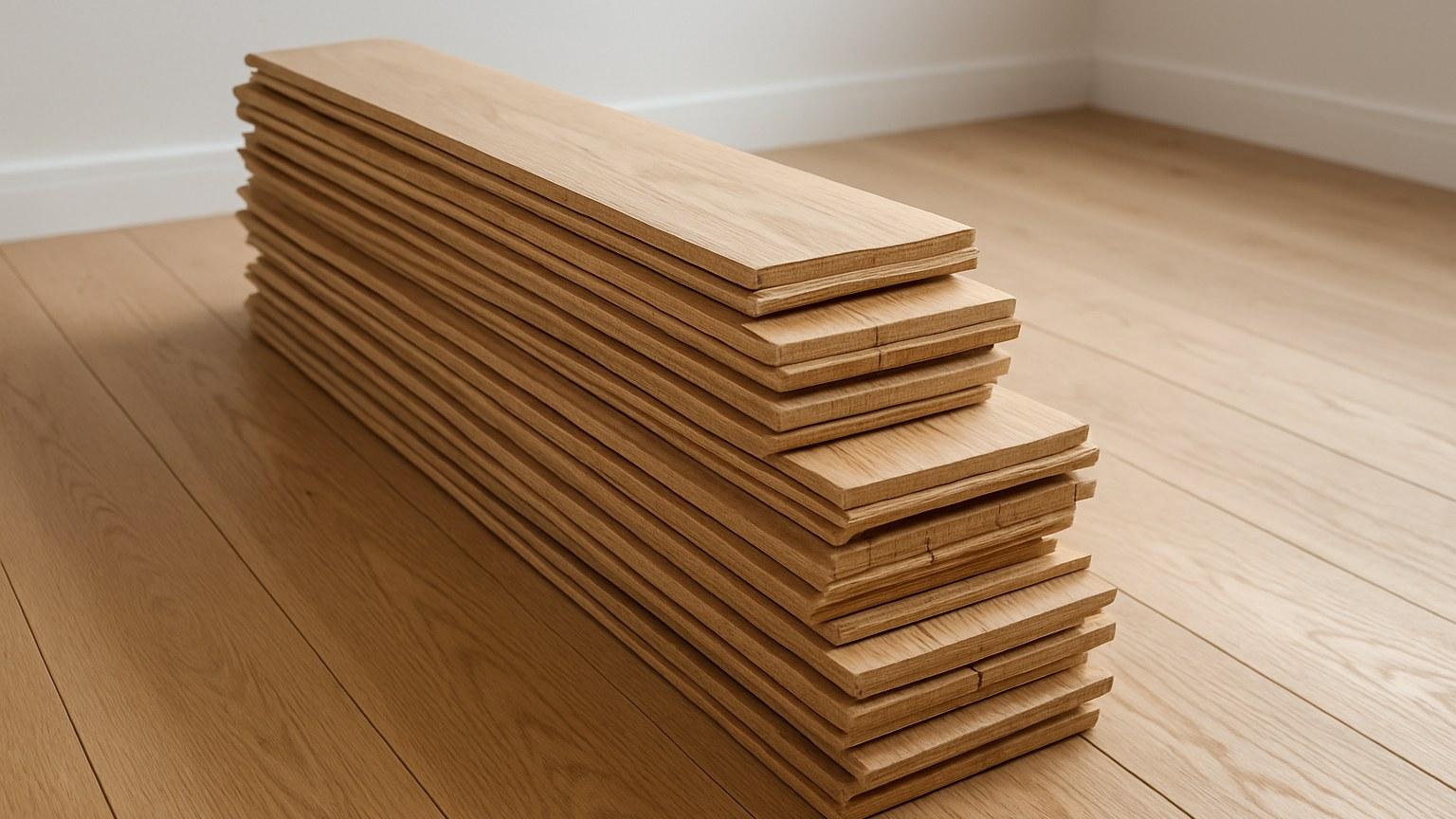
For most homes, an unfinished white oak hardwood flooring order comes down to 3/4-inch solid, #1 Common grade, plain sawn, in a 3-5 inch width - a floor that reads lived-in and sands dead flat without paying for the top grade. The order sheet, though, has five more lines that quietly swing both the look and the price. Read one wrong and you pay for stability or clean grain the room never needed. Getting those five lines right is often what separates a quality oak floor from an overpriced one that looks the same on paper.
Key takeaways
- Grade is an appearance sort, not a strength rating: Select & Better is the cleanest and priciest, #3 Common is the most rustic and cheapest.
- Cut changes look and stability together - plain sawn is cheapest with arched 'cathedral' grain, while rift and quartered run straighter, stay flatter, and cost more.
- 3/4-inch solid white oak can be sanded and refinished many times; it nails down over a wood subfloor and is not meant for below-grade concrete, which is engineered's job.
- Unfinished stock saves on material versus prefinished, but site sanding, staining, and sealing is a separate labor line that can eat the savings.
- Before any board goes down, check subfloor flatness with a straightedge and moisture with a meter - the maker's warranty quietly depends on both.
What "Unfinished" White Oak Means on the Order Sheet (and Why Buy It)
Unfinished means raw wood with no factory coating. You, or your installer, sand, stain, and seal it in place after the boards are nailed down.
The upside is real. You get one continuous sanded surface across the whole floor, a color you mix on site to match the room, and boards that sit flush with your existing floors instead of a tiny beveled groove at every seam. That flush look is why many of my clients who are extending a floor into a new room go unfinished.
The tradeoff is the finishing itself. Site sanding throws dust, eats days, and shows up as a separate labor line on the quote. Cheaper material doesn't always add up to a cheaper floor. Knowing what that sanding-and-finishing process actually involves before the crew shows up makes it a lot easier to judge whether the labor line on your quote is fair.
If you want the floor to show up sealed and ready to walk on, prefinished white oak is the other path. And if you plan to finish it yourself, read up on renting a floor sander before you commit, because the drum sander is where DIY jobs go sideways.
Line 1, The Grade: Select & Better Down to #3 Common
Grade sorts boards by looks, not by strength. A #3 Common board is just as solid underfoot as a Select board; it simply shows more knots, more color swing, and more character.
Pick grade by the look you want and your budget, not by how "good" the wood is. Select & Better reads clean and even, which suits formal, minimal rooms. #1 Common, often sold as Character, brings knots and color variation and fits most lived-in homes. #2 and #3 Common go progressively more rustic and cheaper.
A rustic floor is a grade choice, not a different product. If that busy, knotty look is what you're after, read how rustic hardwood is graded and judged so you buy the character on purpose instead of by accident.
| Grade | Look | Best For | Relative Price |
|---|---|---|---|
| Select & Better | Clean face, few knots, even color | Formal, minimal rooms | Highest |
| #1 Common / Character | Some knots, color variation, small streaks | Most homes, lived-in look | Mid |
| #2 Common | More knots, wider color swing, mineral streaks | Rustic, busy rooms | Lower |
| #3 Common | Heavy character, large knots, sound but rough | Cabins, high-character floors, tight budgets | Lowest |
Source: the NWFA/NOFMA International Standards for Unfinished Solid Wood Flooring
Unfinished white oak grades, sorted by how clean the face reads and how the price moves with it.
Grades follow the NWFA/NOFMA grading standard, so "Select" from one certified mill should match "Select" from another. That matters if you ever need to add to the floor later.
Line 2, The Cut: Plain Sawn, Rift, Quartered, Rift & Quartered
Cut is the angle the log is sawn, and it changes three things at once: the grain pattern you see, how much the board moves with humidity, and the price.
Plain sawn gives the arched "cathedral" figure most people picture in an oak floor. It costs the least and moves the most across a season. Rift runs dead straight and stays the flattest. Quartered adds ray fleck, the short shimmering flakes that run across the board when the medullary rays catch the light. Rift & quartered blends the two straight cuts with no cathedrals.
Straighter cuts hold flatter, which matters most on wide boards and in rooms that bake under dry winter heat. If your furnace runs hard all winter, paying up for rift or quartered buys you fewer gaps come February.
| Cut | Grain | Stability | Relative Price |
|---|---|---|---|
| Plain sawn | Arched "cathedral" figure | Moves most with humidity | Lowest |
| Rift | Straight, uniform lines | Very stable | Highest |
| Quartered | Straight with ray-fleck figure | Very stable | High |
| Rift & quartered | Straight plus fleck, no cathedrals | Stable | High |
| Live sawn | Whole-log mix of all three | Moves more; European look | Varies |
How each saw cut changes an unfinished white oak board's grain, movement, and price.
Live Sawn: The Fifth Cut on Some Order Sheets
Live sawn shows up on European-style order sheets. The mill slices straight through the whole log, so one board can carry cathedral grain down the middle and straight grain at the edges. It gives that wide, old-world look a lot of people chase right now, but because it mixes all three grain directions, it moves more than a clean rift board. Treat it as a look you buy with your eyes open on stability.
Line 3, Width and Length: Strips, Planks, and Long Runs
Width runs from about 1-1/2 inch up to 8 inch. The classic 2-1/4 inch strip is the cheapest and most stable choice. Step up to 5 inch and wider plank and the floor looks fuller, but it moves more and needs tighter moisture control to stay put. If you like that wide-plank look but want a softer wood at a lower price point, wide plank pine flooring is worth comparing before you commit to oak.
Length matters too. Long-length runs cost more because they yield fewer short end-joints and a cleaner, calmer floor. Shorter bundles are cheaper and busier underfoot.
Parquet and herringbone are layout patterns, not a different wood. They use more material and a lot more labor to fit the angles, so budget for both.
Before you order anything over 5 inch, understand how far a wide board really swings across a season. A wide plank that looks great in the showroom can gap or cup in a dry house if the moisture isn't controlled.
Line 4, 3/4-Inch Solid and Kiln-Dried: The Construction Line
3/4-inch solid means one piece of white oak all the way through. Because there's that much wood above the tongue, it can be sanded and refinished many times over its life, which is the main reason people still pay for solid.
Solid white oak nails down over a wood subfloor. It is generally not recommended below grade or straight over concrete, because it moves too much there. That's the job engineered white oak was built for, with its plywood-style core that stays stable over slabs and in basements. If you're still weighing solid against engineered for your specific room, this guide to picking solid vs. engineered hardwood walks through the tradeoffs by species and location.
Kiln-dried means the mill pulled the moisture down for stability. It does not skip acclimation. Whether the boards need to sit in the room first, and for how long, is set by the box's own sheet, not by a rule of thumb you read online.
Line 5, NWFA/NOFMA Certification: What It Actually Guarantees
NWFA stands for the National Wood Flooring Association. NOFMA (National Oak Flooring Manufacturers Association) is the long-running oak flooring grading program the standard grew out of. Together they set the published rules for how unfinished solid wood flooring is graded and milled. Lewis Lumber and Milling is one mill that carries this NWFA/NOFMA certification, so its boards get checked against those same published rules before they ship.
A certified bundle means three things were checked against that published standard: the grade, the moisture content the mill dried to, and the milling itself. Checked milling is why certified boards lock tight end to end instead of leaving you fighting gaps during install.
Not all unfinished stock is certified. Ungraded mill-run can vary board to board, and that variation shows up as bad fit and open joints once it's down.
Don't trust a "Select" sticker on its own. Confirm the grade matches the published standard rather than a seller's own label, that the moisture was dried to the standard's range, that the milling is consistent, and that the maker actually appears on the certified list instead of self-certifying. The box, the invoice, or the maker's spot on the list will tell you.
White Oak vs. Red Oak: Confirm the Species Before You Buy
White oak reads cooler and browner with a tighter grain. Red oak reads pinkish with a busier, more open grain that drinks stain differently. If you've picked a stain color off a white oak sample, red oak will not land the same.
White oak also resists water better. Its cells are plugged with growths called tyloses, which block water from moving through the wood, and it runs a touch harder than red oak. Red oak's advantage is that it's cheaper and easier to find.
| Trait | White Oak | Red Oak |
|---|---|---|
| Color | Cooler, browner | Pinkish, warmer |
| Grain | Tighter, calmer | Busier, more open |
| Water resistance | Better (cells plugged with tyloses) | Less |
| Hardness | A touch harder | Slightly softer |
| Relative price | Higher | Lower |
How unfinished white oak and red oak compare on look, water tolerance, and price.
One more thing: European white oak, sometimes sold as French oak, is a close relative often milled wider and live sawn. It is not the same American species. Pick white oak for a calmer, more water-tolerant floor; pick red oak to stretch the budget on a rustic look.
Before You Lay It: Subfloor, Moisture, and What to DIY
On a solid white oak job, the finished floor only lasts as long as the prep underneath it. The maker's warranty quietly requires subfloor flatness and moisture, not the grade you chose.
Run a straightedge across the subfloor and mark the dips and humps before a single board goes down. Then put a moisture meter on both the subfloor and the oak, and don't nail until the two readings sit close. Leave the expansion gap around the whole perimeter at whatever size the manufacturer's sheet calls for, because that number is theirs to set, not a universal figure.
Nailing down solid strip or plank over a flat wood subfloor is within reach for a patient DIYer. The full step-by-step for installing hardwood walks the method. Site finishing is where I'd recommend most people bring in a professional. Running a drum sander across a whole floor without gouging it, and laying stain evenly so there are no lap marks, takes real reps to get right.
What Unfinished White Oak Costs
Unfinished material almost always costs less per square foot than the same board prefinished. But the site-finishing labor, the sanding, staining, and sealing, is its own line on the quote, and on a smaller room it can eat the savings you got on the material.
The real number splits into two lines on the quote. Material cost moves with grade and cut: a #2 Common plain sawn strip sits far below a Select rift or quartered floor in long lengths. Labor cost moves with the site finishing, since sanding, staining, and sealing a whole floor by hand takes more hours than snapping down a prefinished floor. Add more for stairs or a basement subfloor that needs leveling, because those always cost more than an open room. Ask your mill or installer to show you both lines separately so you can see which one is driving your total.
Scaling the Read-Off to Your Room
Here's the actual math to run once you have both quotes: total cost = (square footage x your material rate) + (square footage x your labor rate). Say you're flooring a 300-square-foot living room. You'd take the mill's price for the grade and cut you picked, multiply it by 300, then take the installer's price for sanding, staining, and sealing, multiply that by 300, and add the two totals together. Bump the grade or cut up a notch and the first number climbs.
Add a basement subfloor that needs leveling or a run of stairs and the second number climbs. Run that same formula at 150 square feet or at 500 square feet and you'll see why two houses with the same white oak order on paper can land at very different final numbers - the square footage is the one constant, but the two rates behind it move with every line on the order sheet above.
One warning on the staining step, learned the hard way. On a refinish in a Dayton two-story, I filled the old board gaps with wood putty before sanding, and the stain soaked in uneven, leaving pale blotches over every patch. Now I tell people the filler and the stain rarely match, so either skip the filling or expect the patchwork to show.