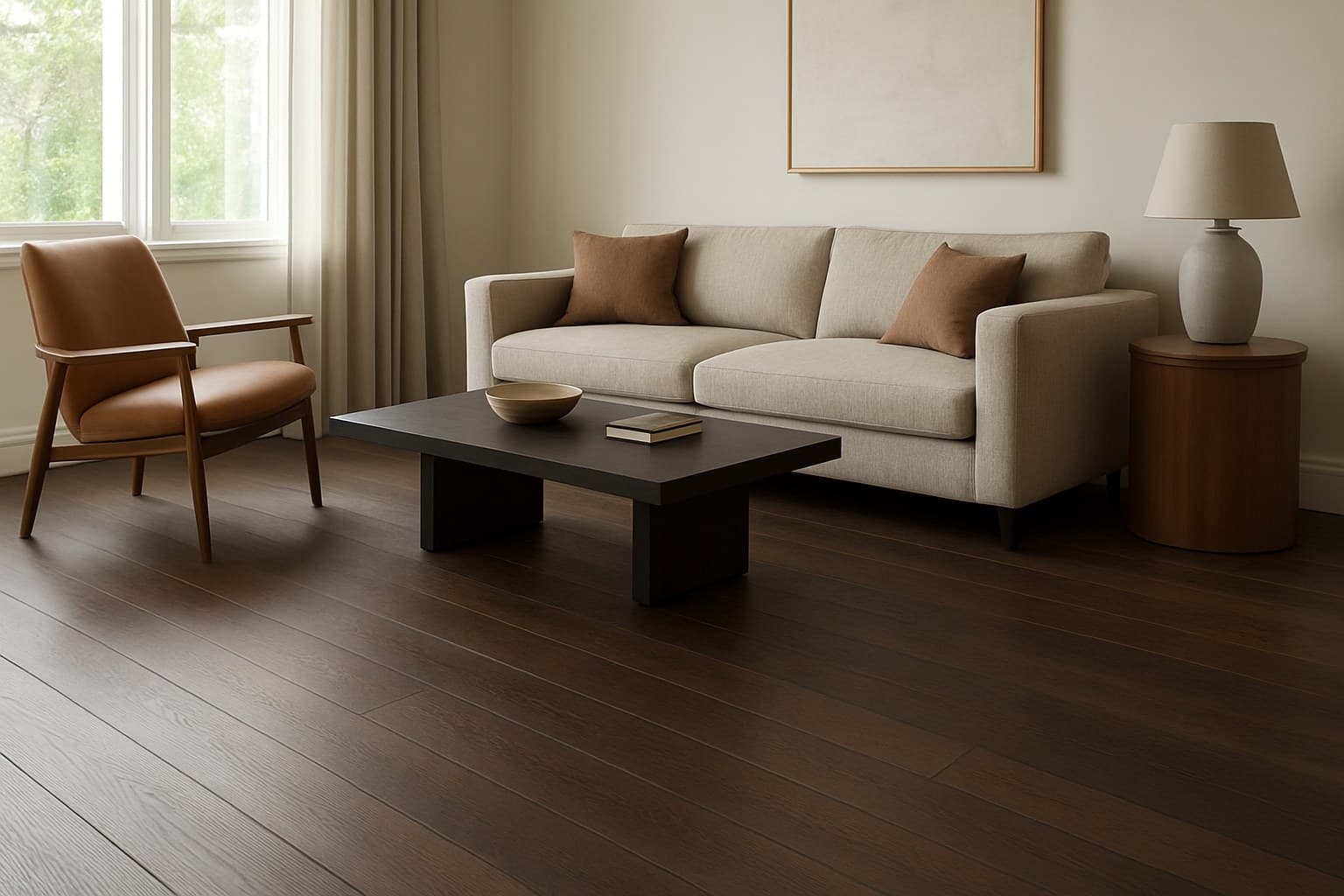
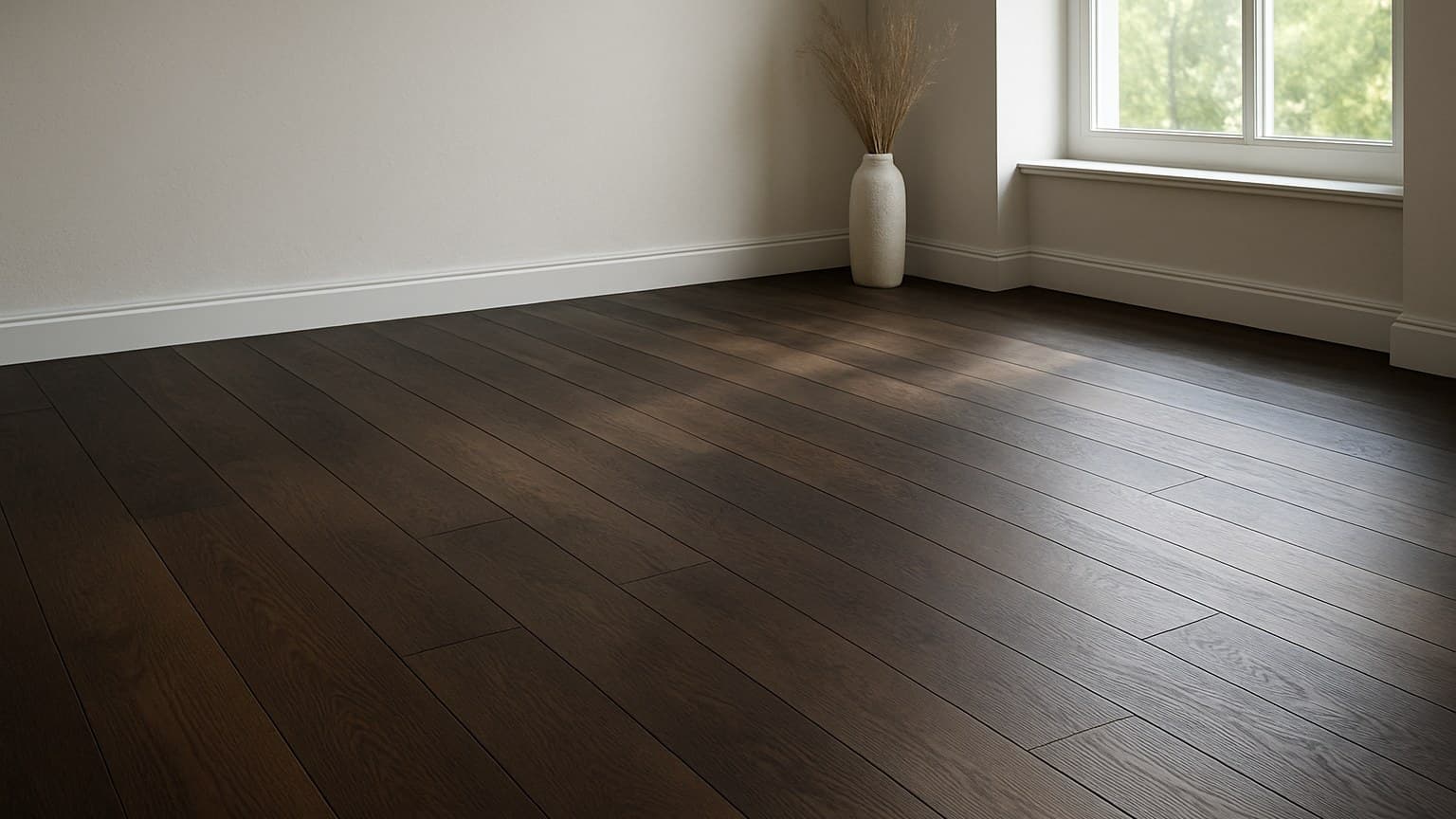
In a rental unit off Route 9 in Manchester, NH, I pulled up a "dark oak" floor for a landlord named Dave and found peel-and-stick vinyl printed over crumbling particleboard. I snapped photos of the delaminating seams before I tore it out, Dave used them to get his money back from the flipper who'd sold him the unit. The listing's words "dark oak flooring" had told him nothing about what he was standing on, and the repair bill proved it. Get the order of decisions right and you won't repeat his mistake.
Key takeaways
- "Dark oak" isn't one product: it's real oak darkened by fuming, smoking, carbonizing, or staining, plus engineered and peel-and-stick lookalikes that only imitate the color.
- Fumed and carbonized color runs deep into the wood, so scratches barely show; a surface stain scratches down to pale raw oak.
- Cost splits roughly to solid oak $5-9 materials plus $3-6 labor per sq ft, engineered $4-9 plus $3-5, and peel-and-stick $1-3 often DIY; basements and stairs run higher than open rooms.
- Clear grade gives the most even dark color; cheaper Common grade can blotch under fuming or stain.
- A matte, wire-brushed finish hides everyday dust and scratches far better than a dark gloss floor.
First, What "Dark Oak" Actually Means
Dark oak isn't one product. It's real oak darkened in one of four ways, plus vinyl and laminate that only print the color on top. The difference between those groups matters more than the shade itself. Before you dive into the darkening methods, it helps to know how oak behaves as a species in the first place, which the guide to oak flooring basics lays out in full.
Here's the jargon product pages throw around without explaining:
- Fumed oak. The wood sits in ammonia, which reacts with the oak's natural tannins (the acids in the grain). The dark color forms below the surface, not on it.
- Smoked oak. A gentler version of the same reaction, usually a softer brown than full fuming.
- Carbonized oak. The board is baked, so the dark tone runs deep through the wood.
- Surface stain, ebonized, or "black oak." A dark dye brushed onto the top. It sits on the surface and nothing more.
Deep color survives sanding and scuffs; surface color doesn't. Scratch a fumed or carbonized board and it still reads dark. Scratch a stained board hard enough and you find pale raw oak grinning back at you.
You can buy any of these prefinished, or buy raw boards and color them in place. If you want full control of the exact shade, on-site work wins, and sanding and finishing unfinished hardwood on site is its own job worth understanding before you commit.
Step 1: Solid, Engineered, or Peel-and-Stick?
Make this call before you fall in love with a color sample. It sets your cost, your lifespan, and whether you can install it yourself. The same discipline applies if you're leaning toward a grayer, weathered look instead of straight dark oak, since picking driftwood oak for each room walks through that decision room by room.
Here's the plain "pick this if" for each:
- Solid dark oak is the forever floor for rooms above ground level that you want to refinish for decades. As NWFA's Homeowner's Handbook to Real Wood Floors notes, solid wood responds to humidity more than engineered wood does, so it moves too much for basements or over concrete.
- Prefinished engineered oak is the safer choice over concrete slabs, in basements, or above heated floors, because its plywood-style core stays put where solid oak swells and shrinks.
- Peel-and-stick vinyl suits renters and tight budgets who need water tolerance in a kitchen or bath, but it trades off a shorter lifespan for that lower price.
- Dark oak laminate gives a more realistic wood grain than vinyl at a similar low price, but standing water at the seams makes it swell, so keep it out of wet rooms.
On DIY: click-lock engineered planks are realistic for most handy homeowners. Glue-down floors, stairs, and big open-plan rooms with moisture transitions are where I'd hire out. A mistake there is expensive to undo. If engineered construction itself is still an open question for you, this breakdown of engineered flooring options covers the layers and where they hold up best.
The catch with the cheap route: peel-and-stick tends to fail at the seams and edges before the printed surface wears out. Water creeps in, corners lift, and the "floor" curls. The plank face isn't the weak point; the joins are.
| Option | Material $/sq ft | Labor $/sq ft | Refinish | Moisture | DIY? | Lifespan |
|---|---|---|---|---|---|---|
| Solid oak (fumed/stained) | $5-9 | $3-6 | 3-5 times | Not below grade | Hire it out | 30+ yrs |
| Prefinished engineered | $4-9 | $3-5 | 0-2 times (thin veneer) | OK over concrete/heat | Click-lock, yes | 20-30 yrs |
| Peel-and-stick faux oak | $1-3 | $0-2 (DIY) | Never | Weak at seams | Yes | 3-8 yrs |
Source: Split from oak-floor quotes I've written for clients, with materials
Materials and labor split for the three dark oak routes, per square foot.
Step 2: Check the Oak Grade (Clear vs. Select)
Oak is sorted by grade before it's ever colored, and grade controls how even a dark floor looks. Product pages almost never print it, so you have to ask.
The grading rules come from the National Wood Flooring Association (NWFA) and the older National Oak Flooring Manufacturers Association (NOFMA) system it grew out of, documented in the NWFA/NOFMA grade photographs and the NWFA/NOFMA unfinished flooring standard. They sort boards by how much color streaking, knots, and mineral marks they carry.
This matters more on dark floors than light ones. Fuming and stain react with the wood's natural streaks and knots, so a busy, cheap grade can blotch, going darker in some spots and patchy in others. A clean grade takes the color evenly.
The trade-off is simple:
- Clear grade costs the most and reads uniform, which is what you want for a smooth, even "double dark" look.
- Common grade costs the least and reads busy, which some folks actually want for a rustic room.
Ask the seller for the grade in writing. "Dark oak" says nothing about it, and two floors at the same price can look completely different once the finish hits.
| Grade | Look | Under dark finish | Relative cost |
|---|---|---|---|
| Clear | Very little color or grain variation, almost no knots | Most uniform; best for a smooth, even dark floor | Highest |
| Select & Better | Some color variation, small knots | Mostly even with a little character | Mid |
| Common (#1/#2) | Heavy color streaks, knots, mineral marks | Rustic; fuming and stain can blotch | Lowest |
Source: NWFA and NOFMA hardwood grading rules
How each oak grade behaves once a dark finish is applied.
What Dark Oak Costs, Installed
Installed, expect roughly $1-5 per square foot for peel-and-stick faux oak, $7-14 for engineered dark oak, and $8-15 for solid dark oak. The materials-versus-labor split behind those totals is in the Step 1 table, so you can see where the money actually goes.
The room changes the number. Basements, stairs, and cut-heavy rooms full of closets, doorways, and bay windows run higher per square foot than an open living room. The labor lives in the cuts, not the open middle. I learned that the hard way quoting flat rate on a job in Bedford, NH, where the homeowner wanted 5-inch wire-brushed engineered French oak run through two bedroom closets and a bay window nook. The bay window alone ate a whole extra day of scribing and coping cuts, and the job ran two full days over what I'd bid on the walkthrough.
Over heated floors or concrete, engineered dark oak is the safer pick because it moves less than solid oak. The product's own install sheet sets the real rules, not a rule of thumb. If you're still weighing which construction type and species suit the rest of the house, this guide to picking solid vs engineered hardwood walks through that decision room by room.
| Option | Total cost, 200 sq ft room |
|---|---|
| Peel-and-stick faux | $200-$1,000 |
| Engineered dark oak | $1,400-$2,800 |
| Solid dark oak | $1,600-$3,000 |
Total installed cost for a typical 200 sq ft room, worked out from the per-square-foot ranges in the chart above, before basement or stair premiums.
If you're weighing wider boards, the way plank size drives both price and gapping is laid out in what wide-plank hickory costs and how much it moves.
Living With Dark Oak: Finish, Dust, Scratches, and Fading
Be honest with yourself first: dark floors show dust, crumbs, and pet hair more than mid-tone floors do, and a glossy dark floor is the worst offender. Light bounces off it and lights up the mess.
The fix is a finish choice. Go matte or oiled instead of gloss, and pick a wire-brushed texture, which means fine grooves brushed into the surface. Together they scatter light instead of reflecting it, so dust and fine scratches nearly disappear between cleanings. Dry dust-mop it rather than wet-mopping every day, put felt pads under every chair leg, and you'll keep it looking sharp with far less work.
One thing product listings gloss over: matte, oiled, and wire-brushed all describe the look, not what's actually protecting the wood. Most prefinished dark oak and engineered planks are sold with a factory-applied polyurethane topcoat, often reinforced with aluminum oxide for extra wear resistance, sprayed on in several thin layers over the stain before the box ever leaves the mill. Site-finished solid oak instead gets that topcoat brushed or rolled on after sanding, usually an oil-modified or waterborne polyurethane, sometimes a hardwax oil if you want the matte look without the plastic-feeling film. The sheen and texture change how the floor looks; the topcoat is what actually keeps heels, grit, and spills from reaching the stained wood underneath, so it's worth asking a seller which one is on the box before you assume "matte" and "durable" mean the same thing.
Fading is the other thing. Dark oak near big windows can lighten or shift color over years of sun, so rotate your rugs to even out the exposure and add UV-cutting film on sun-facing windows in bright rooms.
That slow, uneven color change is the same sunlight-and-oxidation process that makes Brazilian cherry floors darken and blotch over time, and reading how that plays out will tell you what to expect from any deep-toned wood.
What Colors Go With Dark Oak
Warm whites, greige (a warm gray-beige), soft sage green, and warm metals like brass and leather all flatter dark oak. Icy cool-grays fight it and make the room feel cold.
The rule to remember is contrast. A dark floor wants lighter walls and cabinets above it, or the room turns into a cave. White or cream shaker cabinets, a warm off-white on the walls, and brass hardware give you that lift while keeping everything warm.
Where people go wrong is matching a warm brown floor to a blue-gray wall. The undertones clash, and the floor reads muddy. If you love gray, keep it warm and soft, not steel-blue.