
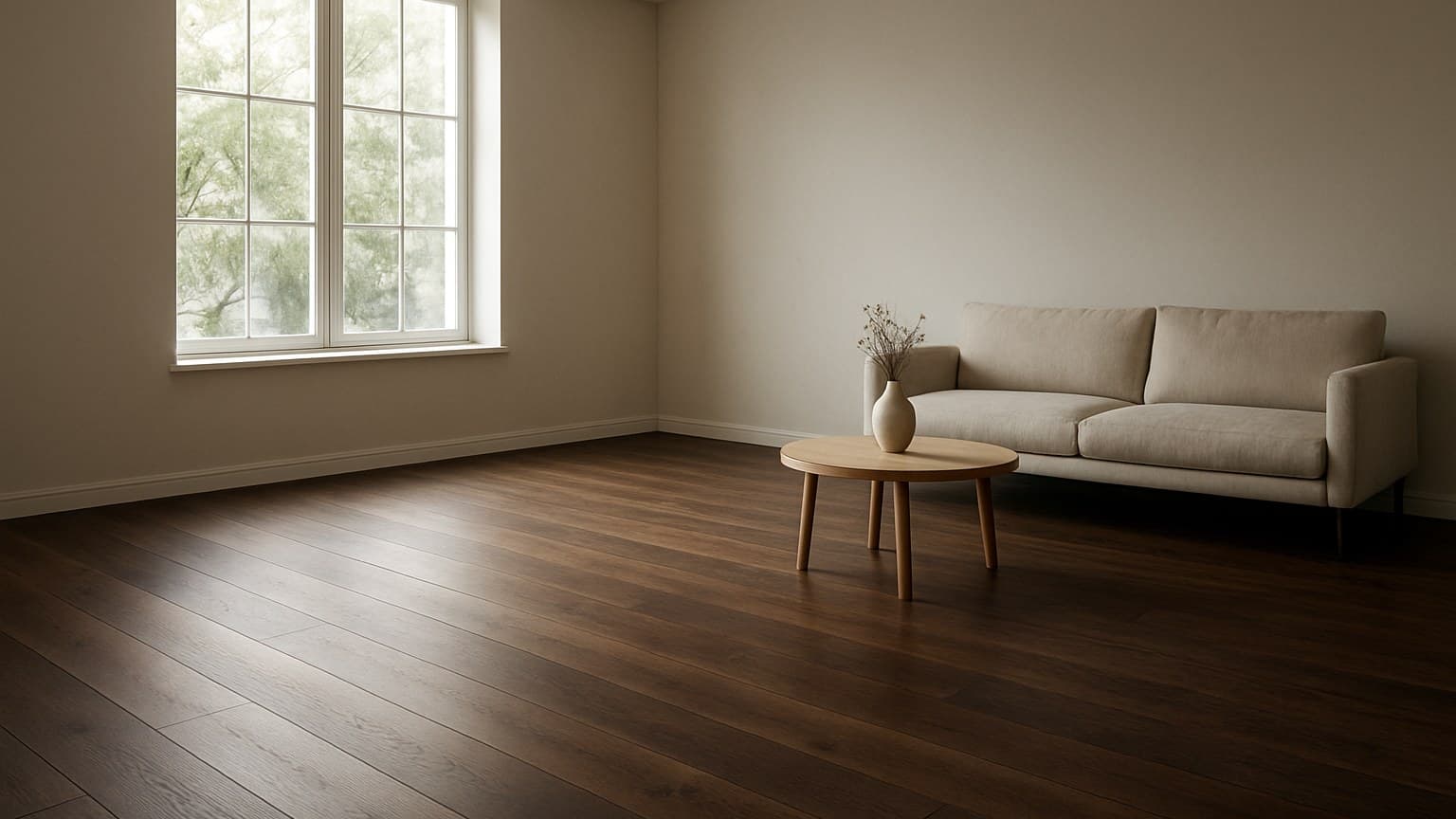
Dark wood flooring splits every review site: one guide swears dark floors hide dirt, the next swears they show every scratch. Both are describing floors I've laid in homes around Dayton, and both are half right. What actually costs you isn't the species you pick, it's the finish: a glossy dark floor broadcasts every scuff, while a matte or hand-scraped one hides them. If you haven't settled on dark yet, it's worth browsing the wider spectrum of options in this guide to wooden floor colors before you lock in a finish.
Key takeaways
- Finish, not species, decides regret: matte and hand-scraped hide scratches and scuffs, while high-gloss on a dark floor shows every one.
- Dark floors hide mud and dirt but show dust, pet hair, and foot smudges, worst on gloss; satin is the safe middle for most homes.
- Naturally dark woods like walnut, jatoba, wenge, and ipe run harder and pricier; oak stained dark is the cheaper, more even path.
- Over concrete or below grade, choose dark engineered hardwood; solid dark wood isn't recommended there.
- Budget materials at roughly $3-12 per sq ft and labor at $3-6 per sq ft for an open room; stairs and basements cost more.
The Dark Floor You Regret Is the Wrong Finish, Not the Wrong Wood
The sheen you pick predicts regret more than the species does. A matte or hand-scraped dark floor hides scuffs; a high-gloss dark floor broadcasts every one of them. Pick the wrong one and no amount of walnut versus oak debate will save you.
That's why the other guides keep contradicting each other. The ones that say dark floors show scratches are describing glossy floors. The ones that say dark tones hide dirt are describing matte and satin. The missing variable between those two camps is the finish, not the color.
Here's the real failure mode. On a dark floor, the thing people hate isn't the scratch count. It's the dust, pet hair, and foot smudges sitting on a shiny surface, catching the light every time the sun comes through. The wood color didn't do that. The sheen did.
Species and stain still matter. They change hardness, price, and how even the color turns out. But they ride underneath the finish decision, not above it. Get the sheen right first, then argue about the wood.
Can a Finish You Regret Be Fixed Later?
Yes, in most cases, but solid and engineered don't play by the same rules. Solid wood floors have enough thickness that they can be sanded down to bare wood and refinished with a different sheen, gloss to matte, scraped to smooth, multiple times over the life of the floor, and sanding also levels out scratches and wear patterns along the way.
Engineered floors are more limited. The dark layer you're walking on is a veneer over a plywood-style core, and how much refinishing it can take depends on how thick that veneer is. A thicker wear layer can usually handle one light sanding and a sheen change; a thin one may only tolerate a light screen-and-recoat, enough to knock gloss down to satin, not enough to strip and start over, and some thin veneers can't be sanded at all.
So the sheen decision isn't permanent on solid wood, but it's worth getting closer to right the first time on engineered, since your second chances are fewer. If you're still weighing solid against engineered for reasons beyond refinishing, it's worth working through the full solid vs. engineered hardwood floors guide before you settle on a species.
Matte vs Satin vs High-Gloss: The One Axis That Predicts Regret
Three sheens, in plain words: matte and hand-scraped have little to no shine, satin has a soft low shine, and high-gloss is close to a mirror. That's the whole scale, and where you land on it decides more than the species ever will.
Score each one on the three things that drive regret: scratch-hiding, how much dust it shows, and how easy it is to keep clean.
| Finish | Hides scratches | Shows dust | Cleaning | Best for |
|---|---|---|---|---|
| Matte / hand-scraped | Best, texture breaks up light | Moderate | Easy, smudges don't catch light | Kids, pets, high traffic |
| Satin (soft shine) | Good | Moderate | Easy | Most homes, the safe middle |
| High-gloss | Worst, every scuff catches light | High | Hard, shows every smudge and footprint | Low-traffic, formal rooms |
Source: comparing how the matte and glossy dark floors I've laid held up to a few years of scuffing
How the three common sheens compare on a dark floor for scratch-hiding, dust, and cleaning.
Hand-scraped and distressed floors hide the most because the texture breaks up the light, so a scratch has nowhere to catch. That's why I steer busy households toward hand-scraped and distressed floors when they've got dogs and a mudroom.
High-gloss on a dark floor is the regret I get called out to look at most. Satin is the safe middle for most homes. If you're torn, go satin and you'll rarely be sorry.
What Makes a Floor Dark: Species and Stain
Two paths get you to a dark floor, and they're not equal. You either buy a wood that's naturally dark, or you take a lighter wood and stain it dark. That choice changes hardness, price, and how even the color turns out.
| Species | Janka hardness | How it gets dark | Note |
|---|---|---|---|
| American Walnut | 1010 | Naturally dark brown | Soft for an exotic, dents easier |
| Jatoba (Brazilian Cherry) | 2350 | Naturally reddish-dark | Very hard, keeps darkening over time |
| Wenge | 1630 | Naturally near-black | Deep brown-black, pricey |
| Ipe (Brazilian Walnut) | 3680 | Naturally dark brown | Extremely hard |
| Red / White Oak | 1290 | Dark by stain | Takes dark stain cleanly, cheapest path |
| Hard Maple | 1450 | Dark by stain | Blotches, pre-stain or go engineered |
| Hickory | 1820 | Dark by stain | Wild grain contrast under stain |
Source: published Janka hardness ratings
Common dark wood species by hardness and whether they're dark by nature or by stain. Janka is the standard dent-resistance score; higher is harder.
Dark by nature: walnut, jatoba, wenge, and ipe
Naturally dark species run darker and often harder, but watch the quirks. American walnut is beautiful and genuinely dark, but it's soft for an exotic and dents easier than people expect. Wenge is near-black and expensive. Ipe is almost indestructible underfoot.
Jatoba, sold as Brazilian cherry, has its own trick: it keeps darkening as light hits it, so the floor you install isn't the floor you'll have in two years. I've watched that catch people off guard, and it's worth reading up on why jatoba keeps darkening before you commit.
Dark by stain: oak, maple, and hickory
Stain is the cheaper road to dark, and red and white oak are the cleanest way to travel it. Oak's open grain drinks a dark stain evenly and costs the least of any dark floor I install.
Maple fights you. It's smooth and tight-grained, so a dark stain goes on blotchy unless the boards are pre-stained at the factory or you buy engineered with the color already set. Hickory takes stain fine but throws wild light-and-dark grain contrast, which some people love and some hate under a dark color.
For context on how many options exist, the National Wood Flooring Association (NWFA), the trade group behind the industry's grading and installation standards, notes in its Homeowner's Handbook to Real Wood Floors that there are "more than 50 domestic and imported species" available. Dark wood hardwood flooring is not a short list.
Dark engineered hardwood flooring over concrete
If your floor sits on a concrete slab or below ground level, go with engineered hardwood, not solid. Engineered's plywood-style core stays stable against the moisture that moves through concrete, and per the NWFA's installation guidelines, solid wood flooring is generally not recommended below grade or directly over concrete.
Before anything goes down there, check two things: that the slab is flat, and that it's dry. I run a moisture test on concrete every time, and I check flatness with a straightedge. Skip either and the best dark floor in the world will cup or gap later.
Does a Dark Floor Make the Room Look Smaller?
Yes, a dark floor can make a room feel smaller, but light walls, light furniture, and good lighting counteract it enough that most people never notice.
The counters are simple. Keep walls and trim light. Drop a lighter rug to break up the expanse of dark floor. Lean on natural light wherever the room gives it to you.
The finish plays in here too. A glossy dark floor reads as dirty rather than small, because it shows every smudge and footprint. A satin or matte sheen keeps the whole room feeling cleaner, which does more for the sense of space than the color alone.
One real upside: dark floors resist visible fading better than light floors. In a sunny south-facing room, that pays off over the years.
Dark Floors by Room and Household: Which Finish for Whom
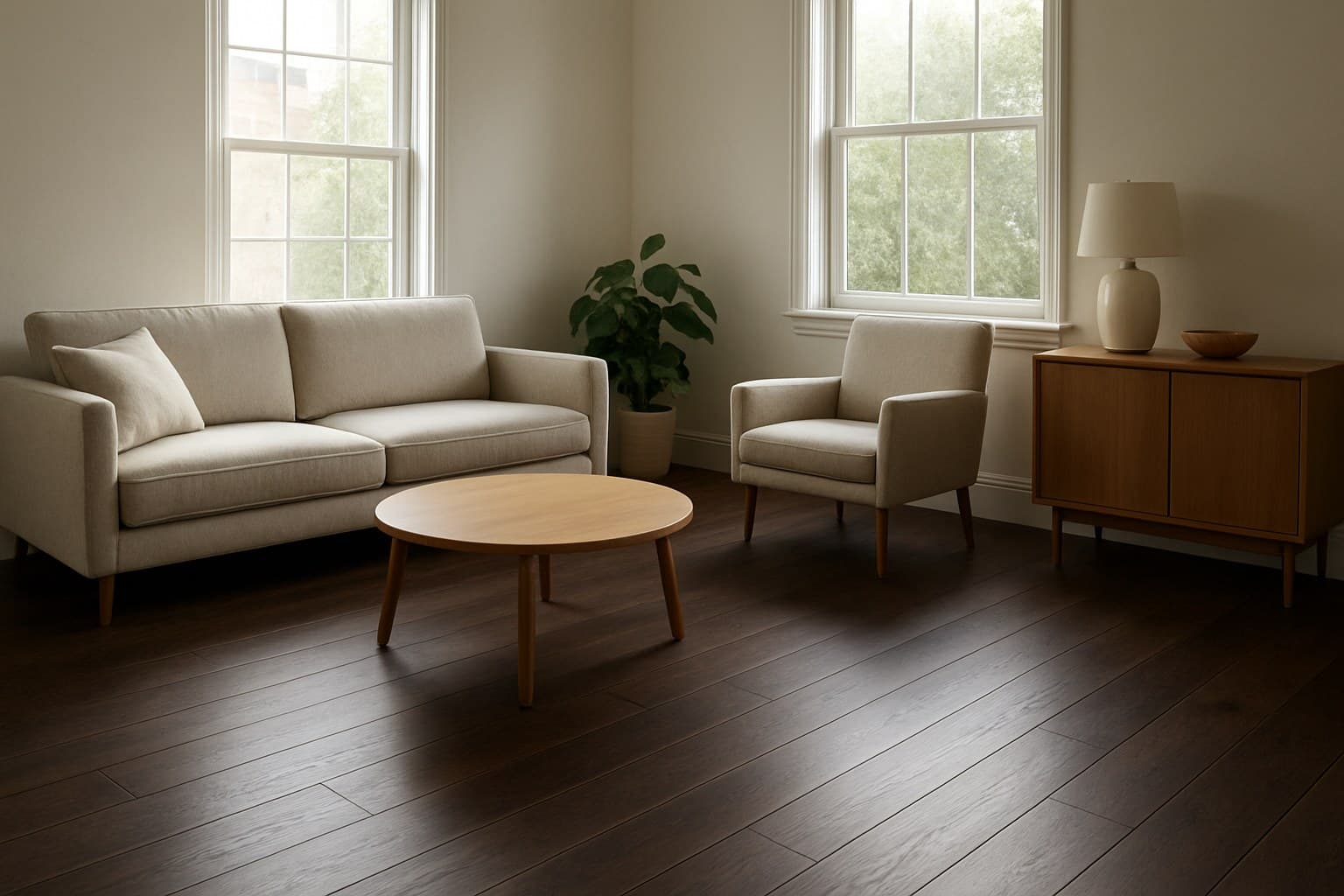
Match the finish to your household, not to a photo you liked. Kids and pets get matte or hand-scraped satin. A low-traffic bedroom can carry satin or even gloss. A formal room is the one place where gloss earns its keep.
| Household or room | Finish | Why |
|---|---|---|
| Kids and pets, high traffic | Matte or hand-scraped satin | Hides scuffs and scratches; sweep often for dust and hair |
| Low-traffic bedroom | Satin, gloss OK | Few scratches, so sheen is just a look choice |
| Formal living or dining | Satin to high-gloss | Drama is fine where feet and claws are rare |
| Kitchen or wet area | Matte engineered, or wood-look vinyl | Water hits the seams first; the core matters more than sheen |
| Basement or over concrete | Engineered, matte or satin | Solid dark wood isn't recommended below grade |
Source: which dark floors held up by the kind of house they went into, across the jobs I've done
Which finish fits which household and room.
Kitchens and wet rooms
Dark wood in a kitchen is risky, and not for the reason most people think. Water doesn't attack the plank face; it finds the seams between boards first. A waterproof wood look is a vinyl thing, not a hardwood thing.
If you want wood in a kitchen, an engineered dark floor handles spills better than solid, and wood-look vinyl handles them better still. It's worth seeing how LVP compares to hardwood before you put real wood near a sink.
Basements and cold climates
Basements and slab-on-grade rooms are engineered territory. Solid dark wood below grade moves with the moisture in the concrete and will not stay flat. Pick engineered, keep the sheen matte or satin, and test the slab for moisture before you start.
What Dark Wood Floors Cost, and How the Job Changes the Number
Budget roughly $3-12 per square foot for materials and $3-6 per square foot for labor in an open room, though these are general ballpark figures that shift with region, contractor, and material grade, so treat them as a starting point rather than a quote. That puts a straightforward dark floor around $6-18 per square foot installed, and the spread is mostly about the wood you pick.
| Part of the job | Cost per sq ft | Notes |
|---|---|---|
| Materials, oak stained dark | $3-6 | Cheapest path to a dark floor |
| Materials, walnut or exotic | $7-12 | Naturally dark species cost more |
| Labor, open room | $3-6 | Flat, straightforward runs |
| Stairs | More per step | Tight cuts and hand-fitting |
| Basement or over concrete | Higher | Engineered plus moisture prep |
Per-square-foot cost to install dark wood flooring in an open room; stairs and basements run higher. Note: these are general estimates built from jobs I've priced and installed around Dayton, Columbus, and Cincinnati; material and labor rates vary by region, contractor, and material grade, so get local quotes before budgeting.
Installed cost per square foot in an open room; a floating bar shows the low-to-high range for each part of the job.
Two things push the number up fast. Stairs cost more per step because every tread and nosing, the rounded front edge of a stair tread, the part your foot lands on first, is a hand-cut, hand-fit piece. Basements and slab rooms cost more because you're buying engineered and adding moisture prep on top of the install.
On DIY versus hiring, be honest with yourself. A click-lock engineered dark floor that floats is realistic for most handy homeowners. Glue-down boards, nail-down solid over joists, stairs, and large open-plan runs that cross a moisture transition are where I'd hire it out every time. Whatever you choose, the prep comes first: check the subfloor is flat with a straightedge and test it for moisture before a single board goes down. The floor only lasts as long as the surface under it.
If you're not sure how many boxes to order, running your room through how much flooring you need before you buy saves you from a second trip and a dye-lot mismatch, boxes from a different production run that don't match your floor's color exactly.