
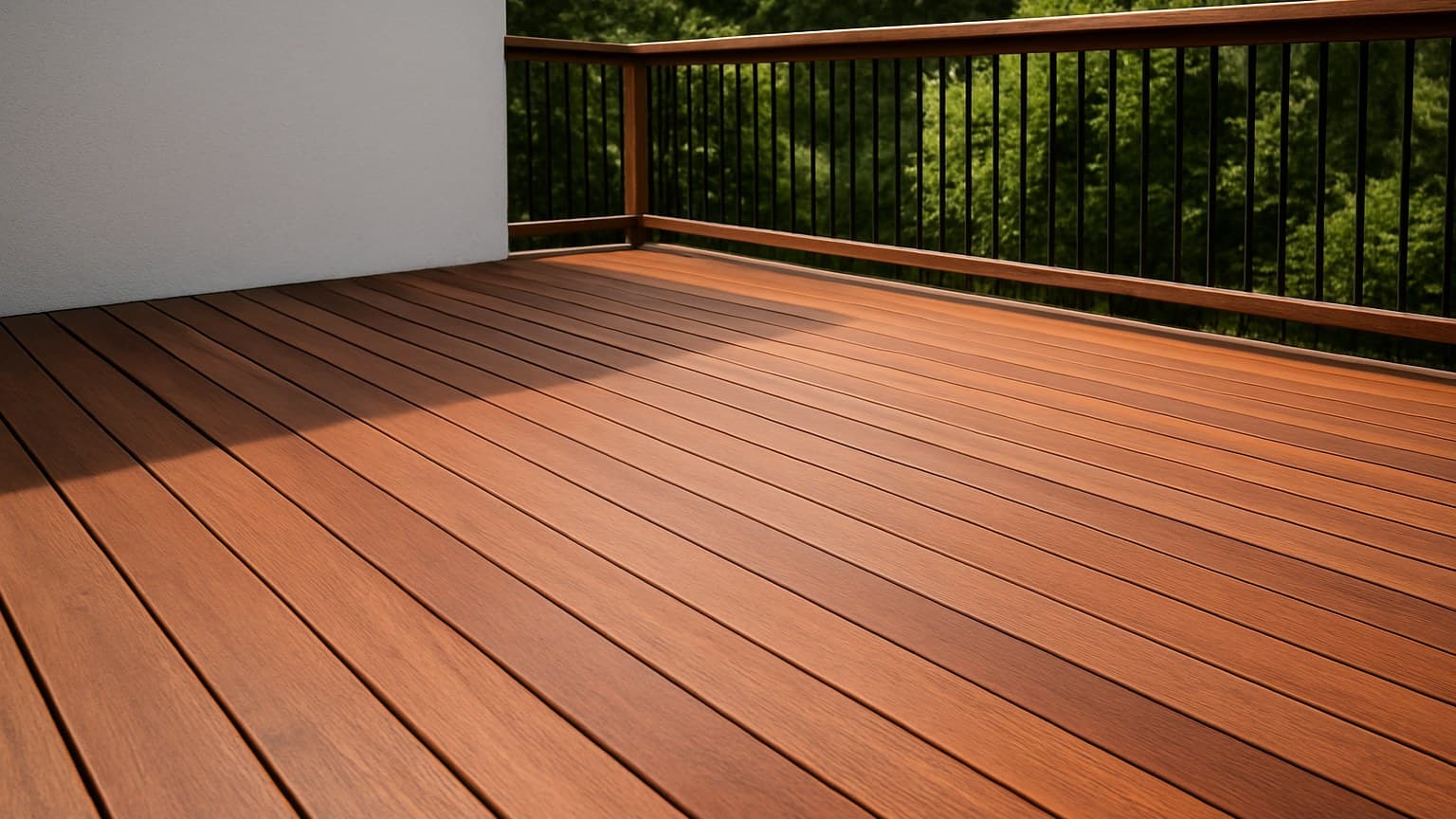
When Dana, a customer in Austin, asked me to price out a nail-down floor labeled "Brazilian teak" off a lumber yard flyer, she figured she was getting real teak at a discount. She wasn't. It isn't teak at all, and the specs that matter for your floor or deck are nothing like teak's. Here's what it actually is, how hard it runs, and what it costs once you split materials from labor.
Key takeaways
- "Brazilian Teak" is a marketing name for Cumaru (Dipteryx odorata); it is not related to real teak (Tectona grandis).
- Janka hardness lands between 3,200 lbf on vendor sheets and 3,540 lbf in the NWFA handbook, so figure it runs roughly 2.5 to 3 times harder than red oak either way.
- It is far harder and cheaper than true teak, but a demanding nail-down install: pre-drilling and carbide blades are a must, not optional.
- Real teak is the pricier, more stable pick for outdoor furniture; Brazilian teak wins on hardness and price for floors and hardwood decks.
- Like Brazilian cherry, Cumaru darkens with sunlight, so rotate rugs early to avoid pale ghost patches.
What Is Brazilian Teak? Cumaru, Not Real Teak
Brazilian teak is a trade name for Cumaru (Dipteryx odorata), a dense South American hardwood. Real teak is Tectona grandis, a completely different and unrelated species. You're not comparing two grades of the same wood. You're comparing two woods that only share a marketing word.
It gets sold under a few other names too. You'll see it called Brazilian Chestnut, Tonka, or just plain Cumaru. Same wood every time. Don't let four names trick you into thinking you're shopping four products.
Why do sellers borrow "teak"? Because teak carries a premium reputation for boats and outdoor furniture, and that name moves product. It's the same trick that dresses up other exotics with borrowed names, the way acacia gets marketed under a dozen labels too.
Here's my quick verdict: Cumaru is a genuinely tough floor and deck wood. Judge it on its own numbers, not on the teak name it's wearing.
How Hard Is It? The 3,200 vs 3,540 Janka Confusion
You'll see two different hardness numbers for this wood, and both are legit. Vendor spec sheets commonly list 3,200 lbf on the Janka scale (the standard test for how well a wood resists denting). The National Wood Flooring Association's (NWFA) Homeowner's Handbook lists "Teak, Brazilian" at 3,540 lbf. Neither is wrong. Treat it as a 3,200 to 3,540 range instead of chasing one hard number.
Put that next to woods you might know. It runs harder than hickory at 1,820 and hard maple at 1,450, and roughly 2.5 to 3 times harder than red oak at 1,290. That's a serious jump. It also leaves strand-woven bamboo in the dust, though bamboo's hardness and pricing swing enough by manufacturing type that it deserves its own look in this bamboo flooring cost and hardness guide.
| Wood | Janka (lbf) |
|---|---|
| True Teak | 1,070 |
| Red Oak | 1,290 |
| Hard Maple | 1,450 |
| Hickory | 1,820 |
| Brazilian Cherry (Jatoba) | 2,350 |
| Brazilian Teak (Cumaru) | 3,200-3,540 |
| Ipe (Brazilian Walnut) | 3,510 |
Janka hardness in pounds-force for the three most-confused "teak" trade names: true teak, Brazilian teak (Cumaru), and Ipe (Brazilian walnut); Cumaru is shown as a 3,200-3,540 band because vendor sheets and the NWFA handbook disagree.
Hardness buys you strong dent resistance, which matters under chairs, dog nails, and dropped pans. It doesn't make the wood scratch-proof, and it has nothing to do with being waterproof. A hard surface still shows fine surface scratches, and no solid wood shrugs off standing water.
There's also movement to watch. Cumaru is very dense, and it moves more with humidity swings than true teak does. That means you follow the maker's own acclimation sheet, the printed instructions telling you how many days the wood needs to sit in your home and adjust to its humidity before it goes down, for your specific product, not a number a buddy repeated online.
Color, Grain, and Why It Keeps Darkening
Fresh out of the box, Cumaru runs tan to reddish-brown with a medium-to-coarse grain. You'll see some interlocked, wavy figure that shifts from board to board, so no two planks look identical. That variation is part of the look.
Here's the part that catches people: like Brazilian cherry, Cumaru is photosensitive. It ambers and darkens over the first months in sunlight. On a cherry floor job for a customer in Portland, I pulled up an area rug after six months and found a bright patch underneath that no refinish fully evened out. Cumaru does the same thing. A rug left in one spot leaves a pale ghost patch you'll fight later.
The fix I use on every one of these jobs is simple. Rotate rugs and furniture early and often through the first year, so the color sets evenly across the whole floor. Move things a foot every month or so while the wood is still shifting.
One more thing that matters for finishing: Cumaru's surface is oily and dense, which can fight finish adhesion. Know that whether you're site-finishing raw boards or recoating a prefinished floor later, because rushed prep can leave the finish peeling.
Brazilian Teak vs True Teak vs Ipe (Brazilian Walnut)
There's a second naming trap right next to this one. "Brazilian Walnut" is a trade name for Ipe, not a walnut at all, and it's a totally different wood from domestic black walnut. So on one shelf you can have three exotic names, and only Cumaru and Ipe are actually related to their marketing job. Here's the four-way breakdown most ranking pages skip.
| Wood | Real teak? | Janka (lbf) | Decay resistance | Best use | Price tier |
|---|---|---|---|---|---|
| Brazilian Teak (Cumaru) | No, it's Cumaru | 3,200-3,540 | Very good | High-traffic floors, decks | $$ mid |
| True Teak (Tectona grandis) | Yes | ~1,070 | Excellent, very stable | Outdoor furniture, boats | $$$$ high |
| Ipe (Brazilian Walnut) | No, it's Ipe | ~3,510 | Excellent | Premium decking | $$$ high |
Source: the Wood Database ratings for density, decay resistance, and price tier I use to size up exotic hardwoods before I quote them
How brazilian teak, true teak, and Ipe differ on real-teak status, hardness, decay resistance, best use, and rough price tier.
The verdict shifts by the job. True teak wins on stability and outdoor furniture, where its low movement and weather resistance earn the high price. Brazilian teak wins on hardness and value for floors and hardwood decks. Ipe leads for premium decking when budget allows.
Notice where Brazilian teak and Ipe nearly touch: they're within a few hundred lbf on hardness. Between those two, the choice comes down to price and color, not toughness. Don't overpay for Ipe expecting a floor that dents less than Cumaru, because you won't feel the difference underfoot.
Best Uses: Flooring, Decking, and Where to Skip It
For flooring, that hardness is the whole selling point. It's a strong pick for entries, hallways, homes with pets, and busy family rooms that beat a floor up. Cumaru holds up where softer woods start showing dents in a season.
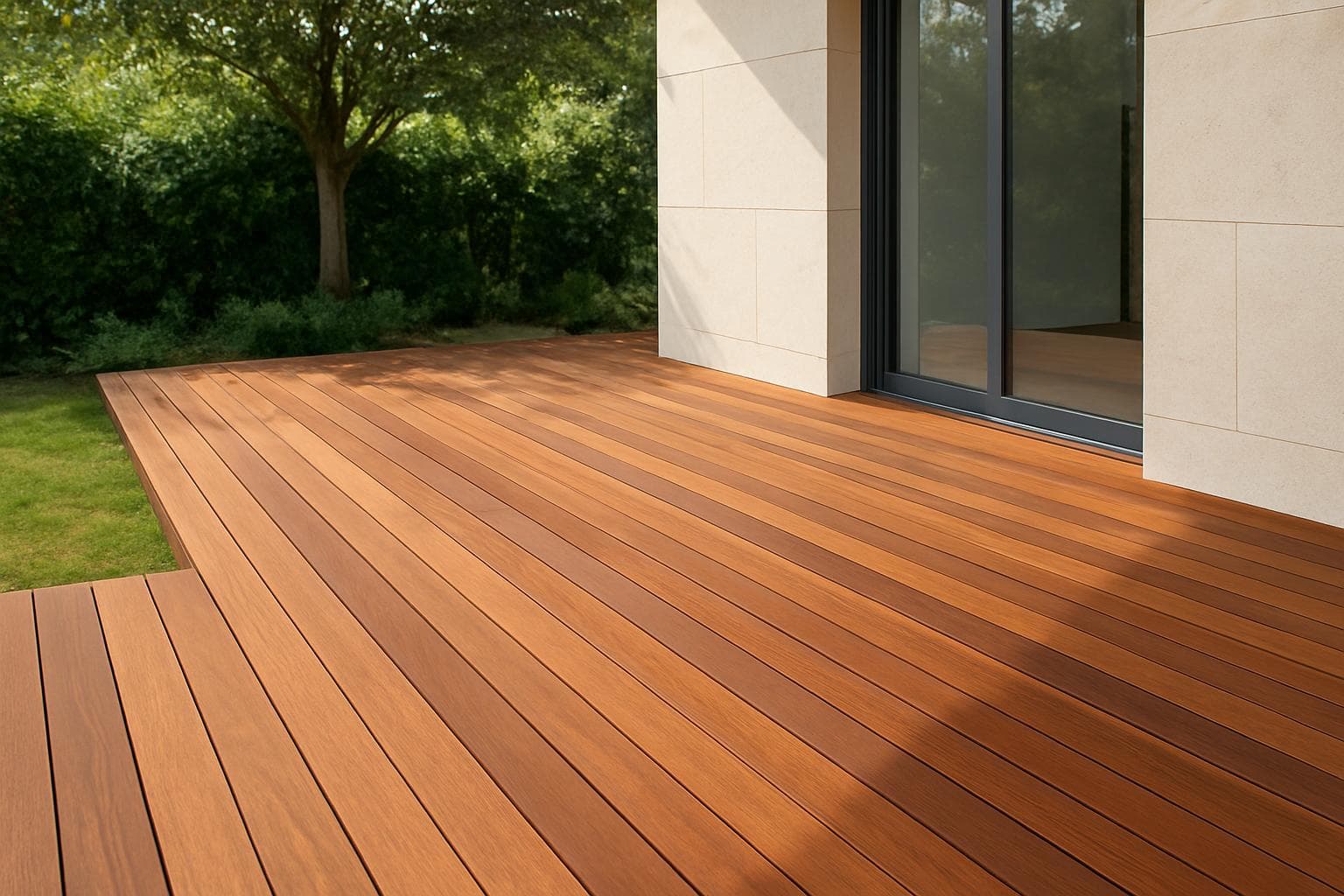
For decking, Cumaru is naturally decay- and termite-resistant. Leave it bare and it weathers to a silver-gray over time. Oil it once or twice a year and it holds that reddish-brown color instead. Both are fine; it's a look choice.
Before any floor goes down, check two things. First, subfloor flatness with a straightedge, because a hump telegraphs right through a hard floor. Second, take a moisture reading with a meter, which is the tool that tells you how wet the subfloor really is. Cumaru's density won't save a floor laid over a hump or a damp slab. Skip either check on a wood this dense, and the movement or moisture problem shows up as buckled or gapped boards within a year, not a floor that ages gracefully.
Where I tell people to skip it: wide solid planks over an iffy basement slab. That combination of movement and moisture is exactly where a dense solid floor fights you, and an engineered floor or a different material is the safer call. If you're still weighing solid against engineered construction for other rooms, this breakdown of solid versus engineered hardwood floors walks through how to match the right build to each space.
Brazilian Teak Hardwood Flooring: Prefinished vs Unfinished
Brazilian teak hardwood flooring comes both ways, and the choice changes your job. Prefinished boards show up with the factory finish already cured on, so there's no sanding or coating on site. You pay more per board but skip the messiest, slowest labor.
Unfinished boards cost less to buy but add sand-and-finish work after they're nailed down. That's where Cumaru's oily surface matters, since finish can be fussy to bond. If you go unfinished and you're not doing the finishing yourself, this is a job for someone who's coated dense exotics before. The same prefinished-versus-raw math plays out with unfinished hickory, if you want to see how another hard species handles it.
Installation Difficulty and the Tools You Actually Need
The honest truth: at 3,200-plus Janka, this wood fights back the whole way down. You pre-drill nearly every fastener or the boards split, you run carbide-tipped saw blades, and you expect to dull tools fast on a solid nail-down job. Regular steel blades burn out on this stuff.
Prep comes first, always. Level the subfloor and confirm a dry moisture reading before a single board goes down. The maker's warranty hinges on that flatness and moisture control, not on the plank you picked. On a job for a customer in Denver, I let a small hump in the subfloor slide because it looked minor. Finding it after the floor was down cost a full day of tear-out, a lot worse than the ten-minute check would have cost me upfront.
You'll want carbide-tipped blades, a drill to pre-drill every nail and screw, a moisture meter, a straightedge to catch humps, and a pneumatic flooring cleat nailer with glue assist for the tough spots. That's the real kit, not a suggestion.
Straight talk on DIY versus hire: this is not beginner click-lock like a lot of vinyl. A solid nail-down exotic, plus any stairs, is where most homeowners should hire out. It's a different animal from an easy softwood like pine, where a careful first-timer can get a good result. Follow the product's own acclimation time and perimeter expansion gap, since both vary by product. Read the box, don't guess a number.
What Brazilian Teak Costs (Materials vs Labor)
There's no single national number that means anything, so split it into materials and labor. The ranges below are starting points to confirm with local quotes, because species, region, and how much prep your old floor needs all swing the total.
| Job | Materials | Labor | Notes |
|---|---|---|---|
| Prefinished flooring | $5-$9 / sq ft | $3-$6 / sq ft (nail-down) | More material cost, less labor |
| Unfinished flooring | $4-$7 / sq ft | $5-$9 / sq ft (install + sand/finish) | Cheaper boards, added on-site finishing |
| Stairs | board cost per tread | $40-$75 per step | Detailed cuts, slow going |
| Basement floor | same board cost | higher than open rooms | Moisture prep and often engineered instead |
| Decking | $4-$9 / sq ft | varies by framing | Pre-drilling adds time |
Source: deck bids I've compared on recent Cumaru jobs, rounded to ranges since region and prep swing them
Cost ranges for brazilian teak flooring and decking, split into materials and labor; confirm with local quotes.
Prefinished costs more in material but less in labor, since the finishing is already done. Unfinished flips that: cheaper to buy, more labor to sand and coat on site. Neither is automatically the better deal; it depends on whether you're paying a pro to finish or doing it yourself.
Stairs and basement floors both run higher than an open room. Stairs cost more because of the per-step labor and all the fussy cuts. Basements cost more because the moisture prep is heavier and you often end up in engineered flooring instead of wide solid planks, which changes both the material and the method. Budget those two spots higher from the start.