
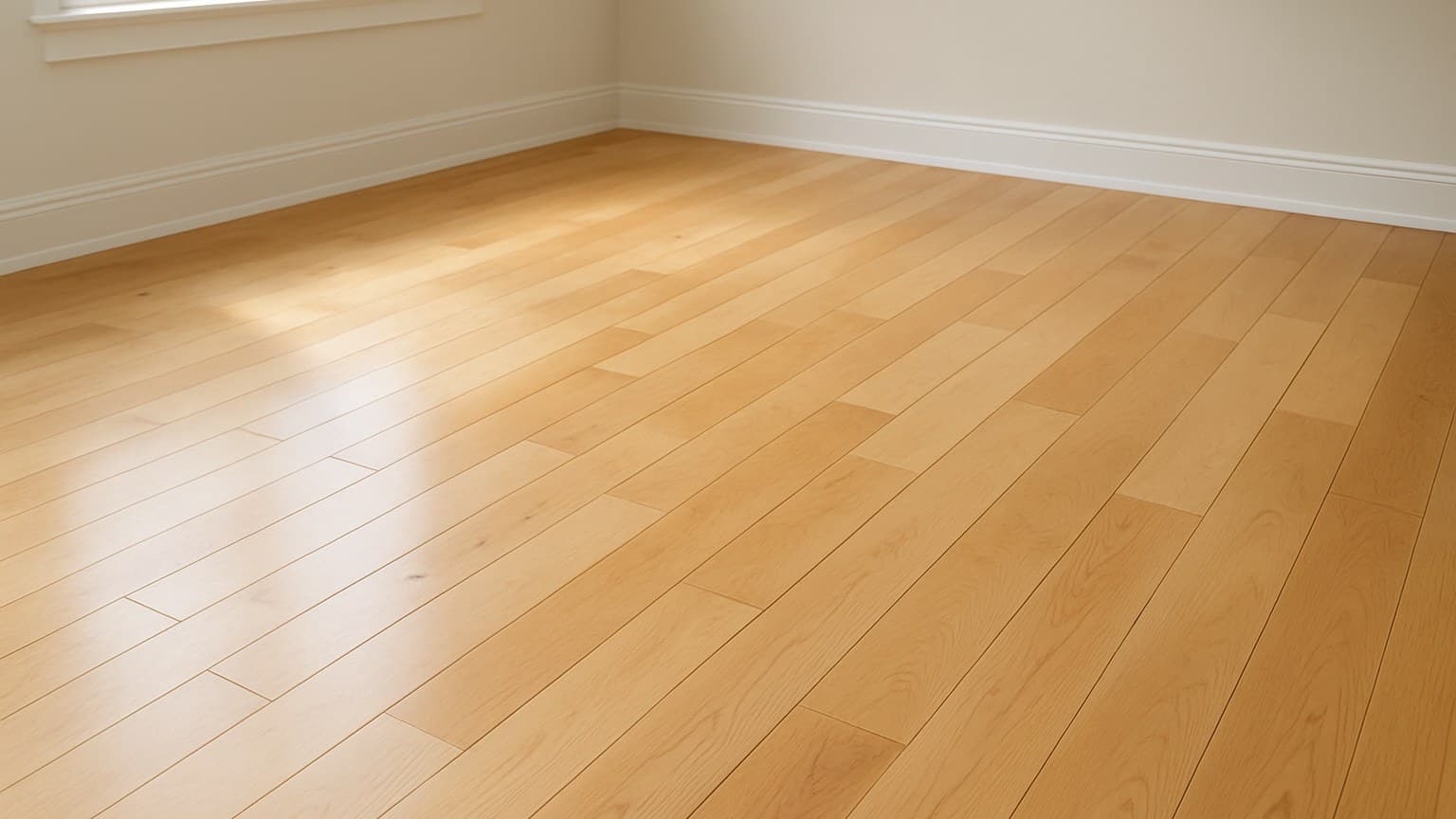
A homeowner named Teresa in Columbus asked me to stain her brand-new maple floors espresso-dark. Hard maple flooring is the one wood that won't take that cleanly, and knowing why before you buy saves a blotchy, expensive lesson. The word "maple" on a sample board hides the rest.
Key takeaways
- 'Hard' maple means sugar maple (Acer saccharum), which rates about 1450 on the Janka hardness scale; the softer red and silver maples sold under the same word rate closer to 950.
- That tight, dense grain resists dents but also rejects stain unevenly, so dark maple often comes out blotchy without a lot of extra prep.
- Most pros finish hard maple natural or clear, which locks you into its pale, creamy tone for the life of the floor since refinishing keeps it light.
- Solid hard maple runs roughly $4-8 per sq ft in materials plus $3-6 per sq ft labor; engineered maple is similar and handles concrete and below-grade rooms better.
- Basement and stair jobs cost more per square foot than open rooms, and moisture testing over concrete is not optional.
What "Hard" Maple Actually Is
"Hard" maple is one specific tree: sugar maple, or Acer saccharum. That's the dense, pale, tight-grained wood people picture when they think of a maple floor. Red maple and silver maple also get sold as "maple," and those are the soft maples. They look close on a small sample but wear and finish differently.
So when you shop, ask for the species by name, not just "maple." A real spec sheet or mill grade sheet will say sugar or hard maple. If the seller can only tell you "maple," treat that as a red flag and dig deeper before you pay a hardwood price. The same buyer-beware rule applies to acacia hardwood flooring, where the name on the box rarely tells you which acacia species you actually got.
Grade matters here as much as species. The pale, tight sapwood (first grade) is the clean creamy look most buyers want. Lower grades show more heartwood streaks and bigger color swings, which some people like and others don't. For how maple stacks up against other domestic woods overall, see the full maple flooring picture.
| Type | Species | Sold as | Look | Typical use |
|---|---|---|---|---|
| Hard (sugar) maple | Acer saccharum | Hard maple, sugar maple, "maple" flooring | Pale, creamy, very tight grain | High-traffic floors, gym-style wear |
| Red maple | Acer rubrum | Soft maple, sometimes just "maple" | Slightly warmer, more open grain | Furniture, budget flooring |
| Silver maple | Acer saccharinum | Soft maple | Softer, more figure and streaking | Lower-cost boards, rarely premium flooring |
What the same word "maple" can actually mean at the store, and how the three species differ.
Why It Dents Less but Stains Worse
The tight, closed grain that makes hard maple tough is the same trait that makes it fight stain. That dense structure resists dents, but it also blocks stain from soaking in evenly. American cherry hardwood flooring takes color the opposite way, deepening richly on its own without any of that fight.
Janka is the industry test for hardness. It measures how much force it takes to press a small steel ball halfway into the wood, and a higher number means a harder, more dent-resistant surface. Hard maple rates about 1450, which puts it above both red and white oak. If you want a domestic species with a higher Janka number than maple, it's worth reading this guide to choosing hickory flooring before you commit.
Here's where the stain trouble shows up. Dark stain pools in the few slightly open spots and skips the tight ones, so instead of an even tone you get patchy dark and light areas. You can reduce it with a wood conditioner and extra prep steps, but you're managing the problem, not erasing it. On Teresa's job, I ran a test board first: two coats of Minwax Pre-Stain Conditioner followed by her requested wiping espresso stain still came out visibly blotchy across the tighter-grained boards, with dark blotches next to almost untouched pale patches. Switching to a gel stain over that same conditioner leveled out close to even, because a gel sits on the surface instead of soaking into the grain the way a wiping stain does. That's the real lesson from that floor, conditioner alone doesn't solve maple's blotching, but conditioner paired with a gel stain (instead of a traditional wiping or penetrating stain) is what actually got her close to the color she wanted.
For context against other floors people cross-shop, note that strand-woven bamboo flooring can test harder than maple, while walnut is softer. Hardness alone doesn't make a floor "better", it just tells you how it handles a dropped pan.
| Wood | Janka rating |
|---|---|
| Soft (red) maple | 950 |
| Black walnut | 1010 |
| Red oak | 1290 |
| White oak | 1350 |
| Hard (sugar) maple | 1450 |
Janka hardness ratings, in pounds of force. Higher means more dent resistance.
Why Pros Usually Leave Hard Maple Natural
Most installers finish hard maple with a clear coat instead of a stain, and it's for one plain reason: clear is the reliable way to avoid the blotching. When a floor has to look right across a whole room, fighting maple's grain with dark stain is a gamble few of us want to take on someone's living room. In practice, that "clear coat" is usually a site-applied oil-based or waterborne polyurethane, two to three coats. On engineered maple, it's more often a factory-cured finish with aluminum oxide mixed into the topcoat, which is why some engineered maple carries a much longer wear warranty than a site-finished floor can offer, the aluminum oxide is a harder mineral additive that resists scratching in a way plain polyurethane alone doesn't.
Going natural does lock something in, though. That pale, creamy tone stays for the life of the floor. Every time the floor gets sanded and refinished down the road, it comes back to light wood, not dark. You can't easily "go dark" later, so pick the natural look because you want it, not because you'll change it someday.
If a rich, dark floor is the real goal, don't force it out of maple. A naturally dark wood like black walnut takes color far more evenly and gives you that deep tone without the patchy fight. That's the honest trade-off.
For the right room, maple's limit is actually a strength. Pale floors read bright and modern, bounce light around a space, and hide everyday foot traffic better than dark floors, which show every crumb and dust bunny. In a bright kitchen or a light-filled living room, natural hard maple looks intentional. In a dark, moody scheme, it's swimming upstream.
Solid or Engineered Hard Maple: Let the Room Decide
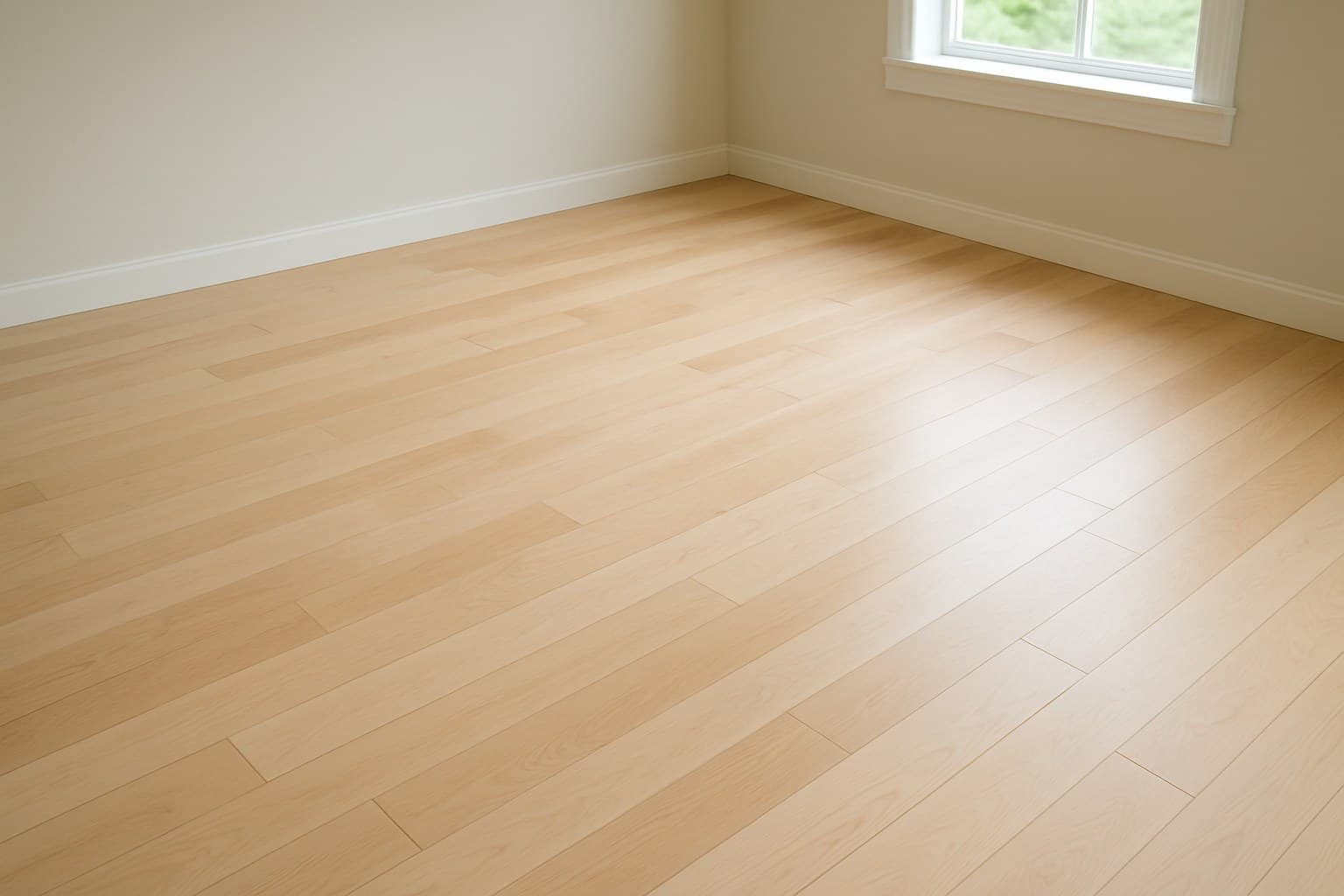
Here's the rule I use on every bid: the room and the subfloor pick solid versus engineered, not the price tag. Solid hard maple isn't recommended below grade or laid straight over concrete, because solid wood moves with moisture and a slab feeds it moisture. Engineered maple, with its plywood-style core, stays far more stable in those spots. That same room-first logic applies across species, and this guide to solid versus engineered hardwood breaks down how to make that call for any wood floor, not just maple.
Both give you the same sugar-maple wear surface on top. The difference is what's underneath and how it handles humidity.
Never skip two checks before a single board goes down. Test the subfloor for flatness, and run a moisture reading over any concrete. On a basement job for Ray in Dayton, I skipped that moisture test to save an afternoon, the floor cupped before the season was out, and I relaid it on my own dime. When I finally pulled a pin meter during the callback, the slab read 4.8%, well past the roughly 2% most engineered maple makers want before install, and the maple itself had already climbed to around 11% moisture content, a gap wide enough on its own to explain the cupping. That's the day I stopped treating the test as optional.
Engineered Maple Hardwood Flooring: When It's the Smarter Pick
Engineered maple hardwood flooring is the smarter call anywhere moisture is in play: basements, slab-on-grade main floors, and rooms over a crawlspace. You get the real maple look with better dimensional stability.
The trade-off is refinishing. Solid maple can be sanded several times over its life. An engineered floor's sanding life is capped by how thick its top veneer is, and the maker publishes that number. So "can I refinish it?" is a spec question you answer off the box, not a guess. A thick wear layer might sand two or three times; a thin one, maybe never.
Solid or engineered hard maple by room. Not drawn to scale.
What Hard Maple Flooring Really Costs
Solid hard maple runs roughly $4-8 per square foot in materials, plus $3-6 per square foot for labor. Engineered maple lands in a similar band, sometimes higher on the materials side when the wear layer is thick. Those are starting ranges, so confirm with local quotes for your species, grade, and prep.
Stairs and basements cost more per square foot than an open room. That's not because the wood costs more, it's the extra cuts, transitions, and moisture prep that eat labor hours. A wide-open living room is the cheapest maple you'll ever lay; a staircase is the most expensive per foot.
There's one hidden cost that's specific to maple. If a customer insists on a stain despite the blotching risk, budget for wood conditioner plus the extra labor to fight for an even tone. Get that added scope in writing before anyone starts, so nobody's surprised at the invoice.
| Step | Detail |
|---|---|
| Formula | Total = square feet x (materials $/sq ft + labor $/sq ft) |
| Measure the room | Example: 300 sq ft open living room |
| Solid maple, low end | 300 x ($4 + $3) = about $2,100 |
| Solid maple, high end | 300 x ($8 + $6) = about $4,200 |
| Same room on stairs/basement | Add roughly 20-40% for cuts, transitions, and moisture prep |
| Insisting on dark stain | Add conditioner + extra labor; get it in writing before start |
Source: engineered maple jobs I've bid and installed
A worked cost example for a 300 sq ft open room, showing the formula and both ends of the range.
The chart below breaks those same ranges into materials and labor, per square foot, so you can see where each dollar goes before you multiply by your own room size.
| Item | $ per sq ft |
|---|---|
| Solid maple labor | 3-6 |
| Engineered maple labor | 3-6 |
| Solid maple materials | 4-8 |
| Engineered maple materials | 4-9 |
Installed cost ranges per square foot, split into materials and labor. Basement and stair jobs run higher.