
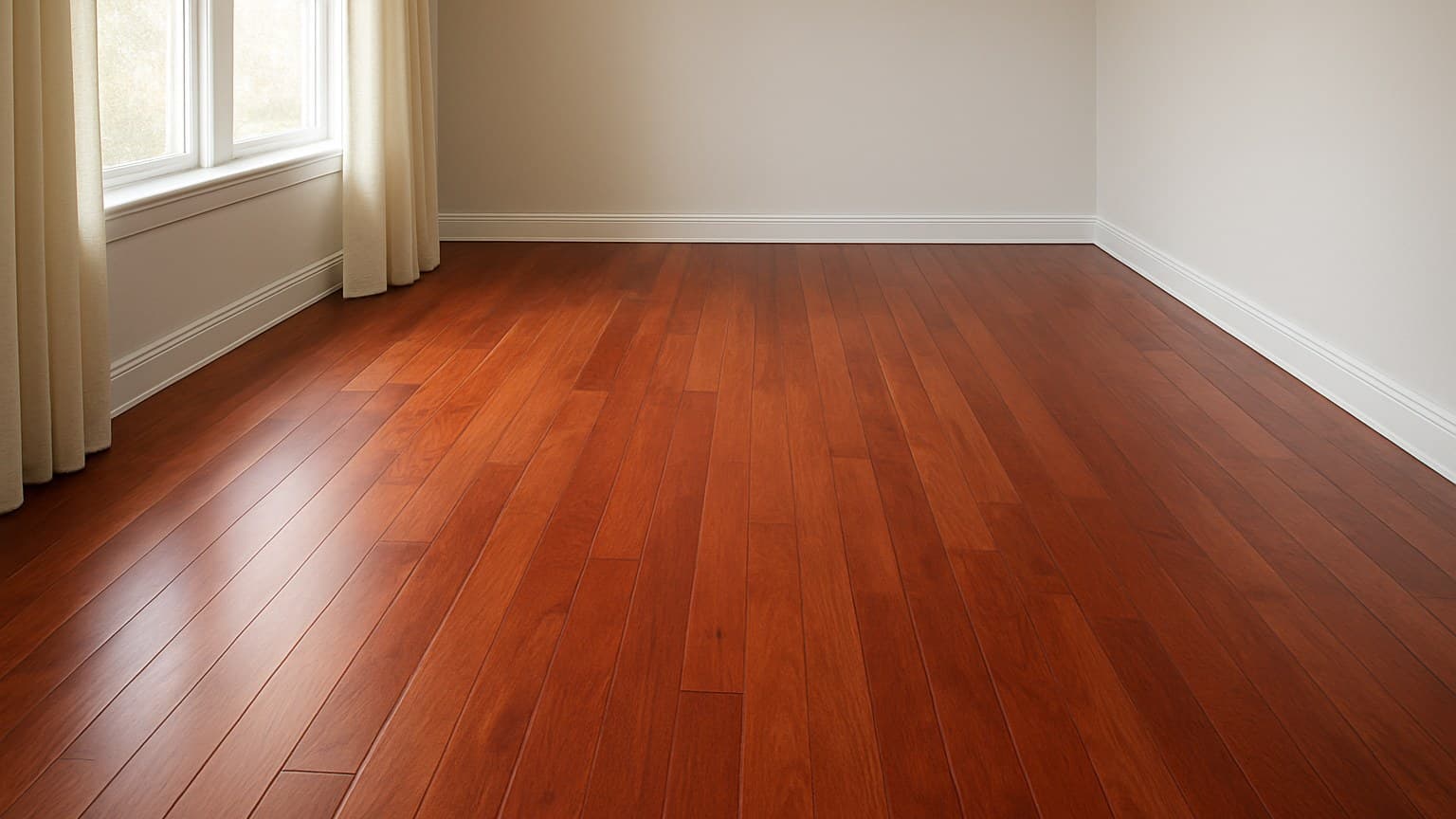
When Renee Castellano called me out to her 1920s bungalow in Dayton, Ohio, she'd already fallen for cherry hardwood for her dining room. It's one of the warmest, richest floors you can lay, and one of the easiest to regret if you pick it for the wrong room. The wood is soft, and its color shifts on you over the first year or two.
Key takeaways
- Cherry rates about 950 on the Janka hardness scale, softer than red oak (~1290) and maple (~1450), so it dents faster under pets and heavy traffic.
- American cherry darkens from pink-tan to deep red-brown in its first 6-24 months, mostly from sunlight, and that change is permanent.
- Materials run roughly $3.69-$9.42 per square foot; installed labor adds about $3-$6 per square foot, with stairs and basements costing more than open rooms.
- Skip solid cherry in a below-grade basement; engineered cherry handles concrete and moisture far better.
- Cherry suits low-traffic rooms like bedrooms and formal living rooms; it's a risky pick for busy kitchens and entryways.
The Honest Verdict: Who Should Install Cherry (and Who Shouldn't)
Here's the plain answer before the detail: cherry is softer than oak, it will redden and darken no matter what finish you put on it, and that makes it a beautiful floor for the right home and a headache for the wrong one.
Good fit: adults and low-traffic rooms. Think bedrooms, a formal living or dining room, and people who genuinely want a warm red tone and won't fight the color change once it starts.
Poor fit: big dogs with long nails, homes full of young kids and dragged toy bins, busy entryways, and kitchens. It's also wrong for anyone who wants the floor to stay the exact shade they saw on the showroom sample.
The rule that saves the job: cherry rewards realistic expectations and area rugs. It punishes buyers who expected oak-level toughness and a color that holds still. Go in knowing both, and you'll love it.
What Cherry Flooring Is and Why It Darkens
Cherry flooring here means American black cherry, or Prunus serotina, a domestic hardwood with a fine, smooth grain and the odd gum fleck or small pin knot. Those little marks are normal, not defects. If you're shopping it prefinished rather than site-finished, running the boards against a spec-sheet checklist for top prefinished hardwood floors will help you tell a normal mark from an actual defect before it's on your subfloor.
Fresh-milled cherry is pale pink-tan, almost blond. Over roughly the first 6 to 24 months it deepens into the rich red-brown people picture when they hear "cherry." The main driver is UV light, the same light coming through your windows. The change is permanent, and no finish stops it.
One surprise catches people out: uneven darkening. Rugs and furniture block light, so the wood under them stays lighter. Lift a rug after a year and you can find a pale "shadow" of it on the floor. It slowly evens out once exposed, but the fix is to rotate rugs and move furniture a bit during that first year so the whole floor ages together.
Don't confuse this with Brazilian cherry, also sold as jatoba. That's a harder, redder imported wood, a different species entirely from the softer American cherry this guide covers.
Janka Hardness: How Soft Is Cherry, Really?
The Janka scale measures how well a wood resists denting, the higher the number, the tougher the floor. Cherry sits near the bottom of that scale among the woods homeowners ask me about most, which is why every "will it hold up" question starts here. The table below lines cherry up against the species it gets compared to on the job. Oak is the name that comes up most in that comparison, so if a tougher, redder floor sounds like the safer bet for your household, this red oak prefinished flooring buying guide walks through what to expect from that species instead.
| Species | Janka rating | Note |
|---|---|---|
| American Cherry | 950 | Soft; dents easily |
| Black Walnut | 1010 | Also soft, similar to cherry |
| Birch | 1260 | Moderate |
| Red Oak | 1290 | The common benchmark |
| Hard Maple | 1450 | Hard, dent-resistant |
| Hickory | 1820 | Hardest common domestic |
Source: the Janka ratings I check against NWFA species data before I quote a job
I check these Janka ratings against species data from the National Wood Flooring Association (NWFA) before I quote any cherry job.
At 950, cherry shows dents from dropped pans, dog nails, and dragged furniture legs sooner than oak does. The flip side: a softer wood tends to feel a touch warmer and more giving underfoot. You're buying cherry for its color and grain, not its toughness, so plan the room and finish around that fact instead of hoping it acts like maple. That planning gets easier once you know the finish and edge details covered in nine things to settle before buying prefinished flooring.
Grades, Cuts, and Solid vs Engineered
Grades: What You're Actually Paying For
Grade sets how the floor looks, not how strong it is. According to the NWFA-NOFMA Unfinished Standard, the flooring industry's official grading reference, Select & Better is the cleanest and most uniform, with even color and few marks. #1 Common, sometimes sold as Character, has more color swing, knots, and gum streaks. Country or rustic grades go the furthest toward variation. A lower grade isn't a weaker board, just a busier-looking one, and it costs less.
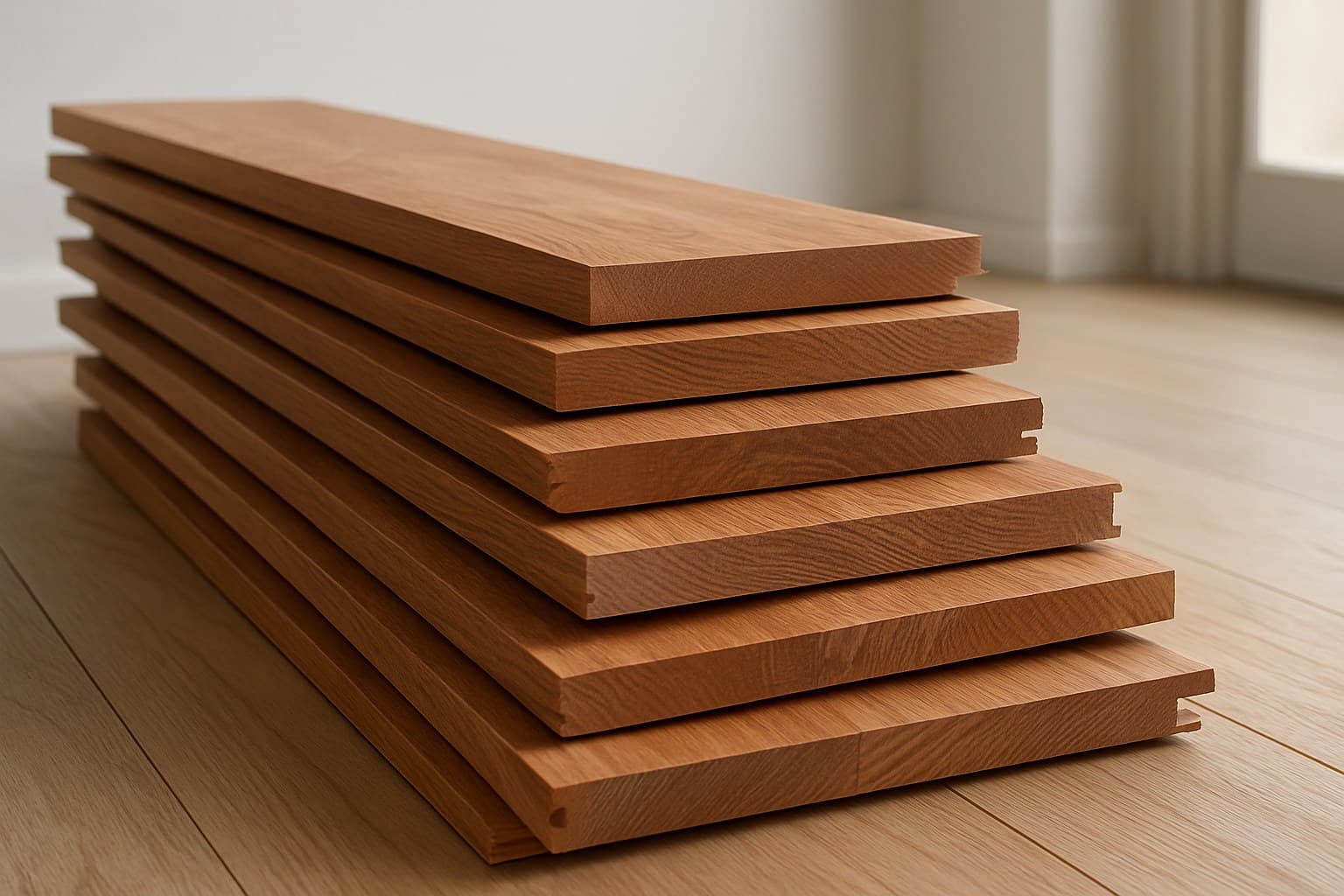
Cuts matter too. Plain sawn is the common, budget-friendly look, cut straight through the log so the grain arches. Rift and quartered means the log is cut at an angle that keeps the grain lines running straight instead of arching, which limits cupping and warping but wastes more wood at the mill, so it costs more. Wide planks, anything from 4 inches up past 7, show more seasonal movement and carry a higher price than narrow strips.
Solid vs Engineered by Room
Where the floor goes should decide this, not the label on the box. Solid cherry can be sanded and refinished several times over its life, but it isn't made for basements. Engineered cherry has a plywood-style core that resists cupping, which makes it the safer pick over concrete or below grade. If you're weighing solid against engineered for a different room or species, this guide to choosing solid vs engineered hardwood floors covers the same decision in more depth.
I take this seriously because I've paid for ignoring it. The NWFA's own Homeowners Handbook to Real Wood Floors calls for testing subfloor moisture before you commit to solid or engineered product, and on a basement job for Tom Riordan in Cincinnati, he talked me out of that test to save an afternoon, and the floor cupped before the season was out. I relaid it on my own dime. On basement jobs now, the slab reading decides the material, full stop. Cherry over a damp slab is trouble no matter how good the plank is. If you want the full method, see Installing Hardwood Flooring: 9 Steps and the Test That Picks Your Method for how to check flatness and moisture before a single board goes down.
What Cherry Flooring Costs Per Square Foot
Cherry sits in the mid-to-upper range for domestic hardwood, priced by grade, plank width, and whether you go solid or engineered. Installed labor adds its own separate cost on top of the material price when you're working in an open room. The table below breaks out the exact material and labor ranges so you can price a room instead of guessing. If you're still comparing options before you commit to a species, this buying guide for Johnson Hardwood floors is worth a look to see how a specific manufacturer's line stacks up on price and durability.
| Line item | Range | Unit |
|---|---|---|
| Cherry material (grade/width dependent) | $3.69 - $9.42 | $/sq ft |
| Installation labor (open room) | $3 - $6 | $/sq ft |
| Stairs / basement premium | Adds above open-room labor | for cuts, transitions, moisture prep |
| Example: 300 sq ft open room, mid material ($6.50) + labor ($4.50) | ~$11/sq ft installed, about $3,300 | before extras |
Source: install quotes I write on cherry jobs across Ohio and Indiana
These numbers come from the install quotes I write for cherry jobs across Ohio and Indiana.
Two premiums push that past the open-room number. Stairs cost more per foot because each tread and riser is its own cut and nosing. Cut-up basement layouts cost more because of the extra transitions and the moisture prep the slab demands. Money also hides in subfloor leveling, moisture testing, old-floor removal, and stair nosings, none of which show up on the material sticker.
One more thing on the "can I refinish it later" question: solid cherry can be sanded several times, but engineered depends entirely on the veneer thickness printed on that product's spec sheet. Thin veneer may allow one light sanding or none. It's a spec question, not a flat yes or no. For a fuller price breakdown by room size, see 500 to 2,500 Sq Ft: What Hardwood Flooring Costs in 2026.
Living With Cherry: Pets, Kids, and Sun
Match the room to the wood and cherry lasts. Bedrooms, formal living rooms, and dining rooms suit it because traffic is light and shoes usually stay off. Kitchens, mudrooms, and front entries are exactly where a soft floor takes the worst beating, from grit, water, and dropped weight.
If you install it in a busier spot anyway, protect it. Felt pads under every chair and table leg, a real doormat at each entry, and area rugs in the walking lanes all cut down the dents. Keep dog nails trimmed. Wipe up water fast, standing moisture is harder on any hardwood than a stray scuff.
Manage the sun on purpose. Because UV drives the color change, rooms with big south-facing windows darken fastest and most unevenly. Rotate rugs and shift furniture during the first year so the floor ages as one shade. Sheer shades help slow it, but nothing stops it, so pick cherry because you want that deep red-brown, not despite it.