
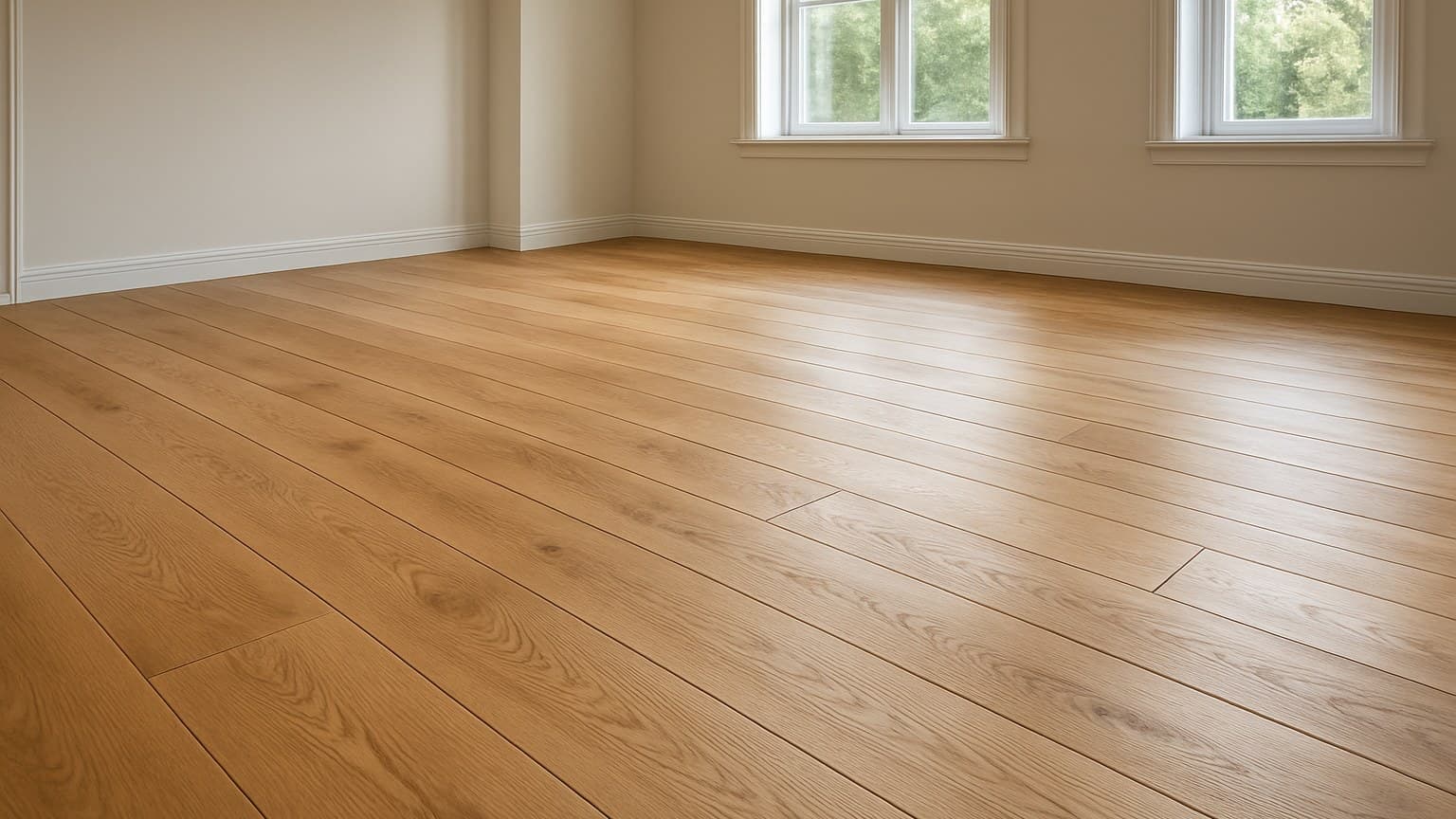
European white oak flooring costs more than American white oak, but that premium buys looks, not a harder floor. Both oaks hit the same 1,360 Janka hardness. The confusion comes from sellers who pin that one number on whichever oak they happen to be calling "tougher."
Key takeaways
- European and American white oak share the same NWFA-documented Janka hardness of 1,360, so the price gap is not about a tougher floor.
- The premium buys looks: warmer golden color, wavier open grain, higher tannin for deep fumed and reactive finishes, and long wide planks.
- Only a small share of European white oak logs make Select grade, which is why the cleanest, most uniform boards cost the most.
- Install labor is the same whether the oak is European or American; the price gap lives almost entirely in the material.
- For a light, natural, straight-grained look on a budget, American white oak does the same job for less.
Is European White Oak Worth the Premium?
Yes, European white oak is a durable, stable, refinishable floor worth installing. But the premium over American white oak is almost all cosmetic. You're paying for the way it looks, not for a stronger board.
What that premium buys is a warmer golden color, wavier and more open grain, higher tannin that drinks up fuming and reactive stains, long wide planks, and grades so clean they're hard to find.
What it doesn't buy is a tougher surface. American white oak dents and wears the same. So if you want a lighter, straighter, natural floor, American white oak does that job for less money.
The rest of this article unpacks each piece, hardness, grain, grades, board size, finish, and cost, so you can see where your dollars go. For a wider view of species beyond white oak, a general hardwood flooring guide covers how hickory, maple, and walnut stack up on the same scales.
| Attribute | European White Oak | American White Oak |
|---|---|---|
| Color | Warm, golden to light brown | Paler, cooler tan |
| Grain | Wavier, more open, more character | Straighter, tighter, more uniform |
| Janka hardness | 1,360 | 1,360 (same) |
| Tannin content | Higher; fumes and reacts strongly | Lower; takes light/natural finishes evenly |
| Board length | Long planks, stocked up to about 7 ft | Standard strip is shorter; custom mills reach 12 ft |
| Select grade | Scarce and pricey | More widely available |
| Price | Premium | More budget-friendly |
Where the European premium shows up versus American white oak, attribute by attribute.
The Janka Number, Settled: Both Oaks Hit 1,360
Both oaks land at 1,360 on the Janka scale. According to the National Wood Flooring Association's (NWFA) Homeowner's Handbook to Real Wood Floors, white oak is rated at 1,360 on the Janka scale, and European and American white oak sit in the same white oak group at that same number.
So why do sellers argue about it? One listing pins 1,360 on European oak and calls it the hard one. Another pins the same 1,360 on American oak and calls that one harder. They're both quoting the one white oak figure and spinning it their way.
Janka in one line: it measures the force it takes to dent the wood, so a bigger number shrugs off dings better.
Neither white oak is the toughest floor on the market. They're just dead even with each other. Hickory's higher number is a big reason it shows up so often in hickory hardwood floors built for high-traffic, rustic-style rooms.
| Species | Janka (lbf) |
|---|---|
| Red Oak | 1,290 |
| European White Oak | 1,360 |
| American White Oak | 1,360 |
| Hard Maple | 1,450 |
| Hickory | 1,820 |
Source: robbins.com, hardtwoodus.com and NWFA Homeowner's Handbook
Janka hardness in pounds-force: both white oaks tie at 1,360, below hickory and maple, just above red oak.
Color, Grain, and Why European Oak Takes Fuming So Well
On color, European oak runs warm, golden to light brown straight out of the box. American white oak reads paler and cooler, more of a flat tan. Red oak, by comparison, leans pinkish, which is why it clashes under a gray or whitewash finish.
Grain is the other giveaway. European oak shows wavier, more open grain with more natural character. American oak is straighter and more uniform. If you want to tame the big cathedral swirls in either one, ask for rift-and-quartered boards, cuts that run straighter lines across the face. If you'd rather skip the grain debate entirely, geometric parquet flooring patterns arrange short wood pieces into designs instead of running planks.
Now fuming. Fuming means sealing the raw wood in a chamber with ammonia vapor so the wood's own tannin darkens it from the inside, no stain added. European oak carries more tannin, so it fumes deeper and reacts stronger with reactive stains.
The practical read: if you're after a rich, even, dark fumed floor, European tannin earns its keep. If you want a light, natural, whitewashed look, American oak gets you there for less.
Grades: Why Select European Oak Is Rare
Grades aren't a seller's buzzword. They trace back to the NWFA/NOFMA grading standards, the official unfinished-flooring rules published jointly by the National Wood Flooring Association and the old National Oak Flooring Manufacturers Association (NOFMA), which sort boards by how many knots and how much color swing they show.
In plain words: Clear shows almost no knots and barely any color change. Select allows a few small knots and a little variation. No. 1 Common, often sold as Character, shows knots, color streaks, and more movement across the floor.
The price driver comes down to scarcity. According to wideplankflooring.com, only about 5% of European white oak logs make Select grade. The cleaner and more uniform the board, the smaller the share of the log that qualifies, so the cleanest floors cost the most.
Shopping tip: match the graded sample to the grade you're quoted. Names like "Prime," "AB," and "Rustic" are marketing labels stacked on top of these real rules, and they don't always line up the way you'd expect.
| Grade | What the board shows | Common marketing name | How common |
|---|---|---|---|
| Clear | Minimal knots, very uniform color | Prime, AB | Very limited |
| Select | Small knots and slight color variation allowed | Select, ABC | Scarce |
| No. 1 Common (Character) | Knots, color streaks, more movement | Character, Rustic, CD | Most of what's milled |
Source: NWFA/NOFMA oak grading rules
How oak grades map to the marketing names you'll see printed on samples.
If you want the full grade-by-grade breakdown for the species itself, the white oak hardwood flooring guide goes deeper on widths and looks.
Wide Plank, Length, and Stability
European white oak is what most people picture when they say "wide plank." It's sold in wide boards and long lengths, which is a big part of why it reads as high-end.
Wide-plank widths and board lengths
European white oak commonly comes in 7-1/2 inch and 9 inch widths, in long boards stocked up to about 7 feet. That long, wide look is what buyers are chasing when they pay the premium.
But longer isn't automatically European. Standard American strip flooring is shorter, true, yet American custom mills run boards up to 12 feet, averaging around 6 feet. If length is your goal, you can get it in American oak, you just have to spec it.
Solid vs. engineered (and radiant heat)
Pick engineered European oak when the room works against solid wood. That means a concrete slab or a below-grade basement, rooms with radiant floor heat, any time you want wide planks with less seasonal swelling and shrinking, and when you only plan to refinish once or never. Engineered's plywood-style core holds flat in those conditions where solid oak isn't recommended. For the fuller rundown on weighing solid against engineered across species and rooms, the guide to picking solid vs. engineered hardwood breaks down that decision in detail.
What you give up with engineered is refinishing. The thin wear layer on top caps how many sandings you get. Most engineered wear layers are thin enough that the maker rates them for only one sanding. Solid oak can be sanded several times, so it's the pick for standard above-grade rooms where you want decades of refinishing. The engineered hardwood guide walks through core types and wear layers if you're weighing the two.
One prep rule before any of this goes down: check that the subfloor is flat and dry first. On the floating and glued wide-plank jobs I've done, the finished floor only lasts as long as the flat, moisture-controlled base under it. A gorgeous 9 inch plank over a wavy or damp slab will cup, gap, or telegraph every low spot, and no board choice fixes that.
Which Oak for Your Room and Budget
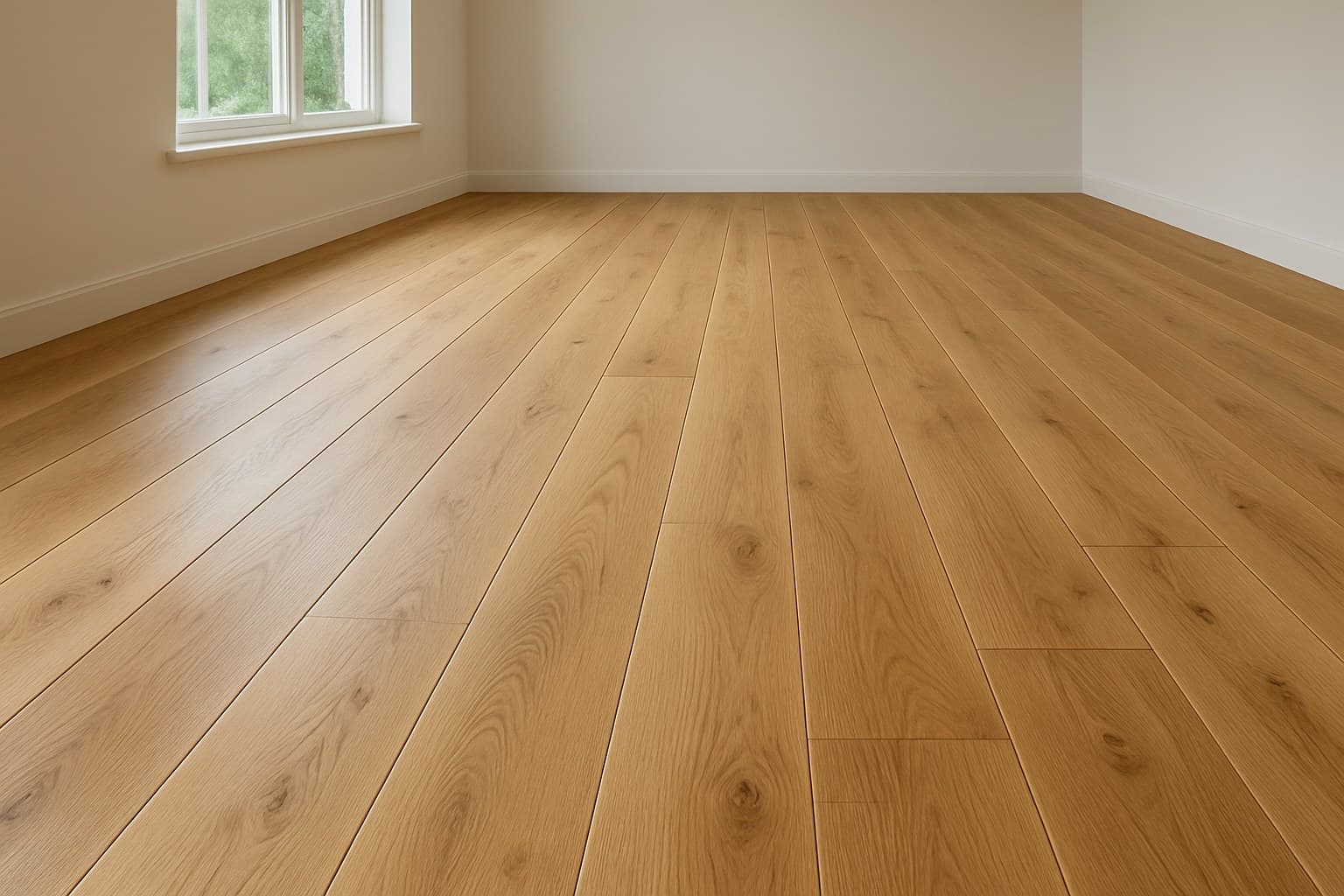
Pay the European premium when you want one specific thing: a warm, wide-plank, deep-fumed floor you can't get cheaper. If that look is the whole point of the project, European oak delivers it and American oak doesn't.
Choose American white oak for a lighter, straighter, natural floor at a lower material cost. Same hardness, same refinish-ability in solid form, less money per square foot.
On cost, be clear about where the gap lives. Install labor runs about the same whether you choose European or American oak, so the premium sits almost entirely in the material line, and your supplier should be able to split a quote into material cost and labor cost so you can see that for yourself. That material price swings with plank width and grade, the two levers that move the number most. Basement and other below-grade rooms cost more too, since those spots call for engineered oak over the slab plus a vapor barrier, not solid wood. Stairs also run higher than an open room, because each tread takes custom cutting and fitting instead of a straight run of planks.
For DIY versus hire: click-together engineered wide plank is realistic for a confident DIYer. Glue-down installs, stairs, and large open rooms with moisture transitions between spaces are worth hiring out, where a bad seam or a missed moisture reading turns into a tear-out.
If the room's budget is tight enough that any solid oak is a stretch, it's worth seeing the vinyl side-by-side before you commit. The LVP vs hardwood comparison lays out the cost and water tolerance tradeoff for the rooms where oak isn't the obvious call.