
When Denise in Columbus asked me which engineered hardwood flooring brands to avoid, I told her that's the wrong question. The same brand can sell a floor you'll refinish for decades or one that peels in two years, so the trick is reading the line, not the label.
Key takeaways
- One line predicts quality: a thicker real-wood veneer, a stable plywood core instead of cheap HDF, and a certified mill standing behind the name.
- Store-exclusive private labels (Home Decorators Collection, TrafficMaster, Hampton Bay) have no single accountable mill; they get sourced from whichever factory is cheapest that quarter, so specs drift between runs.
- Bruce isn't uniformly bad, but its big-box entry lines draw more complaints than its better collections; read the specific line's spec, not the brand name.
- Cross-check any brand against the NWFA/NOFMA certified-mill list, FSC wood sourcing, and a CARB Phase 2 stamp on the actual box before you pay.
- Install runs roughly $3-9 per sq ft in materials plus about $3-8 per sq ft in labor, and basements and stairs cost more than open rooms.
1. The One Line That Predicts a Floor's Lifespan
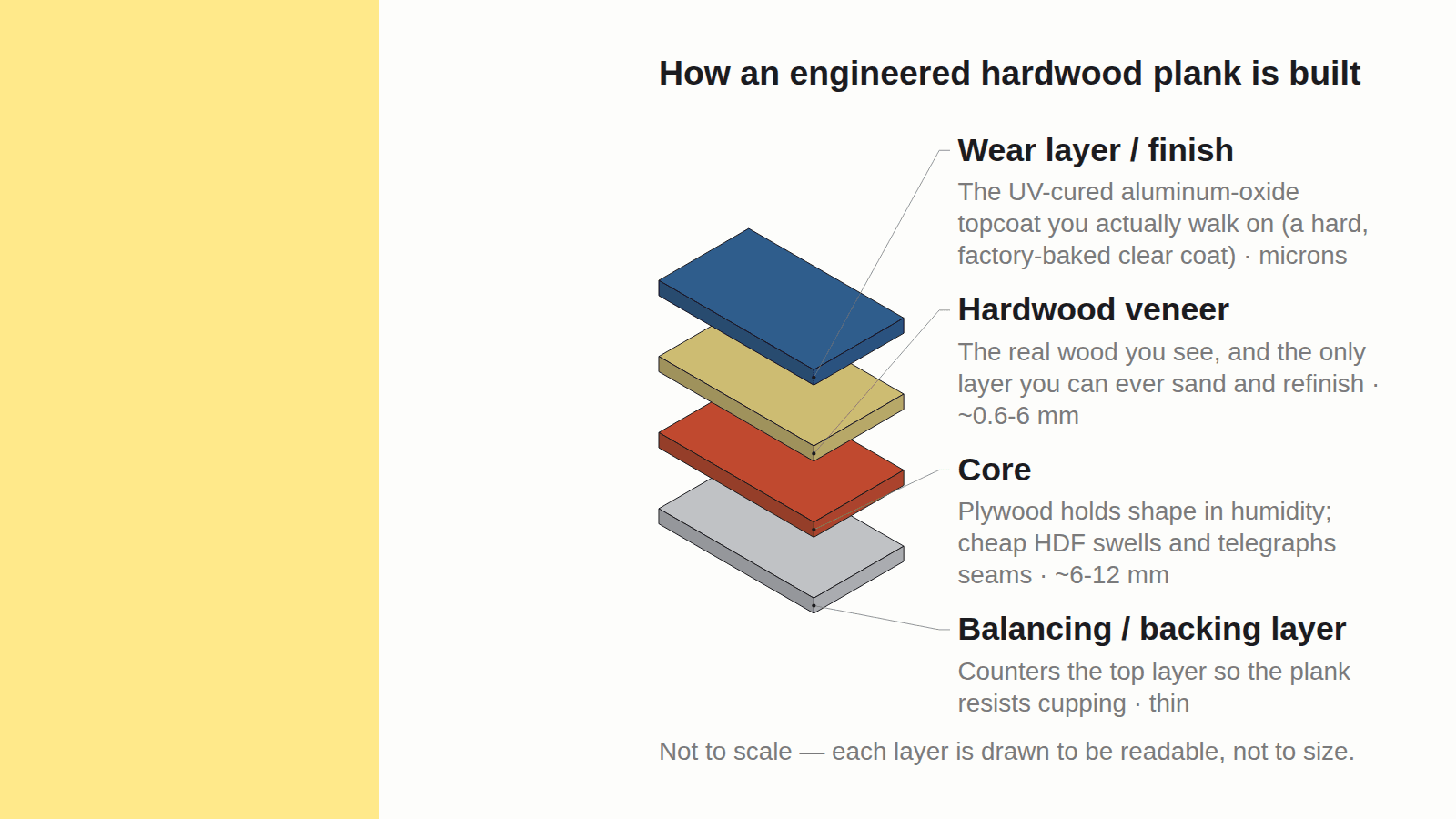
Three things separate a floor that lasts from junk, and all three are checkable at the store: a thick real-wood veneer on top, a stable plywood core instead of thin HDF, and a certified mill standing behind the name. HDF is high-density fiberboard, a pressed-wood board that swells when water reaches it.
The veneer is the layer you can sand down and refinish when it gets scratched up, so its thickness sets how many second chances the floor gets. I won't quote a single millimeter number here on purpose. Thickness belongs to a specific product, not the whole category, and any honest spec sheet lists it by line. Brazilian cherry is one species where that thickness question gets asked constantly, since the wood's color shift over time makes buyers want to know exactly how much veneer they're working with, and the Brazilian cherry engineered hardwood buying guide walks through that spec by name.
The core matters just as much. A plywood core holds its shape when a room's humidity swings. A cheap HDF core puffs up once moisture gets in and telegraphs every seam through the surface. Everything else on this list is just that one test, run against real brands.
2. Store-Exclusive Private Labels: Home Decorators Collection, TrafficMaster, Hampton Bay
These are the names I'd steer a first-time buyer away from, and it's structural, not snobbery. They're private house labels with no single accountable mill behind them, sourced from whichever factory bid lowest that quarter, so two boxes of the "same" floor can come from different plants.
That's the real risk. Veneer, core, and finish specs can drift between production runs, and there's no consistent maker whose reputation is tied to a long warranty. When something fails in year three, the store points at the factory and the factory is already gone.
The same risk shows up under a real brand name too, not just anonymous private labels. Lumber Liquidators, now operating as LL Flooring, is the clearest branded example on this list: it built its retail model on switching between whichever overseas mill was cheapest, and paid for it in two separate federal cases covered in Section 5 below, a formaldehyde recall and a Lacey Act guilty plea for illegally sourced timber. If a brand name shows up in the news for sourcing problems once, assume the underlying sourcing habit hasn't changed just because the name did.
If you still buy one because the price is right, make the store show you the CARB Phase 2 compliance, the California limit on how much formaldehyde a wood product can release, and the actual spec printed on this batch's box. Not the brochure, not the website. The box in the warehouse.
3. Bruce and Big-Box Lines: Know Which Line You're Actually Buying
Bruce isn't junk across the board. Its cheap big-box entry collections draw the recurring complaints, while its better lines hold up fine, which is exactly why the brand name alone tells you nothing.
So read the specific collection or SKU spec, because two lines under one brand can run very different veneer thicknesses and different cores. I've pulled up a builder-grade entry floor and laid a nicer line from the same maker in the next house over, and they were barely the same product.
The complaint pattern on the cheap lines is consistent: veneer so thin you can never refinish it, edges that gap in the first winter, and finish that wears through right in the traffic lanes to the kitchen. That's a spec problem you can spot before you buy, not bad luck.
4. Delamination, Cupping, and Gapping: The Red Flags You Can See
Bad adhesive and an unstable core show up three ways you can see with your own eyes: delamination, where the layers peel apart; cupping, where board edges rise above the center; and gapping between planks. All three trace back to weak factory glue, an HDF core meeting moisture, or a subfloor nobody checked.
That last one is on the installer, not the box. Always test subfloor flatness and moisture before a single plank goes down, because a floating floor only lasts as long as the prep under it.
Be honest about where engineered hardwood doesn't belong. In a bathroom or a basement, no engineered wood is really the right call. A waterproof LVP like COREtec belongs there instead, and even then the seams and edges still need attention. If you're weighing the two more broadly across drier rooms too, how engineered hardwood stacks up against LVP is worth reading before you decide room by room.
A "waterproof core" is not the same as waterproof seams. Most floor failures start at the joints, not the surface, so a core rating tells you nothing about whether water can sneak in at the edges. If you want a floor built to shrug off spills without that seam vulnerability at all, it's worth understanding waterproof engineered hardwood flooring as its own category before you shop.
5. What the 2016 Lumber Liquidators Recall Teaches Buyers
In 2016, the U.S. Consumer Product Safety Commission (CPSC) announced that Lumber Liquidators would repair or replace Chinese-made laminate flooring after testing found formaldehyde emissions above the allowed limit, a case the agency documented itself, not just a forum complaint. That matters here because it shows these sourcing risks are regulator-documented, and the compliance paperwork is worth asking for by name.
That 2016 CARB case wasn't the company's only brush with federal regulators. In 2015, the U.S. Department of Justice announced that the same company had pleaded guilty to violating the Lacey Act, the federal law that makes it illegal to import wood harvested or traded in violation of another country's laws, after investigators traced some of its hardwood flooring to illegally logged timber from protected forests in the Russian Far East, sourced through Chinese mills. Two separate agencies, two separate cases, one company: that's what "regulator-documented" sourcing risk actually looks like, and it's why FSC certification exists as a paperwork trail, not just a marketing sticker.
Here's the standard in plain words. CARB Phase 2 is the California Air Resources Board limit on how much formaldehyde a wood product is allowed to off-gas, and it's the exact document you want to see on the box.
The lesson carries straight to engineered hardwood. The real danger isn't a country of origin, it's unknown overseas sourcing with no compliance documents at all. Ask for the CARB Phase 2 record before you commit, and treat a shrug as your answer.
6. How to Verify Any Brand Before You Pay
Run one check at the register and most of the bad floors screen themselves out. Confirm the maker is on the NWFA/NOFMA certified-mill list, that there's a CARB Phase 2 stamp on the box, that the wood carries an FSC mark, that the veneer thickness and core type are printed on the spec sheet, and that the warranty is tied to this exact line and not just the brand.
Spell the acronyms out once so they mean something. NWFA is the National Wood Flooring Association, NOFMA is its wood-flooring certification arm, FSC is the Forest Stewardship Council, which certifies where the wood came from, and CARB is the California Air Resources Board. This is a real, checkable registry, not a marketing badge, when a mill like Premier Hardwood Products joins the program, NWFA lists it by name as an NWFA/NOFMA-certified manufacturer, which is exactly the kind of listing you're looking for on a brand before you buy.
Do all of it on the actual box before any deposit changes hands, because a brochure spec and the batch sitting in the warehouse aren't always the same floor. For brands that clear this check, the best engineered hardwood flooring guide is where I'd start a shortlist.
7. The Specs of a Floor That Lasts
Match the spec to the room and its traffic, not to the lowest price tag. A thicker veneer over a plywood core is what buys you a floor you can refinish later, and here's how that stacks up across price tiers, each tied to a named example line rather than stated as an industry rule. Before you even get to price tiers, though, it's worth working through choosing solid vs engineered hardwood floors for that specific room, since that decision determines which tier applies at all.
One term worth defining: UV-cured aluminum oxide is a clear topcoat with hard aluminum-oxide grit baked onto it under UV light at the factory, and that grit is what resists scratches.
| Tier / example line | Veneer | Core | Finish | Warranty |
|---|---|---|---|---|
| Big-box entry (some Home Decorators Collection SKUs) | ~0.6 mm | HDF | thin UV urethane topcoat | short residential, varies by run |
| Mid line (e.g. a Bruce plywood-core collection) | ~2 mm | plywood | UV-cured aluminum oxide | ~25-30 yr residential, per line |
| Premium line (e.g. a Mirage plywood-core collection) | ~3-6 mm | plywood | multi-coat aluminum oxide | up to lifetime residential, per line |
Source: warranty figures Mirage and Bruce publish on their own product spec sheets
These figures are illustrative ranges only, not quoted from a single spec sheet, always confirm the exact veneer thickness, core, finish, and warranty terms on the current spec sheet for the specific line you're buying, since manufacturers can update specs and warranties by line and over time.
Typical specs by tier, with each figure read off the named example line's own spec sheet rather than applied to the whole category.
The entry row is refinish-once-if-you're-lucky. The premium row is a floor your kids could sand down and keep. Pay for veneer and core, because that's the part you can't fix later. That upfront spending decision is also where the real price gap between tiers shows up, and the engineered hardwood flooring cost breakdown for 2026 puts actual numbers next to each tier so you can see what you're paying for.
Sources
- NWFA/NOFMA Certified Manufacturers Directory
- NWFA Engineered Wood Flooring Environmental Product Declaration (EPD)
- NWFA: Premier Hardwood Products Joins the NWFA/NOFMA Wood Flooring Program
- CPSC News Release: Lumber Liquidators Laminate Flooring Recall
- EPA Facility Registry Service (FRS) Facility Record