
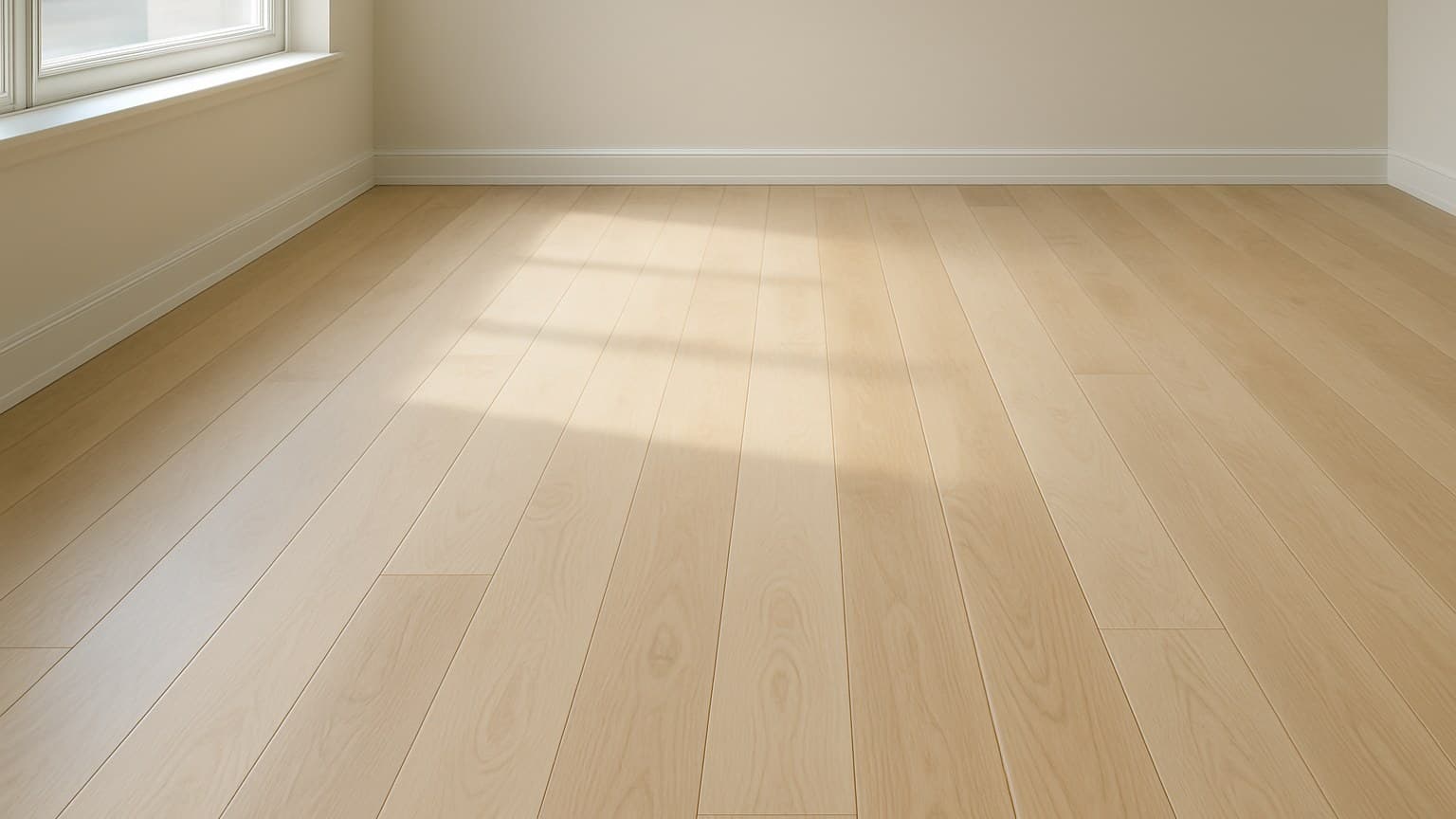
On a remodel I ran in Rochester, New York, the homeowner picked birch engineered hardwood because the sales rep at the store called it "hard" and left it there. That pitch skips which birch species you're actually getting, how thin the veneer really is, and what happened to the plywood core underneath. Here are the eight facts I check before I let a birch floor go down in someone's house. I hear that same thin pitch repeated almost word for word by staff walking customers through Floor & Decor's engineered hardwood options.
Key takeaways
- Yellow birch rates about 1,260 lbf on the Janka hardness scale, essentially tied with red oak (1,290) and softer than maple (1,450) or hickory (1,820).
- Only the veneer refinishes: a 2mm-plus sawn wear layer can take a sanding or two, while a 0.6mm budget veneer takes none.
- Engineered birch can install below grade over concrete; solid birch cannot, and neither belongs in a bathroom.
- Birch plywood cores got pricier and scarcer after Russian and Belarusian birch was sanctioned in 2022, so ask where a plank's core is sourced now.
- Budget roughly $3-8 per sq ft for material plus $2-5 per sq ft labor, with basements and stairs costing more than open rooms.
1. Yellow Birch Rates ~1,260 lbf on the Janka Scale, Just Under Red Oak
Yellow birch sits around 1,260 lbf on the Janka scale, per the USDA Forest Products Laboratory. That puts it basically tied with red oak at 1,290, not "harder than oak" the way a lot of sales copy claims.
Janka is a simple dent test: it measures how much force it takes to press a steel ball halfway into the wood. A higher number means fewer dings from chair legs, dog nails, and hard heels. Birch and oak resist dents about the same, and both give up ground to maple and hickory. That same dent question changes shape entirely once you're weighing engineered hardwood vs laminate, since laminate's wear layer doesn't dent the way real wood veneer does.
One catch: not all birch is yellow birch. Sweet and paper birch run softer, so ask exactly which birch species the veneer is before you trust a hardness pitch.
And on an engineered plank, that Janka number only applies to the thin birch veneer on top. The plywood core underneath does nothing for surface dent resistance, so a hard core is not the same as a hard floor.
| Species | Janka hardness (lbf) |
|---|---|
| Black cherry | 950 |
| Black walnut | 1,010 |
| Yellow birch | 1,260 |
| Red oak | 1,290 |
| Hard maple | 1,450 |
| Hickory | 1,820 |
Janka hardness in pounds-force for six common flooring woods, with yellow birch marked.
2. The Veneer Thickness Decides Whether You Can Ever Refinish It
An engineered birch plank is a sandwich: a thin birch veneer on top (that's the wear layer, the real wood you see and step on), glued over a cross-layered plywood or HDF core, with a balancing backing veneer on the bottom. HDF is high-density fiberboard, basically compressed wood fibers.
Whether you can ever refinish it comes down to that top veneer, and nowhere else. According to the National Wood Flooring Association's guidance on refinishing engineered wood floors, wear-layer thickness, not the word "engineered" on the box, is what determines whether a floor can be sanded again. Tie the mm figure to the actual product, never to an "engineered" label. Mullican's Muirfield birch line, for example, ships with a sawn veneer of 2mm or more and can usually take a light sanding once or maybe twice. A budget plank like Home Legend's birch collection runs closer to a 0.6mm veneer, which can't be sanded at all, because there's nothing there to remove before you hit glue. Somerset's engineered birch lines tend to land somewhere between those two extremes, so it's worth pulling the spec sheet on Somerset's engineered hardwood flooring before assuming either way.
I've seen how little margin thin wood gives you. On a solid oak floor for a customer in Dayton, Ohio, who wanted it refinished a fourth time, one corner sanded down to the tongue before I caught it. Now I check remaining thickness at the edges first. On an engineered plank that margin is far smaller, sometimes zero, so treat "can I refinish this later" as a spec question, not a freebie that comes with the word engineered.
The cross-layered core earns its keep a different way. Those plies stacked at right angles are why engineered birch stays flatter over concrete than a solid birch board would, since they cancel out each other's swelling and shrinking. That stability is the core reason so many buyers weigh solid vs. engineered hardwood floors before settling on a species and construction for the room.
If you want lines that are actually built with real sawn veneer, my rundown of the best engineered hardwood options sorts the ones worth refinishing from the ones that aren't.
3. Birch's Sapwood-Heartwood Contrast Splits Into Select and Character Grades
Birch's signature look is strong contrast between pale, creamy sapwood and reddish-brown heartwood. Grade is what controls how busy that contrast reads once the whole floor is down.
Select grade is cleaner and more uniform, with the color kept closer together board to board. Character grade shows more color swing, small tight knots, and mineral streaking (dark mineral lines in the wood) for less money. Neither is better in a vacuum; a busy Character floor can look great in a casual room and fight a formal one.
Figured birch, the curly, flame, and tiger patterns, is genuinely rare and carries a real premium. It's almost always used as a veneer showpiece, not a whole-plank feature, so expect it on the top layer only.
Plank widths run roughly 4-12 inches. Wider boards show off more of that contrast, but they also telegraph any bump in the subfloor, so flatness matters more the wider you go.
4. Engineered Birch Can Go Below Grade, Solid Birch Can't
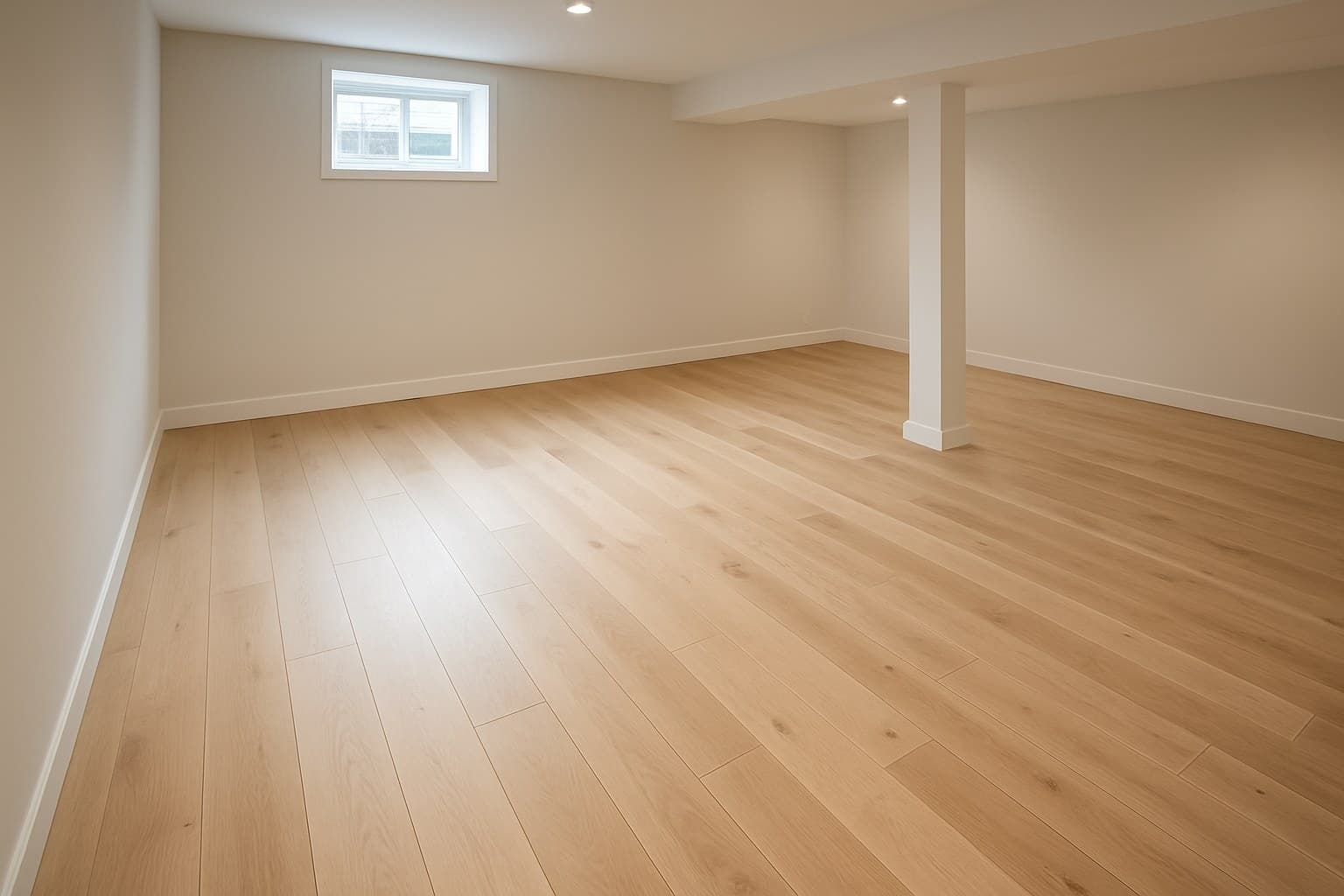
The core's cross-layers are what let engineered birch install over a concrete slab in a basement, where solid birch is not recommended. That said, neither one belongs in a full bathroom. Below grade means below ground level, like a basement.
You've got three install methods: glue-down, floating click-lock, or nail-down over a wood subfloor. Many engineered birch lines are also radiant-heat compatible, but that's a per-product claim, so confirm it on that exact floor's spec sheet before you assume it.
Keep two claims separate. A birch core may shrug off normal humidity swings, but the seams and plank edges are the weak point, not the plank face. Standing water finds those joints and wrecks the floor from the seams out, which is why I keep birch out of rooms that flood. If a genuinely wet room is non-negotiable, look at waterproof engineered hardwood options built to handle standing water at the seams instead.
Where moisture is the real driver of the decision, weigh birch honestly against vinyl using this engineered hardwood vs LVP breakdown. And no matter which you pick, check subfloor flatness and slab moisture before a single plank goes down. A moisture meter (a handheld tool that reads how wet the slab is) and a straightedge across the floor catch the problems that void warranties later.
5. The 2022 Sanctions Reshaped Birch Plywood Cores and Prices
Here's the part vendor pages skip: Russia and Belarus were major sources of birch plywood, and the 2022 sanctions after the invasion of Ukraine cut off that supply. According to the NWFA/FCICA webinar on the impact of the Russian-Ukrainian conflict on birch plywood used in engineered flooring, prices on birch cores climbed and lead times stretched as manufacturers scrambled to line up alternative mills.
So ask where a specific plank's core is sourced now, whether that's a domestic, Baltic, or Asian mill. Sourcing shifted fast after 2022, and core quality varies more than it used to depending on which mill filled the gap.
This is also part of why some birch engineered prices jumped. A suspiciously cheap "birch" floor deserves a hard look, because the bargain may ride on a non-birch core with a thin birch veneer glued on top. The word birch on the box does not guarantee birch all the way down.
If price is the sticking point, compare current birch lines against budget-focused engineered options before you commit to paying the birch premium.
6. Installed Birch Engineered Runs About $5-13 per Sq Ft, Split Two Ways
Don't trust a single flat number here. Material lands roughly $3-8 per square foot, and labor roughly $2-5 per square foot, which is where the $5-13 installed range comes from. Figured or wide-plank birch pushes the material end higher.
Basements and stairs cost more than open rooms. Basements add moisture prep and slab work; stairs add slow, fussy cutting. Both mean more transitions and more waste than a wide-open living room where the boards just run.
I used to quote flat by the square foot until a job in Tulsa, Oklahoma, full of closets, doorways, and a bay window ate a whole extra day. Now I count the cut-heavy areas separately, because the open middle of a room is never where the time goes.
Install method moves labor too. Glue-down and nail-down usually cost more in labor than a floating click-lock install, and click-lock is the one a handy homeowner can realistically tackle. Glue-down and stairs are where I'd hire out.
| Cost component | Low ($/sq ft) | High ($/sq ft) |
|---|---|---|
| Material | 3 | 8 |
| Labor | 2 | 5 |
Typical material and labor ranges per square foot for birch engineered hardwood, before basement or stair premiums.
For a full room-by-room breakdown, see the engineered hardwood flooring cost guide.
7. A Birch Floor's Carbon Footprint Is Spelled Out in Its EPD
If sustainability matters to you, the honest number lives in the product's EPD. An EPD, or Environmental Product Declaration, is a third-party-verified label that lists a product's carbon and energy use across its life. According to the NWFA's Engineered Wood Flooring Environmental Product Declaration, the industry EPD for wood flooring is measured over a 75-year functional unit, meaning the assessment assumes the floor serves for 75 years.
Don't buy on a vague "eco-friendly" sticker. Ask for the specific product's EPD, and look for FSC-certified birch. FSC stands for the Forest Stewardship Council, an independent group that certifies wood came from responsibly managed forests.
Wood itself stores carbon, which helps birch's case. But the plywood core's glue and the shipping distance count against it, and the EPD is where those offsetting numbers actually show up instead of getting hand-waved away.
I won't quote a per-square-meter carbon figure I can't tie to your exact plank. The product's own EPD is the only honest source for that, and any single number I threw out here would be a guess dressed up as a fact.
8. Birch vs. Oak vs. Maple vs. Hickory, by the Numbers
Line up the hardness and birch lands in the middle: birch around 1,260 lbf, oak at 1,290, maple at 1,450, and hickory at 1,820. Birch dents easier than maple or hickory and holds up about the same as oak. If a busy household with big dogs is your reality, hickory buys you real margin that birch does not.
Finish behavior is where birch surprises people. Birch takes stain unevenly and can blotch, much the same way maple does, because its tight, closed grain doesn't drink stain in evenly. Oak's open grain accepts stain far more predictably, so a dark, even stain is easier to get right on oak than on birch.
For appearance, birch and maple both read smooth and modern with subtle grain, while oak shows the stronger cathedral grain pattern most people picture when they think "wood floor." Hickory is the wildest of the four, with dramatic color swings board to board.
So the pick isn't "which is best," it's which trait you're buying for: birch for that pale-to-reddish contrast at a mid price, oak for stain flexibility and grain, maple for a clean look, hickory for toughness. If birch is edging out of your budget or your durability needs, my guide to the best engineered hardwood lines lines up strong options across all four species.
Sources
- NWFA Engineered Wood Flooring Environmental Product Declaration (2025)
- NWFA Engineered Wood Flooring Environmental Product Declaration (2023)
- NWFA/FCICA Webinar: Impact of the Russian-Ukrainian Conflict on Birch Plywood Used in Engineered Flooring
- NWFA Homeowner's Handbook to Real Wood Floors
- NWFA Hardwood Floors Magazine: Is It Refinishable?