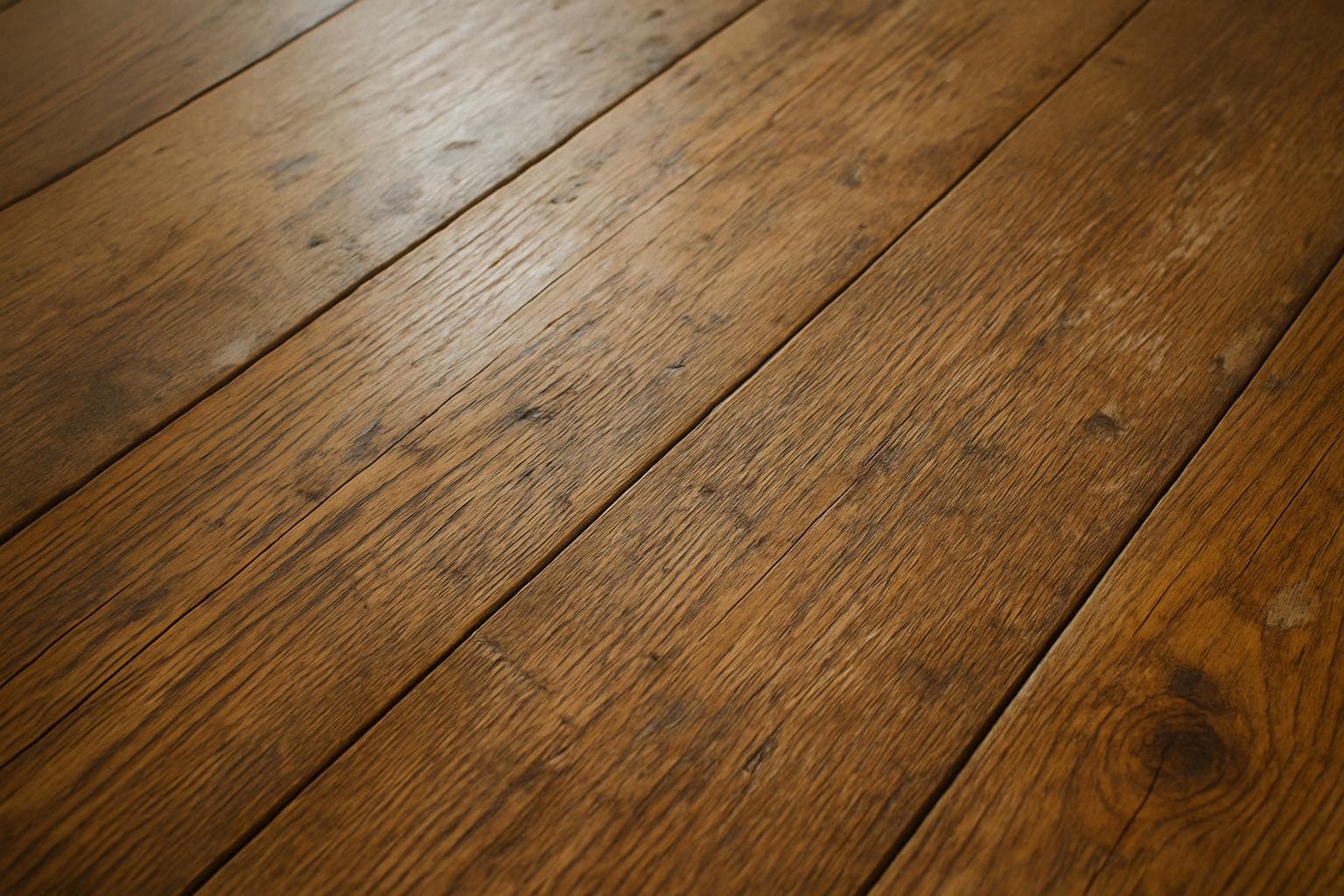
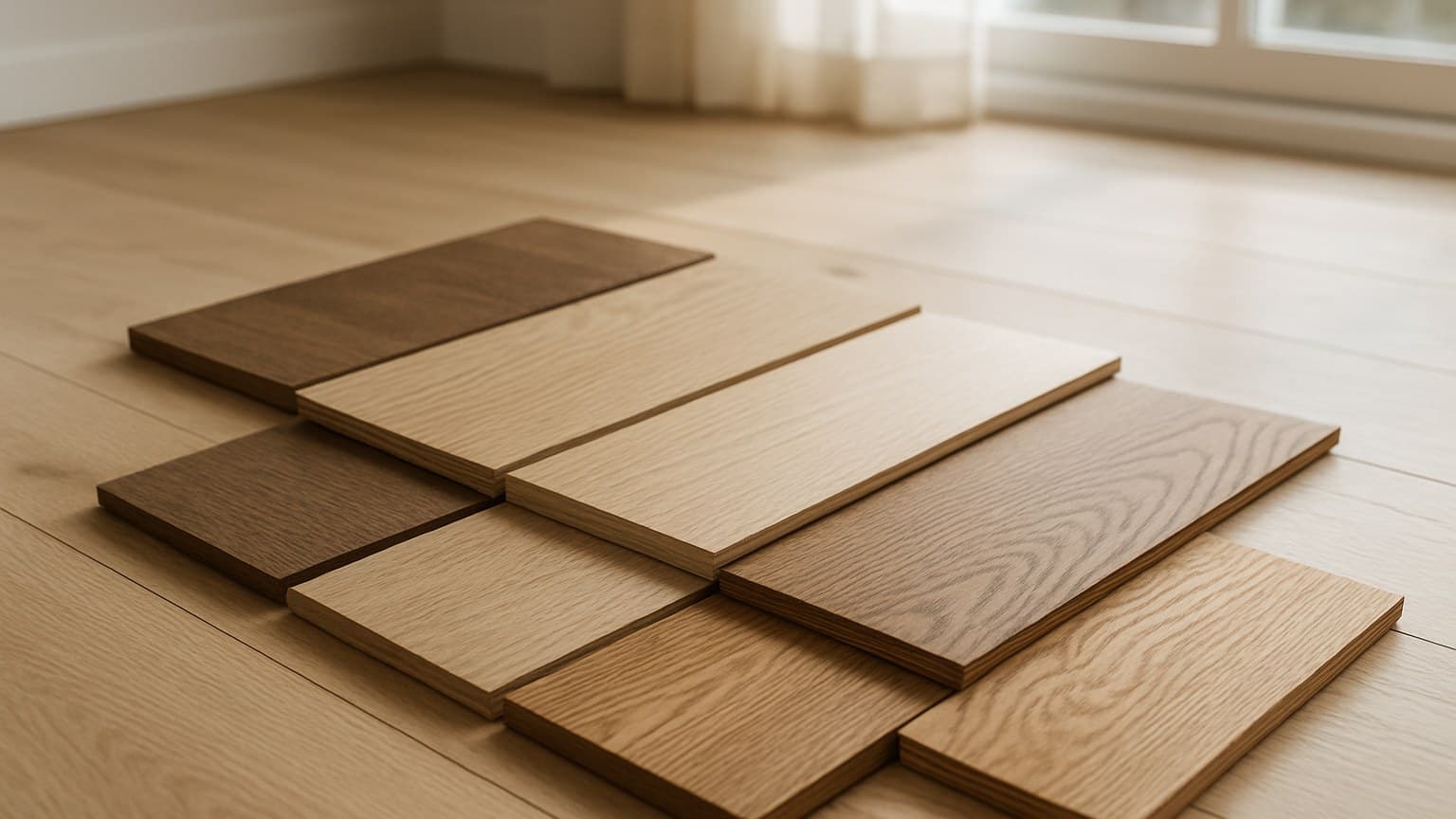
Last month, a homeowner in Columbus, Ohio, lined up four engineered hardwood swatches on her kitchen counter, and not one matched the board she'd picked out at the showroom. That's normal, a swatch only answers a color question. The thing that actually decides how long the floor lasts is hiding on a spec sheet, not on the wood in your hand. Mixing those two up is how people end up buying a floor they can never sand and refinish.
Key takeaways
- Manufacturer swatches run bigger than store chips: Mirage mails 10-inch (254mm) swatches, up to 4 for $9.99, while retailers like Floor & Decor and Home Depot often hand out small chips free.
- A sample shows you color and texture, not durability. The number that matters is the wood veneer (wear layer) thickness and whether the product carries NWFA Refinishable Program certification.
- Tape samples to the floor for a few days and look at them in morning and evening light before you commit, because color shifts hard by lighting and some species like Brazilian cherry keep darkening for years.
- Order a full-plank sample, not just a chip, when the floor has a wide board, heavy texture, or hand-scraping, because a 3-inch swatch hides how the pattern actually repeats.
- Paid samples are usually refundable or credited toward your order, but check the return policy before you buy four of them.
What Engineered Hardwood Samples Show You (and What They Can't)
A sample confirms color, sheen, and texture in your own light. That's the whole job. It can't tell you how durable the floor is, whether you can ever refinish it, or how it will wear under a dog and a dining chair, because none of that is printed on the wood. Those answers live on the product's spec sheet.
As a flooring installer, I see two mistakes come up on almost every job I walk into. The first is judging color under store lighting, which is built to flatter every board on the rack. The second is assuming the little chip's feel matches the whole plank, when a 3-inch piece flattens out texture and hides how the grain and knots really repeat across a room.
Samples come in three forms, and each answers a different question. A small store counter chip gives you a fast color gut-check. A mailed manufacturer swatch is bigger and lets you judge color and sheen in your actual room. A full-plank sample shows you the real board: the width, the texture, the way a hand-scraped pattern moves.
Treat sample shopping as a numbers decision, not a transaction. Get the right size for the floor you're eyeing, know what it should cost, then back it up with the one spec that decides how long the floor lasts.
How to Order Samples: Cost, Size, and Delivery
You have three places to get samples, and they trade cost against how much they actually show you. In-store chips are usually free and the smallest. Mailed manufacturer swatches are bigger and cheap to free, Mirage mails 10-inch (254mm) swatches, up to 4 for $9.99. Full-plank samples are the largest and sometimes carry a small fee that's refundable or credited to your order.
Free vs. Paid Samples
Free store chips cost you nothing, but they show the least, often a piece too small to read texture on. A paid full plank costs a few dollars and can save you a mismatch on a wide or heavily textured board. On a floor that's going to run into the thousands installed, paying for one real plank to avoid a reorder is cheap insurance.
Most mailed swatches arrive within about a week. One warning: clearance and discontinued colors often have no samples left at all, so if a retailer can't get you a swatch, treat that as a sign the color may be on its way out.
Chip vs. Full-Plank Sample
Order more than one finish of the same species so you can lay them side by side instead of judging one at a time, alone, from memory. Memory is a poor color-matching tool. When the board is wide, textured, or hand-scraped, skip the chip and pay for the full plank.
| Format | Typical size | Typical cost | Delivery | Best for |
|---|---|---|---|---|
| In-store counter chip | 3-5 inches | Usually free | Take it home same day | Quick color gut-check |
| Mailed manufacturer swatch | 5-10 inches (Mirage: 10 in / 254mm) | Free to ~$10 (Mirage: 4 for $9.99) | About a week | Judging color and sheen in your room |
| Full-plank sample | 12-48 inches | Small fee, often refundable | About a week | Wide boards, heavy texture, hand-scraping |
Source: Mirage's published sample page and the sample runs I order before every hardwood job
Sample formats compared by size, cost, delivery, and what each one is good for.
Here's the same size gap drawn out, so you can see why a chip and a full plank aren't answering the same question.
| Format | How many to order |
|---|---|
| In-store chip | Grab 2-3 finishes so you can compare colors side by side |
| Mailed swatch | Order at least 2 finishes of the same species before judging one alone |
| Full-plank sample | One is usually enough, but get extra on wide or hand-scraped boards |
How many samples of each format to order before you commit, pair this with the size and cost table above.
What to Check on a Sample: Wear Layer and Refinishability
On engineered hardwood, the real wood veneer on top, called the wear layer, decides whether you can ever sand and refinish the floor, and how many times. That single number matters more than any color you'll pick. If you haven't settled on engineered over solid yet, my guide to picking solid vs. engineered hardwood and the right species walks through that bigger decision first.
A thin veneer may never be sandable, meaning when it's scratched or dull, your only fix is to replace it. A thicker veneer can usually take a light sanding once, sometimes more. But I won't hand you a magic thickness, because the number that counts is the one on that exact product's spec sheet, not a rule of thumb passed around online. Two boards that look identical can have very different veneers under the finish.
There is one shortcut for buyers who don't want to guess: according to the NWFA's Refinishable Program, a product can only carry that certification after its veneer meets the association's documented criteria for a sandable, refinishable wear layer. If a product is certified, look for that instead of squinting at the edge of a sample.
Because none of this prints on the wood, the sample alone won't answer it. Before you buy, pull the spec sheet or ask the retailer flat out for the veneer thickness and the warranty terms in writing. If they can't tell you, that tells you how much they know the product. For the fuller breakdown of how veneer thickness stacks up against a vinyl core, my rundown of engineered hardwood versus LVP walks through where each one wins.
Finishes and Textures You Can Only Judge in Person
Finish and texture are the two things a photo lies about most, which is exactly why you order a sample. Matte and satin finishes hide scratches, footprints, and dust better than gloss. Gloss looks rich in a listing photo and then shows every scuff and paw mark in real life. Seeing that sheen in your own light is worth more than any product page.
Sheen: Matte, Satin, Gloss
Hold the sample flat and tilt it under a lamp. A matte or low-satin sheen scatters light and forgives daily wear. A gloss coat throws a hard reflection that broadcasts every mark. If you're leaning gloss, order the sample first and live with it a few days before you commit.
Texture: Smooth, Brushed, Scraped
Texture terms trip people up, so here's the plain version. Wire-brushed means the soft grain is scraped out to leave shallow grooves that hide everyday wear. Smooth is exactly that, the cleanest look, and it shows every mark. Hand-scraped has hand-carved dents and waves for a worn, older look.
A small chip flattens all of that. When the floor is hand-scraped or distressed, order a full-plank sample so you can see how the pattern repeats, because a 3-inch piece won't show you the rhythm of the scraping across a whole board. If you're weighing those looks, my guides to hand-scraped engineered hardwood and distressed engineered hardwood lay out the tradeoffs before you order a single swatch.
Testing Samples in Your Room's Real Light
Tape the sample flat to the floor right where it's going to live, then look at it over a few days in morning light, at midday, and under your lamps in the evening. Color moves hard between those, and the sample that read warm and brown in the store can turn gray or pink in your hallway.
Showroom lighting is designed to make wood look good. Your kitchen at 7 a.m. is not. That gap is why so many returns happen, and taping down a swatch for a few days costs you nothing but patience.
One caution from my own tear-outs: some species keep changing color with sun exposure for years. Brazilian cherry is the worst offender. I've pulled area rugs off floors like that and found a bright patch underneath that no refinishing ever evens out, because the exposed wood kept darkening while the covered wood stayed put. If that species is on your list, read what to settle before buying Brazilian cherry engineered hardwood so the color shift doesn't surprise you.
Last thing: judge the sample against your trim, cabinets, and wall color, not just against the old floor you're ripping out. A board can match the floor it replaces and still fight everything else in the room.
Durability and Long-Term Cost the Sample Won't Show
The sample can't show you the two numbers that decide value: how long the floor lasts and what it costs installed. Both come from the spec sheet and a local quote, never from the swatch. A gorgeous chip on a floor you can't refinish is a floor you'll be paying to replace sooner than you think.
On cost, split it in two and never trust a single flat national number. For engineered hardwood, materials commonly run about $3-$14 per square foot depending on veneer thickness, species, and plank width. Labor to install usually adds about $3-$8 per square foot for a straightforward glue-down or floating job in an open room. Those are starting ranges to confirm with local quotes, because region and prep swing them a lot.
Two things push the labor end up. Stairs are slow, hand-fit work and cost more per step than open floor. Basements add moisture testing and sometimes a moisture barrier, so a below-grade job runs higher than the same square footage in an open living room. Wide 12-inch boards also demand a flatter subfloor and more careful setting, which is its own reason to check a few things before buying 12-inch-wide engineered hardwood.
There's also a sustainability angle the spec sheet doesn't advertise but the NWFA's environmental product declaration documents directly: the life-cycle environmental footprint of engineered wood flooring, covering raw material sourcing, manufacturing, in-home use, and eventual disposal. The NWFA's life-cycle-cost research draws the same thread through to your wallet, refinishability is what keeps a floor's total cost, and its material footprint, down over decades, because a floor you can sand and recoat stays out of the landfill far longer than one that gets torn out the moment the wear layer dies. Read that way, the veneer thickness on the spec sheet isn't only a durability spec; it's a sourcing and disposal decision too.
Here's the part the sample buries: on a job for a homeowner in Dayton, Ohio, the subfloor felt dry to the hand, but a moisture meter, a tool that checks how much water sits in concrete or wood, read otherwise, and that mismatch is what buckled the floor six months later, not the plank itself. A hump I talked myself into ignoring caused the same kind of failure on another job. So before you fall for a swatch, budget for subfloor flatness and moisture checks. Skip them, and the manufacturer's warranty won't cover what happens next. In rooms where moisture is a recurring risk, it's worth reading up on waterproof engineered hardwood flooring options before you commit to a standard veneer.
Picking a brand that publishes real specs makes all of this easier. If you're still narrowing the field, my ranking of the best engineered hardwood brands by the numbers and my list of engineered hardwood warning signs and brands to avoid will tell you which makers actually stand behind the veneer. For the full money picture, read the engineered hardwood flooring cost guide next, because it breaks materials and labor down room by room before you sign a quote.