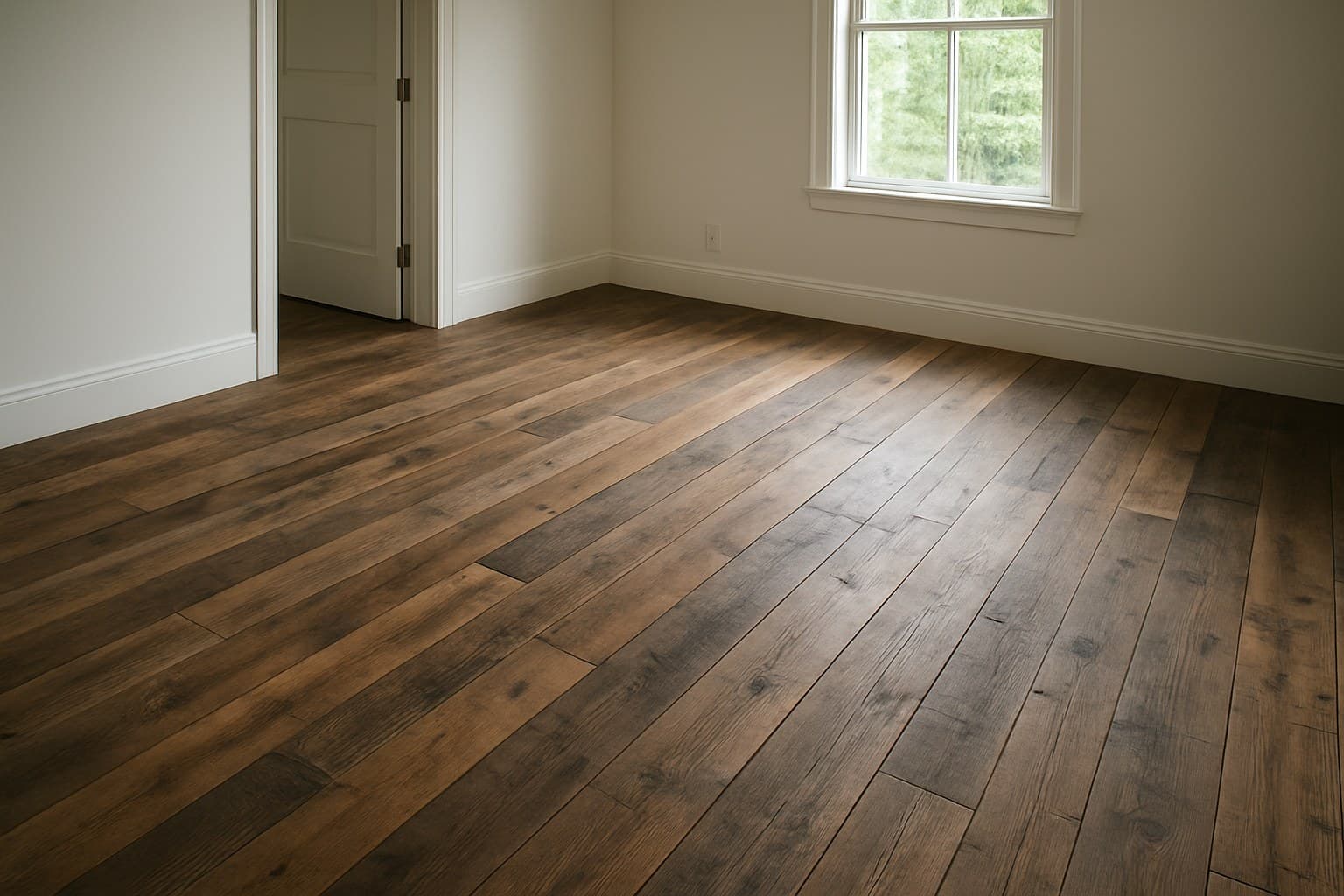
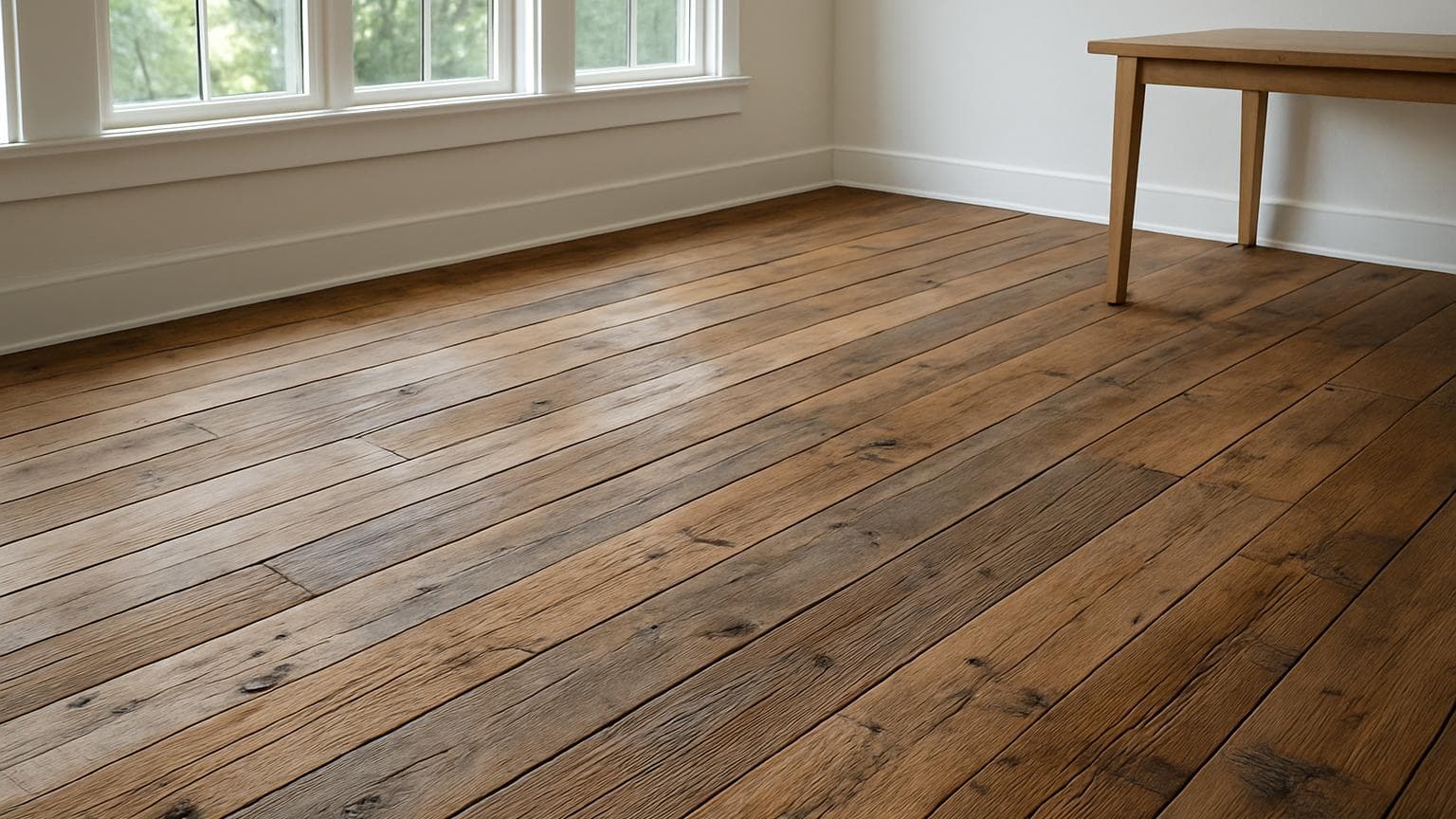
When I bid a farmhouse remodel for a client in Lancaster, Pennsylvania, the "reclaimed barnwood" sample she'd been quoted turned out to be new pine run through a wire brush and a stain gun. Chemically distressed new wood can look almost identical to real reclaimed barnwood flooring in a showroom, and plenty of it gets sold at reclaimed prices. The tells hide on the parts you don't normally look at, and here's how to find them before you pay.
Key takeaways
- Real reclaimed planks show saw marks and weathering on the BACK and edges too; printed or machine distressing stops at the face you look at.
- Old nail holes are square-ish with rust ghosting (a brown halo bleeding into the grain) and placed unevenly; drilled fakes are round, clean, and evenly spaced.
- Chemically distressed new wood smells sharp and shows the same wear pattern repeating plank to plank; real barnwood smells like old dry wood and repeats nothing.
- Genuine reclaimed barnwood materials commonly run $8-20 per square foot before milling and labor; a quote that looks cheap for 'reclaimed' usually isn't reclaimed.
- Ask three chain-of-custody questions: where is the barn, can they show a tear-down photo or invoice, and is the wood kiln-dried and de-nailed.
The Short Answer: Five Checks Before You Pay
Real reclaimed barnwood carries its history on every face, including the back and the edges. No factory bothers to fake the parts a buyer will never see, so that's exactly where you catch it. The National Wood Flooring Association (NWFA), the flooring industry's trade group, maintains an official definition of "real wood flooring" that draws this same line, genuine solid or engineered wood, not a printed or laminated look-alike, which is the distinction every check below is built around.
Run these five checks, in this order, on a sample plank before any money changes hands: flip it and read the back, read the nail holes, smell it and scan for chemical aging, ask the supplier three sourcing questions, then sanity-check the price. You can do all five with your eyes, your nose, and your phone camera.
One thing worth saying plainly first: chemically distressed new wood is a real, legitimate product. It's fine at its own price. The problem is only when someone charges you true reclaimed money for it. None of these checks are about shaming the fake, they're about making sure the price on the tag matches what's actually under it.
Step 1: Flip the Plank and Read the Back
The single fastest tell is to turn the sample over. Real reclaimed barnwood was cut on old mills and then weathered for decades on a standing barn, so the back shows blade marks and gray patina too, not a clean sanded face.
On genuine stock you'll see arced circular-saw marks (the curved cuts an old blade left) or straight sash-saw lines (the parallel cuts left by an old up-and-down framed saw), plus checking, which is the fine surface cracks that run along the grain. Look for dirt and gray weathering worked down into those cracks. Sun and rain reached that wood for years, and you can't sponge that color on evenly.
The fake tell is distressing that stops at the show face. If the front looks aged but the back is machine-smooth or carries a printed grain, the "age" was added at a factory, not earned on a barn.
Go or no-go: if the back tells a matching story of saw and weather, that's a GO. A pretty face over a blank machined back is a NO-GO. Treat that plank as barnwood-style, not reclaimed, and pay accordingly.
Step 2: Read the Nail Holes for Rust Ghosting
Old barns were built with square-cut nails driven by hand. Real holes are roughly rectangular, they sit at odd spacings where boards were actually fastened, and they often carry rust ghosting.
Here's what rust ghosting means in plain words: the iron in an old nail reacted with the wood's natural tannins and moisture over many years, staining a brown or black halo that bleeds out into the grain around the hole. You cannot paint that on convincingly. It reads as depth, not a surface dot.
The fake tell is round, clean holes of one uniform size, spaced in a tidy grid, with no rust stain at all. That's a shop drilling holes for looks.
Go or no-go: square-ish holes with rust halos and random placement is a GO. Uniform round drill holes in neat rows is a NO-GO.
Step 3: Sniff and Scan for Chemical Distressing
Your nose does real work here. Genuine barnwood smells like old, dry wood, and sometimes faintly of the barn itself, like hay and dust. A sharp, solvent, or ammonia-like smell points to chemical aging or a heavy new finish laid over new wood. The EPA notes that solvent-based stains and finishes can release volatile organic compounds (VOCs) into indoor air, which is often exactly the sharp smell you're picking up on a freshly "aged" fake.
Then scan several planks side by side. Manufactured "wormholes," saw marks, and worn spots often repeat in the exact same place from plank to plank. Real weathering repeats nothing, because no two boards on a barn aged the same way. A pattern that copies itself down the stack is a rolled or stamped process, full stop.
One more field test: rub a hidden spot with a damp rag. If a gray or brown "age" color wipes off or lightens, it was sitting on the surface. Real weathering goes into the wood and won't budge with a wet cloth.
Go or no-go: neutral old-wood smell with no repeating pattern is a GO. A chemical smell, or a wear pattern that clearly repeats, is a NO-GO.
Step 4: Ask the Supplier Three Chain-of-Custody Questions
Chain of custody just means the paper trail: where the wood came from and what happened to it before it reached you. A real reclaimer can walk you through it. A reseller dressing up new wood will get vague fast.
Where did it come from? A real reclaimer can name the region and usually the building type, like a dairy barn, a tobacco barn, or an old mill. Answers like "sourced from old structures" with no specifics are a flag.
Can you show it? Ask for a tear-down photo, a salvage invoice, or at least the barn's rough age. Legitimate suppliers have this on hand. Greenwashers change the subject.
How was it processed? According to the NWFA's installation guidelines, real reclaimed flooring should be de-nailed, kiln-dried to a stable moisture level, and re-milled with a tongue-and-groove edge so it locks together. Kiln-drying matters more than it sounds. Old barn wood sat outside for decades and needs its moisture pulled down and evened out, or it moves after install, a failure mode the NWFA's Homeowner's Handbook to Real Wood Floors flags as one of the most common causes of cupping and gapping in solid wood floors. When I re-laid a farmhouse floor for a homeowner in York, Pennsylvania, the only boards that cupped within a month were the ones the supplier had skipped kiln-drying on, the wood itself was fine, the shortcut before it left the yard wasn't. If moisture-driven cupping like that worries you, our breakdown of solid versus engineered hardwood floors explains which construction resists it best in rooms prone to humidity swings.
Go or no-go: straight, specific answers to all three is a GO. Dodging any one of them is a NO-GO, or at least your cue to renegotiate down to a barnwood-style price.
Step 5: Sanity-Check the Price
Real reclaimed barnwood is slow, labor-heavy work. Someone pulled a barn down, yanked nails by hand, kiln-dried the stock, and re-milled it. That labor is baked into the price, which is why genuine reclaimed materials commonly land around $8 to $20 per square foot before install. Rare species run higher.
Reclaimed stock is often old-growth wood you simply can't buy new anymore, like heart pine from beams and barn siding, old-growth oak, or American chestnut. As the NWFA's "Use Real Wood" resource points out, genuine solid or engineered wood flooring can typically be traced back to the mill or forest it came from, a chain of custody no printed vinyl or laminate floor can offer. If you love wide, character-heavy boards but don't need the barn history, a new wide-plank pine floor gives you a similar feel for a lot less. Another new-wood option worth a look is acacia, which brings similarly bold grain and hardness without the reclaimed price tag; here's what to check before you buy acacia flooring.
Split the money honestly, because materials are only part of it:
| Cost piece | Typical per sq ft | Notes |
|---|---|---|
| Reclaimed barnwood materials | $8 - $20 | Rare species like American chestnut run higher |
| Milling + de-nailing (rough stock) | $1 - $4 | Skip if you buy finished, milled planks |
| Pro install labor | $3 - $8 | Stairs and basements cost more than an open room |
Source: chestnut farmhouse floors I've bid and installed around the mid-Atlantic
What genuine reclaimed barnwood typically costs per square foot, split into materials, milling, and labor, before finish and waste.
The arithmetic is simple: total = area (sq ft) x (materials + milling + labor). Say you've got a 200 square foot room and you land at $12 materials, $2 milling, and $5 labor. That's $19 per square foot, so 200 x $19 is about $3,800 before finish and waste. Add roughly 10 to 15 percent for waste on reclaimed, since more boards get culled.
Go or no-go: a quote that lands in that reclaimed range is a GO. "Reclaimed barnwood" priced like $3 to $5 per square foot laminate is a NO-GO. You're being sold a look, not the real thing. And if it's the look you're after, you'll get more honest grain from a new solid floor in hickory, black walnut, or the warmer tones of cherry than from fake-aged filler.
Putting the Five Checks Together
No single check is bulletproof on its own. A good faker can nail one or two. What they can't do cheaply is pass all five at once, because faking the back, the nail holes, the smell, the paperwork, and the price all together costs more than just selling real reclaimed wood.
So weight them. The back and the nail holes are your hardest physical evidence, since they show what a factory won't spend money faking. The smell and the repeat-pattern scan catch chemical jobs. The three questions and the price are your backstop when the sample looks convincing but something feels off.
If a plank passes the back and the nail holes, and the supplier answers all three questions straight, and the price sits in the real range, you're almost certainly looking at genuine reclaimed barnwood. If it fails two or more, walk, or pay barnwood-style money and know exactly what you're getting.