
Last spring I redid a mudroom for a family in Aurora, Colorado, whose two dogs and three kids had chewed up a plain gray LVP floor in under two years, every seam and scratch on full display. This time we went with terrazzo vinyl flooring: standard luxury vinyl, printed with a speckled stone-chip pattern instead of a wood grain, not real stone at all. The busy print swallows plank seams, crumbs, and micro-scratches that a wide wood-look floor puts on full display, and that's exactly why it's become my go-to pick for rooms that take a beating.
This floor is easy to get wrong at the seams, the format, and the subfloor, and those three are exactly where the cheap version fails. So before you fall for a showroom sample, it's worth knowing what you're actually buying and where it earns its keep.
Key takeaways
- Terrazzo vinyl is ordinary LVP, tile, or sheet vinyl printed with a high-res photo of the speckled stone-chip look over a plastic core; there are no real stone chips in it.
- The core is either SPC (stone plastic composite, denser and more dent-resistant) or WPC (wood plastic composite, softer and warmer underfoot), and the clear wear layer on top decides scratch resistance, a number set per product, not across the category.
- The busy speckled pattern hides seams, crumbs, and dust far better than a wood-look plank, which is why it wears well in kitchens, baths, and entries.
- A waterproof core only means the plank body won't swell; water still gets in at seams and edges, so wet rooms need sealed seams or a glue-down/sheet format.
- Expect materials around $2-7 per sq ft for click-lock plank and $1-4 for sheet, with labor roughly $2-6 per sq ft by format; basements and stairs run higher than open rooms.
What Terrazzo Vinyl Flooring Actually Is
Terrazzo vinyl flooring is standard luxury vinyl, sold as click-lock plank or tile, glue-down tile, or sheet vinyl off a roll, printed with a photo of the speckled stone-chip terrazzo look. There are no real stone chips in it. What you walk on is a high-resolution picture of ground stone set in cement, laid over a plastic core, the same way wood-look LVP is a photo of an oak board.
Real terrazzo is a different animal. It's actual stone or glass chips poured into cement or resin, then ground and polished flat. It's heavy, it's poured in place or cast into tiles, and it costs a lot more to buy and install. Vinyl copies the look at a fraction of the weight and price, and you can float it over an existing floor in a weekend — though if you're starting from an old vinyl floor and weighing the opposite move, it's worth checking whether you can tile over vinyl flooring before you commit either direction.
If it's a genuine patterned tile floor you're after instead of a printed one, that's a whole different project with its own headaches, like the ones I walk through in 8 hexagon tile decisions that come back as callbacks. But if you just want the speckled look underfoot without the poured-stone budget, vinyl is the shortcut.
One more thing worth knowing: the terracotta-look and other stone-look vinyls you'll see next to it on the shelf are the same build with a different printed image. Change the photo, keep the core. That's the whole family.
The Layers That Decide If It Holds Up
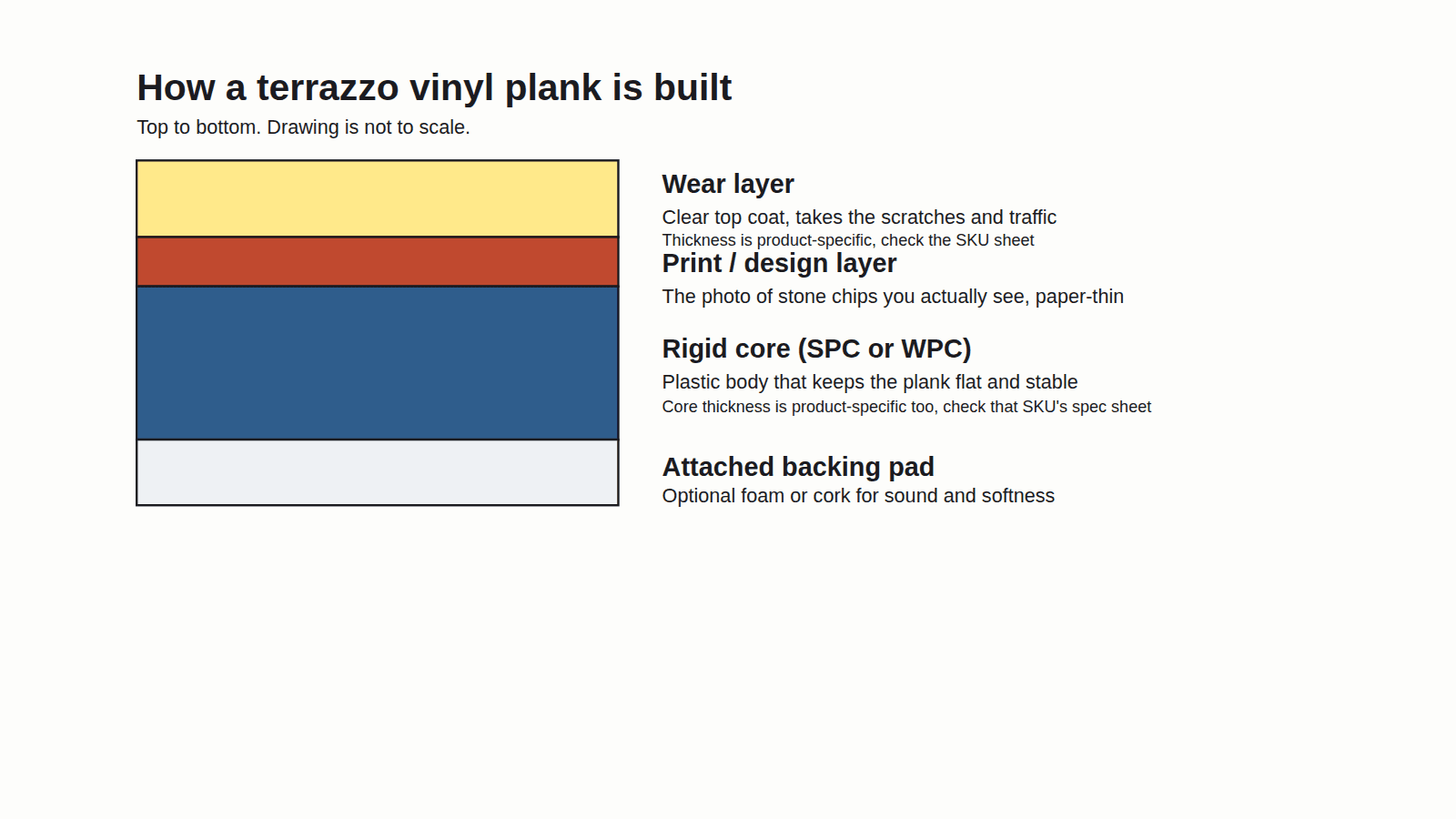
A terrazzo vinyl plank is a stack, and each layer has one job. From the top down: a clear wear layer, the printed design layer, a rigid plastic core, and sometimes an attached pad on the back.
The clear wear layer is the part that actually takes the scuffs, not the print. It's measured in mils (thousandths of an inch), and thicker generally means more scratch resistance. Every product lists its own number, so read the exact SKU's spec sheet rather than trusting a category rule of thumb. A heavier residential or light-commercial plank will carry a thicker wear layer than a bargain line, and that gap is what shows up after a few years of dog nails and dragged stools.
The core comes in two flavors, and the names sound worse than they are:
- SPC (stone plastic composite) is denser and harder. It shrugs off dents from dropped pans and heavy furniture legs, and it stays flat over small subfloor imperfections. It also feels harder and cooler underfoot.
- WPC (wood plastic composite) is a bit softer and warmer to stand on, with a little more give. It's kinder to feet and joints but dents a touch easier.
The layers above are a not-to-scale cutaway of a typical terrazzo vinyl plank.
Here's the honest part, and it's the same truth behind whether any vinyl floor lasts 5 years or 20: the finished floor only lasts as long as the prep under it. A great plank over a lumpy, damp subfloor will telegraph every flaw and pop apart at the seams. The core and the wear layer matter, but they matter less than what you laid them on.
Why the Speckle Hides Seams and Dirt Better Than Wood-Look
The random dot pattern is the reason this floor forgives so much. There are no long, straight grain lines running the length of the room, so your eye has nothing to follow. Plank seams and light surface scratches dissolve into the busy field instead of catching the light and standing out like they do on a wide, dark wood-look plank.
Dirt disappears the same way. Crumbs, dust, and pet hair blend into the scatter of chips, where a matte espresso-colored floor shows every fleck an hour after you sweep. That's why I steer clients with kids, dogs, and busy kitchens toward speckle over wide plank when they want a floor that looks clean between deep cleans. The pattern is doing work a solid color never could.
Where the print repeat gives it away
The catch with cheap terrazzo vinyl is the repeat. To keep costs down, budget lines use only a handful of printed images and cycle the same photo every few planks. Once you spot one distinctive chip cluster showing up over and over across the floor, you can't unsee it, and it makes the whole install read as fake.
Here's a plain check that beats any store sample: buy or borrow enough loose planks to lay six or eight of them out side by side on the floor in daylight, then step back and hunt for the same chip pattern repeating. A single sample tile can't show you this. A spread of planks will, and it's the difference between a floor that looks like real terrazzo and one that looks printed. Better lines use more image variations, so the more unique boards you can lay out without a repeat, the better the print.
Plank, Tile, Glue-Down, or Roll: Picking the Format
Terrazzo vinyl comes in four formats, and the right one depends on the room and on whether you're laying it yourself. Click-lock plank or tile floats over the subfloor and is realistic DIY — if you'd rather go with real ceramic instead of a printed vinyl look, plank tile flooring is the closest analog in actual tile. Glue-down LVT sticks down with adhesive and leans toward hiring out. Sheet vinyl off a roll covers wide areas with almost no seams. Peel-and-stick tile is the budget entry point.
The terrazzo-look click flooring and roll options solve different problems. Sheet vinyl comes in wide rolls that give you a near-seamless floor and the lowest material cost, which is why it shows up in bathrooms and laundry rooms. The trade-off is fitting it. Cutting a roll to a room's exact shape and seaming it cleanly is fussy work, and it's where amateurs end up with gaps and lifted edges.
| Format | Core / backing | DIY difficulty | Best use |
|---|---|---|---|
| Click-lock plank/tile | SPC or WPC, floating | Beginner-friendly | Most rooms, DIY jobs |
| Glue-down LVT | Flexible, needs adhesive | Harder, lean to hire | High-traffic, large open areas |
| Sheet / roll | Felt or fiberglass backed | Tricky seams | Baths, budget jobs, few seams |
| Peel-and-stick tile | Self-adhesive | Easiest | Small rooms, rentals, budget |
Source: my own install jobs
How the four terrazzo vinyl formats compare on build, install difficulty, and where each fits.
On the DIY question, I'll be straight with you: click-lock vinyl is well within reach for most handy homeowners. Glue-down, stairs, and big open-plan rooms with moisture transitions are where I'd hire a pro, because the adhesive work, the tricky cuts, and the flatness demands stack up fast. Peel-and-stick tile is the cheapest way in and fine for a small rental bathroom or a laundry nook, but I don't oversell it. The adhesive gives up sooner than a glued or floating floor, especially anywhere it gets wet.
Best Rooms for Terrazzo Vinyl (and the Waterproof Catch)
The strongest fits are kitchens, bathrooms, laundry rooms, mudrooms, and entries. In all of those, the pattern hides tracked-in grit and the plastic core shrugs off spills that would ruin real hardwood. This is a floor built for the rooms that take abuse.
Now the catch nobody wants to hear. A "waterproof core" only means the plank body itself won't swell when it gets wet. It says nothing about the seams and edges, and that's where nearly every failure I've seen actually starts. Water finds the joints between click-lock planks, works underneath, and gets trapped against the subfloor. The plank is fine. What's under it is not.
Room-by-room fit for terrazzo vinyl. Drawing is not to scale.
So the wet-room rule is simple. In a full bathroom or a laundry that gets standing water, favor sheet or roll vinyl, or a glue-down floor with sealed seams, over a floating click-lock plank. Fewer seams and sealed edges keep water on top where it belongs. In a powder room or a kitchen, floating click-lock is usually fine.
Since kitchens and bathrooms are the two rooms this floor fits best, the underfloor-heating question comes up almost every time: yes, terrazzo vinyl in click-lock, glue-down, or sheet form can generally go over radiant floor heating, but the heating system is what sets the rules, not the flooring look. The core issue is surface temperature, not the print on top. Most vinyl manufacturers cap the floor's surface temperature well below what bare tile or stone can take, commonly somewhere in the low-to-mid 80s°F, so check the specific product's spec sheet for its actual limit rather than assuming. A newly poured or newly tiled-in radiant system also needs to be run through its startup heat-up and cool-down cycle and fully cured before vinyl goes down, and it's standard practice to turn the system off (or down low) for a day or two before and during installation so the adhesive, if it's a glue-down job, sets at a normal temperature instead of a warm one. Sheet and glue-down formats tend to sit more predictably over sustained radiant heat since there's no floating joint pattern to open and close as the floor cycles warm and cool, but any of the three formats can work as long as the system stays under the plank's rated surface-temperature limit.
Basements can work, but only over a concrete slab that passes a moisture check first. A slab can feel bone-dry to your hand and still push enough moisture through to wreck a floor. And in a calm bedroom, be honest with yourself about the look, because a busy speckle can fight a quiet room instead of settling into it.
What Terrazzo Vinyl Flooring Costs
Split the cost into materials and labor before you budget anything, because a single national number tells you nothing useful. For materials, click-lock plank and tile run roughly $2 to $7 per square foot depending on the wear layer and core, while sheet and roll vinyl run about $1 to $4. Peel-and-stick tile sits at the bottom, often $1 to $3.
Labor moves by format and by how cut-up the room is:
| Format | Materials ($/sq ft) | Labor ($/sq ft) |
|---|---|---|
| Click-lock plank/tile | $2 - $7 | $2 - $5 |
| Glue-down LVT | $2 - $6 | $3 - $6 |
| Sheet / roll | $1 - $4 | $1 - $3 |
| Peel-and-stick tile | $1 - $3 | DIY to low |
Source: my own install jobs
Rough materials-versus-labor ranges by terrazzo vinyl format; regional rates vary, so get local quotes.
Two premiums to plan for. Stairs cost more per square foot than any flat room because every tread and riser is a separate cut, edge, and glue-up. And a chopped-up basement with closets, a mechanical room, and posts costs more to install than a wide-open living room, because you pay for all that cutting and edging and the extra prep a slab needs. An open rectangle is always the cheapest floor to lay.
Against real terrazzo, the vinyl version is a bargain. Poured or precast stone terrazzo is a specialty install with a much bigger budget, and if you're weighing that, it's worth reading up on whether terrazzo flooring is expensive before you commit. Vinyl gets you the look for a fraction of the money.
Getting the Subfloor Right Before You Install
Before a single plank goes down, two checks decide whether this floor lasts: flatness and moisture. Skip either and you're buying yourself a callback.
For flatness, run a long straightedge or a level across the floor in several directions and watch for daylight underneath it. If you can slide a credit card into the gap between the straightedge and the floor, that low spot needs filling with patch compound or leveler first. High spots get sanded or ground down. Most vinyl makers spell out a flatness tolerance in their install guide, something like a maximum gap over a set span, and that tolerance is quietly what their warranty depends on. A floating floor over waves will flex, gap, and click apart at the seams.
For moisture, you need a meter, which is a small handheld tool that reads how much water is in the subfloor. This matters most over concrete slabs and in basements, where moisture pushes up from below even when the surface looks dry. Real terrazzo, being solid stone and cement, doesn't care about a little slab moisture the way a vinyl floor's adhesive and seams do. If the reading comes back high, you fix the moisture or choose a different plan before you install, not after.
I've pulled up more than one terrazzo vinyl floor that failed at the two-year mark, and both times the plank itself still looked brand new. One had a hump nobody bothered to flatten before the install. The other had a slab reading nobody trusted enough to act on. Run the straightedge and the moisture meter before you order material, not after the delivery truck shows up. If your terrazzo vinyl meets a different flooring at a doorway, plan that joint too, and the tile-to-hardwood transition options matched to the height gap cover the same thinking for any height mismatch you'll hit.